Category: Thailand

  • Chasing leopards by the falls!

    Common Leopard Butterfly (Phalanta phalantha) mud-puddling at Mae Klang waterfall, Doi Inthanon, Thailand.

    It was a very hot day when I visited Doi Inthanon, Thailand’s highest mountain (at 2565 metres or 8415 feet), in early May this year. Temperatures in Chiang Mai city had reached 40 deg C the day before, but it was much cooler up the mountain. There are large tracts of different types of forest on this mountain – Doi Inthanon National Park covers an area of about of about 482 square kms – but it is often shrouded in cloud near the top.

    Forest on Doi Inthanon, by the Royal Chedis (or stupas) at about 2140m.

    Unfortunately, the top of the mountain was rather cloudy on 7th May, so we headed further down, stopping off at a number of waterfalls, where I hoped to photograph butterflies.

    Wachirathan Falls, Doi Inthanon, Thailand, May 2017.

    One of the most beautiful falls on the mountain is Wachirathan Falls, just over 20 km into the NP, which is a magnificent spectacle, even in the dry season. Unfortunately, there were not many butterflies about, or the ones that were flying about were rather inaccessible, so I decided to head further down to the ever popular Mae Klang Waterfall. This lies just outside the boundaries of the NP, so is more heavily visited by picnickers and sightseers.
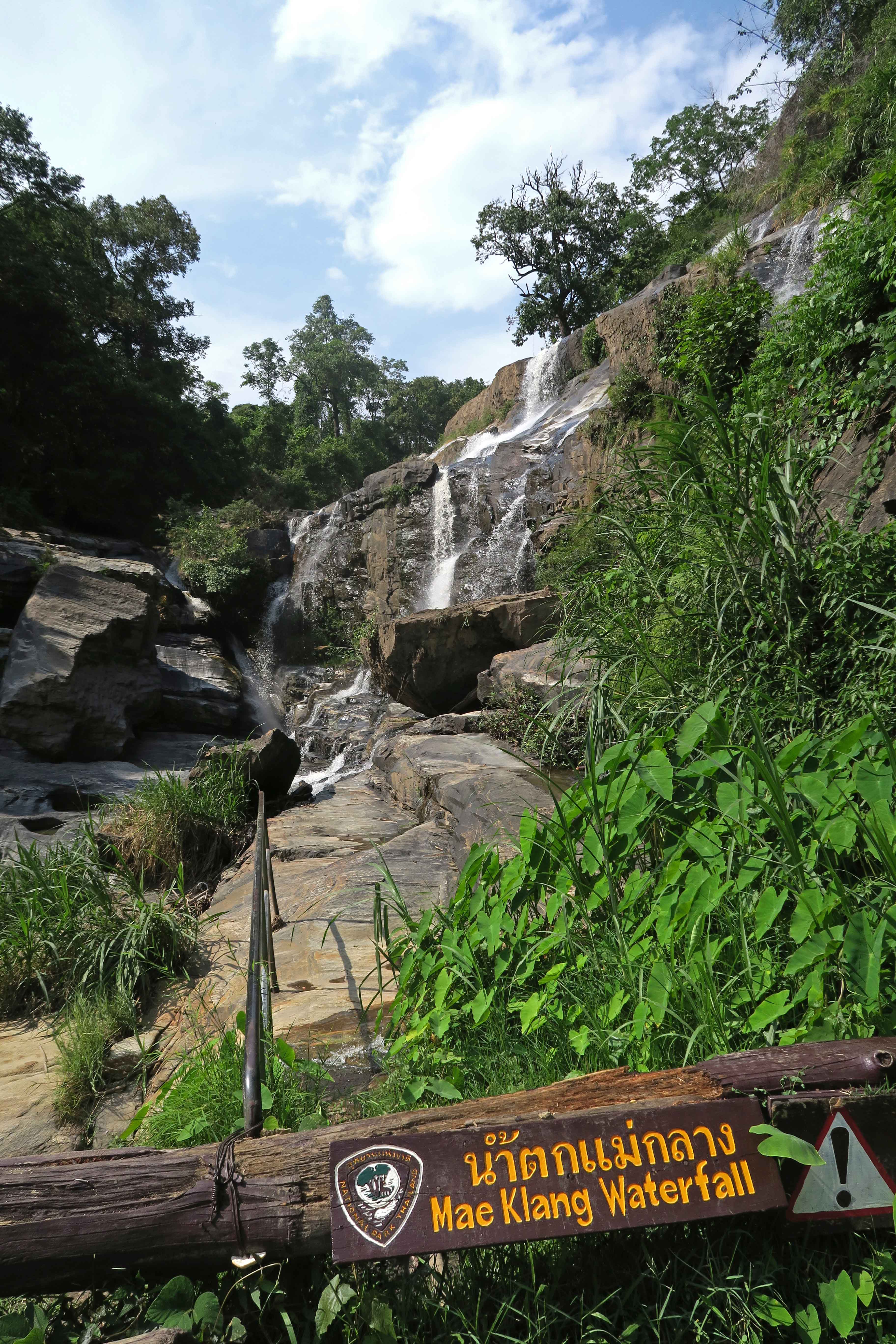
    Mae Klang Falls on 7th May 2017

    There was much less water flowing than in previous visits; compare the photograph above (taken in May, before the rains have arrived) with that taken in November (at the end of the rainy season) in a previous year.
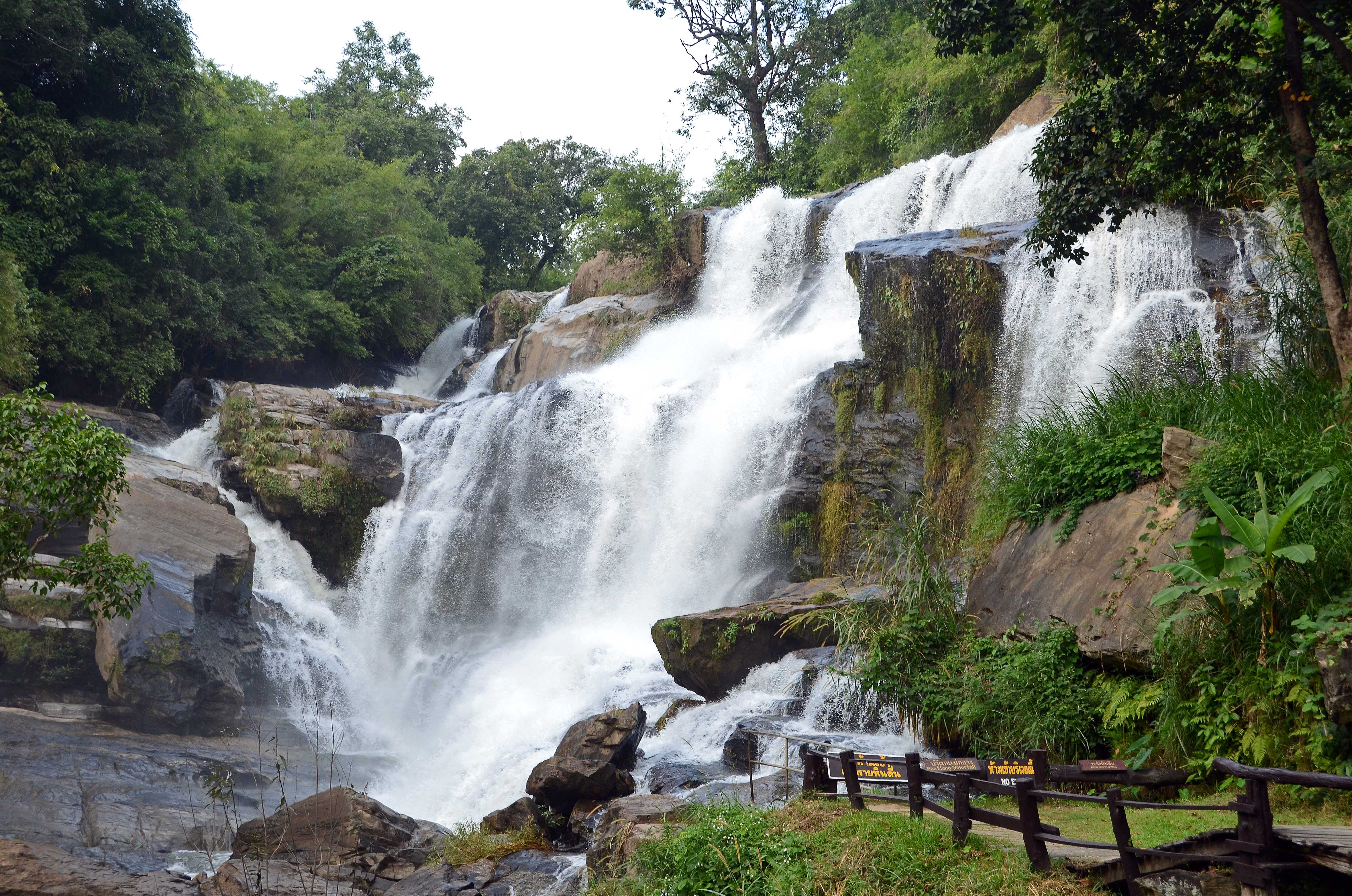
    Mae Klang waterfalls 8 Nov 2013

    Mae Klang waterfall is at an altitude of about 1,200 m or so, so is much hotter than further up the mountain, and there were plenty of butterflies around! The problem was that because of the high temperatures, the butterflies were flying about so fast it was very difficult to photograph them! One of the more obliging species was the Common Leopard Butterfly (Phalanta phalantha), which were present in quite large numbers along the stream beds next to the river.

    Common Leopard Butterfly (Phalanta phalantha) mud-puddling at Mae klang waterfall, Doi Inthanon.

    The butterflies were ‘puddling’ or ‘mud-puddling’ as it is called; they are trying to absorb sodium (in the form of sodium chloride, salt) or nitrogen (in the form of amino acids) from moist substrates such as mud, animal excrement, rotting fruits, carrion, dung, bird droppings, sweat, tears and so on (See 1: See you down the puddle). Curiously, many of these Common Leopard butterflies were sucking up moisture from the rocks themselves (below). There must have been a thin layer of water on the rocks, which may have produced a solution of salts or minerals attractive to these insects.
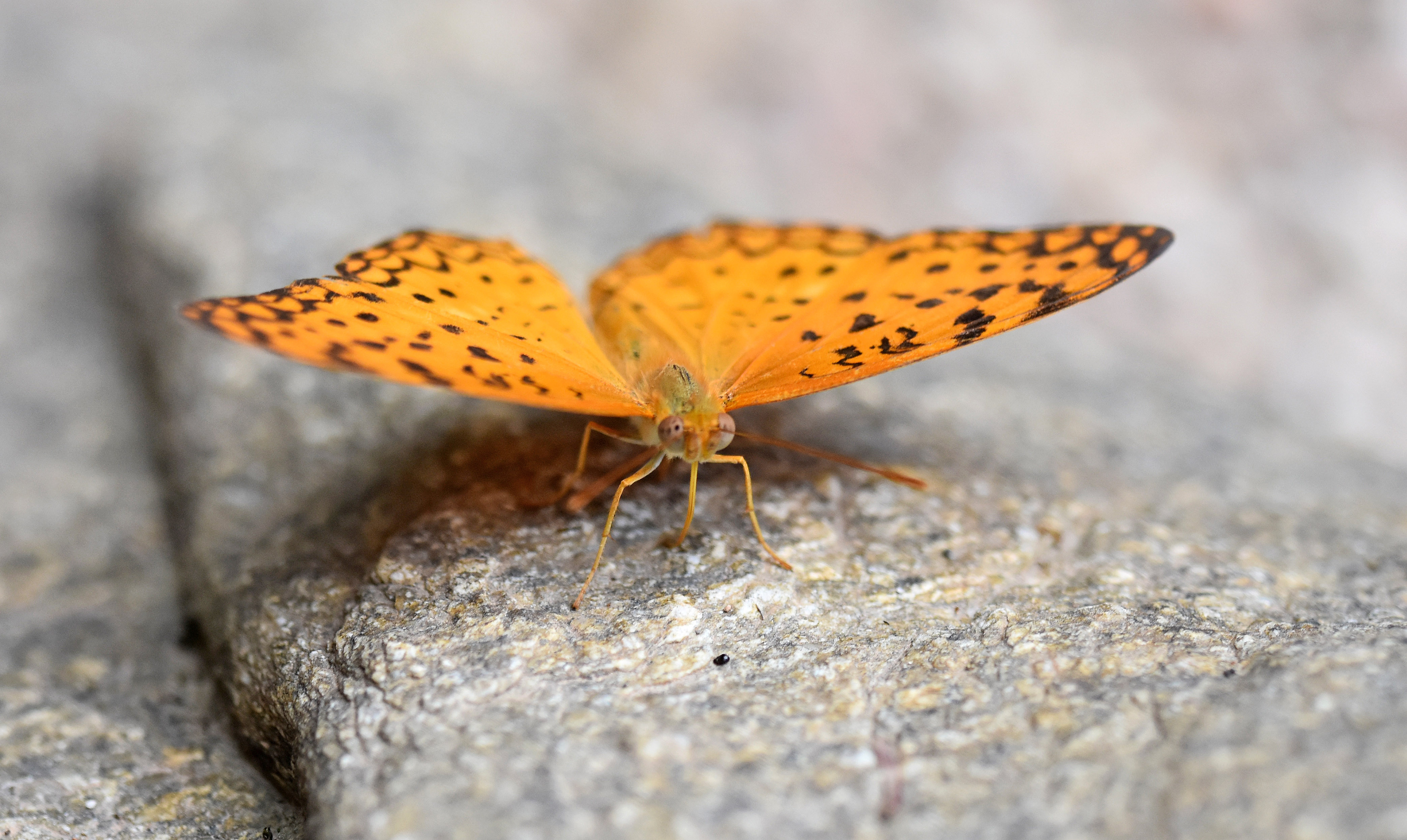
    Common Leopard Butterfly (Phalanta phalantha) Mae klang, with extended proboscis

    Despite being engaged in mud- or moisture-puddling, the butterflies did not stay put for long, and usually flew off as soon as the lumbering photographer approached them! I did not manage to get as close as I would have liked, but after taking dozens of shots, I managed to get a few usable ones.
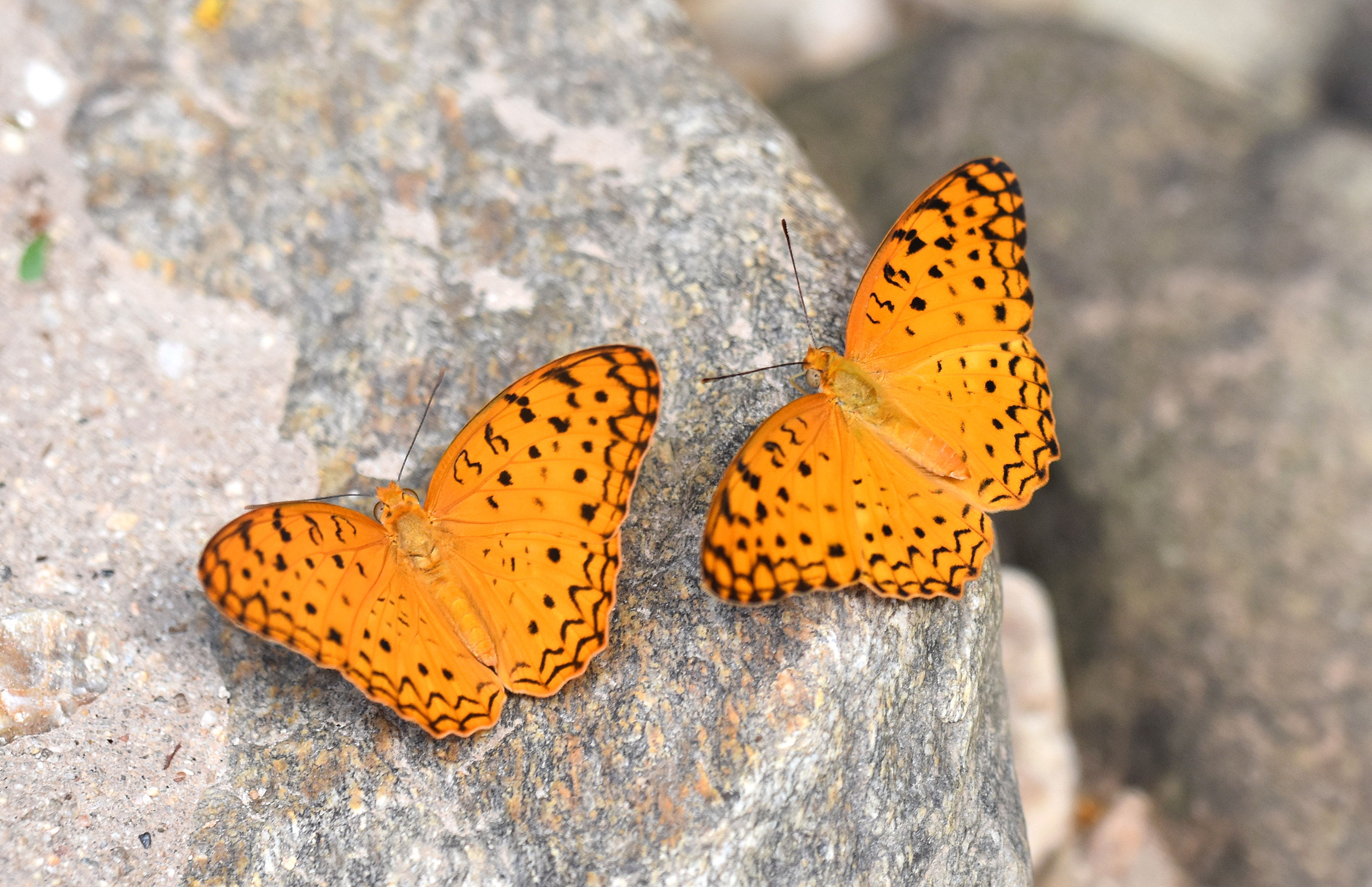
    Common Leopard butterfllies (Phalanta phalantha)

    These butterflies take about three weeks to develop from egg to adult (at 28 deg C) and the larvae feed on flowering plants in the Willow family (Salicaceae) including Flacourtia inermis and Salix babylonica (Links 2 and 3).
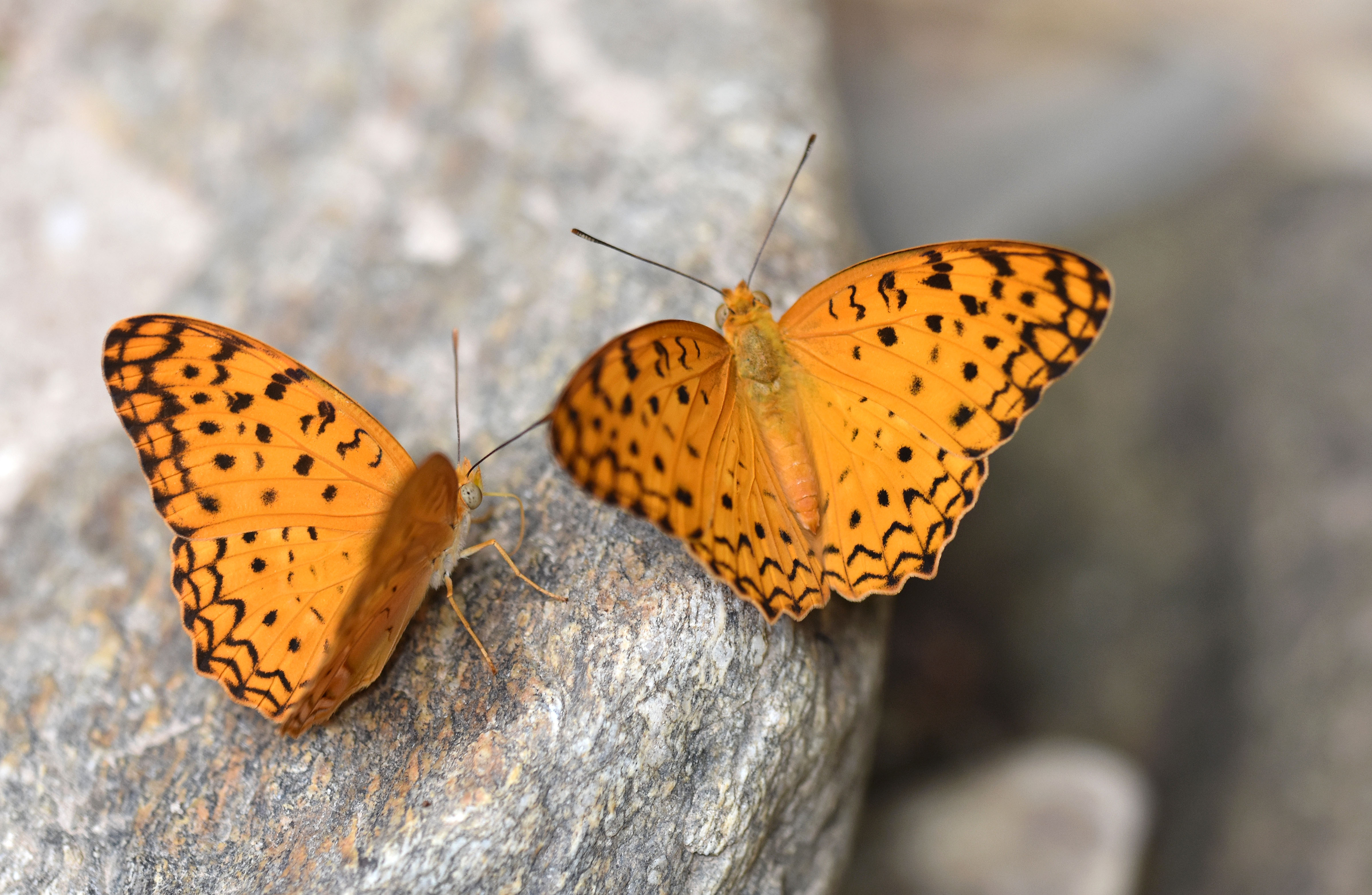
    Common Leopard butterfllies (Phalanta phalantha) on rocks

    There were also quite large numbers of yellow/green butterflies flying about, at amazing speeds! One often sees pictures of stationary butterflies, which fail to do justice to the extraordinary vitality of these insects. Butterflies can be very fast fliers – especially the nippy little Skippers, which can reach speeds of up to 60 km per hour! Skippers are shaped like little jet fighters! As the following photograph illustrates.
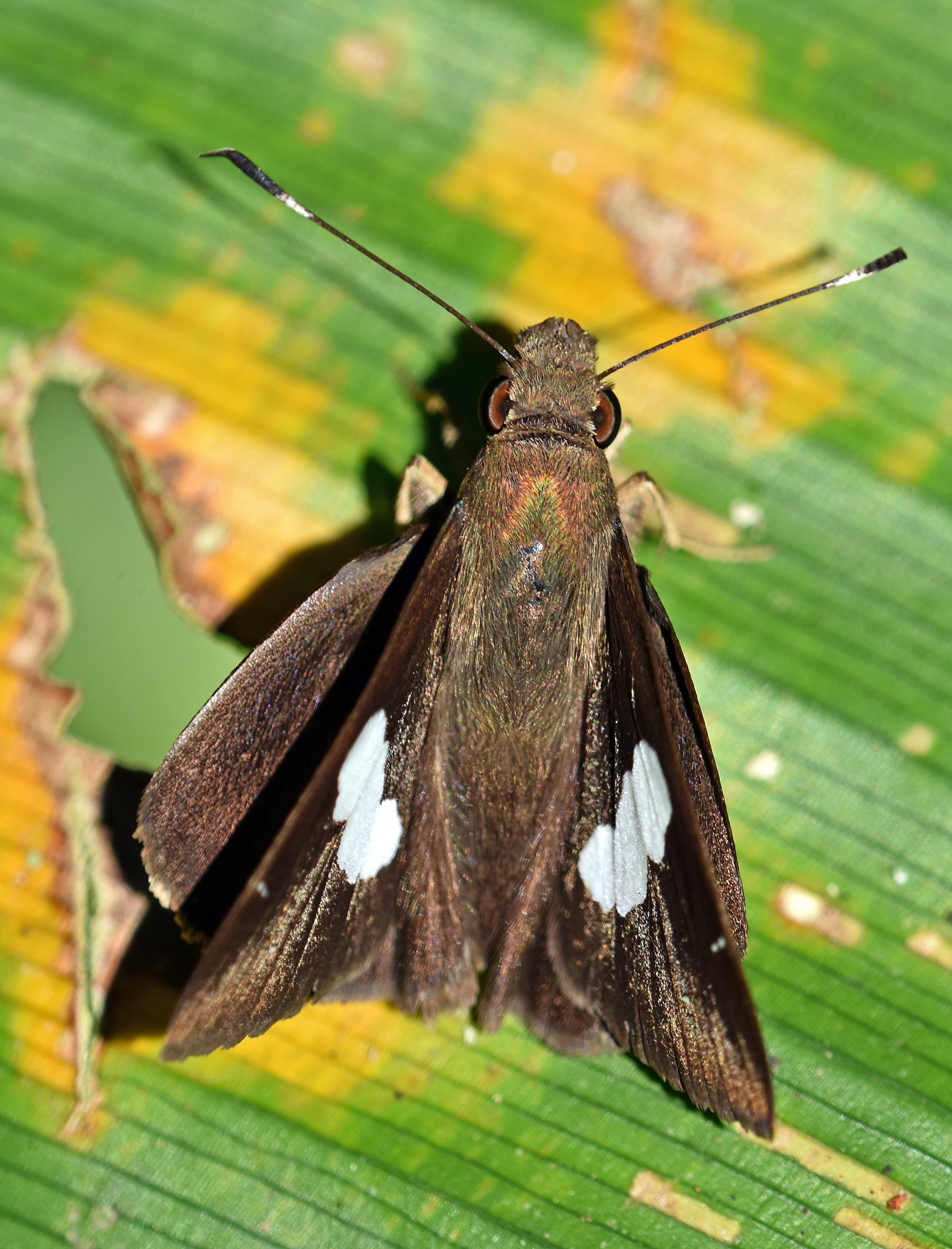
    Spotted Demon (Notocrypta feisthamelii alysos). A Skipper from Chiang Dao, Thailand.

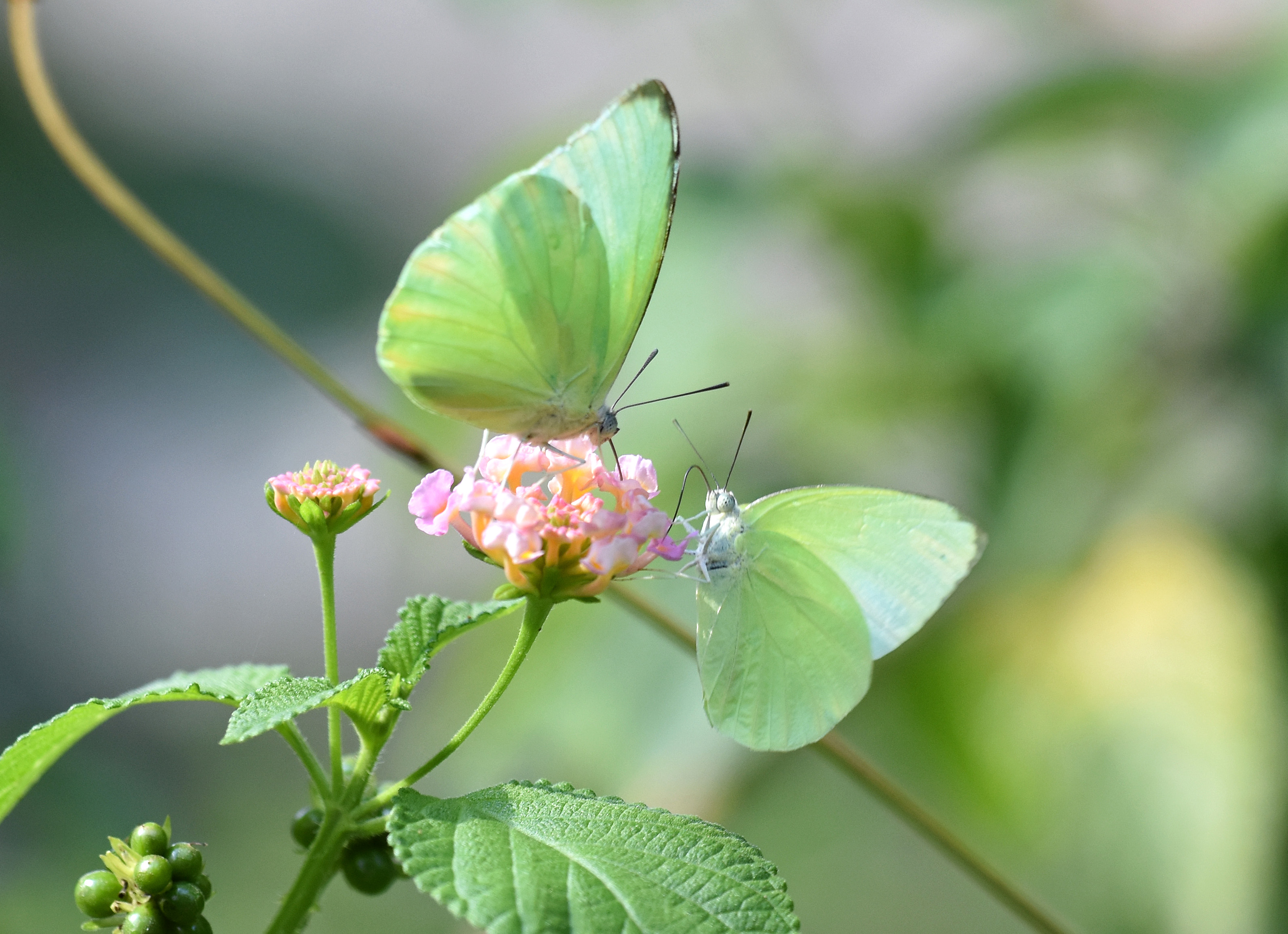
    I did manage to grab a couple of photographs of the lively yellow/green butterflies, which turned out to be Lemon Emigrants, feeding on nectar from Lantana flowers.
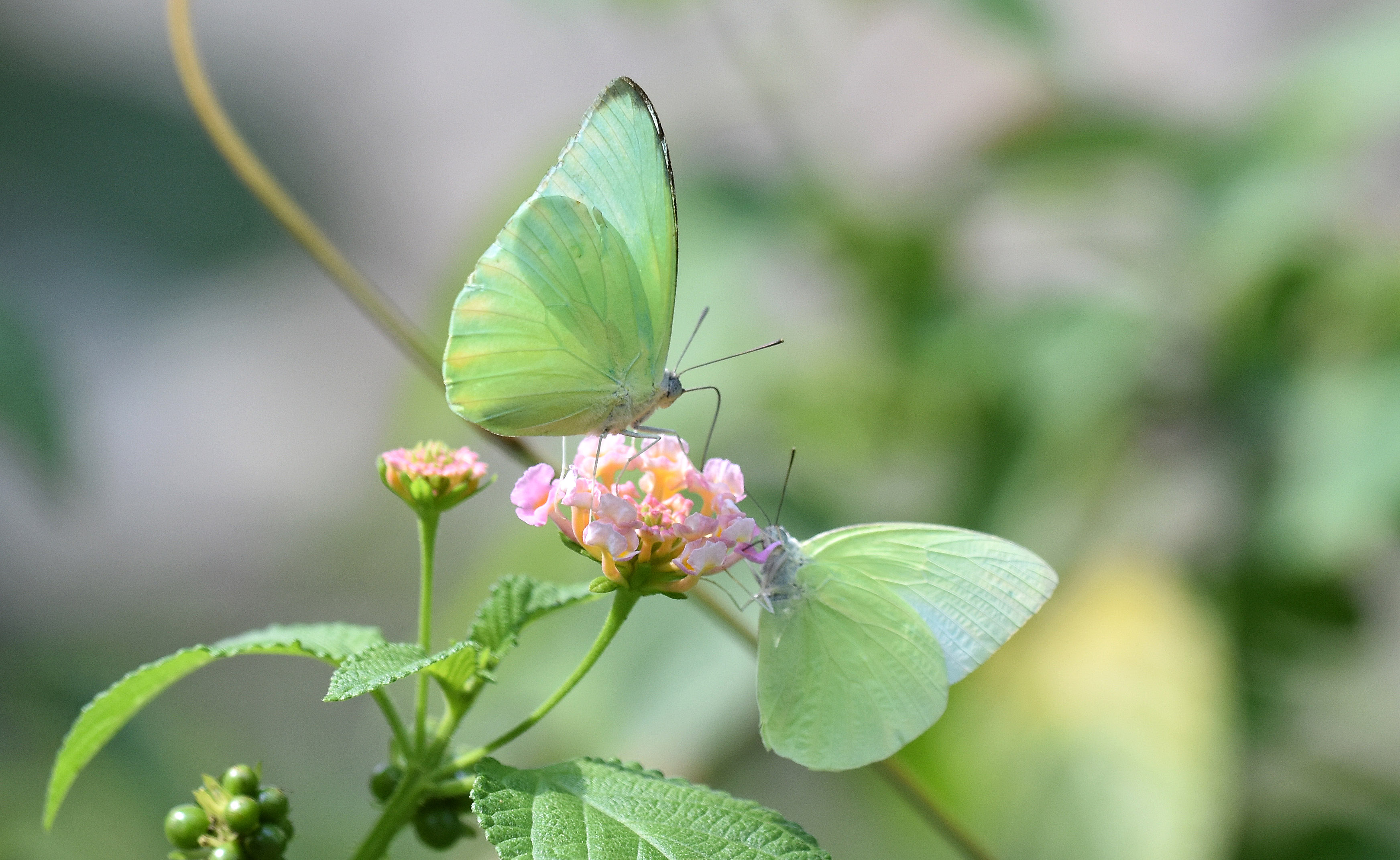
    Lemon Emigrant (Catopsilia pomona pomona) Mae Klang
    Lemon Emigrants (Catopsilia pomona pomona) Mae Klang

    I also came across this little skink – a Streamside Skink  (Sphenomorphus maculatus) – on the rocks near the waterfalls (below).

    Streamside Skink (Sphenomorphus maculatus) Mae Klang, Doi Inthanon, Thailand.

    The waterfalls are a good place to cool off on a hot day, and people like to sit and relax on the rocks beside the streams. There are plenty of small restaurants and vendors nearby providing food and snacks for visitors.
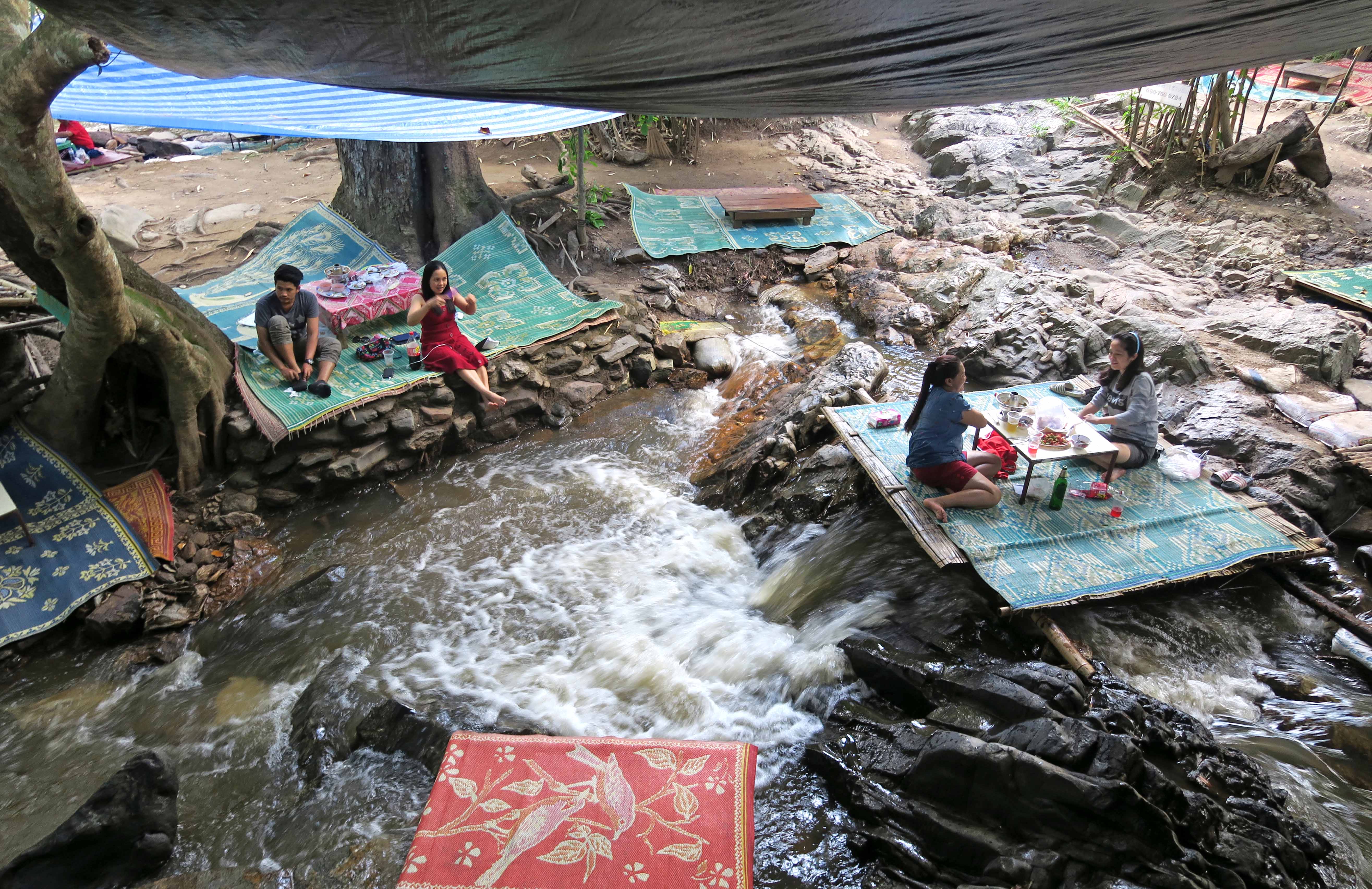
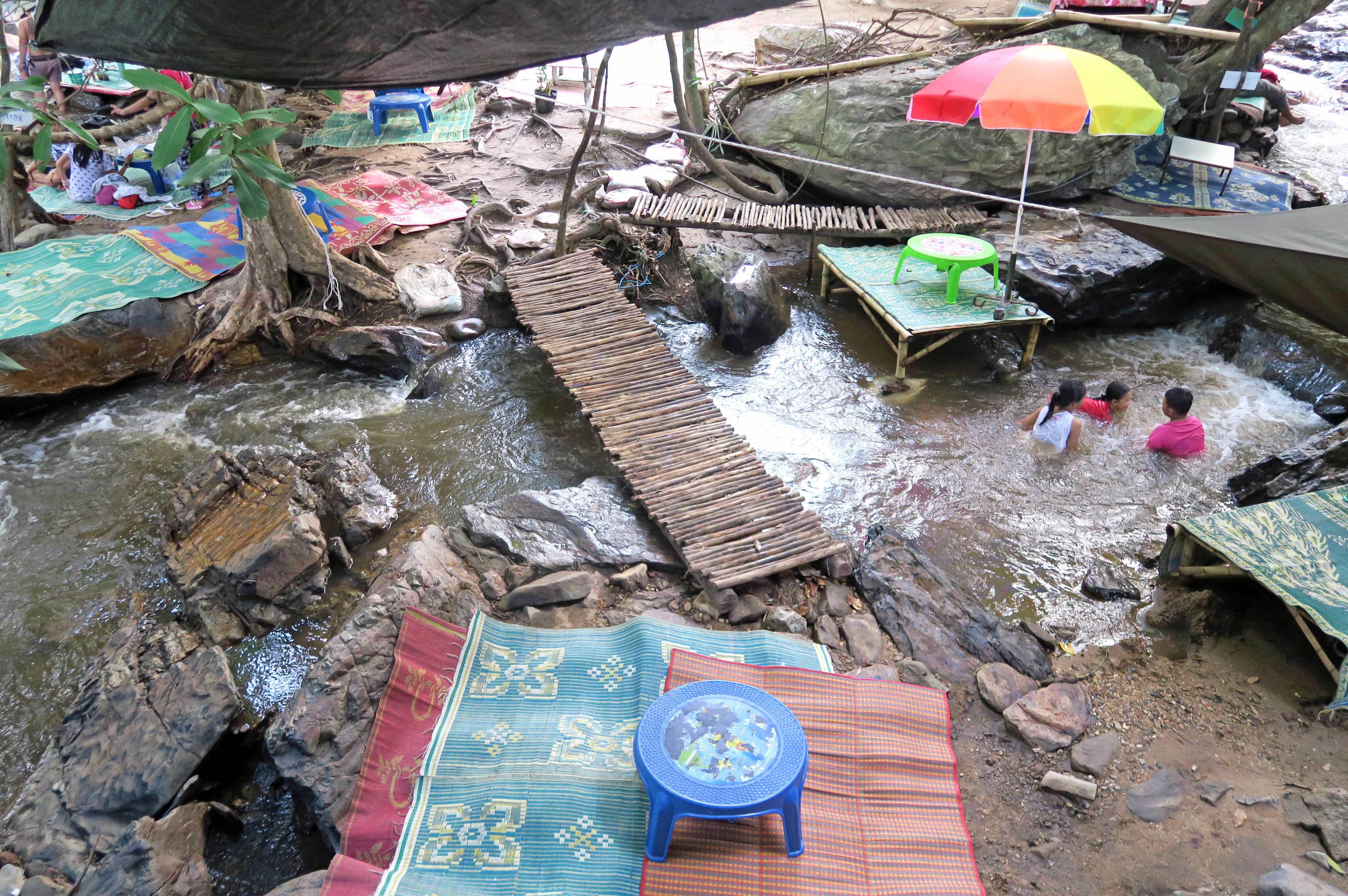
    Mae Klang Falls. People sitting and eating by the streams.
    Mae Klang Falls bathers

    So even when temperatures are unbearably hot, there are many places to go to chill out, whether you are a butterfly, skink or primate!

    1. https://rcannon992.com/2016/03/10/see-you-down-the-puddle-puddling-in-butterflies/
    2. Rayalu, M. B., Kumari, V. K., Naidu, M. T., & Atluri, J. B. (2014). Life history and larval performance of the Common Leopard butterfly, Phalanta phalantha Drury (Lepidoptera: Rhopalocera: Nymphalidae). International Journal of Advanced Research in Science and Technology, 3, 191-195.
    3. http://butterflycircle.blogspot.co.uk/2010/09/life-history-of-leopard.html
  • Princesses of the steps – innocent!

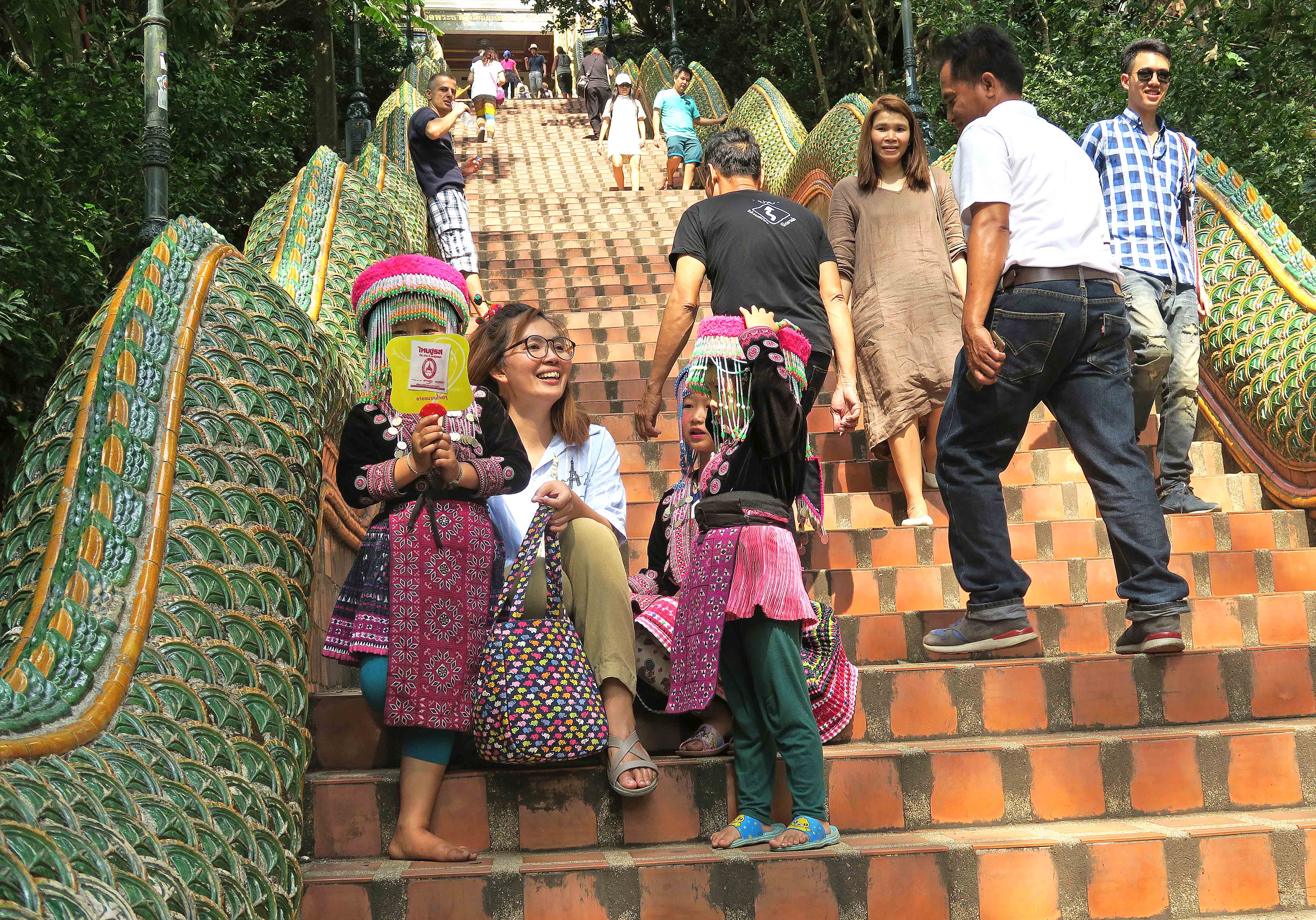
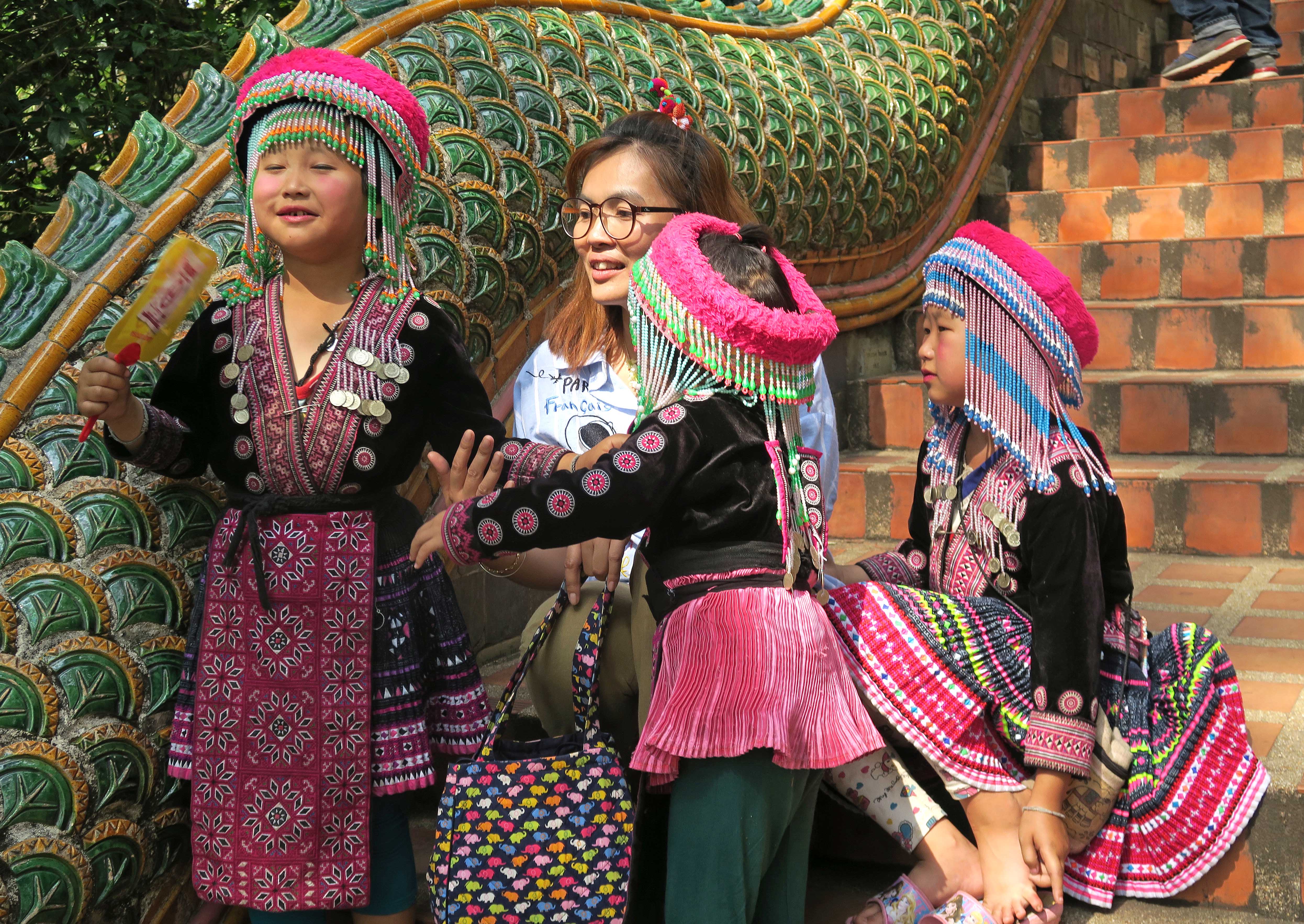
    Hmong girls posing with a tourist in May 2017 on the steps of Wat Phra That Doi Suthep, Chiang Mai, Thailand

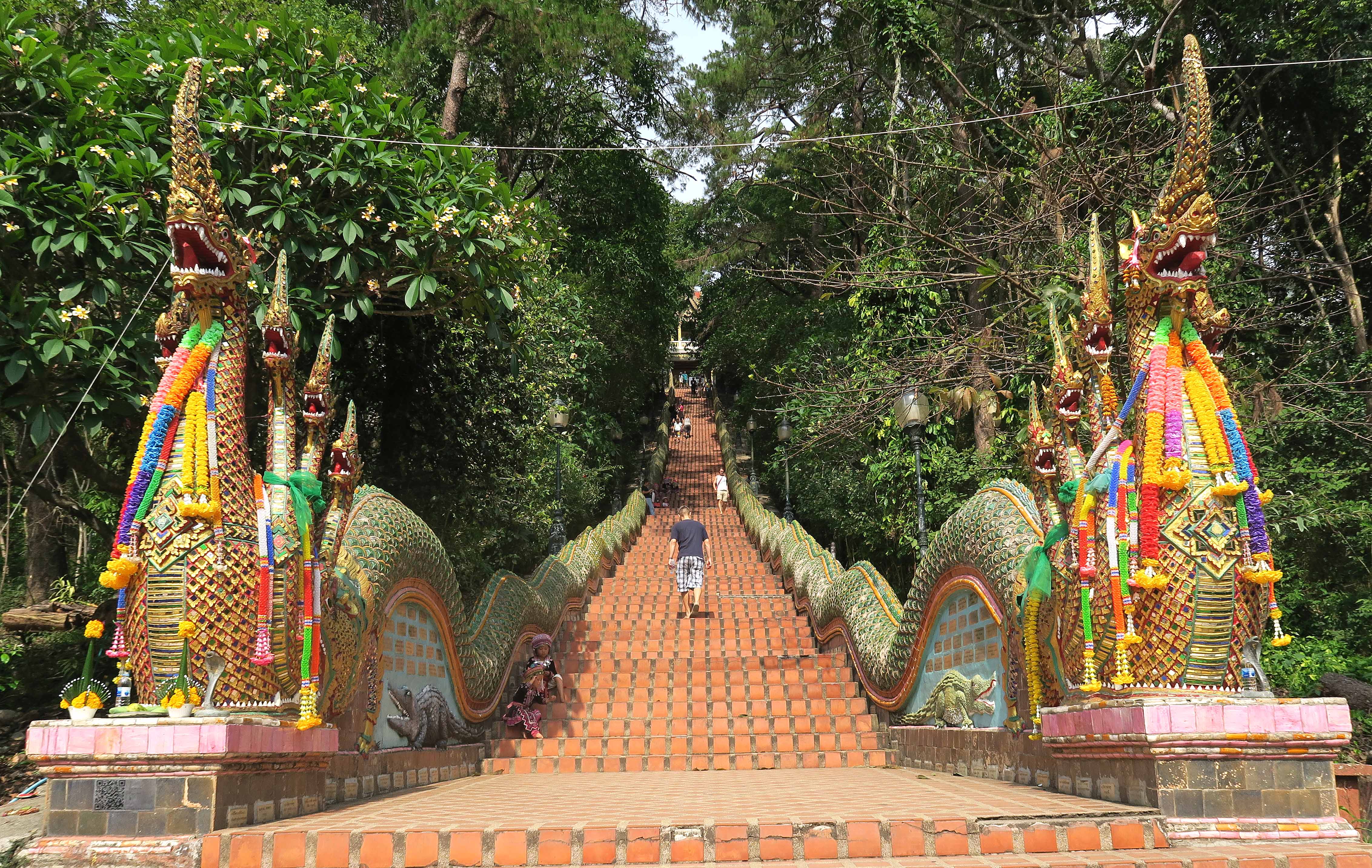
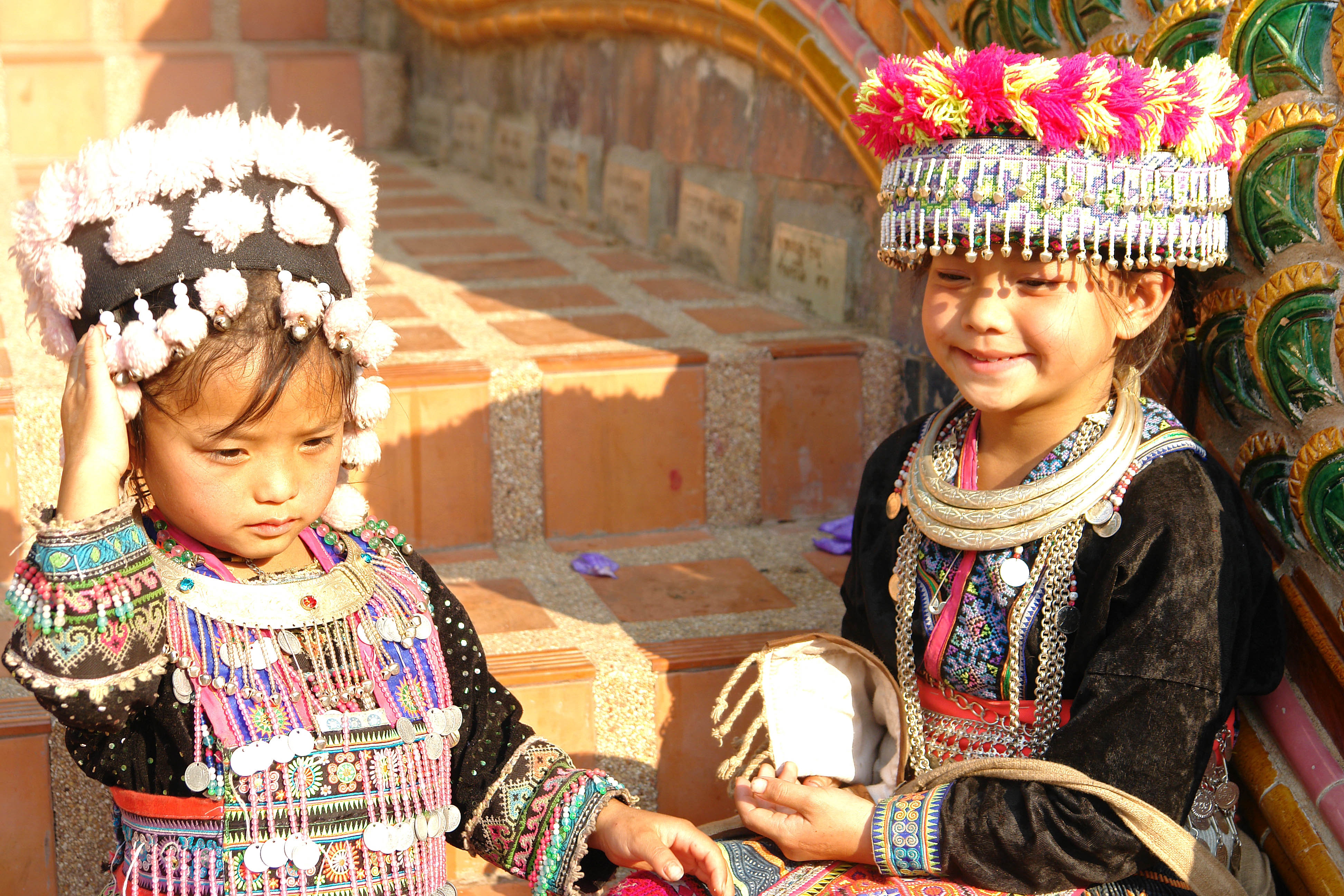
    Anyone who has visited the beautiful temple – Wat Phra That Doi Suthep – on the mountain above Chiang Mai, in northern Thailand, and has walked up the long flight of stairs rather than taken the funicular lift, will have seen the lovely little girls in Hill tribe costumes who sit on the bottom of the steps – and half way up – posing for photographs. They are dressed in traditional Hmong costumes.

    There are over 300 steps up to the pagodas on  Wat Phra That Doi Suthep

    Over the years I have visited this temple a number of times and have pictures of what must be different generations of youngsters sitting on the steps, going back to 2005.

    Hmong girls on the steps of  Wat Phra That Doi Suthep in 2005
    Hmong girls on the steps of  Wat Phra That Doi Suthep in 2005

    The girls don’t just dress up in these gorgeous costumes for fun, although they clearly enjoy interacting with tourists, they usually ask for payment. A few coins. Although, being so young they are not very aggressive in asking. Nevertheless, in my estimation they must accumulate a fair bit of money over the course of a few hours. I could be wrong, but I have the impression that they are little gold mines!

    Hmong girls on steps of Wat Phrathat Doi Suthep Buddhist temple, Doi Suthep, Chiang Mai, Chiang Mai Province, Thailand. May 2017.

    Nevertheless, I was very surprised to learn that two of the girls had been accused of stealing a tourist’s watch! (Links 1 and 2, below) A British tourist who had posed for a photograph with the girls, subsequently found that her watch was missing and accused them of stealing it. In the photograph, one little girl has her fingers next to the watch, but the evidence is circumstantial. The photograph and story went viral, and like millions of other people around the world I was left with the impression that this was the end of the story.

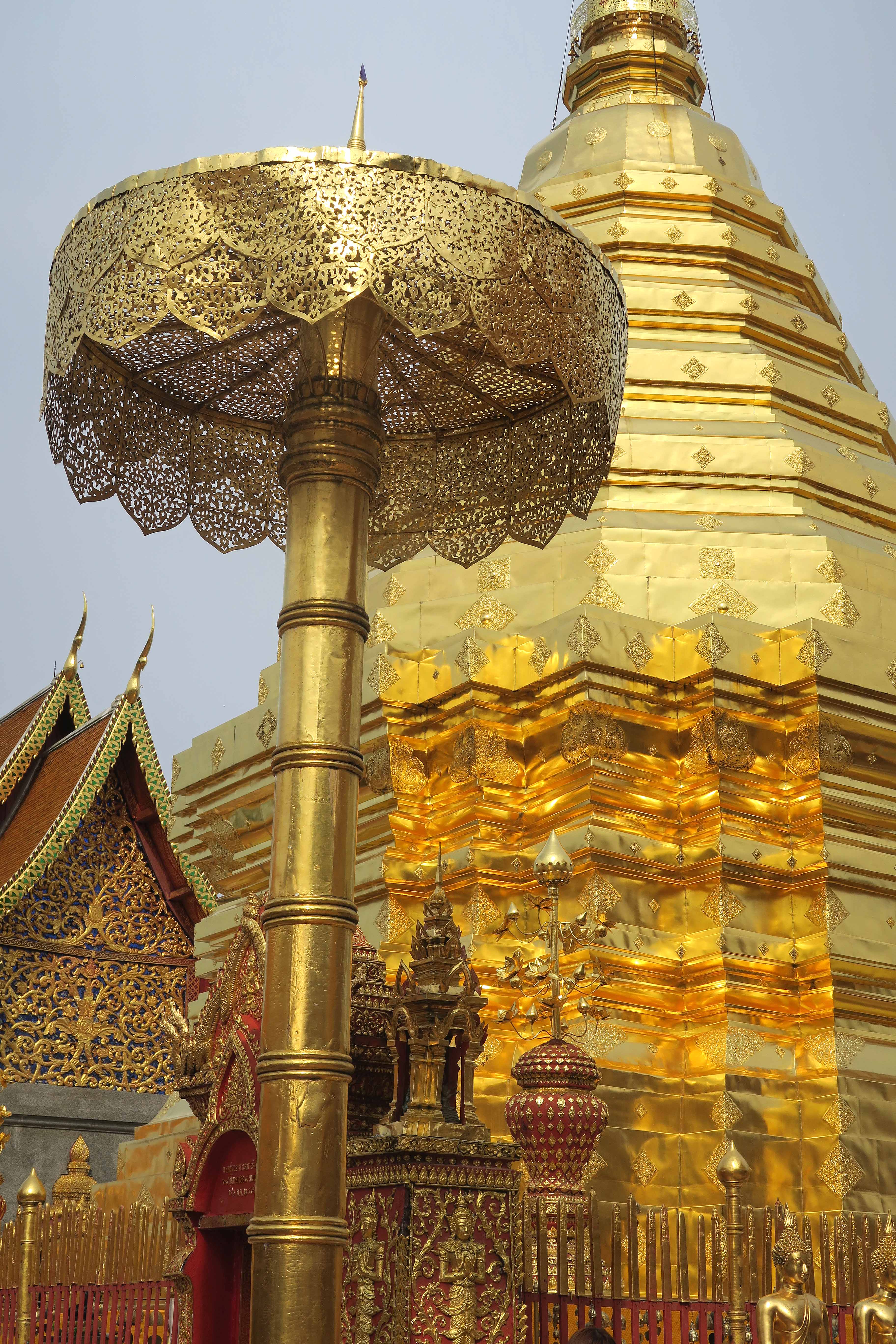
    Golden umbrella on Wat Phra That Doi Suthep, Chiang Mai Province, Chiang Mai, Thailand.

    It was a good story! Innocent-faced little ‘treasures’ pocket a tourist’s watch! But it turns out that it was false (See Link 3) The tourist eventually found the watch, but by then the damage was done. There are still articles on the Web accusing the children of theft (4).

    This is one little apocryphal story (definition: of doubtful authenticity, although widely circulated as being true) which thanks to the power of social media, reached millions of people around the world, and left most of them with the impression that it was true. Well maybe there are child pick-pockets, and perhaps I am naive, but my impression is that they were innocent. What it demonstrates however, is that once a story has ‘gone viral’ there is very little that can be done to change it, whatever the facts may be. This is why politicians – who could I mean?! – are prepared to lie and promote falsehoods; they know that if the story is juicy enough, or salacious, it will get picked up by social medias – which we all use – and shared or spread by us all. I suppose all we can do is to remain skeptical, cautious about things until proven beyond reasonable doubt; perhaps not believing everything we see or read and remaining open to alternative explanations!

    1. http://www.bangkokpost.com/print/1156857/
    2. http://www.dailymail.co.uk/news/article-3811462/I-didn-t-watch-want-come-visit-Thai-girls-adorable-pickpocket-storm-say-INNOCENT-plead-tourist-victim-come-forward.html
    3. https://www.google.co.uk/url?sa=t&rct=j&q=&esrc=s&source=web&cd=11&cad=rja&uact=8&ved=0ahUKEwj5t6LBjZvUAhUFDsAKHRq9BZEQFghBMAo&url=https%3A%2F%2Fwww.pressreader.com%2Fthailand%2Fbangkok-post%2F20161211%2F282875140418184&usg=AFQjCNFclT7GzYkdaGl1euIVCunZ_Ry7Dw&sig2=DKdpP18kGOjNl04RaPAWNA
    4. http://www.news.com.au/travel/travel-updates/tourist-snaps-the-moment-cute-thai-girl-steals-his-girlfriends-watch/news-story/959ee23bbcece1b77072bc6d6002466f


  • Songkran 2016 Pattaya

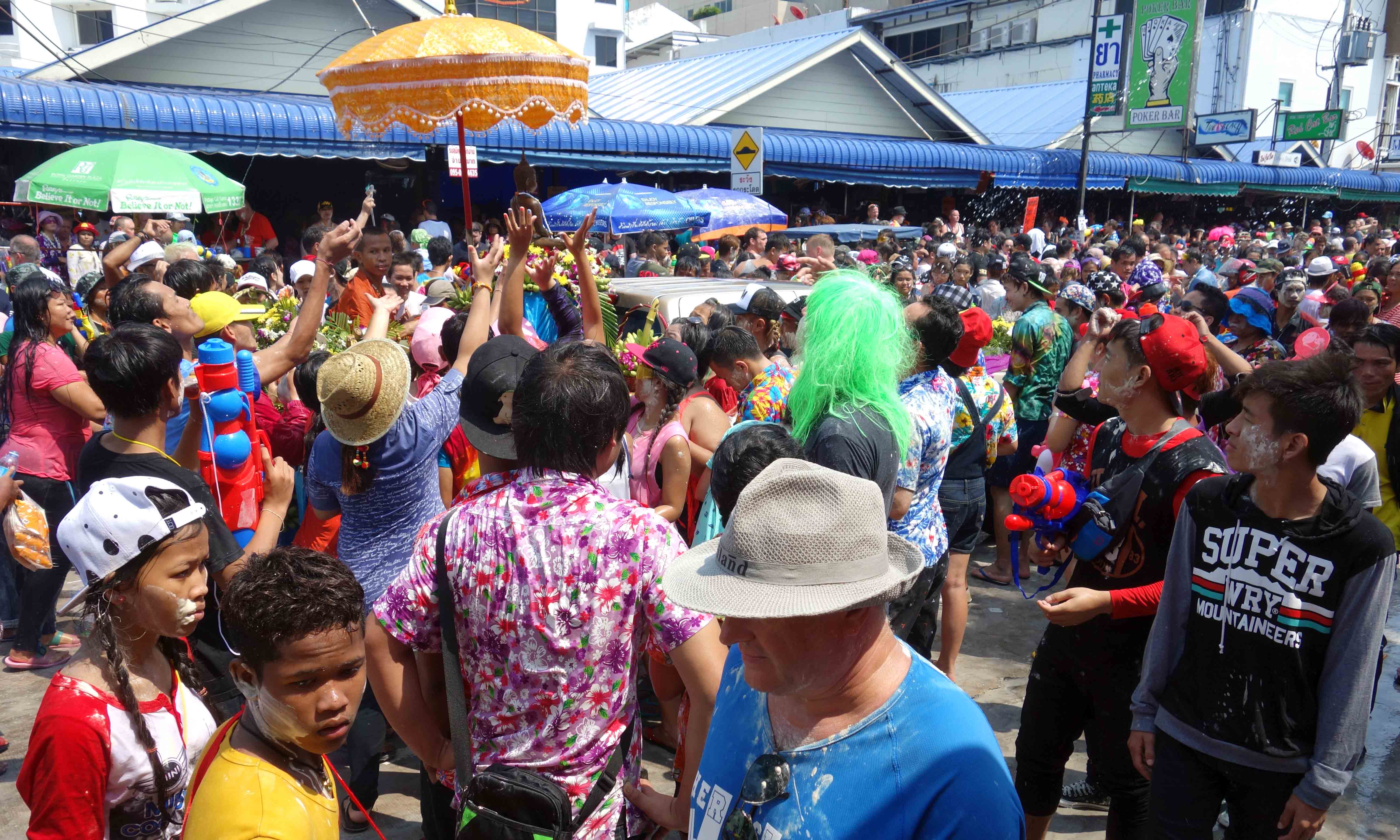
    Catching drops of water from a Buddhist monk
    Catching drops of water from a Buddhist monk

    Depending upon your age and inclination, the Thai New Year Songkran water festival is either your worst nightmare, or a lot of wet fun! Personally, I do enjoy it in moderation, but eventually get fed up of being continually doused in water and need to retreat to my hotel.

    Getting wet along Beach road, Pattaya
    Getting wet along Beach road, Pattaya

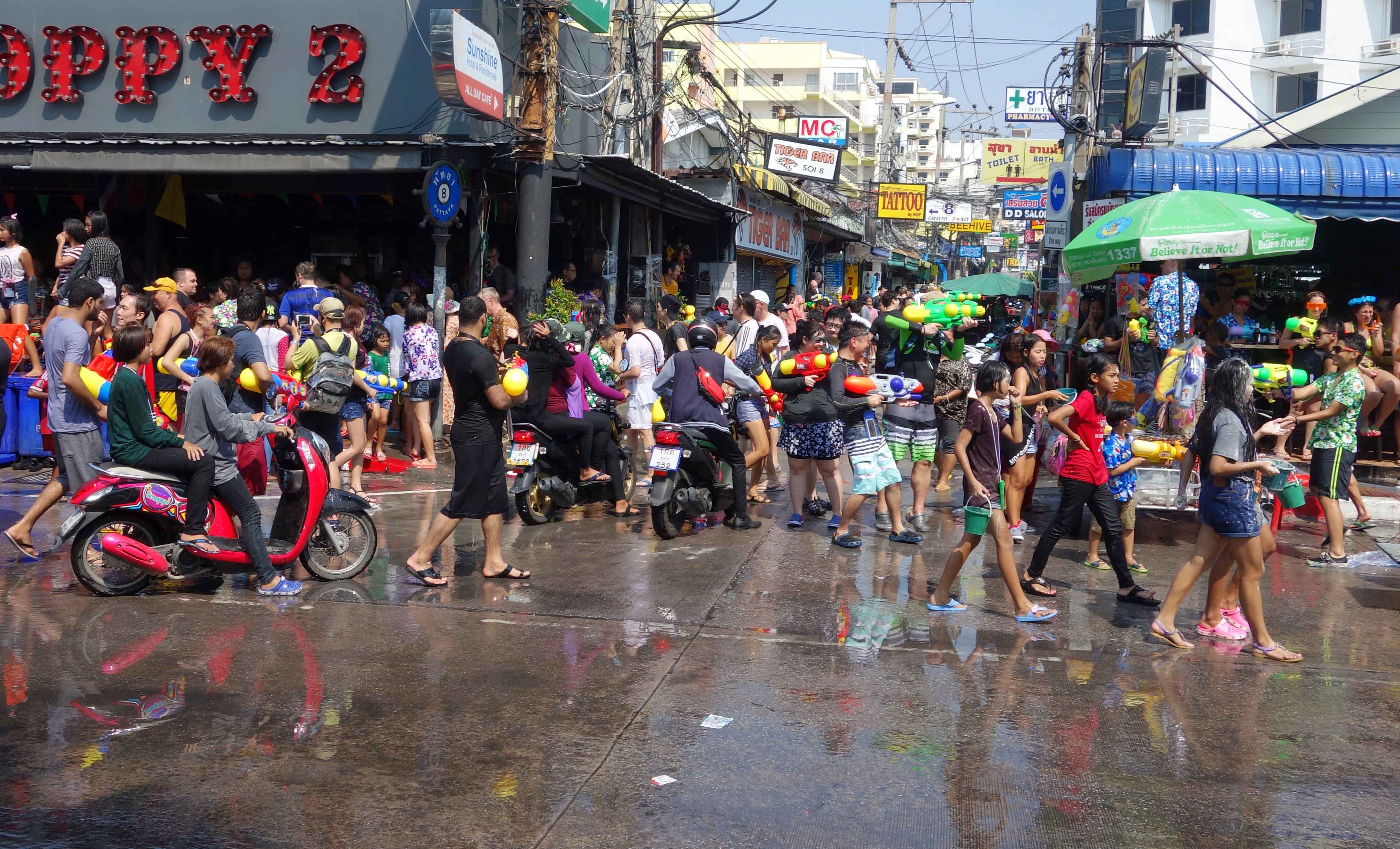
    Officially, Songkran only lasts three days in most of Thailand, but in Pattaya it goes on for a full nine days, which spanned the 10-19th April this year (2016). The extended days are called “Wan Lai” and this is when the all out water fights really get going.

    Water fights by Soi 8, Beach Road, Pattaya
    Water fights by Soi 8, Beach Road, Pattaya

    Fortunately, the action is largely localised so it is still possible to get about without getting too soaked. Unless you catch a songtau (pick-up style open backed taxi) that is; these are subjected to continual dousings by people throwing buckets of water. So I find it is easier to walk!

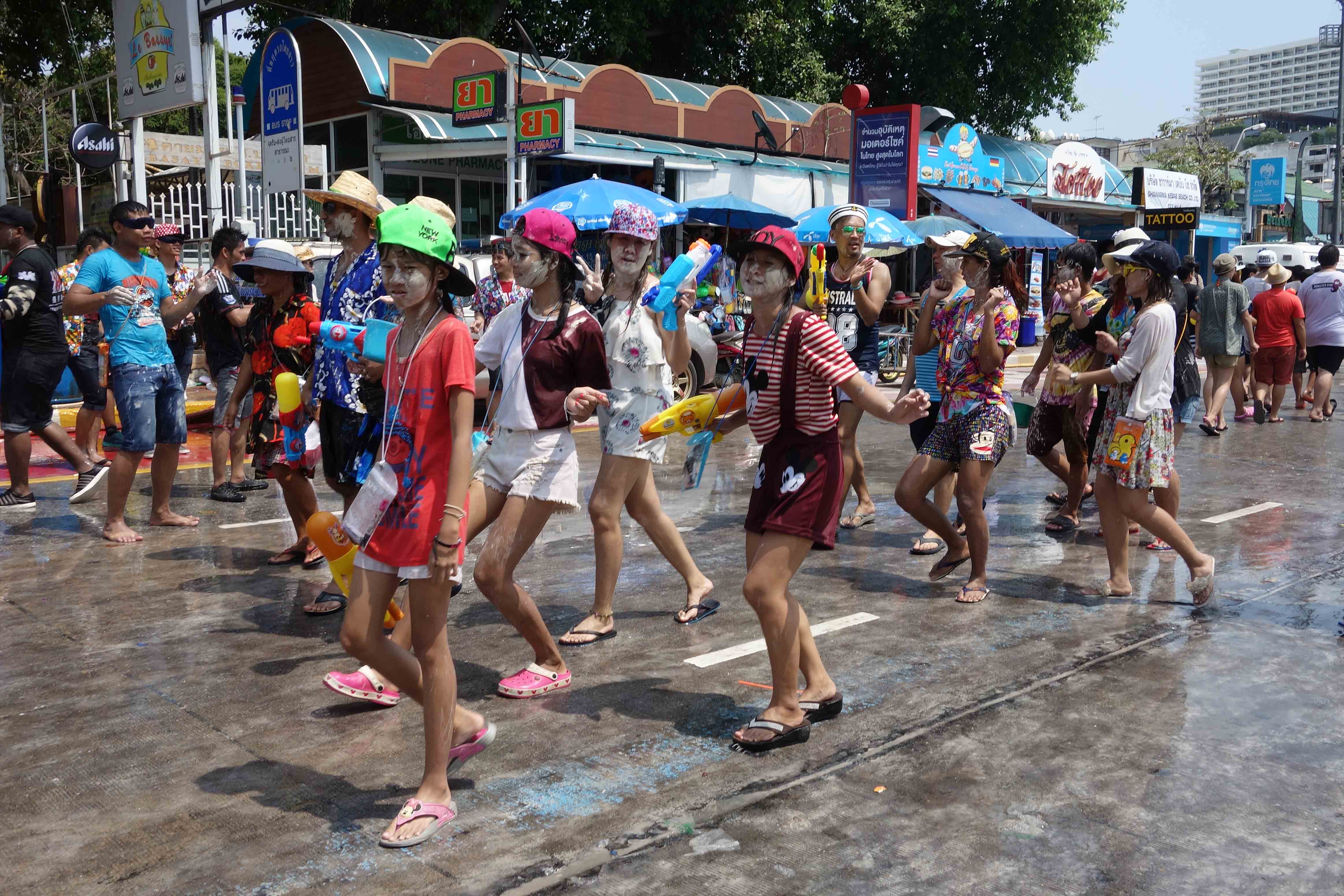
    Wet revellers on 19th April, Pattaya
    Wet revellers on 19th April, Pattaya

    What started out as a traditional festival celebrating the Thai New Year, and marked by the throwing and sprinkling of water, has rather degenerated into an all out orgy of water fights. The availability of large, powerful and cheap plastic water pistols has facilitated the process.

    Tourists armed with water pistols
    Tourists armed with water pistols

    The really big party is held on the last day, 19th April this year, in Pattaya. People come from all over Thailand to participate. It is a family day, with lots of food stalls along the beach road.

    Plenty of refreshments available
    Plenty of refreshments available

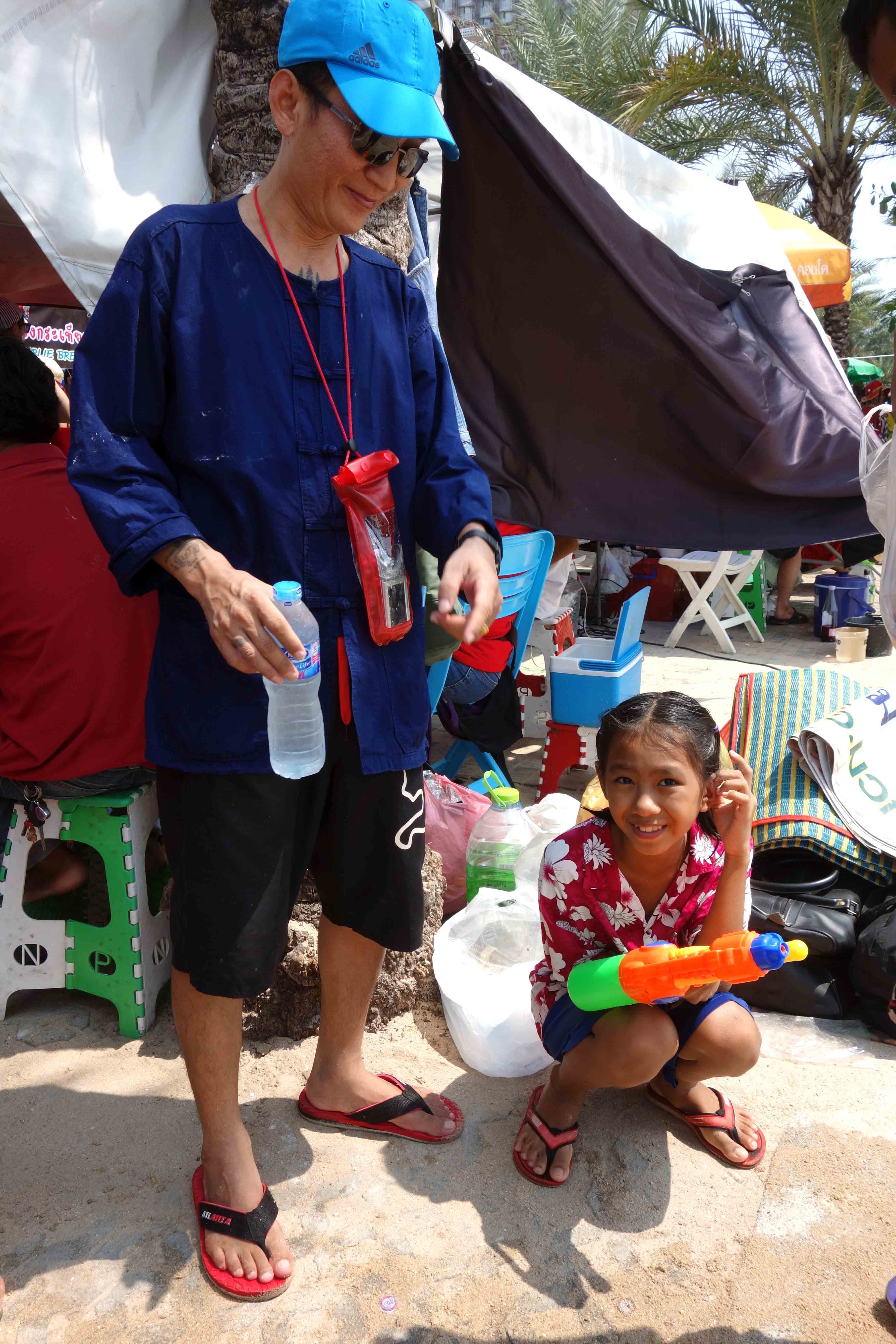
    Children of all ages enjoy the day, which was particularly hot this year in Thailand.

    Family fun
    Family fun

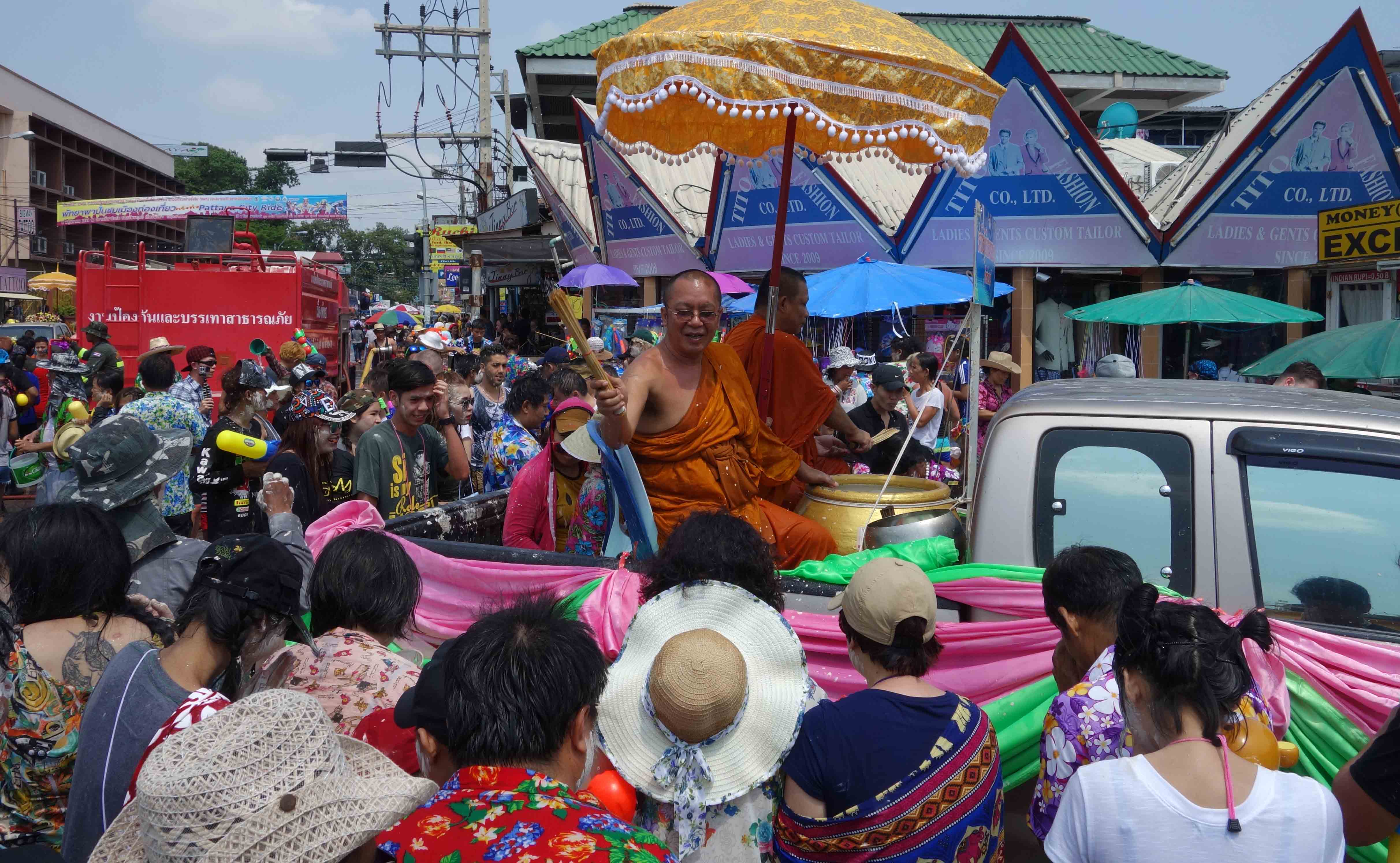
    Songkran is a family occasion and traditionally a way to show respect to your parents for example, by water pouring over their palms. Paying reverence to ancestors is also an important part of the Songkran tradition, and Buddhas appear in many shops, malls and hotels, which people anoint by pouring flower scented water over the statue. Buddhist monks also anoint devotees with water as a sort of good luck blessing.

    Buddhist monks blessing people with water
    Buddhist monks blessing people with water

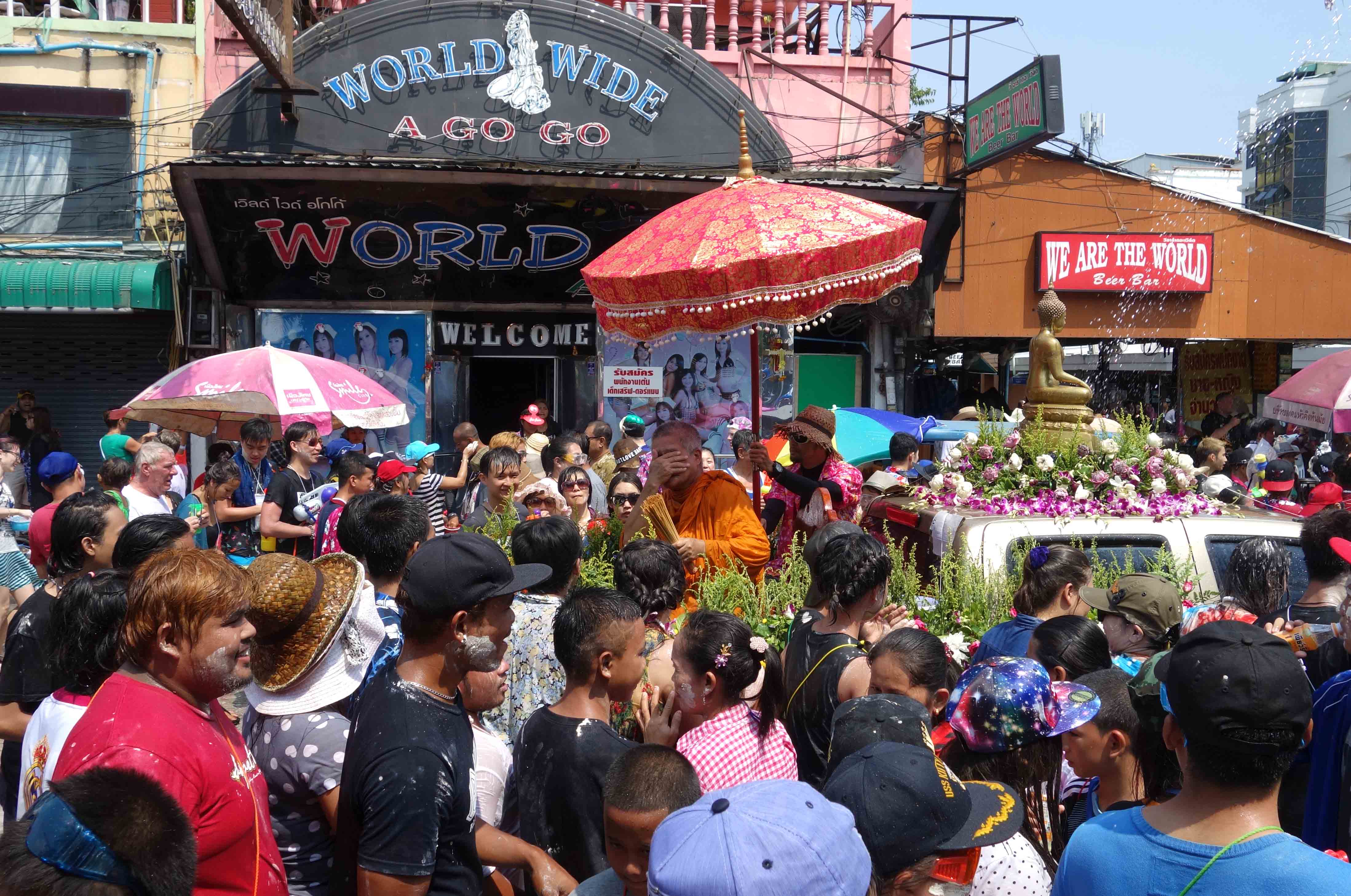
    In the following picture, the monk appears to be covering his eyes as he passes by a GoGo bar!  But it is just a coincidence.

    Monk delivering watery blessing along Beach Road, Pattaya.
    Monk delivering watery blessing along Beach Road, Pattaya.

    I rather like these images, because for me they capture some of the apparent contradictions of Thai society. Thais are tolerant and fun loving; they tend not to be as judgemental as Westerners (I think).

    Monk blessing th crowd on 19th April 2016, Beach Road, Pattaya.
    Monk blessing th crowd on 19th April 2016, Beach Road, Pattaya.

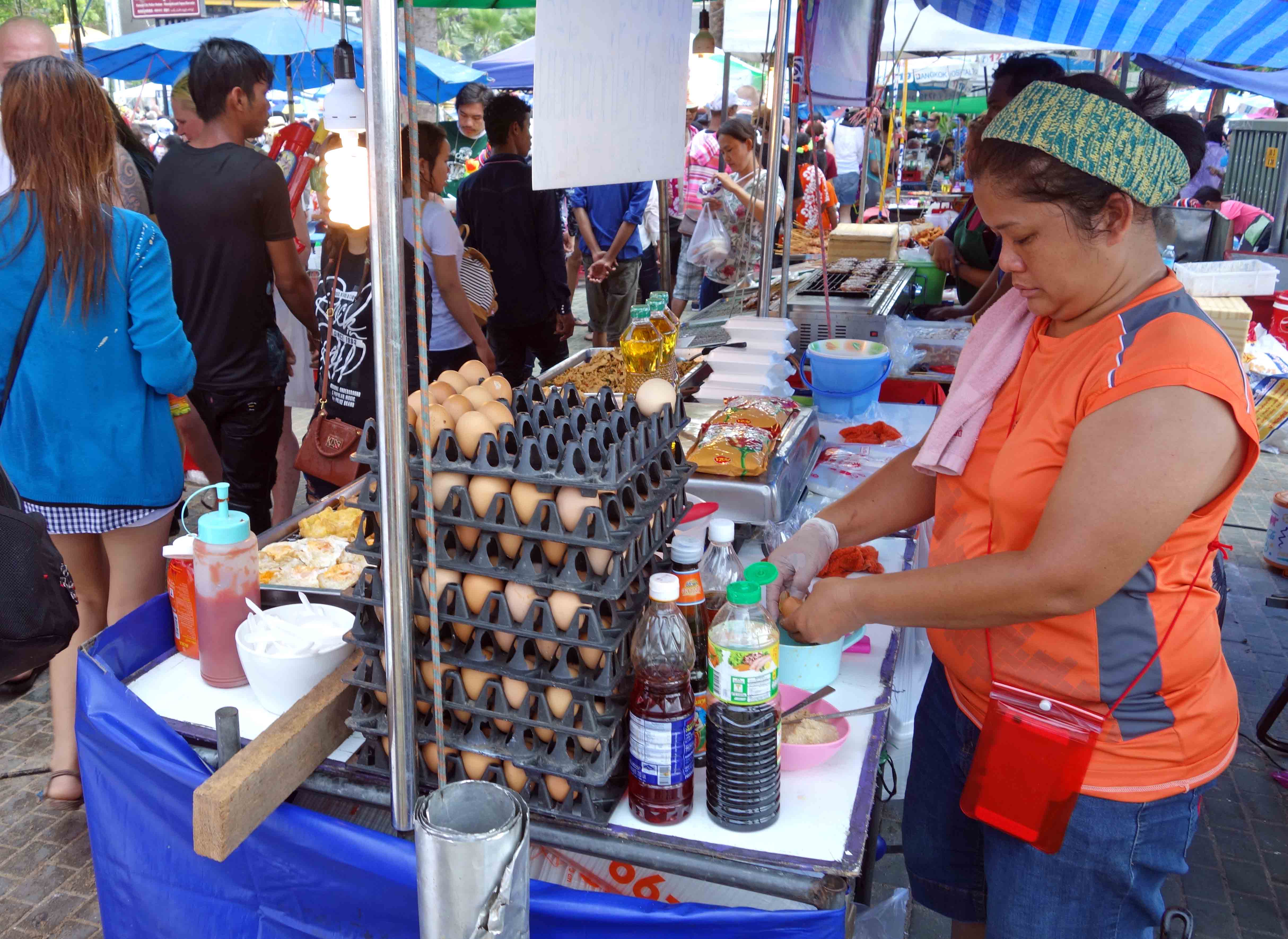
    As always in Thailand, lots of delicious food was available to fortify the participants. I do admire these ladies, surely the backbone of Thai culture, who prepare these meals from small portable kitchens all over the country.

    Lady cooking eggs to fortify revellers
    Lady cooking eggs to fortify revellers

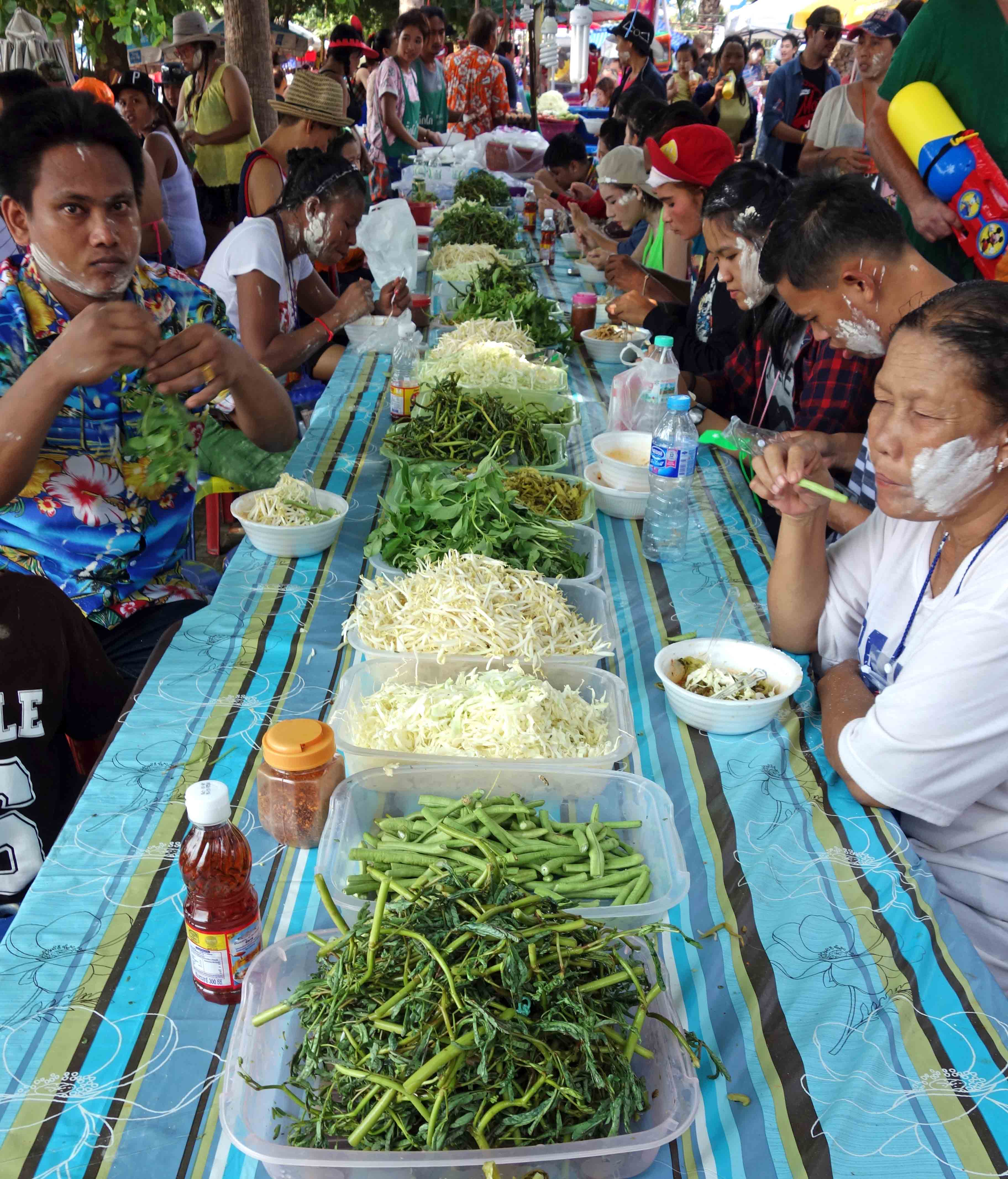
    The salads were amazing!

    Delicious vegetables on the table for customers to enjoy by the beach, Pattaya
    Delicious vegetables on the table for customers to enjoy by the beach, Pattaya

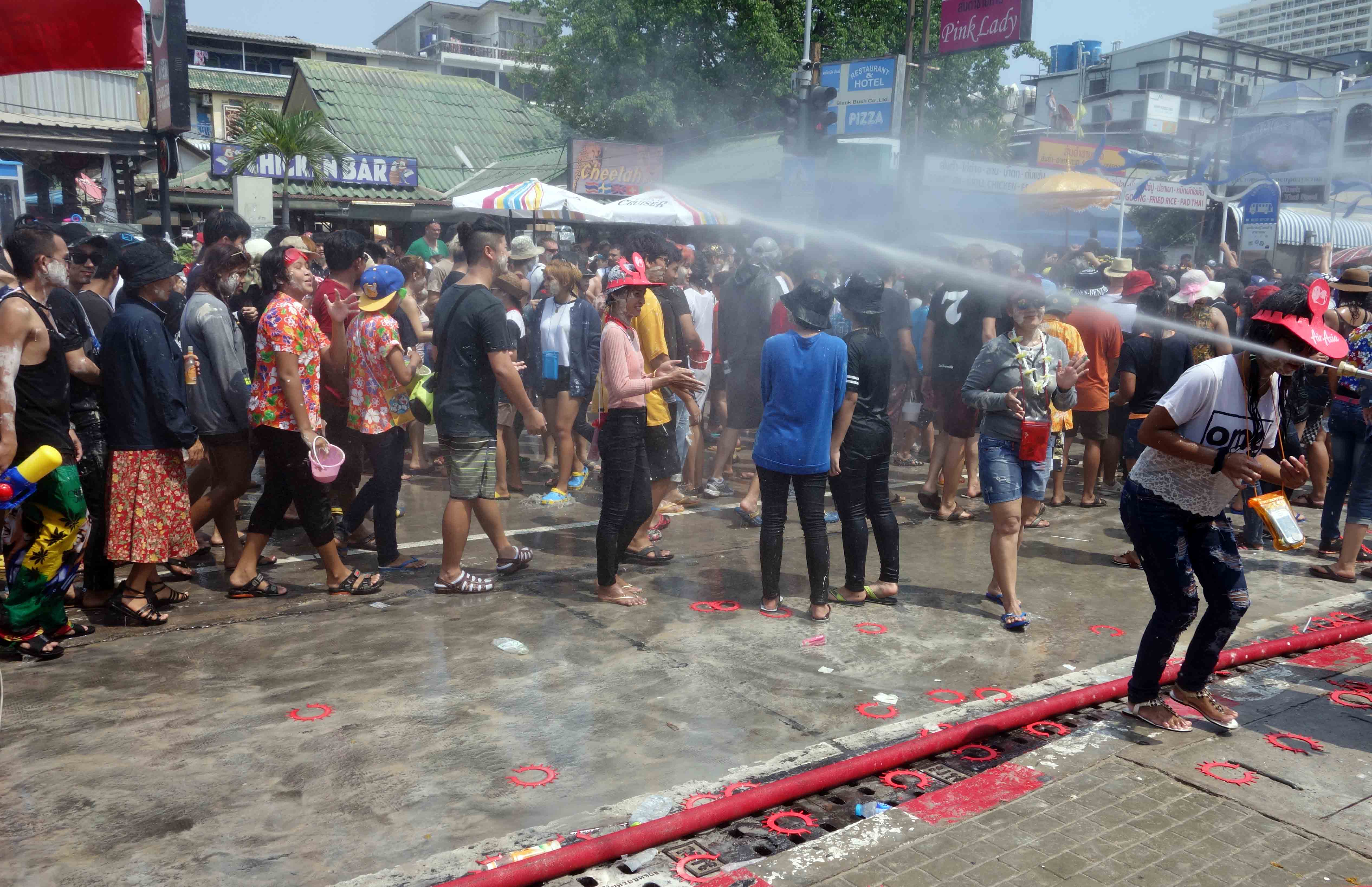
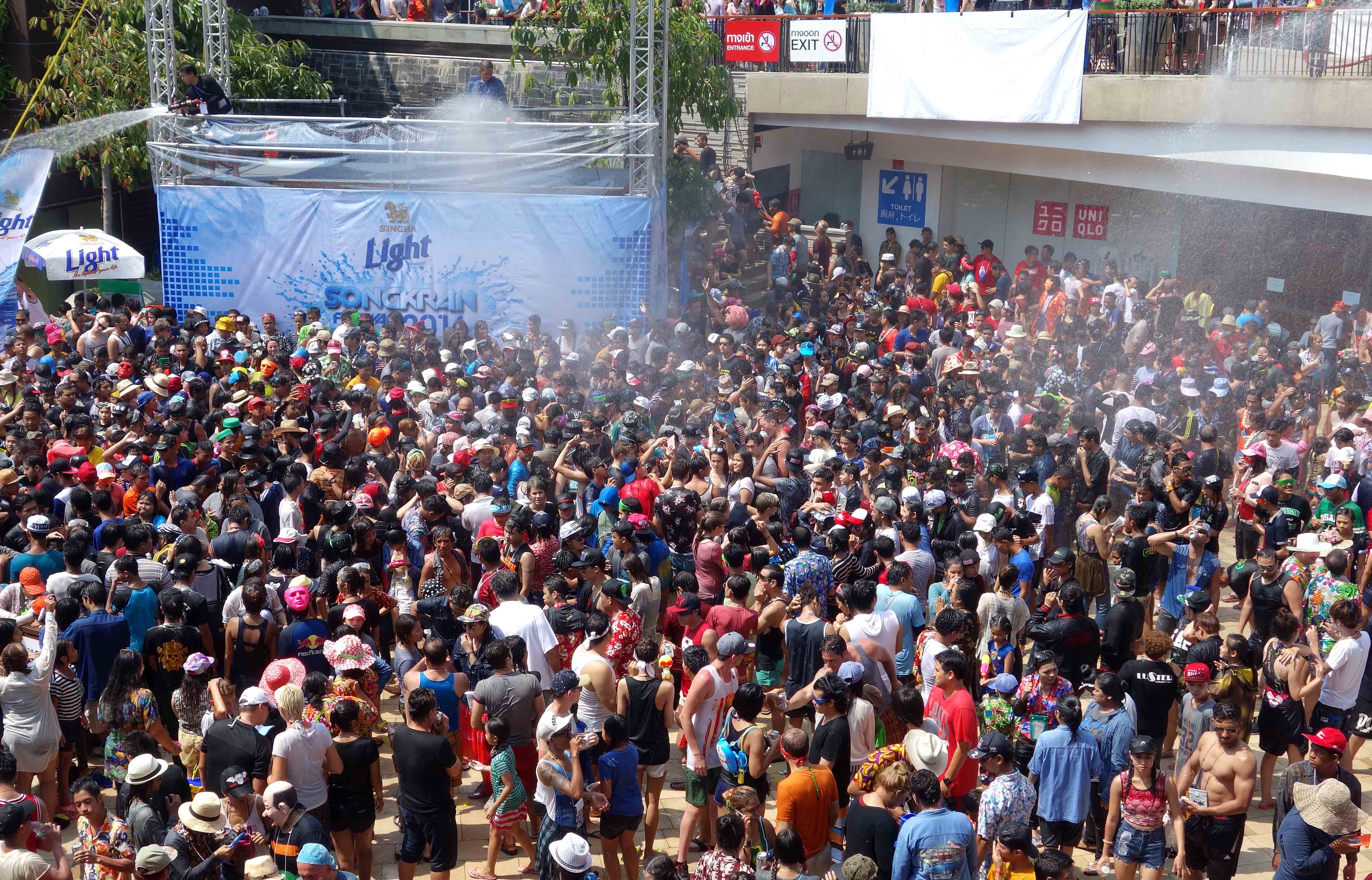
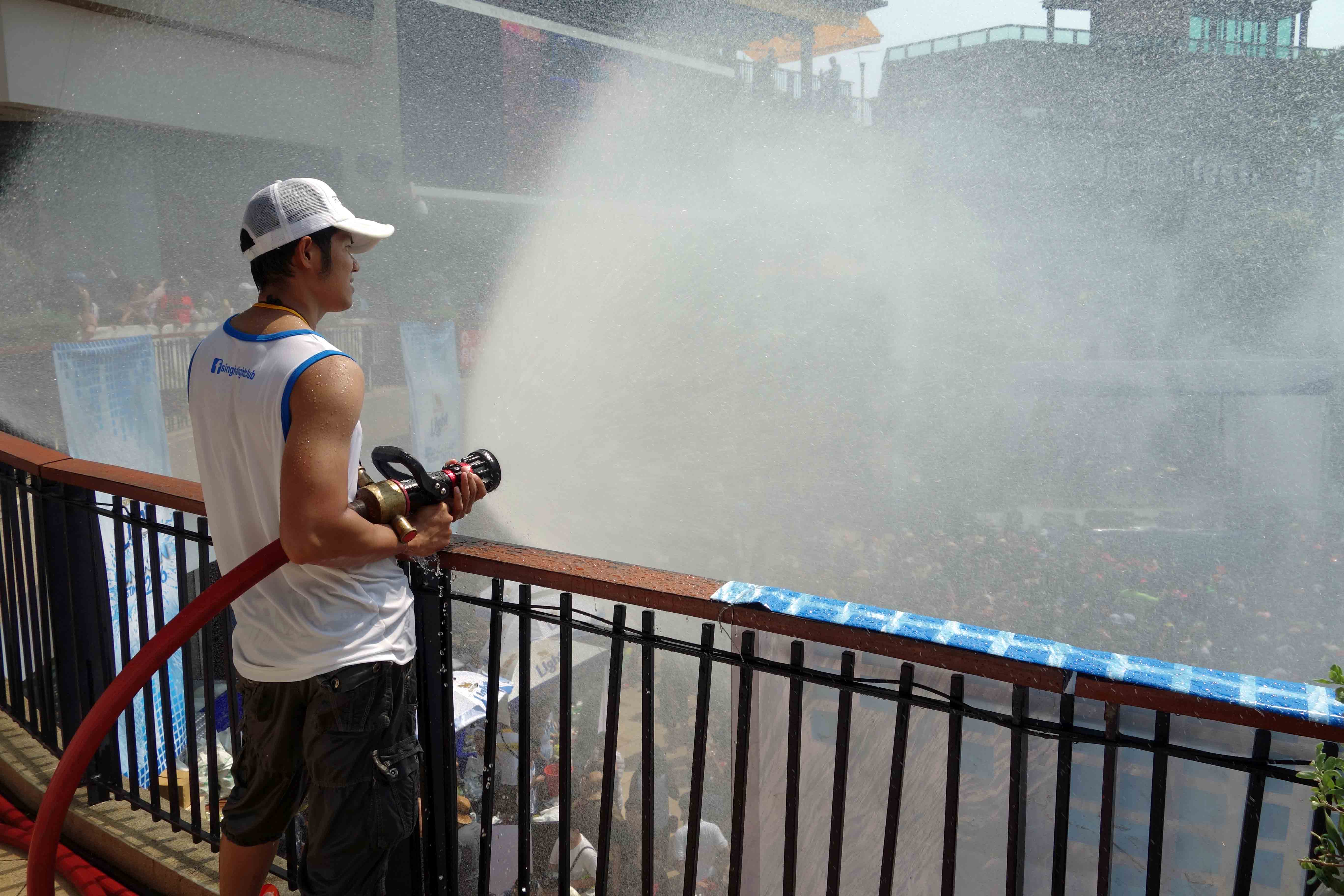
    Songkran is a noisy, very wet, fun time. For those with sufficient stamina it is fun to be continually drenched with water on a very hot day. Being blasted with very loud pop music is also part of the experience! It helps to be young! This throng of mainly young people were enjoying the music of a band playing in the Central Mall, Pattaya, whilst being drenched with water from fire hoses.

    Central Mall
    Crowd at Central Mall, Pattaya, on 19th April 2016
    Fire hose
    Fire hose

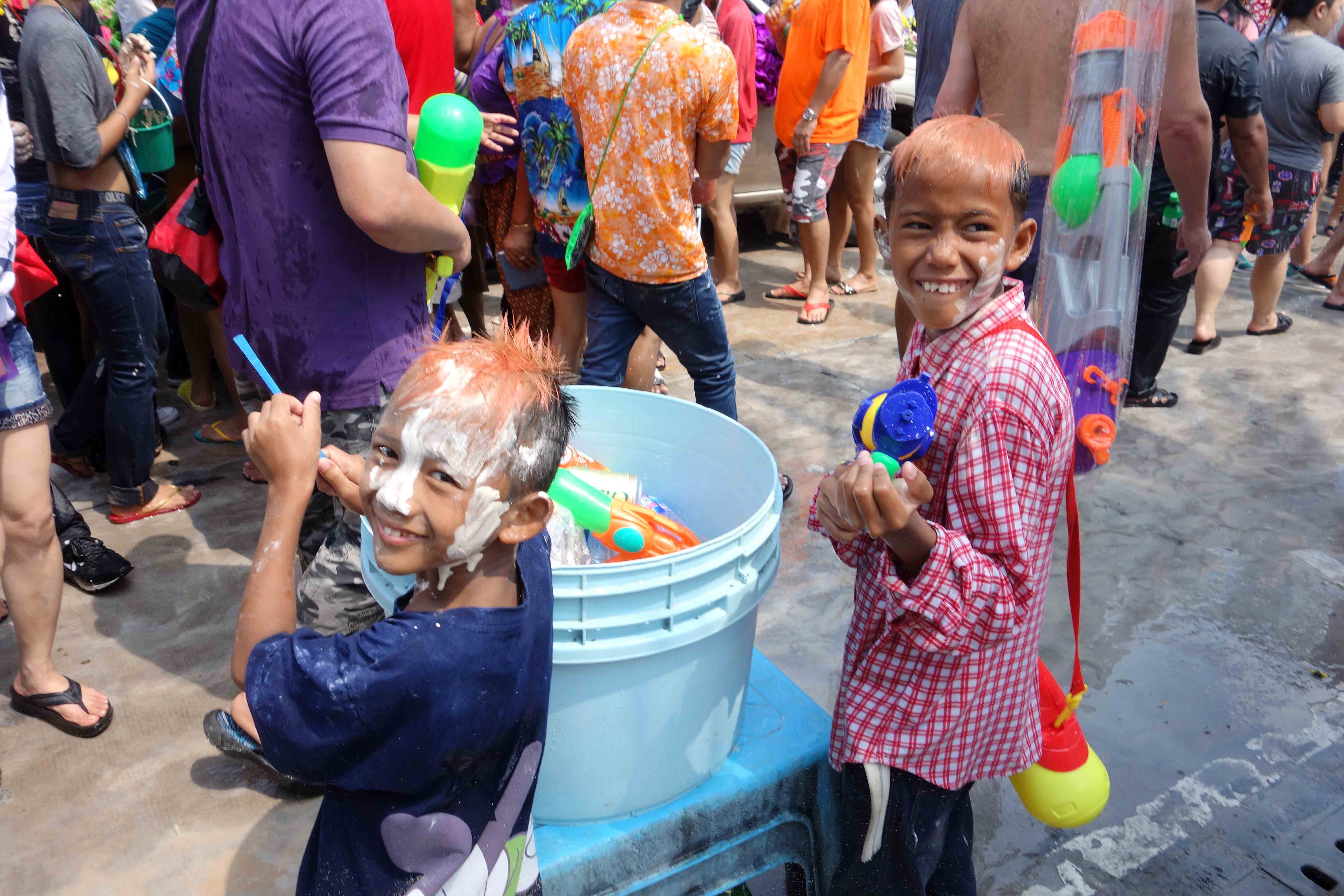
    These youngsters were enjoying themselves!

    Boys with water pistols
    Boys with water pistols

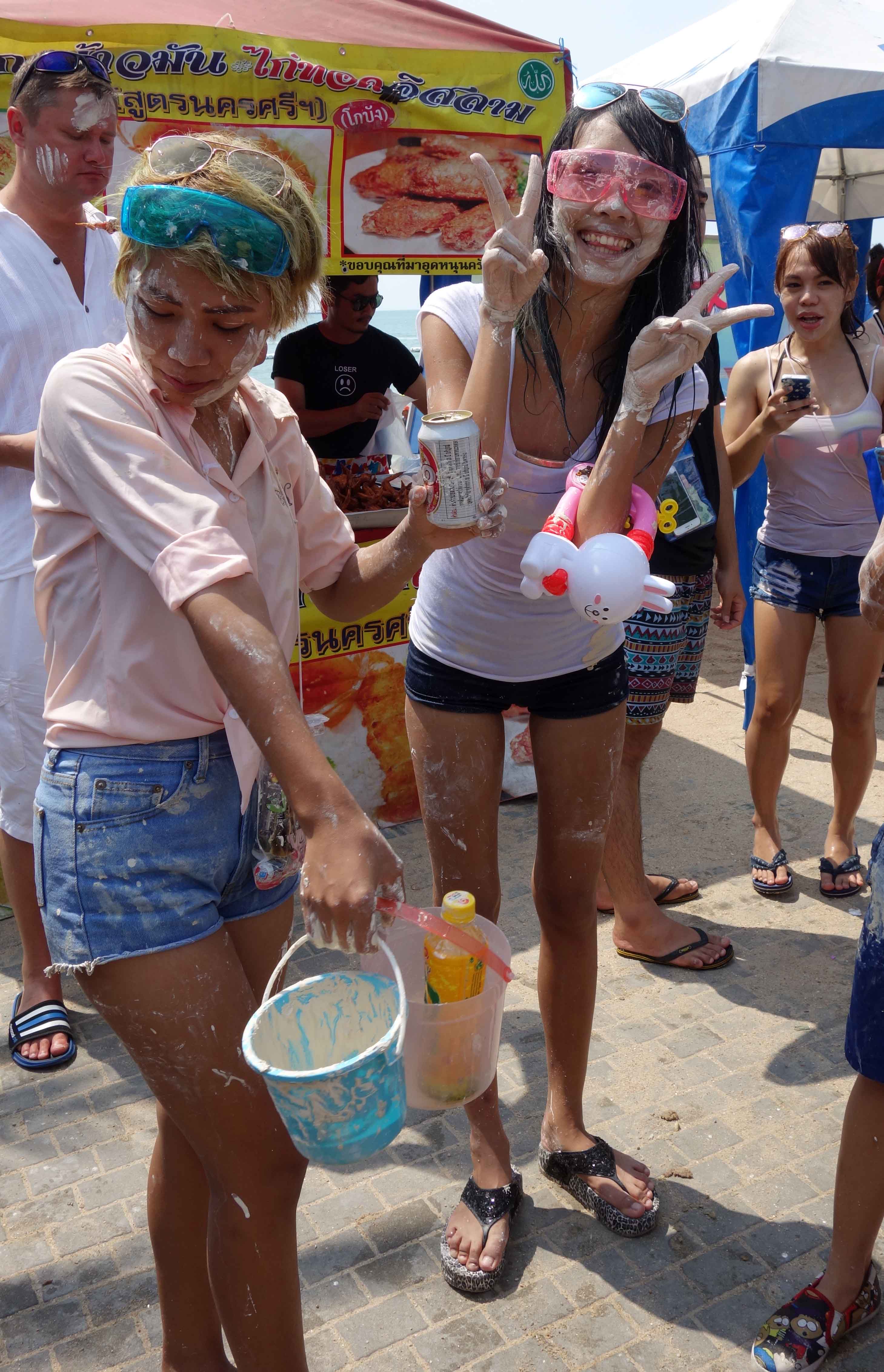
    Oh I forgot to mention the face paint (wet powder)! The protective glasses are a good idea as some of the water pistols are very powerful.

    Girls with face paint and protective glasses, 19th April 2016, Pattaya
    Girls with face paint and protective glasses, 19th April 2016, Pattaya

    This man seemed to be getting into the spirit of the occasion. His dancing reminded me of a bird!

    Dancing man, Pattaya
    Dancing man, Pattaya

    Would I go again to Pattaya at this time of year? Maybe not, as I am a bit of an old git(!), but it was fun to see it once.

  • Thai classical dance

    Thai classical dance

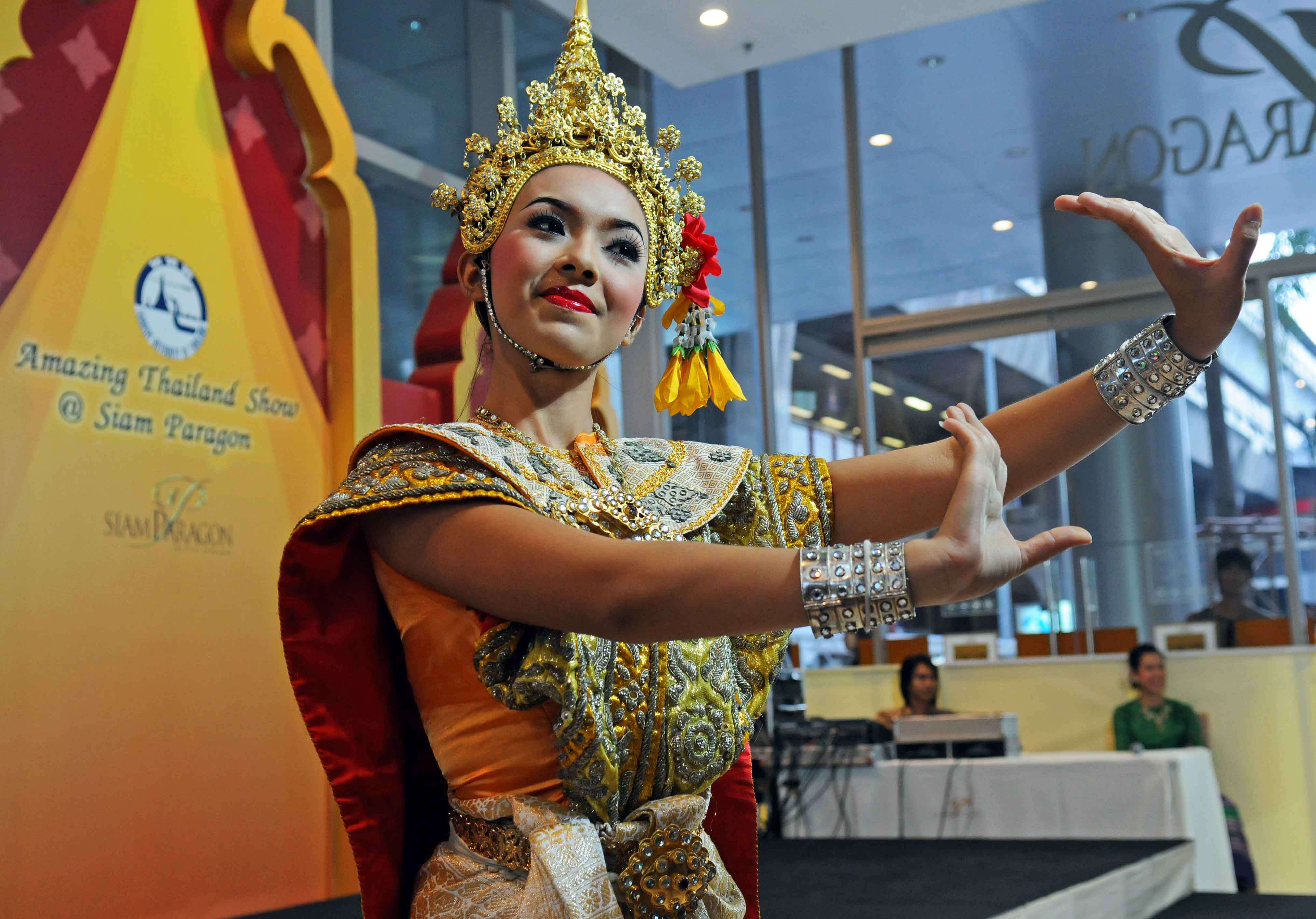
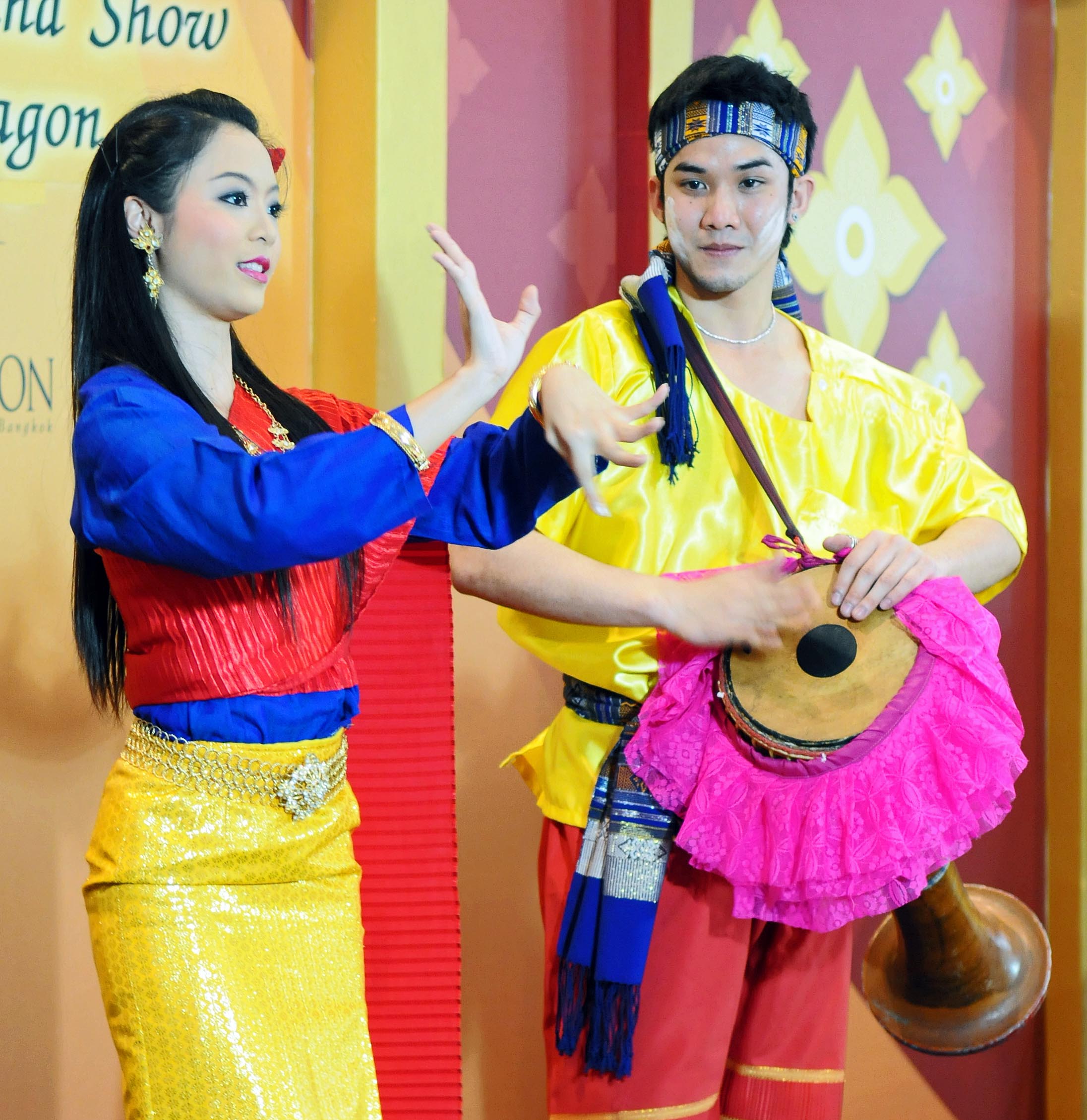
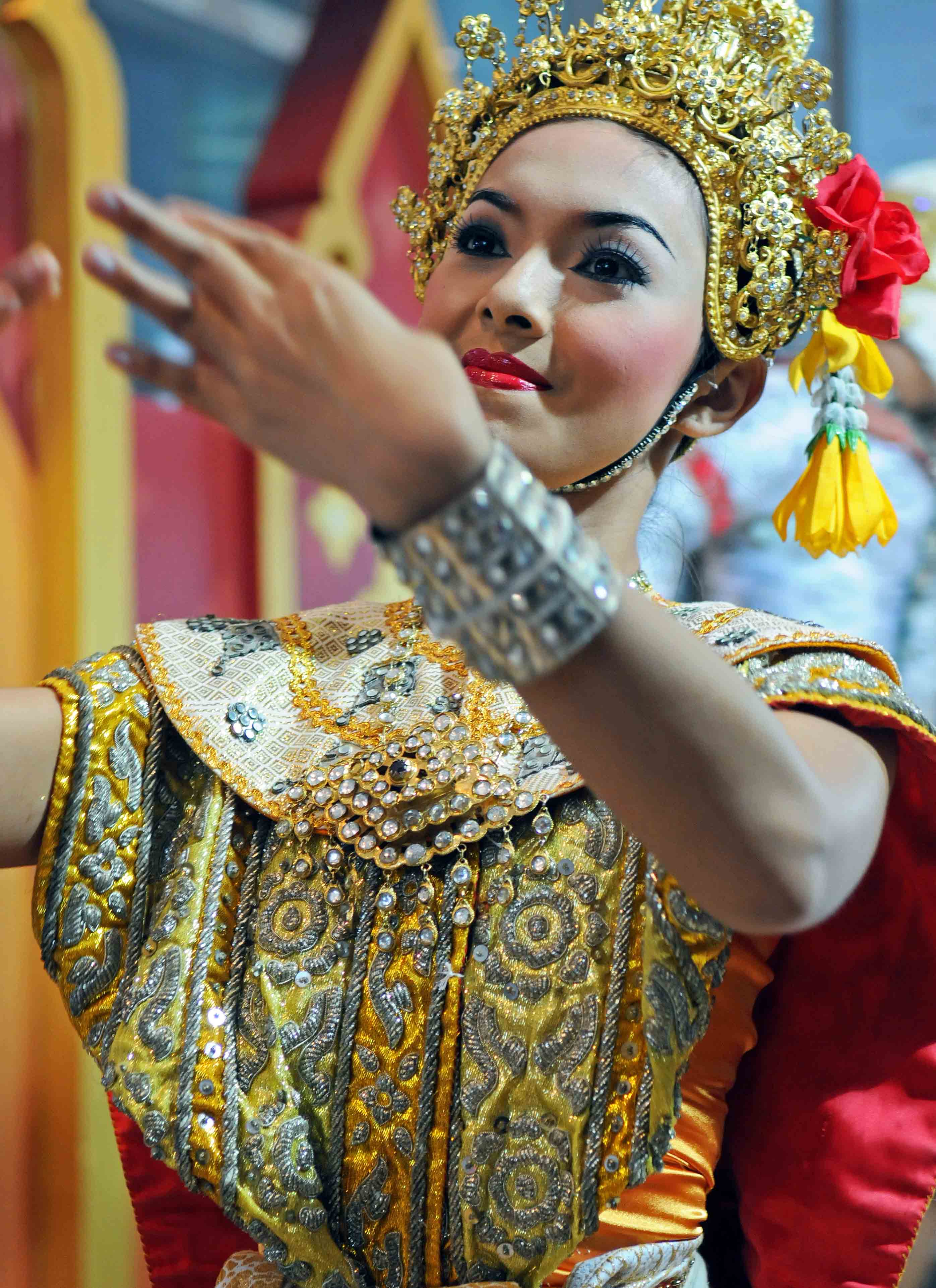
    I love watching Thai dances, the delicate hand and leg movements and the beautiful music. Not to mention the grace and beauty of the dancers themselves!

    Dancer in Bangkok (Siam Paragon department store)
    Dancer in Bangkok (Siam Paragon department store)

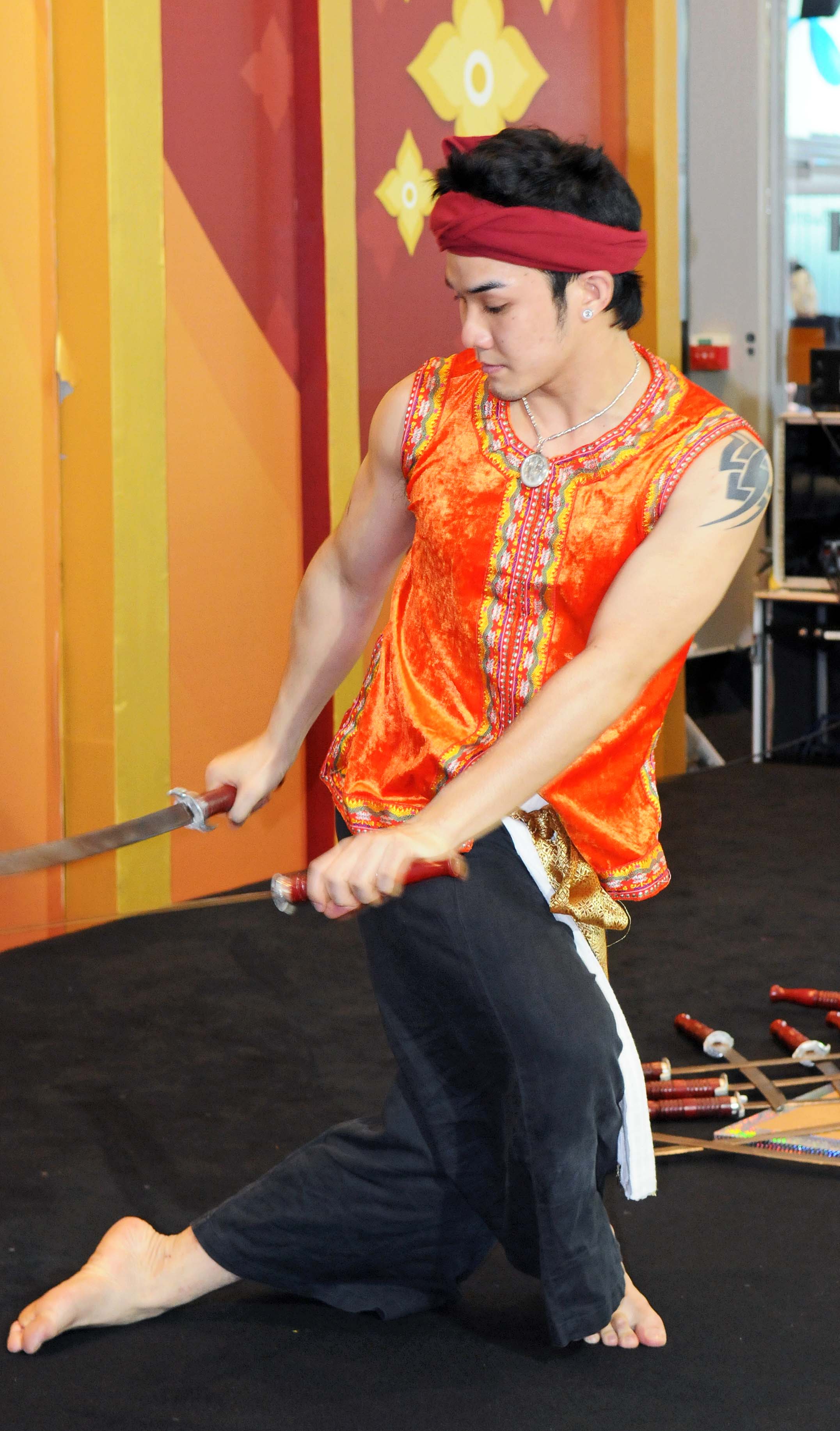
    There are many different types of dance in Thailand, all sorts of regional dances with different styles and meanings. For example, sword dances were inspired by types of combat that were typical in ancient times and were no doubt useful in terms of training speed and agility of the dancer/fighter.

    Sword dancer
    Sword dancer

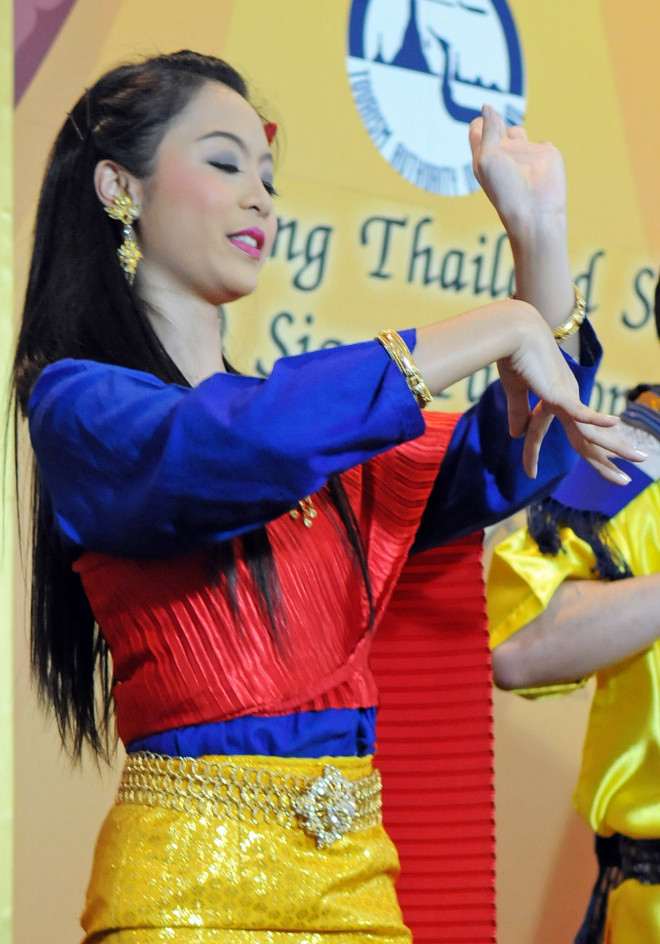
    Over the years of travelling in Thailand, I have snapped the occasional dancer, but as anyone who has tried it knows, it is not easy to capture the grace and fluidity of a dancer in a still photograph. Sometimes it works just by chance! This girl (below) was dancing as she moved along the street with the annual Flower Festival parade in Chiang Mai (2014). The festival started late in the afternoon that year, and the sun had set when I took this photograph, so the dancers were at least spared the heat of the midday sun, as in previous years. She is wearing the traditional  brass finger nails which amplify the movements of the fingers.

    Dancer in 2014 Flower Festival, Chiang Mai
    Dancer in 2014 Flower Festival, Chiang Mai

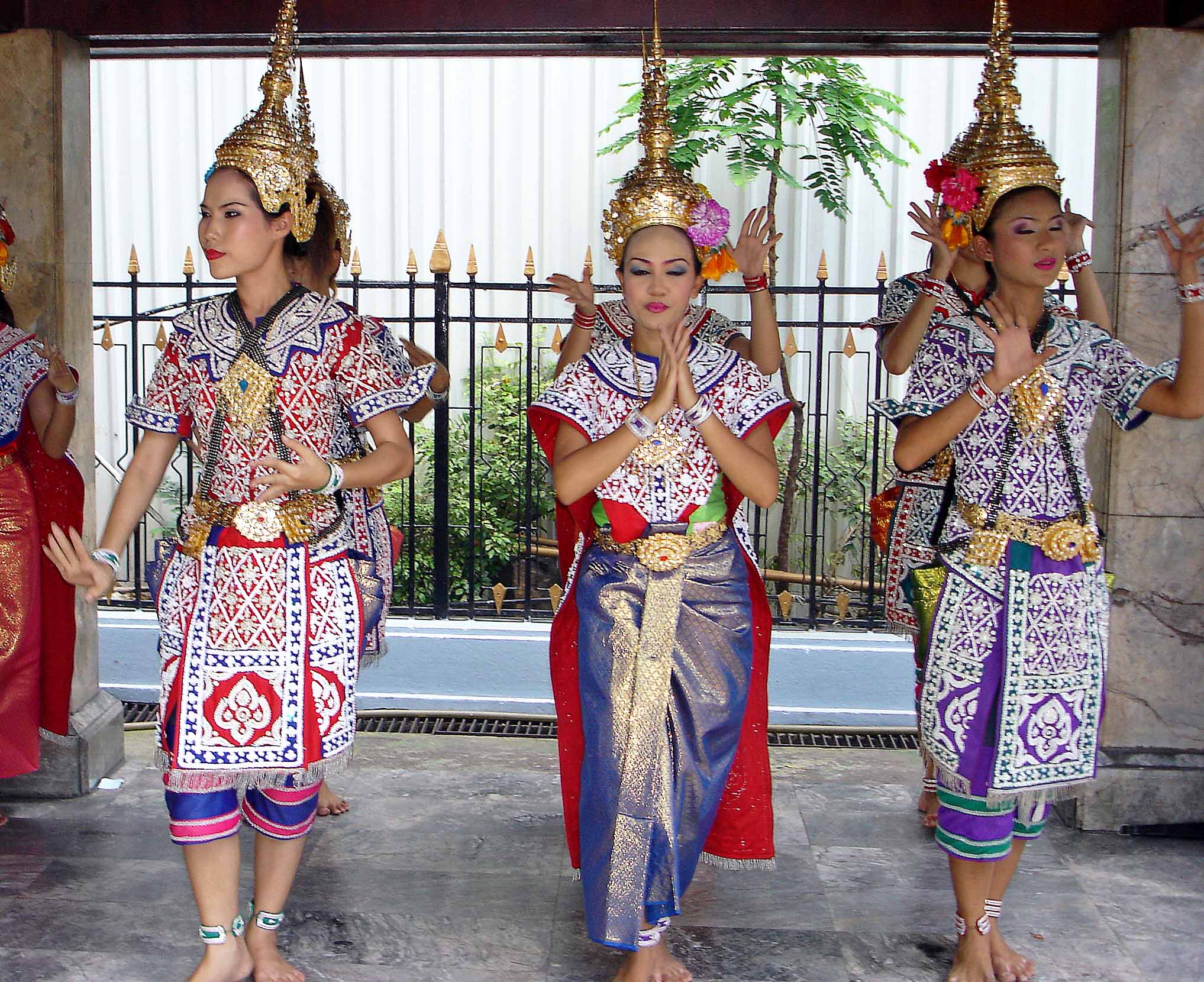
    These traditional Thai dancers (below) were performing at the Erewan shrine in central Bangkok, where worshipers donate money for them to dance. They perform these elaborate dances all through the day in temperatures in the mid 30 degrees C or above. It is incredible that the look as cool and unflustered as they do.

    Dancers at Erewan shrine, Bangkok
    Dancers at Erewan shrine, Bangkok

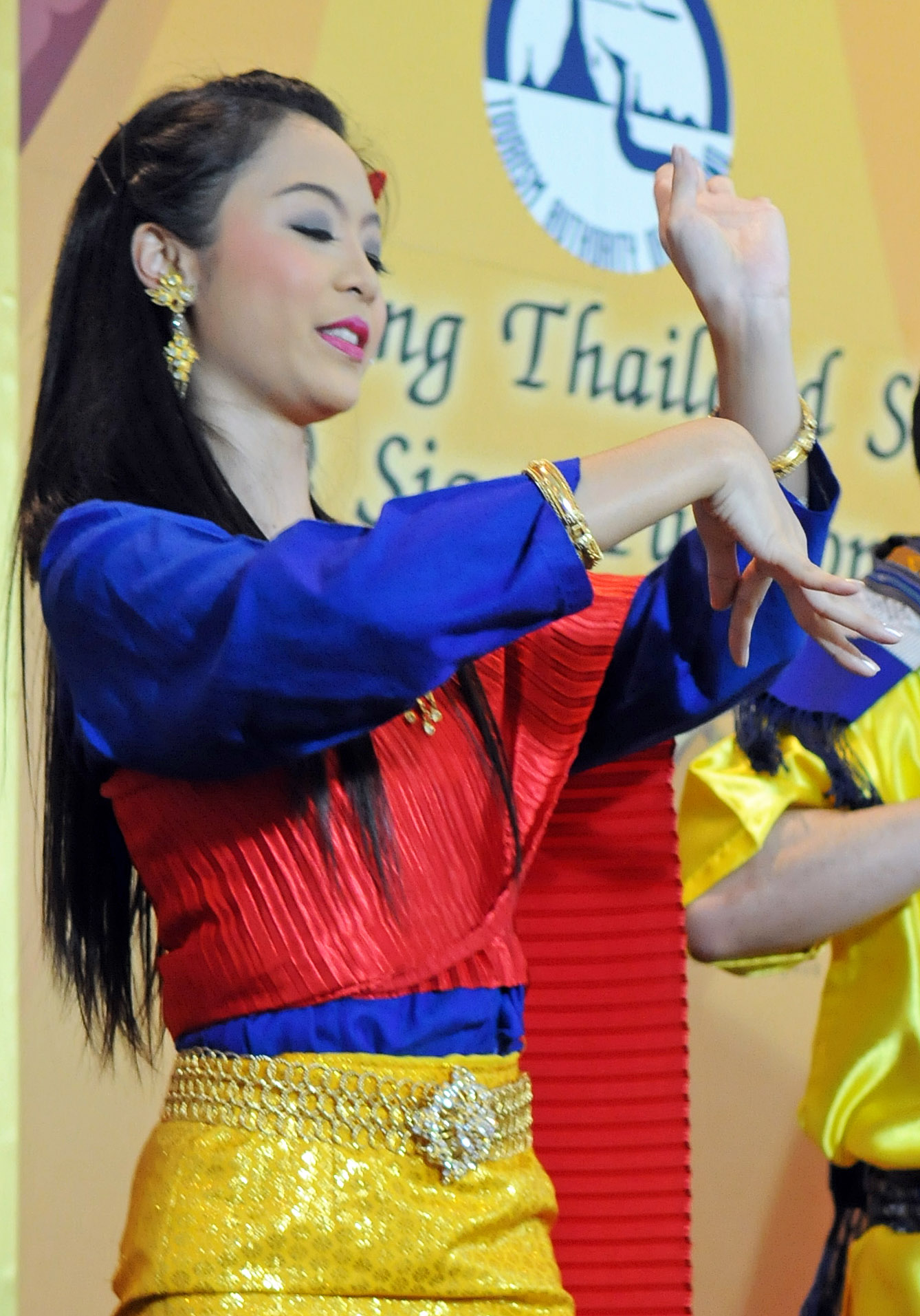
    These Thai dances and hand movements have meanings, which unfortunately I do not understand, although I would like to learn. The extremely elastic finger movements in which the fingers are stretched backwards are an aesthetic of the dances familiar to all Thais, but special training is needed to do it properly (without breaking ones fingers that it!). It is a symbol of grace and elegance.

    Hand movements
    Hand movements
    Hand movements by Thai dancer
    Hand movements by Thai dancer

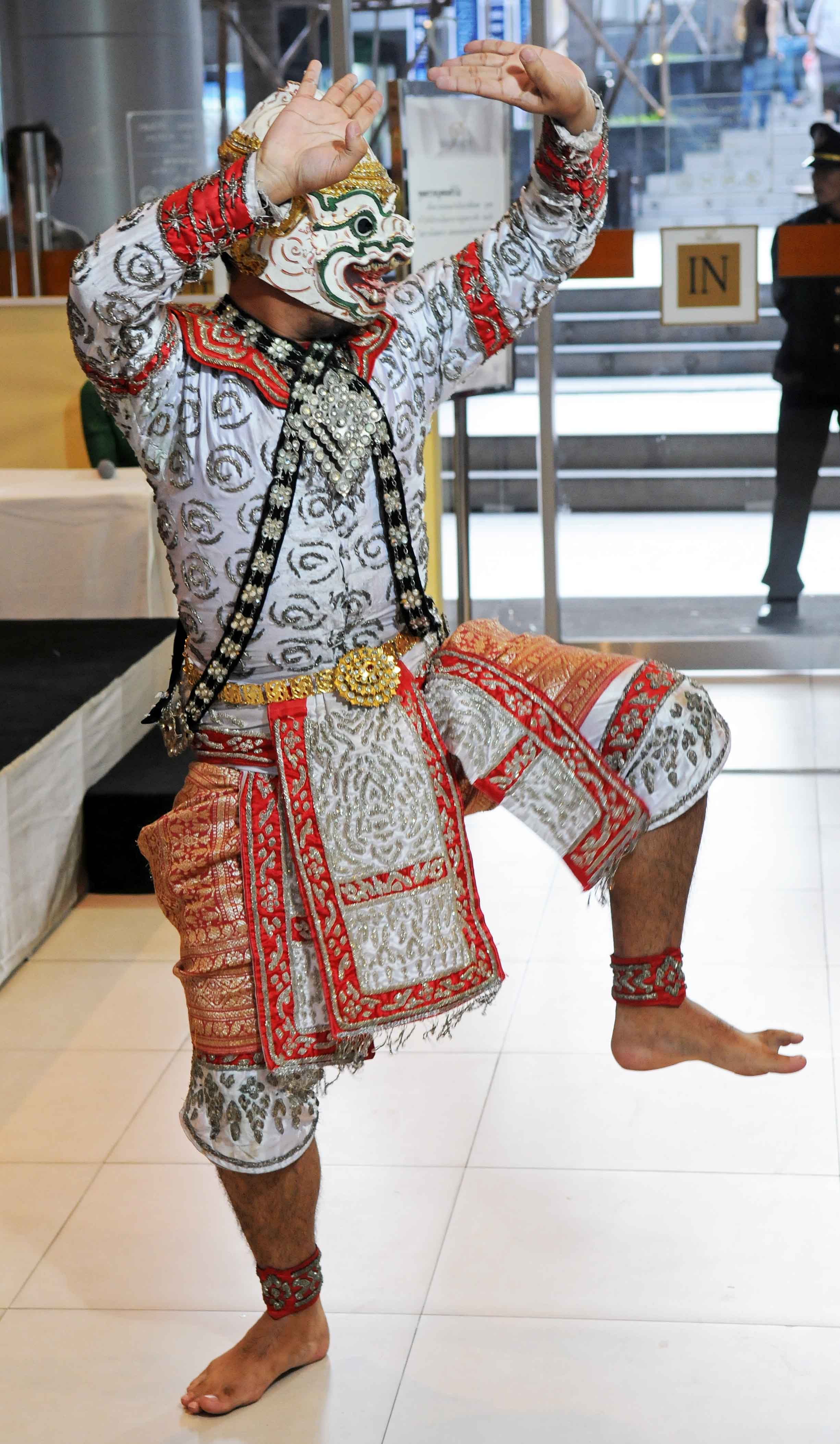
    The khon (classical masked dance) was originally performed as entertainment in the royal court and features episodes from the Ramakien (the Thai version of the Ramayana) with masked characters which will be familiar to most Thai school children, like Hanuman the monkey mask (shown below).

    Dancer wearing khon mask of hanuman, the magical monkey
    Dancer wearing khon mask of Hanuman, the magical monkey

    The grace and beauty of these dancers has a universal appeal, even if we farangs  (foreigners) don’t really understand the symbolism of the dances, as the Thais themselves do.

    Classical Thai dancer
    Classical Thai dancer
  • Happy New Year! Am I a goat or a horse?

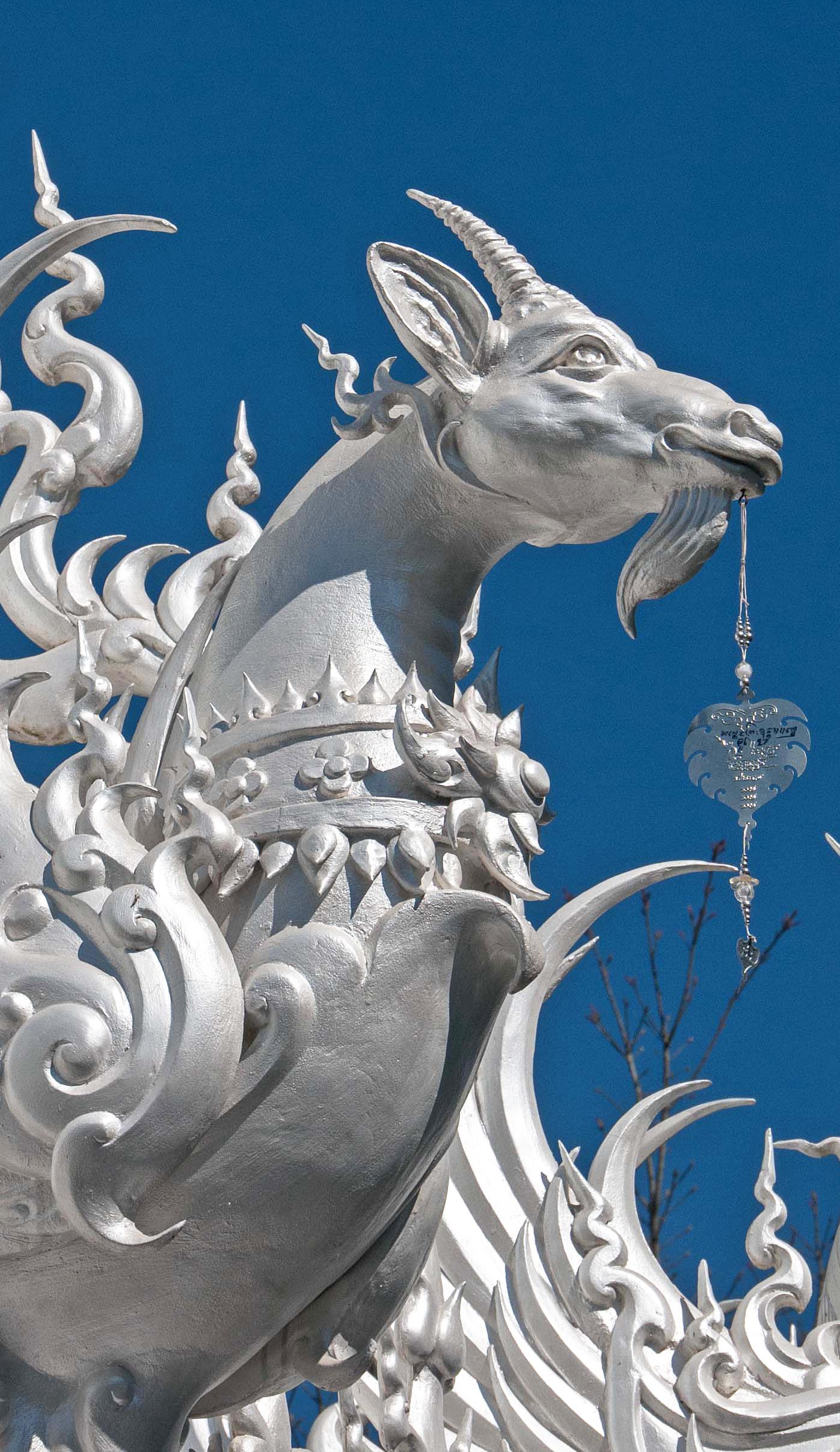
    Goat at  Wat Rong Khun
    Goat statue at Wat Rong Khun, Thailand

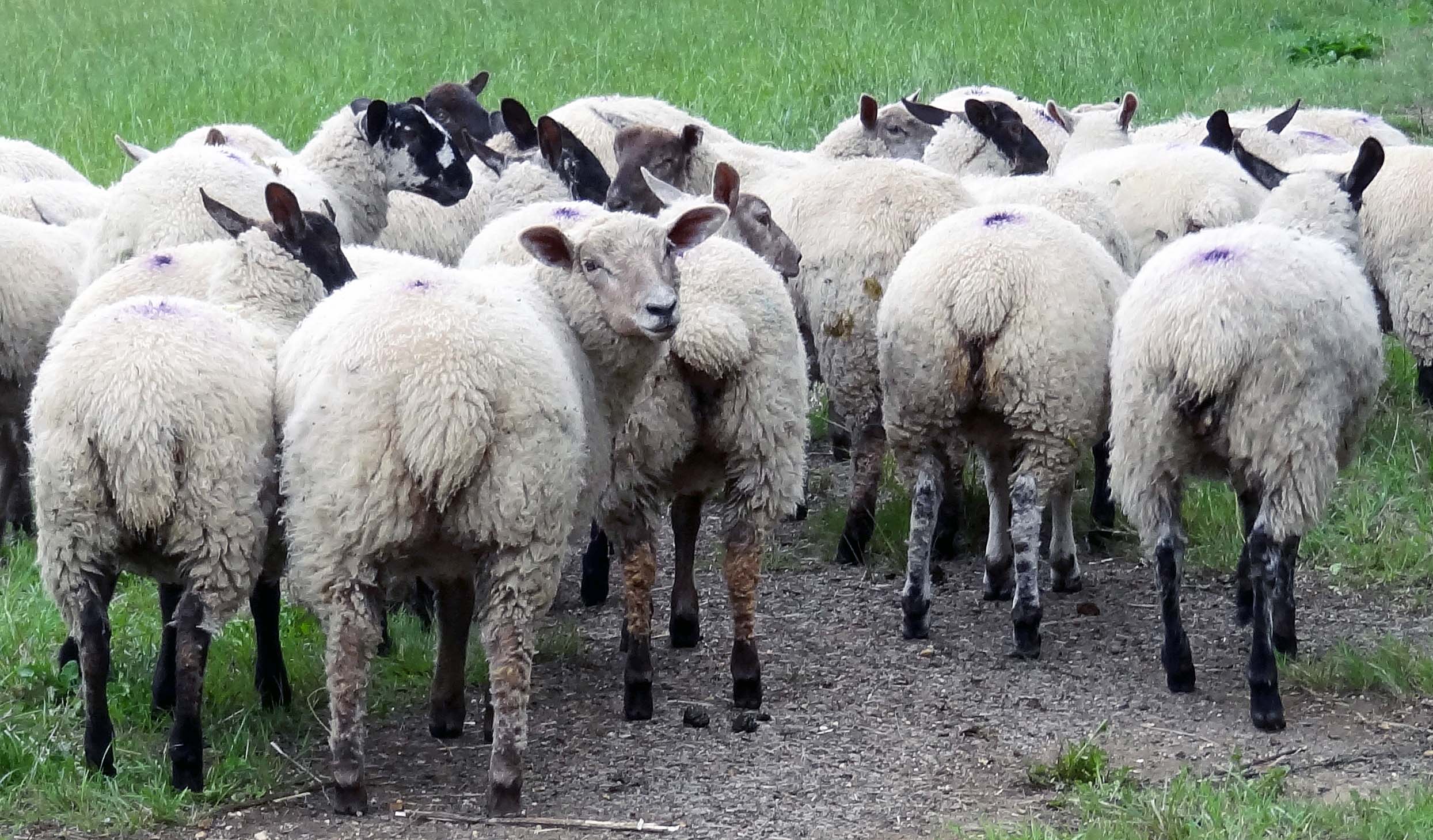
    It is now the year of the goat.  Or is it the year of the sheep? Or the ram?! According to one site on Chinese Astrology (1) “goat people are elegant, charming, artistic, gifted and fond of nature”! Well I certainly identify with that!

    Sheep
    Sheep in Kent

    So I looked it up and it turns out I was born in a year of the goat (1955) but I missed the start of the Chinese New Year by one day! Less than one day as I was born at 9 am according to my Mum! I was born on 23 January 1955 and the Year of the Goat started on 24 January that year!  That really makes me a horse. “Horse people are active and energetic [yes that’s me!]…..got lots of sex-appeal [sure!]…..love to be in a crowd [oh no, not me at all!].  So, I guess I must be on the cusp, with some goat-like and some horse-like qualities!

    Wild ponies in Galicia, Spain
    Wild ponies in Galicia, Spain


    1. Chinese Astrology. http://www.chinese-astrology.co.uk/goat.html
  • The White Temple: Wat Rong Khun

    The White Temple: Wat Rong Khun

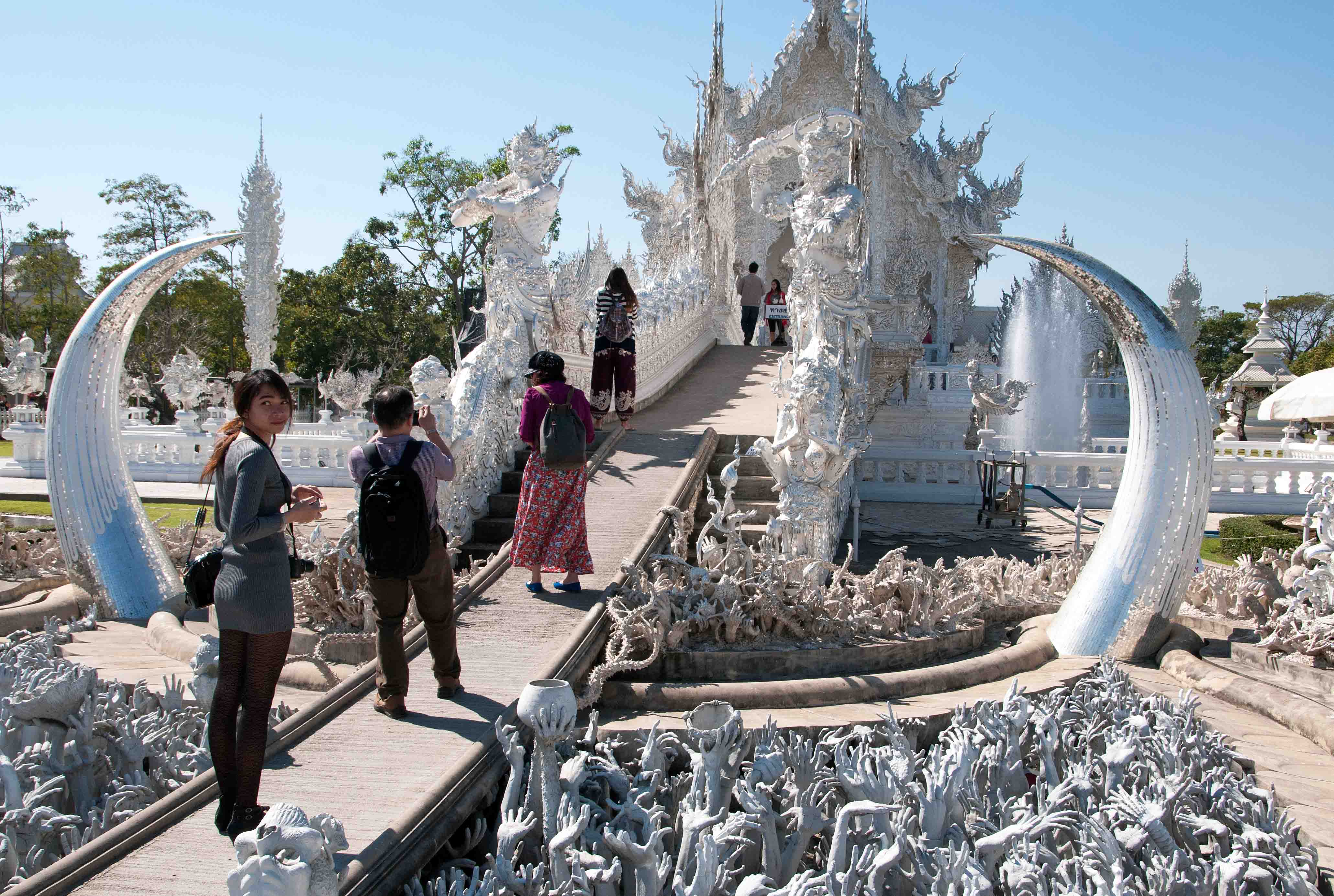
    Wat Rong Khun (วัดร่องขุ่น) is a unique temple situated near Chiang Rai. It is the life work of a Thai artist called  Chalermchai Kositpipat – with an army of assistants – and is an extraordinary creation of buildings, statues and murals, all of which are very modern but nevertheless in the Buddhist tradition.  It is easier to illustrate this temple using photographs than to describe it in words.
    Wat Rong Khun
    Wat Rong Khun

    From a distance it looks like a traditional Thai Buddhist temple (Wat), albeit incredibly ornate and all white. On closer inspection, it becomes apparent that this is no ordinary temple, since it contains all sorts of allegorical art works, part art gallery, part religious building.

    The bridge of the Cycle of Rebirth with Noon

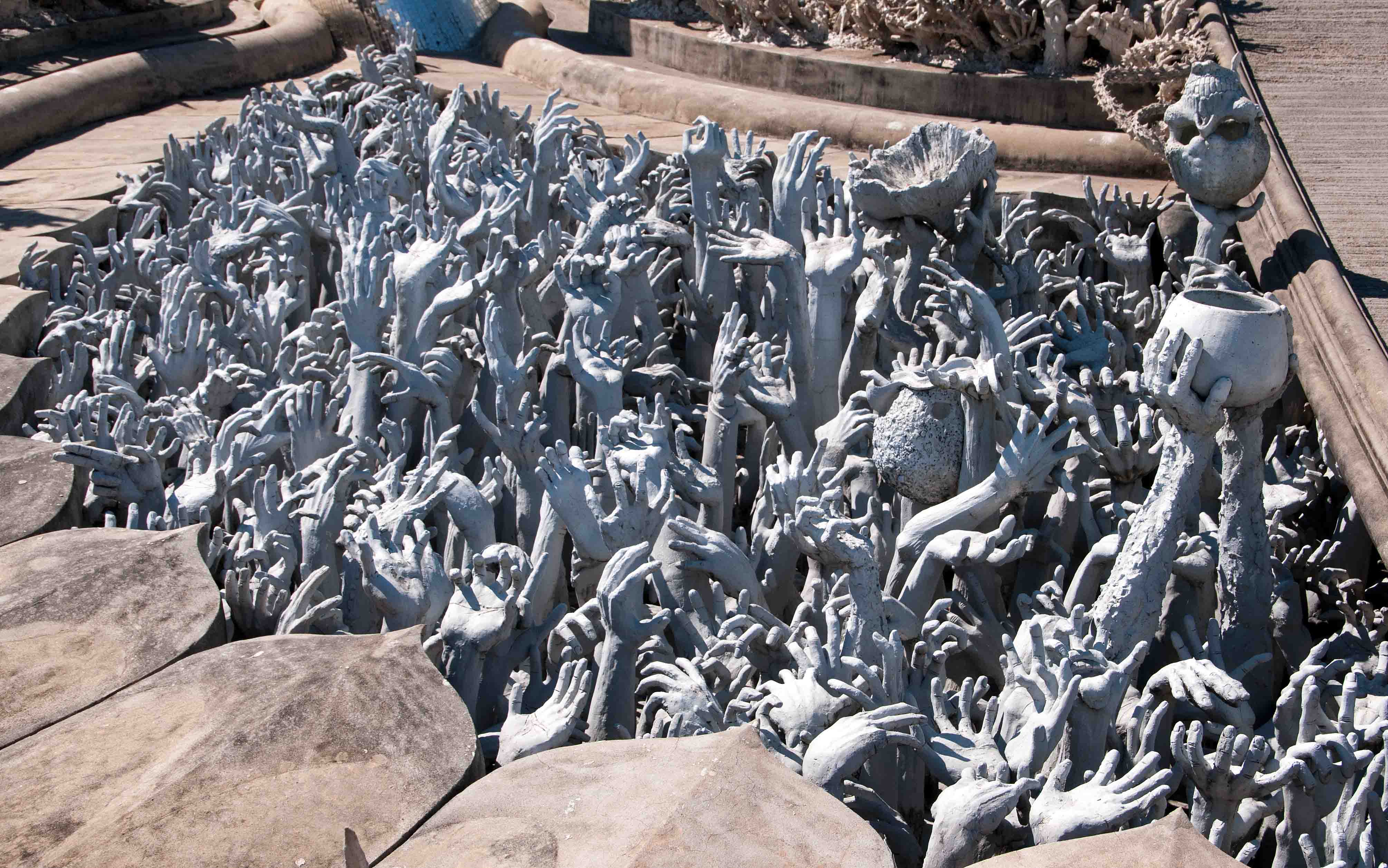
    At first one crosses the bridge of ‘the cycle of rebirth’ past a pit of outstretched hands.  These are presumably humans beings locked into a cycle of continual rebirth as a result of their unrestrained desire for pleasure.  The sea of hands was a very potent symbol of human suffering.

     Outstretched hands

    Outstretched hands

    The bridge itself is the way towards happiness: a Buddhist pathway involving letting go of temptations, greed, and desire.  There are some vivid and gruesome exhibits elsewhere in the temple of the evils of temptations such as alcohol and smoking.

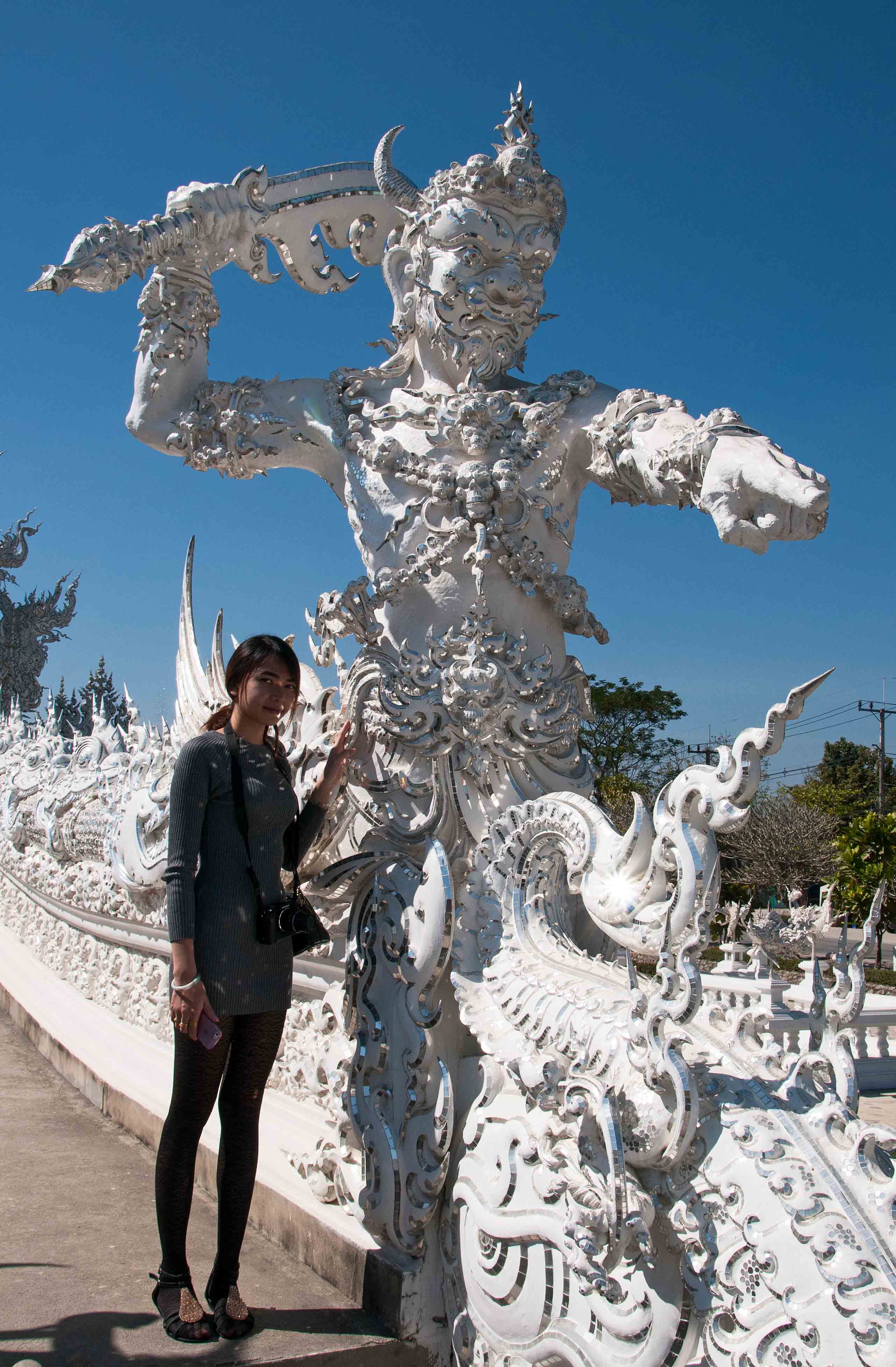
    The giant Rahu guarding the gates of heaven
    The giant Rahu guarding the gates of heaven

    Once across the bridge, the visitor arrives at the ‘gates of heaven’, guarded by two giant mythical creatures (Rahu and Ketu I think).

    Wat Rong Khun detail
    Wat Rong Khun detail

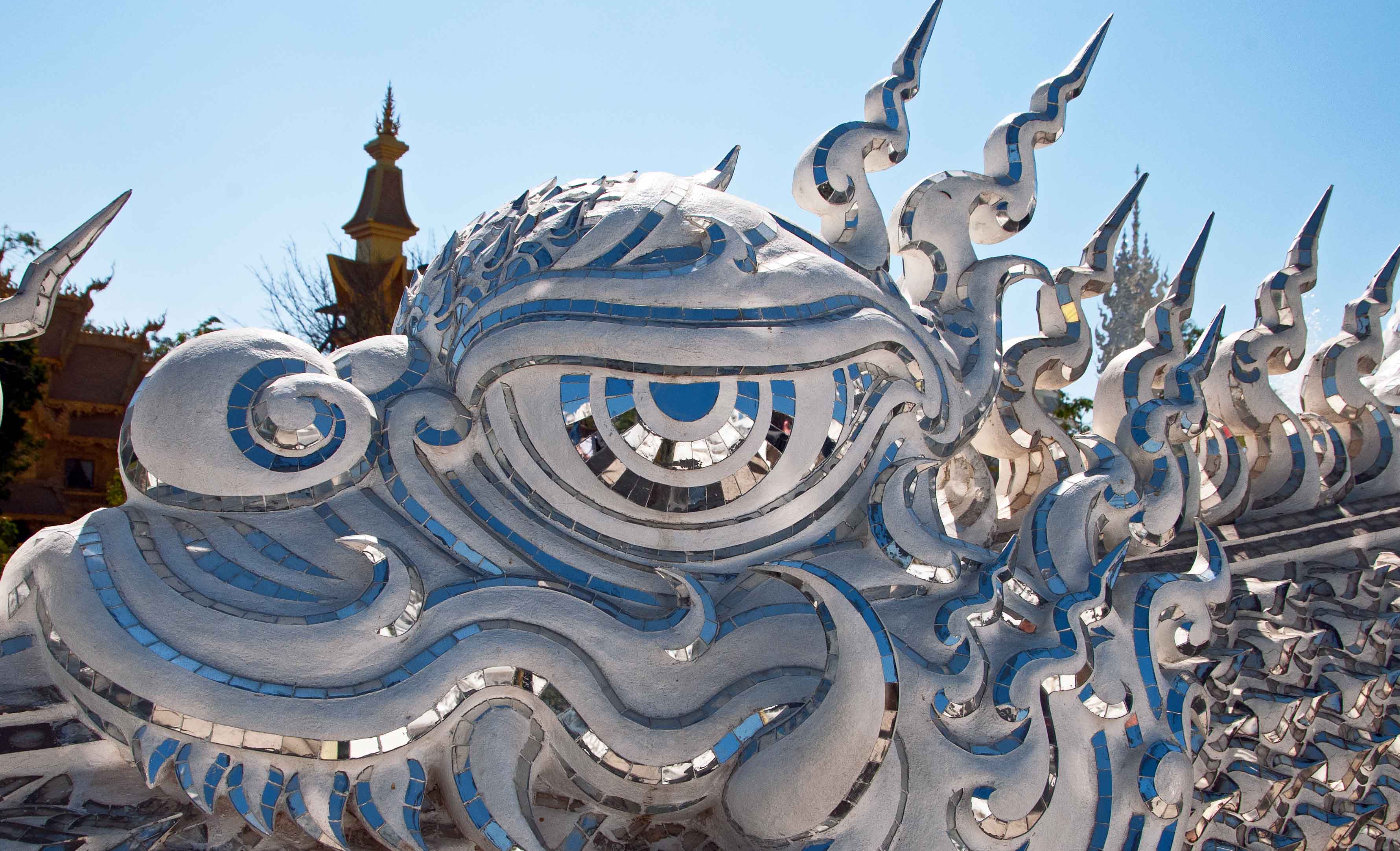
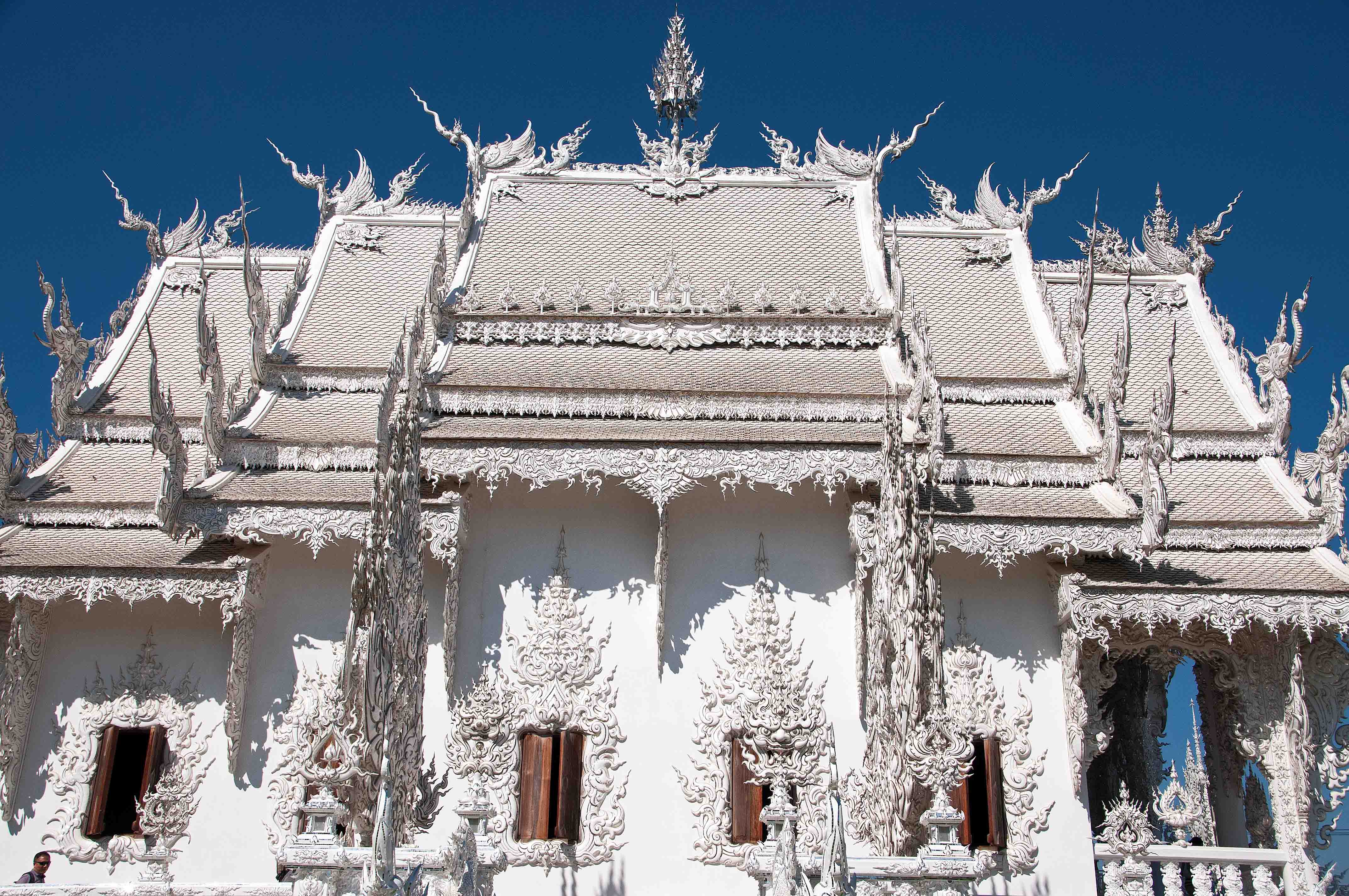
    The main building, called the ubosot is an extraordinarily ornate and beautiful building, decorated with glass and elaborate carved nagas, extending outwards from the roof.

    Ornate roof of the ubosot
    Ornate roof of the ubosot

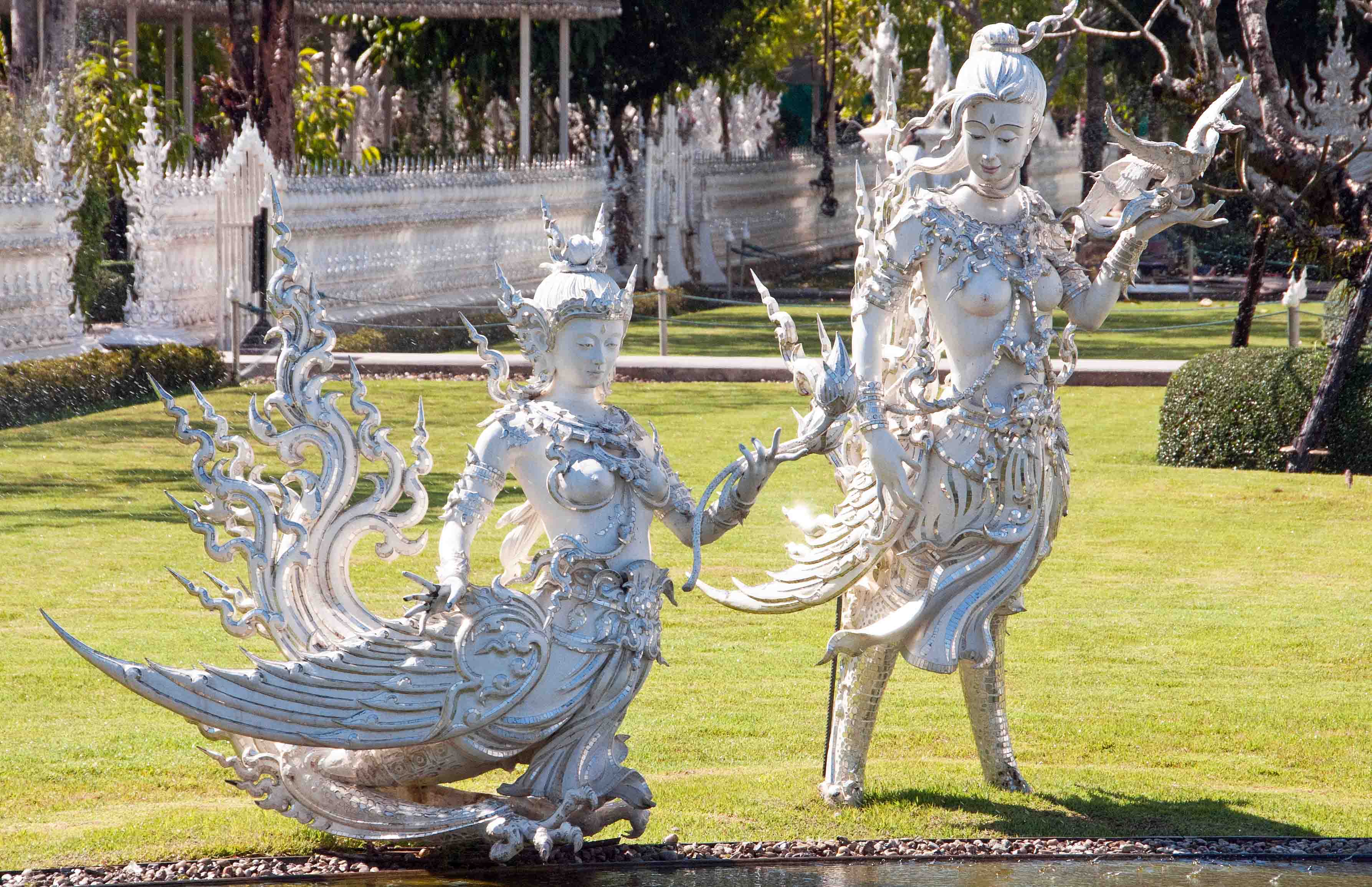
    Two Kinnarees are positioned next to the lake.  A Kinnari (or kinnaree) is an angelic half-woman, half-bird (in Thailand), an eternal lover who can fly between human and spiritual worlds.  A symbol of  feminine beauty and grace, which these statues certainly are.

    Statues representing kinnaree
    Statues representing kinnaree

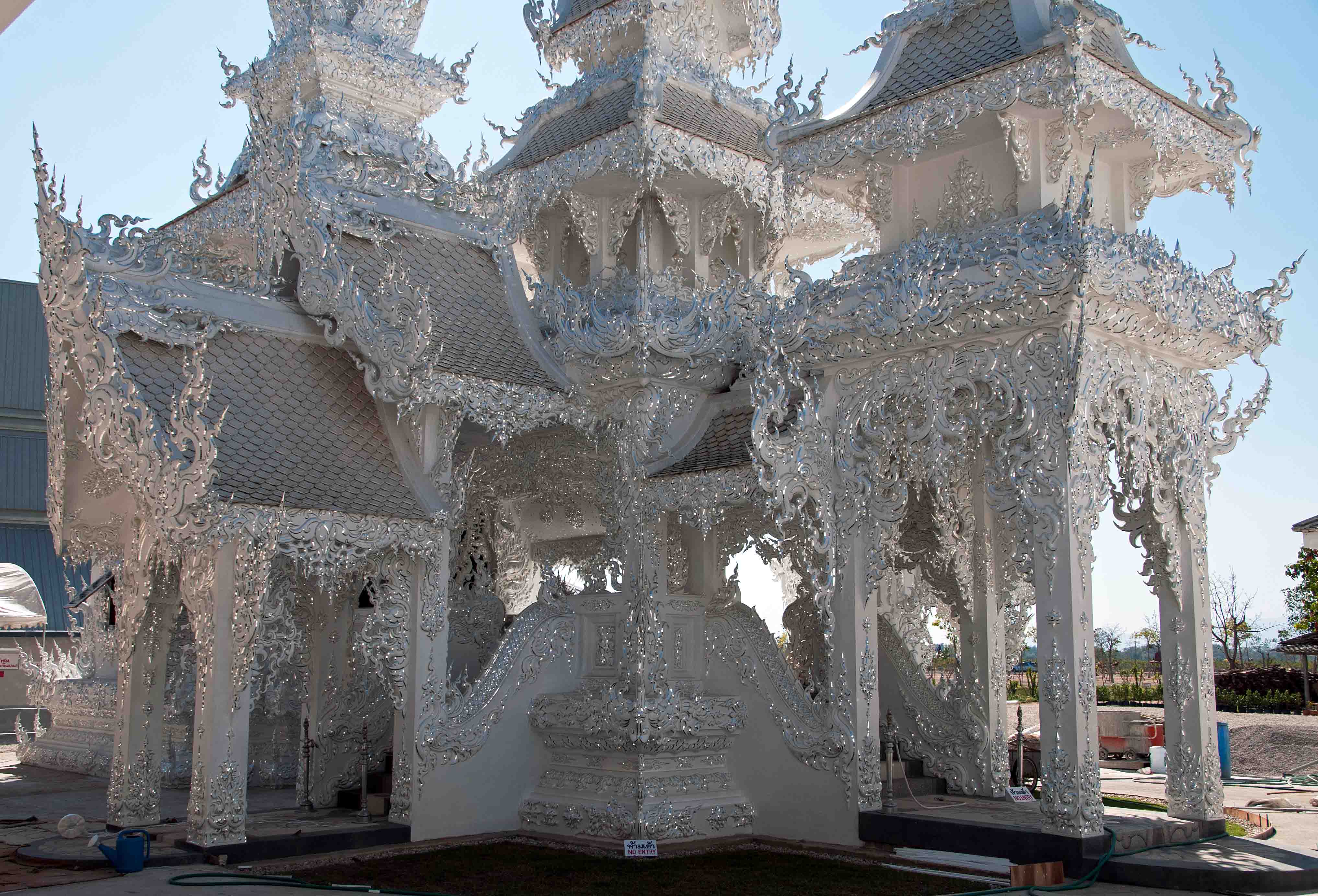
    There are a variety of other buildings at Wat Rong Khun, in various stages of completion.  How they fared in the earthquake (see below) I am not sure.  The head of a large Buddha statue reportedly fell off.

    Unfinished building at Wat Rong Khun
    Unfinished building at Wat Rong Khun

    What I most liked at Wat Rong Khun were the statues.  Many were still being carved in the workshops (below).

    Statues in workshop at Wat Rong Khun
    Statues in workshop at Wat Rong Khun

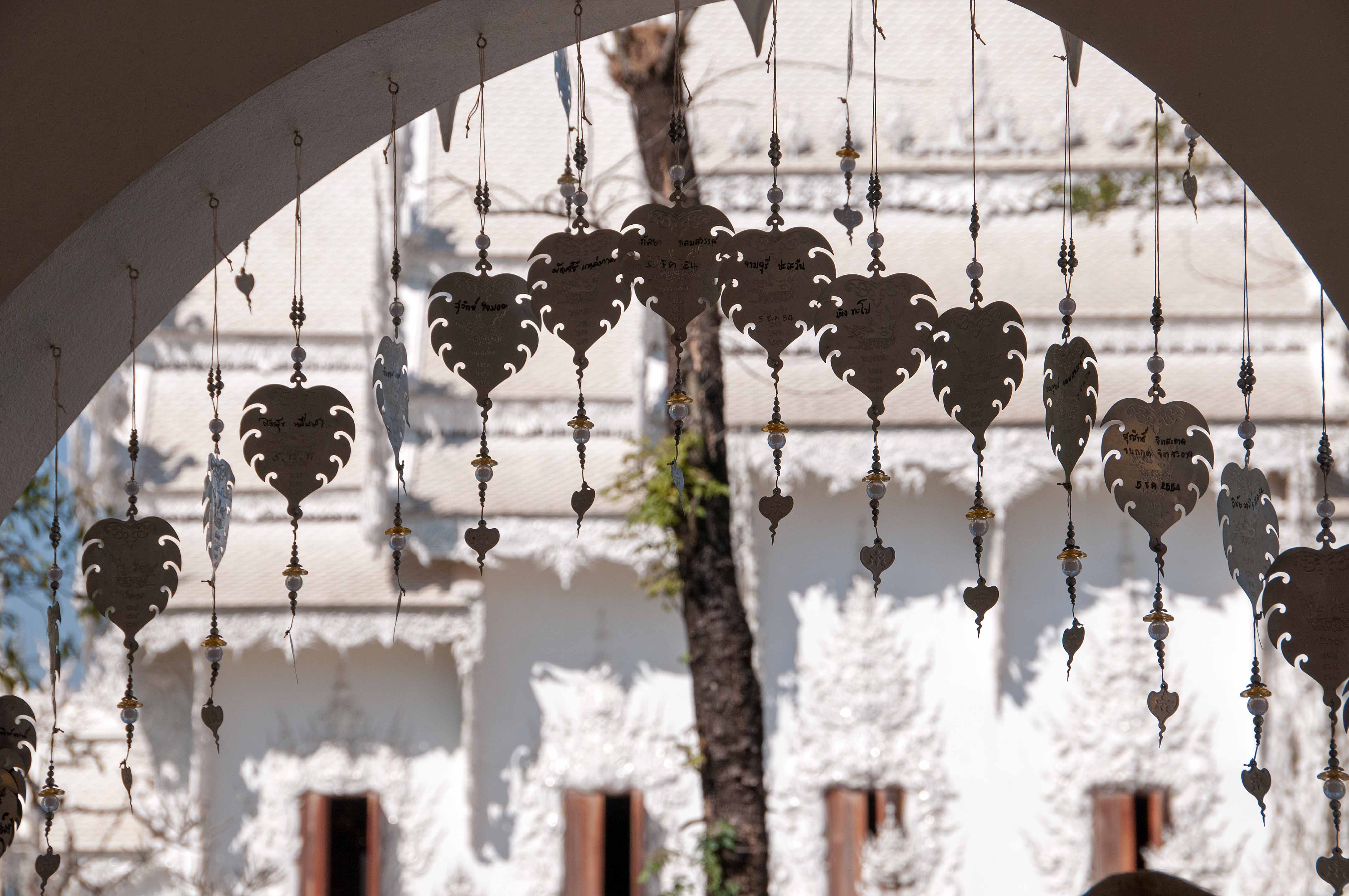
    One of the buildings I liked most at Wat Rong Khun was the wishing well.  The building itself housed a water-filled wishing pond filled with coins; Thai Buddhist wishing pendants were hung from the eaves (below).

    The ubosot at Wat Rong Khun from the wishing well
    The ubosot at Wat Rong Khun from the wishing well

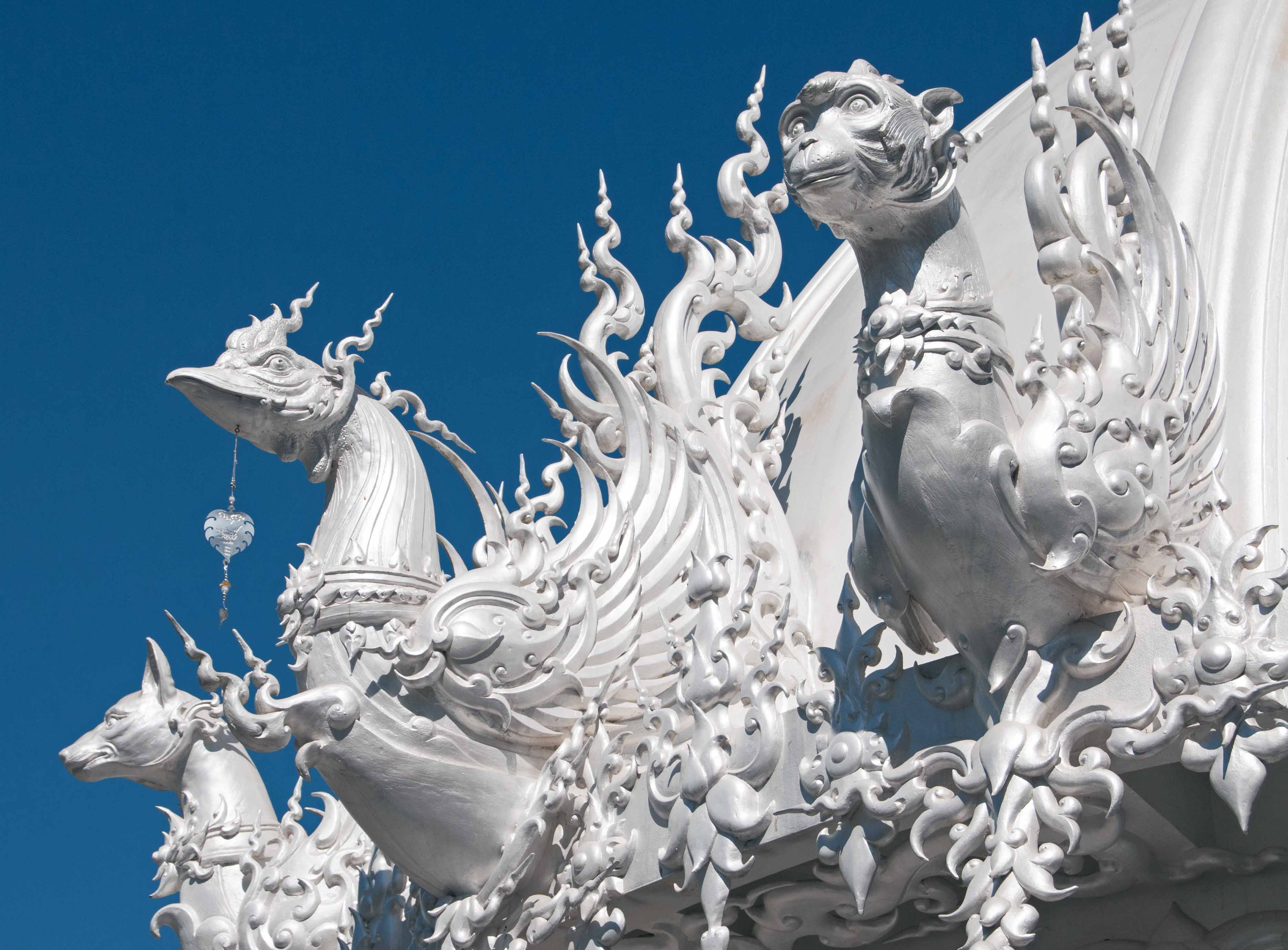
    The roof of the wishing well building was adorned with the most beautiful statues, representing the animal signs of the zodiac (monkey, chicken goat etc.).  These were the highlight of the whole temple for me and I took photographs of them all; they are worth featuring in a separate blog.

    Animals of the zodiac at Wat Rong Khun
    Animals of the zodiac at Wat Rong Khun

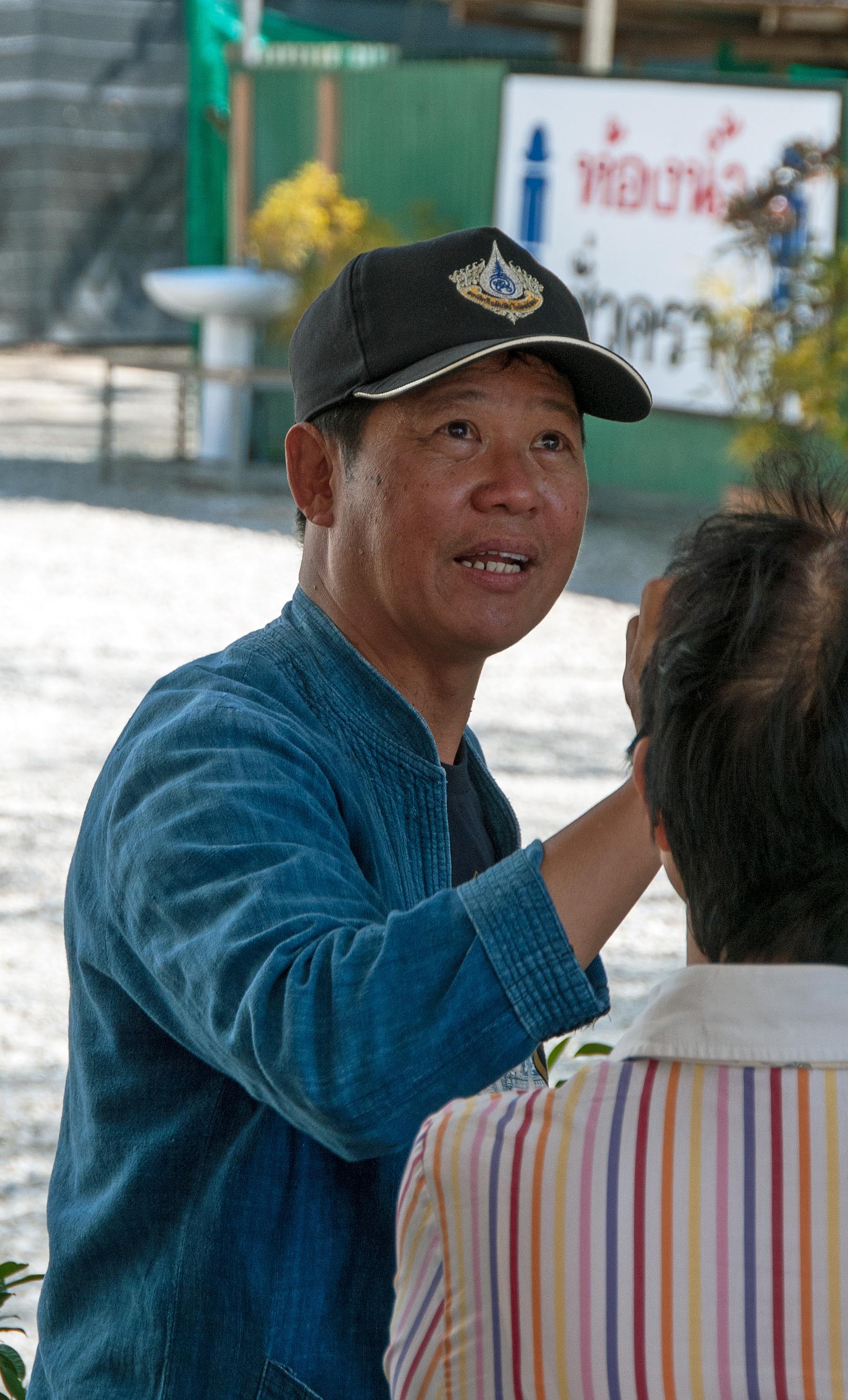
    We were fortunate to see the artist, Chalermchai Kositpipat, during our visit.  He was talking to some Thai visitors.

    Chalermchai Kositpipat at Wat Rong Khun
    Chalermchai Kositpipat at Wat Rong Khun

    Update

    I visited the white temple in February 2014, when these photos were taken.  In May 2014, a nearby earthquake of magnitude 6.3 caused substantial damage to Wat Rong Khun (1). The artist must have been devastated by the destruction, and according to media reports, initially appeared to give up hope of restoring it. The buildings in the compound were however, structurally unharmed by the quake, and buoyed by huge public support, the artist and his team have reportedly taken up the challenge of restoring the temple to its former glory (2, 3).  The murals on the walls and ceiling of the ubosot, which took nearly 20 years to complete, were apparently destroyed.  It will be interesting to see if these are restored exactly as the were before, or whether Chalermchai will decide to create something new.

    1. http://www.bangkokpost.com/most-recent/408354/exquisite-wat-rong-khun-closed-indefinitely-by-earthquake-damage.

    2. https://www.facebook.com/pages/Wat-Rong-Khun/133021290072176#

    3.  http://en.wikipedia.org/wiki/Wat_Rong_Khun

  • Queen Sirikit Botanic Garden

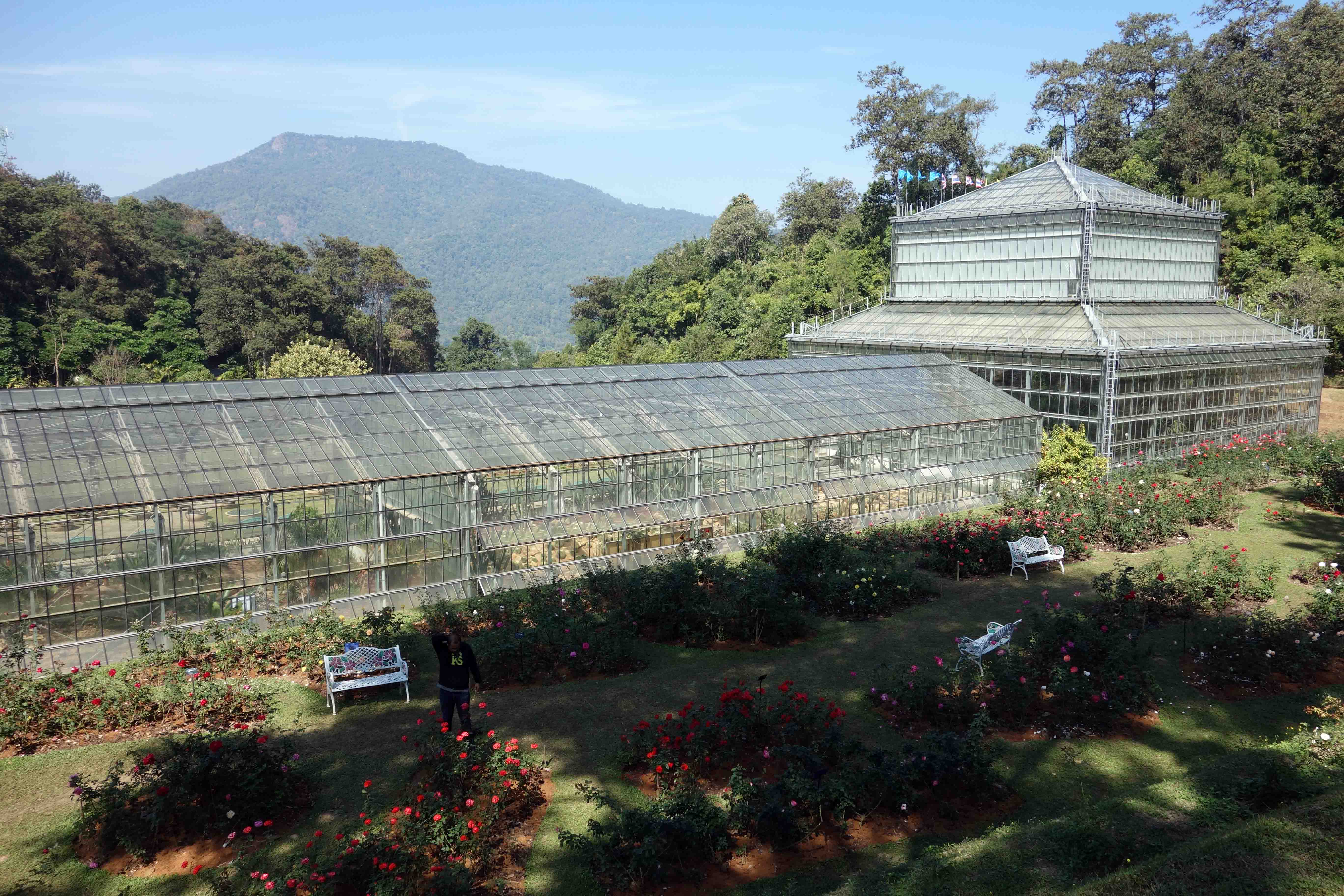
     Glass house complex

    Glass house complex

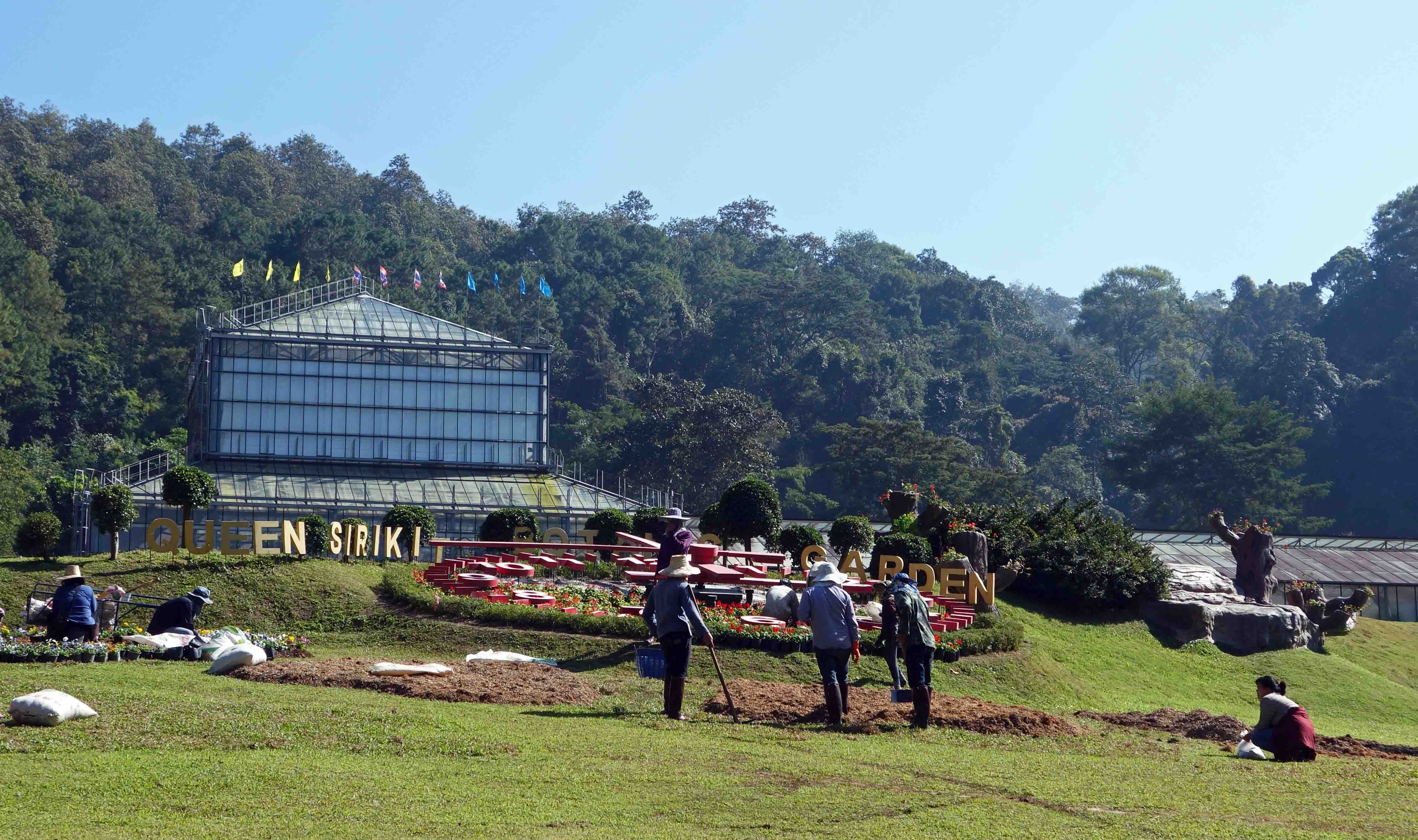
    The Queen Sirikit Botanic Garden is located in the Mae Sa Valley, on the edge of the Doi Sutep-Pui National Park, about fifteen km north of Chiang Mai.

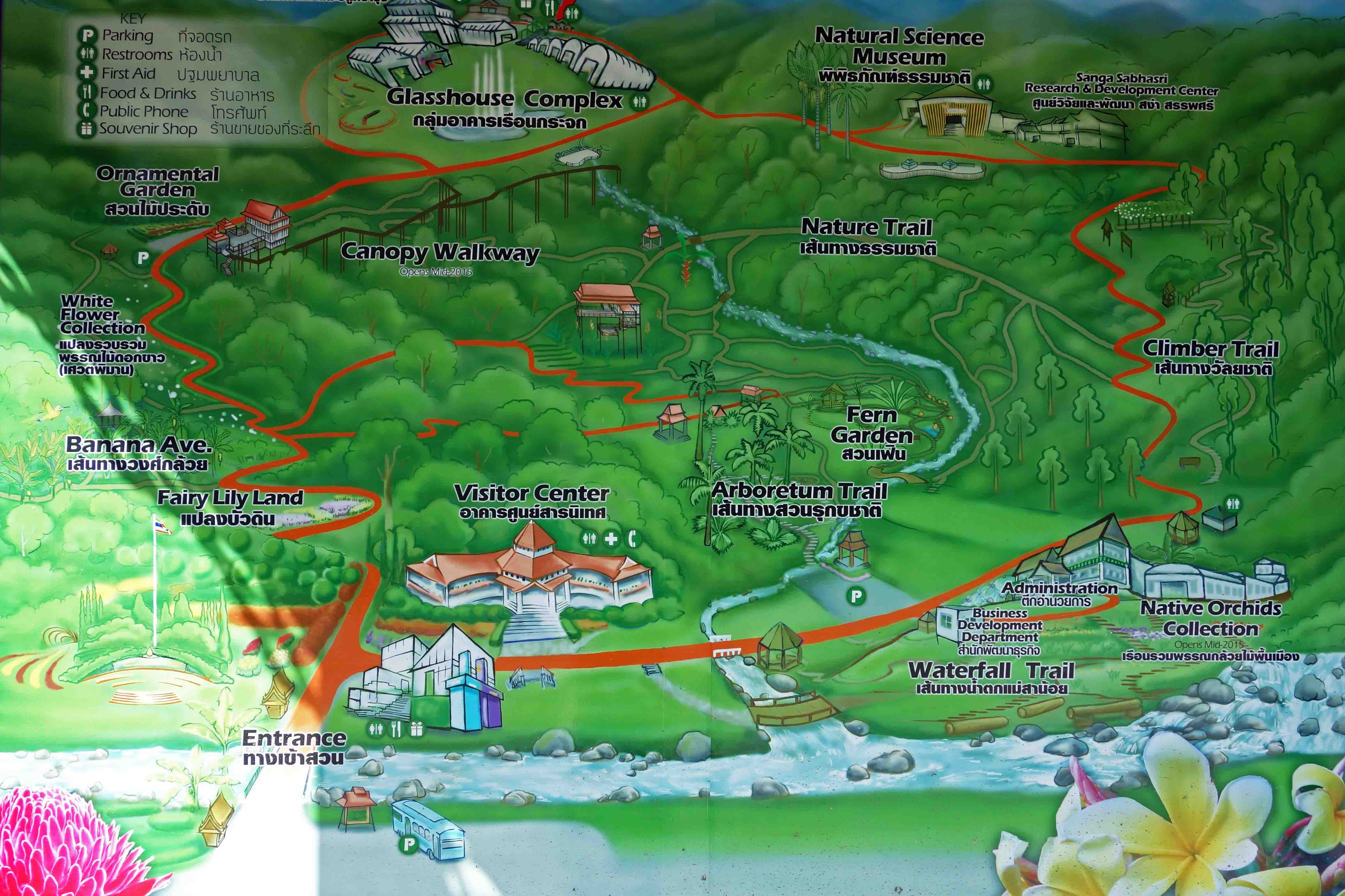
    Map of Queen Sirikit Botanic Garden
    Map of Queen Sirikit Botanic Garden

    The park is large (1000 ha) and there are a number of different sites and glasshouses linked by a perimeter road (see map).  Perhaps the most impressive exhibits are the indoor displays, housed in a series of conservatories and glasshouses at the top of the park.  When I visited in December of last year, there were relatively few visitors, and least compared to some of the more popular tourist sites in other parts of the valley.  There are also a number of trails in the garden, which are very pleasant to walk – especially in winter – and because of the elevated hillside location.

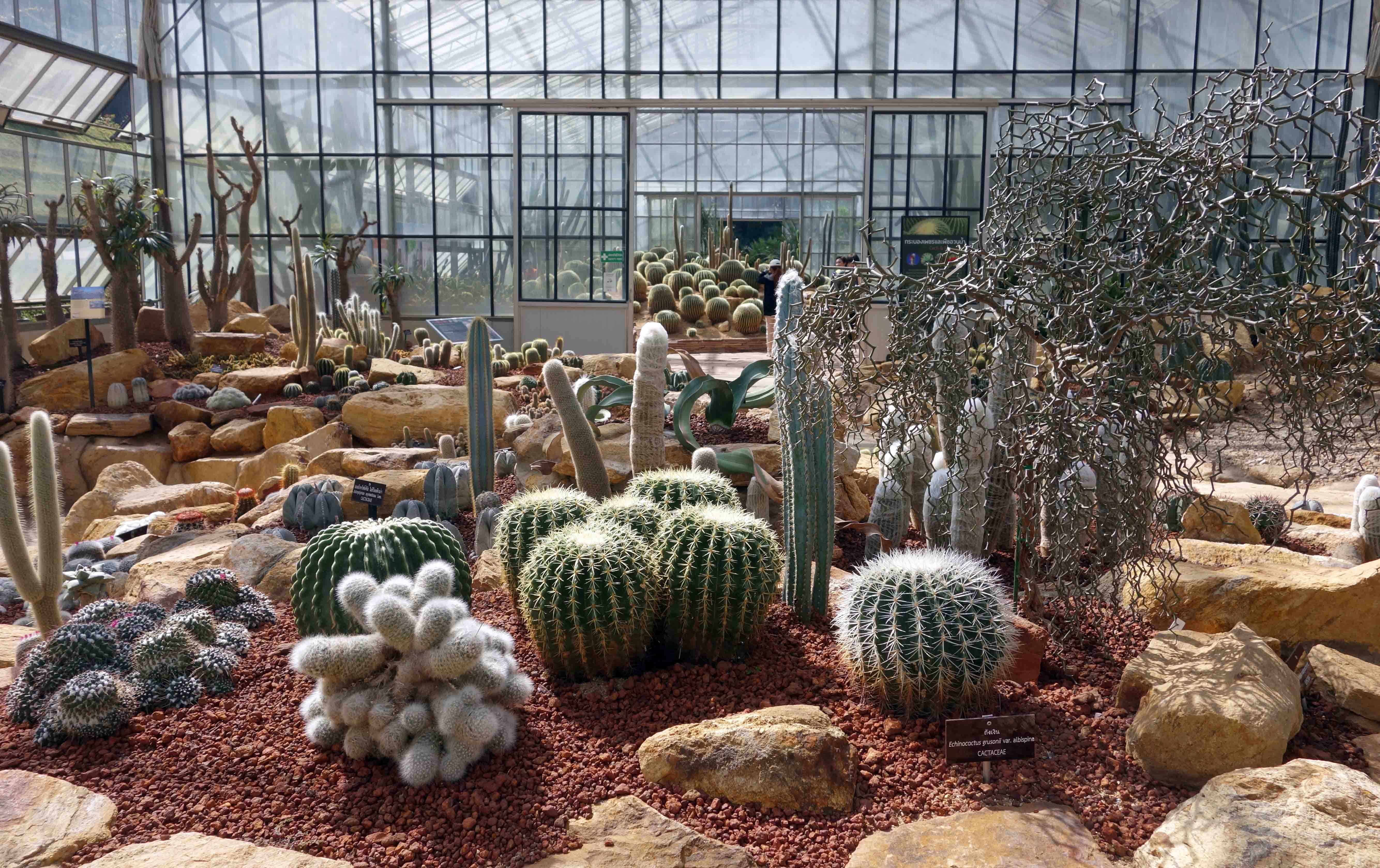
    Although the large Rainforest House is impressive, I particularly enjoyed the Arid House with its large collection of desert-dwelling cacti and succulents, which was beautifully laid out.

    The Arid House
    The Arid House

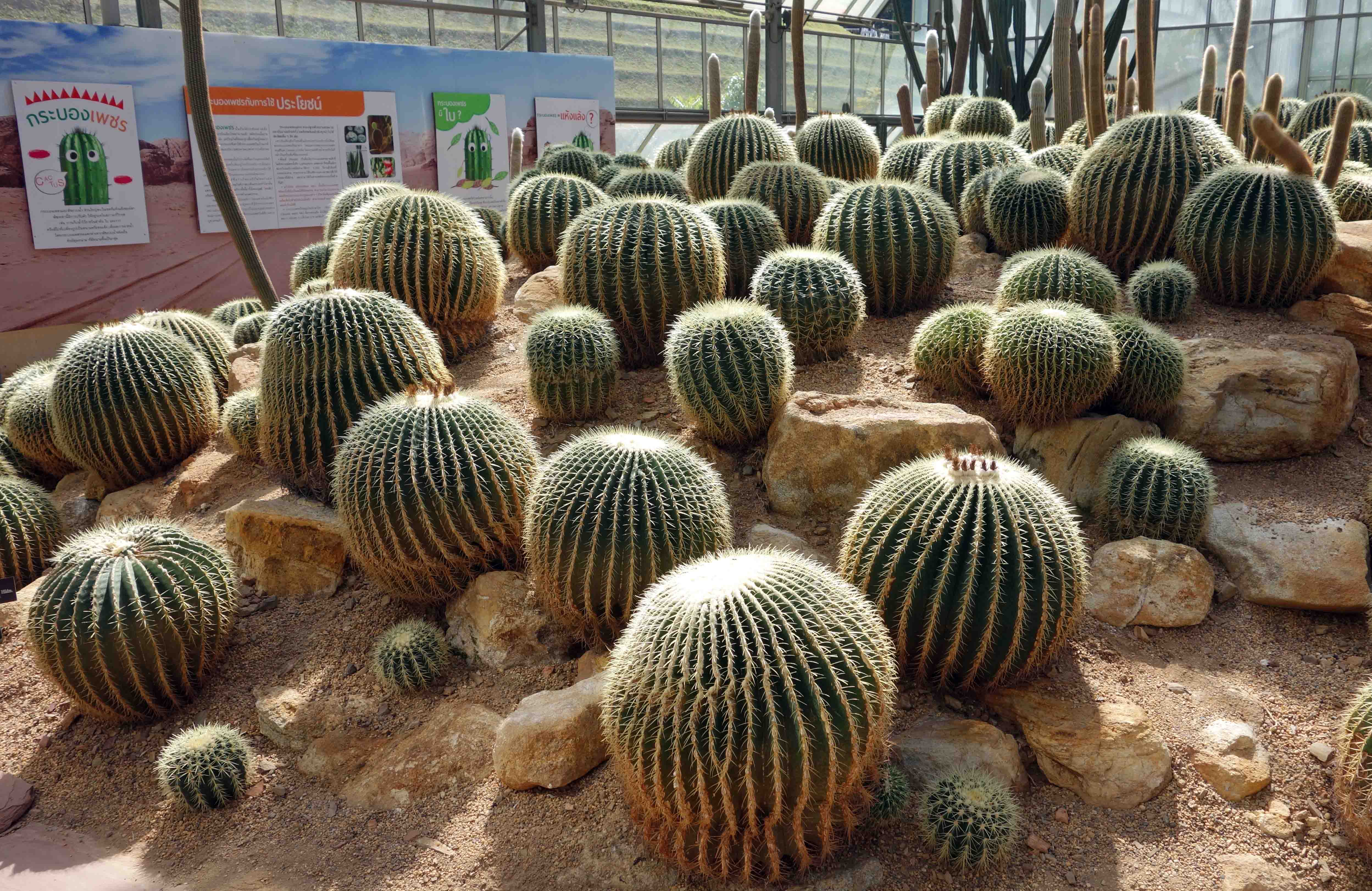
    The display of large Barrel cacti (Echinocactus grusonii), which are native to Mexico and SW United States, was very attractive (below).  Apparently, they have yellow flowers, but these were not in evidence at the time I visited.

    Barrel cacti (Echinocactus grusonii) in the Arid House
    Barrel cacti (Echinocactus grusonii) in the Arid House

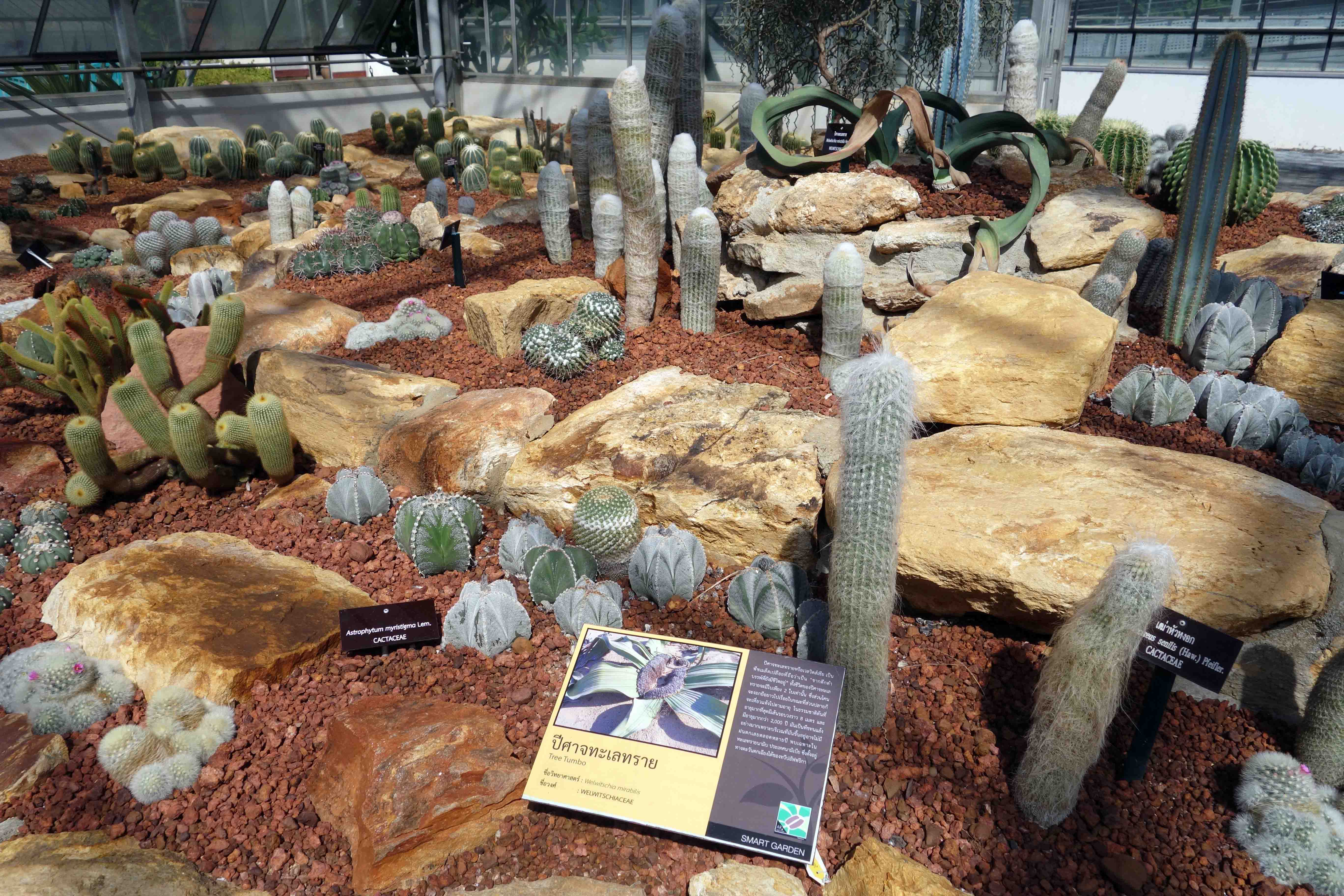
    There were good information labels and signs, albeit in Thai, with the species’ common and taxonomic names in English.

    Good signage in The Arid House
    Good signage in The Arid House

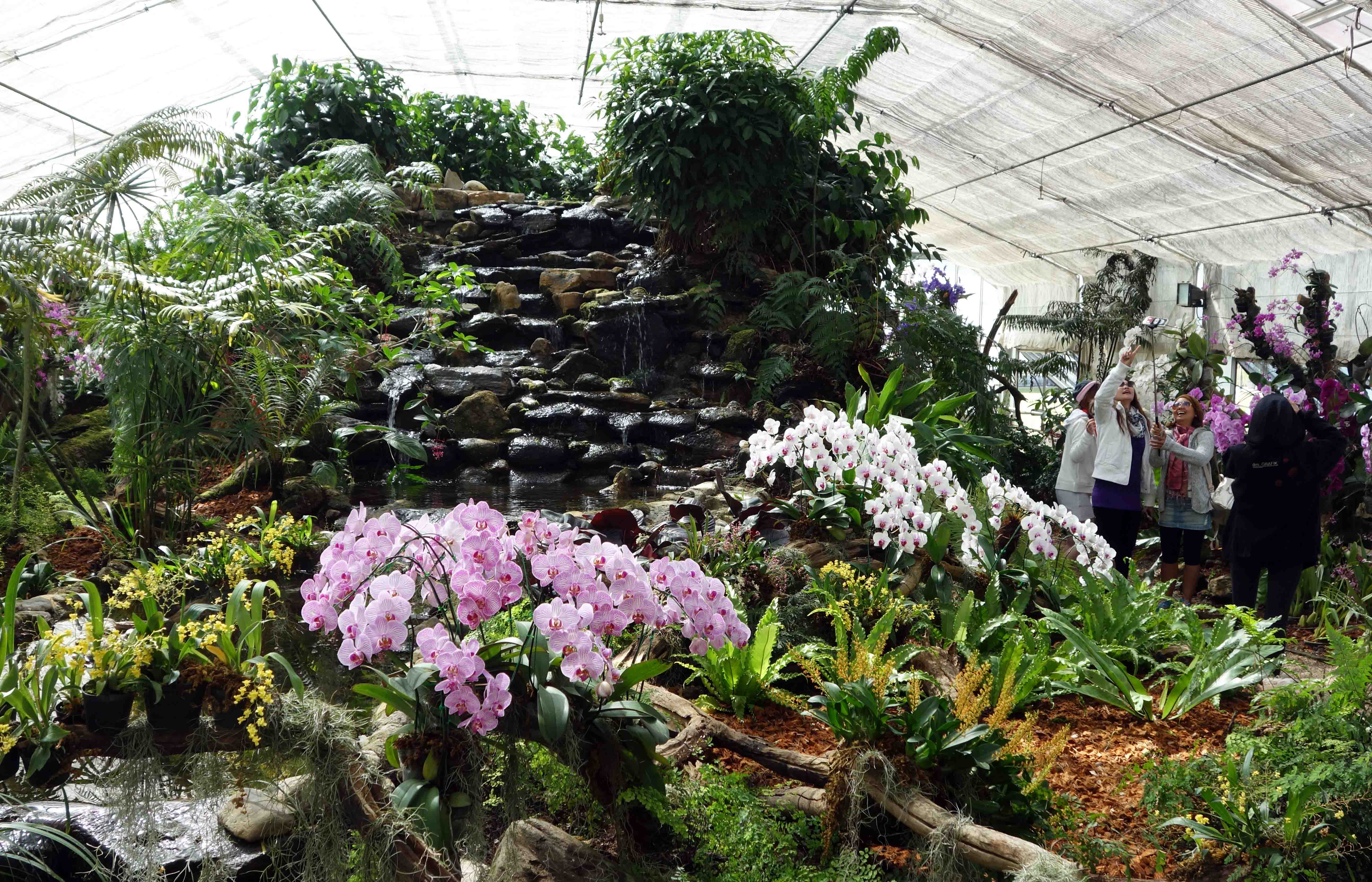
    Not surprisingly perhaps, the Orchid House was very good.  There were lots of different types of orchids on display; all were beautifully presented and in excellent condition; it must involve a great deal of work to keep this house looking so pristine and beautiful.

    Visitors in the Orchid House
    Visitors in the Orchid House

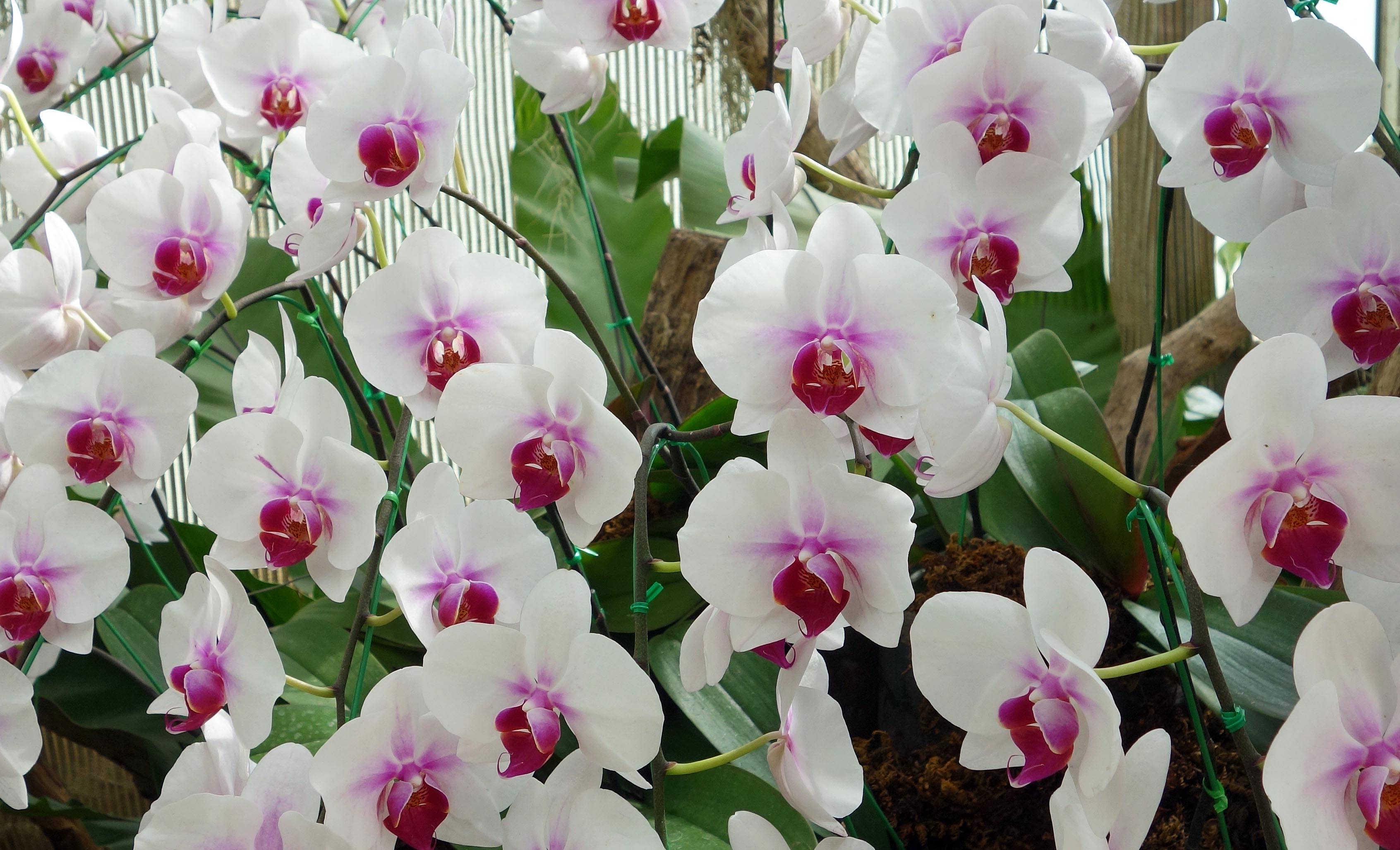
    There were many different varieties of orchids representing the different genera, such Phaelenopsis, Dendrobium and Vanda.  I think I will do a separate blog (see Ray’s Nature Notes) on the orchids; here are a few to be going on with!

    Phalaenopsis orchids in the Orchids and Ferns House
    Phalaenopsis orchids in the Orchids and Ferns House
    Pink Phalaenopsis orchids
    Pink Phalaenopsis orchids

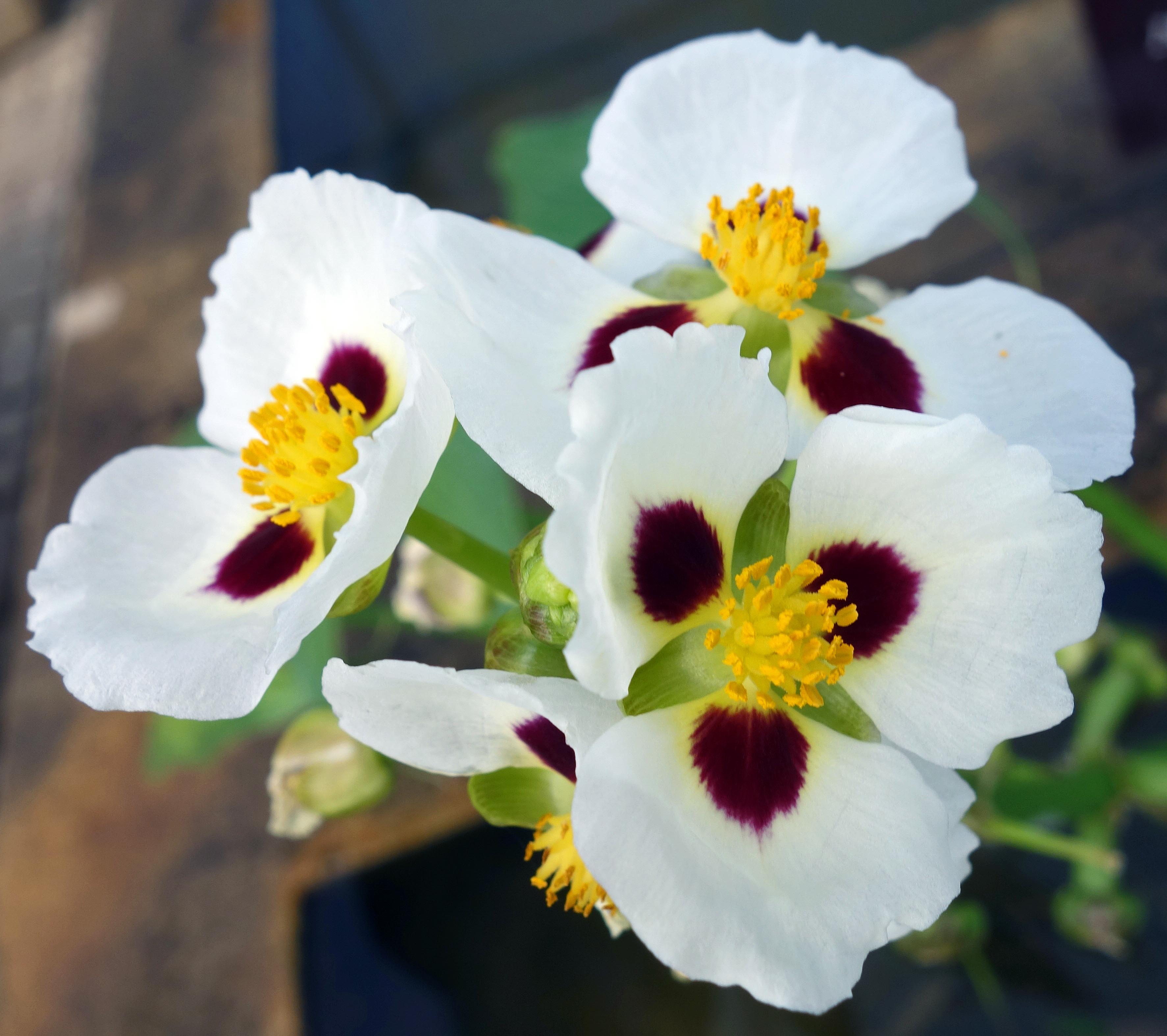
    The other highlight for me in the Garden were the water lilies; both in the Aquatic House and in the outdoor pots and ponds.  Inside the Aquatic house, it is possible to get a good close up look at some of the lilies, not all of which are native, like this gorgeous variety from the United States (below).

    Nymphaea 'St Louis Gold' USA
    Nymphaea ‘St Louis Gold’ USA

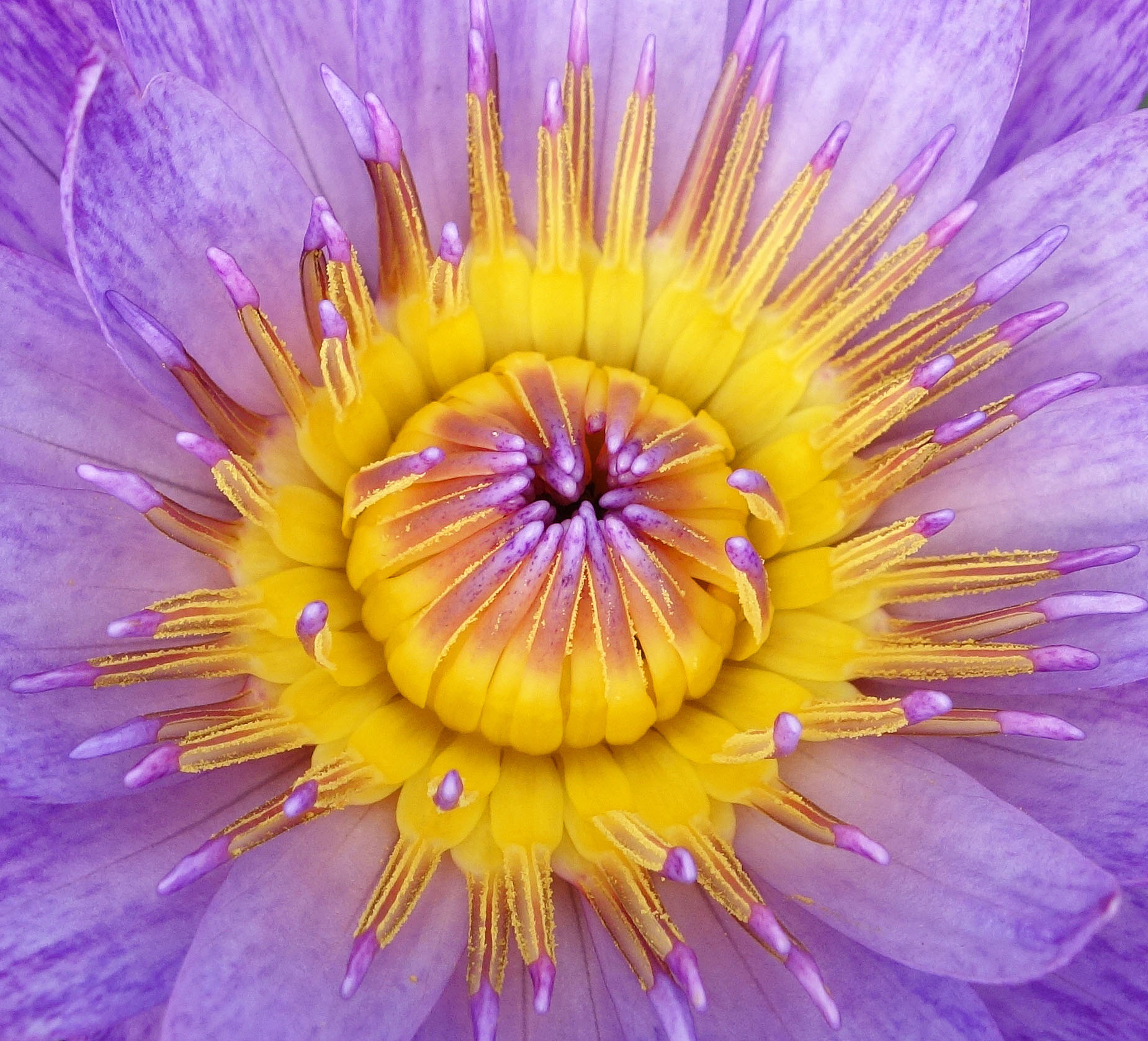
    There is something fascinating about the gold, sun-like centre of a lily flower (below).

    Centre of a lily (Nymphaea sp.) flower
    Centre of a lily (Nymphaea sp.) flower

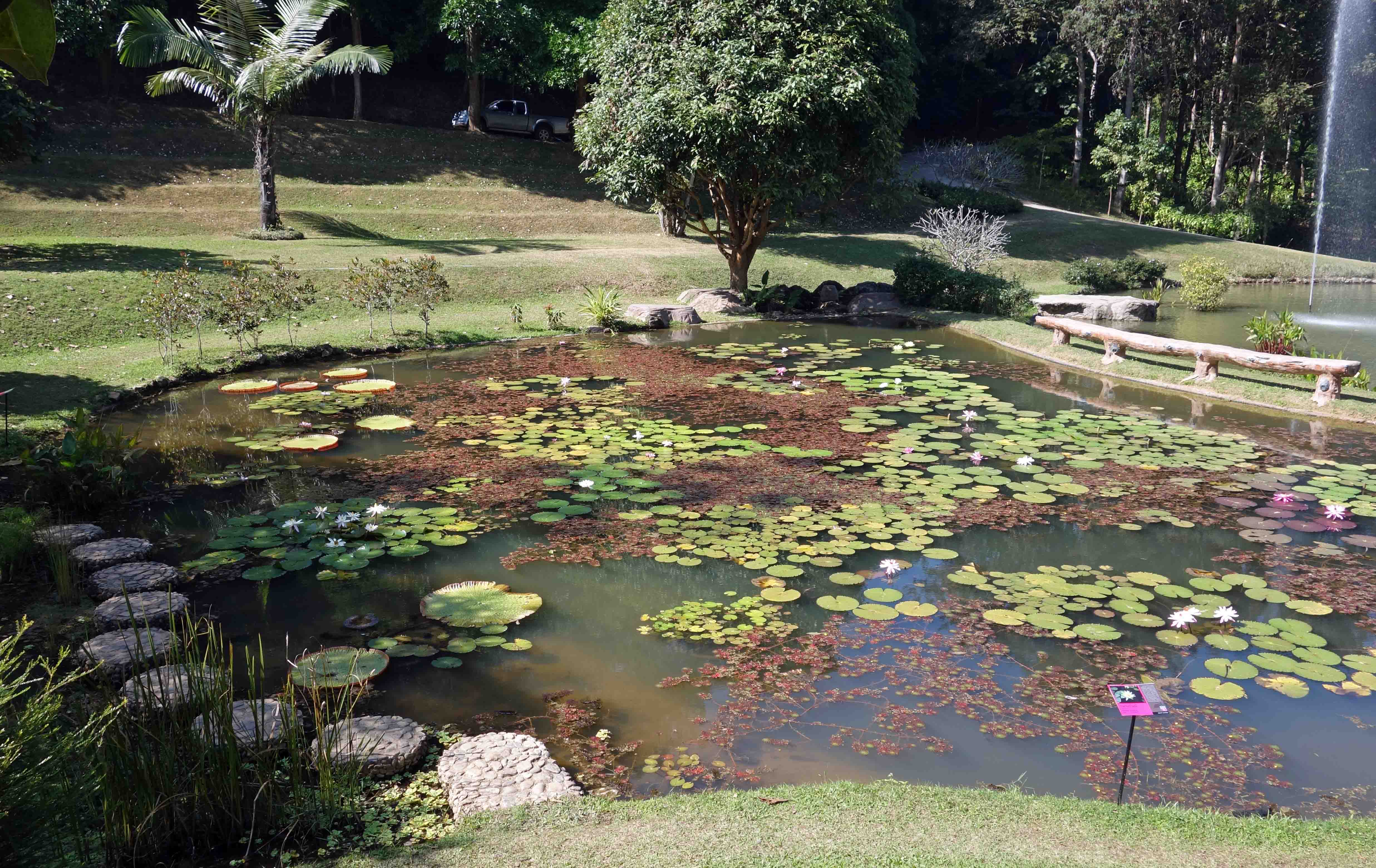
    Downhill from the Glasshouse Complex, there is a large lily pond filled with different species, including the popular, non-native Giant Water Lily (Victoria amazonica).

    Lily pond below the Glasshouse Complex
    Lily pond below the Glasshouse Complex

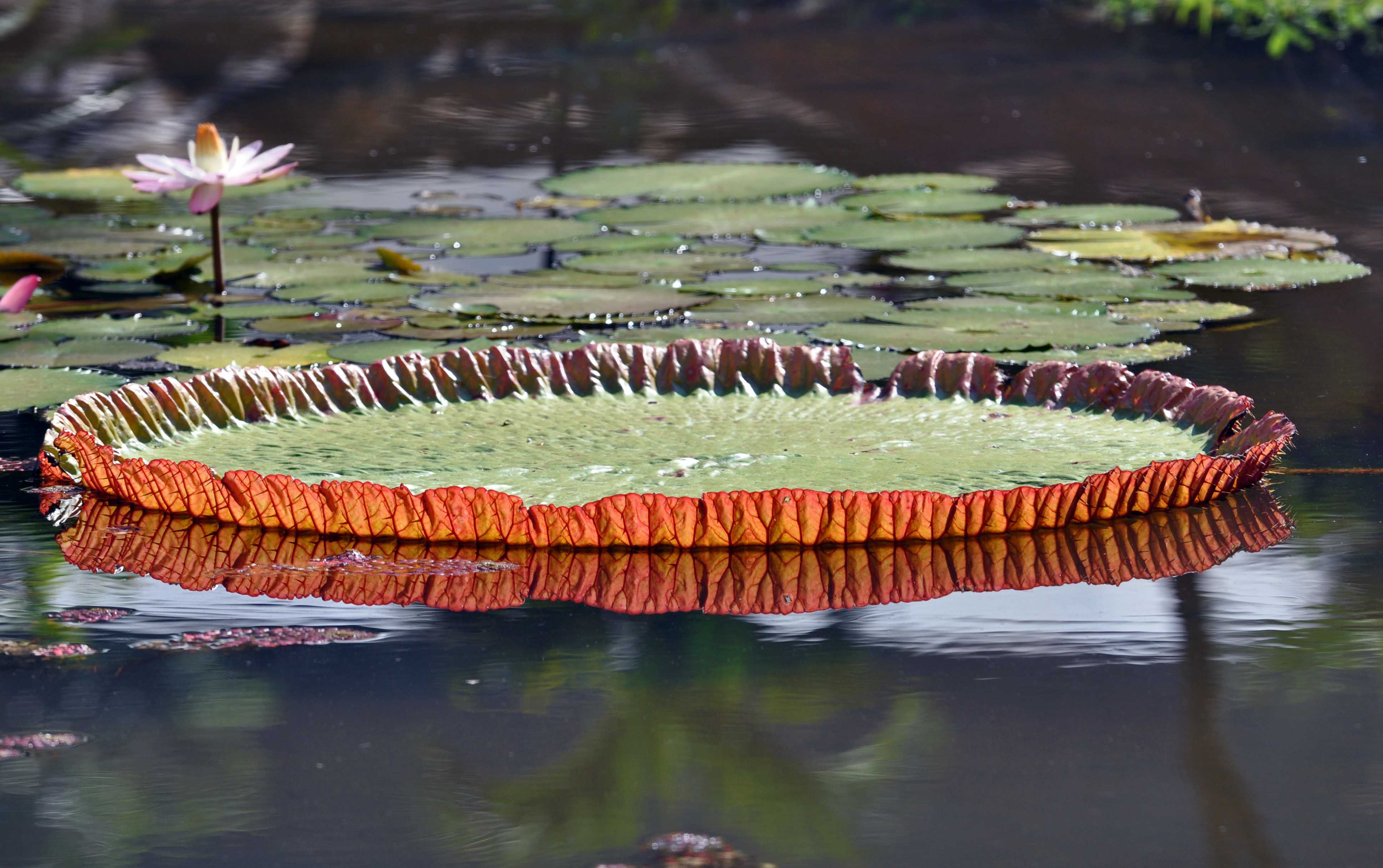
    The huge round lily pads of the Giant Water Lily really do look like you could stand on them!  It is said that they can support quite a weight but it has to be widely and evenly distributed across the leaf.  These lilies were not flowering at the Garden when I visited.  The flowers are  however, white when they first open, but turn pink on the second night!

    Giant Water Lily pad (Victoria amazonica)
    Giant Water Lily pad (Victoria amazonica)

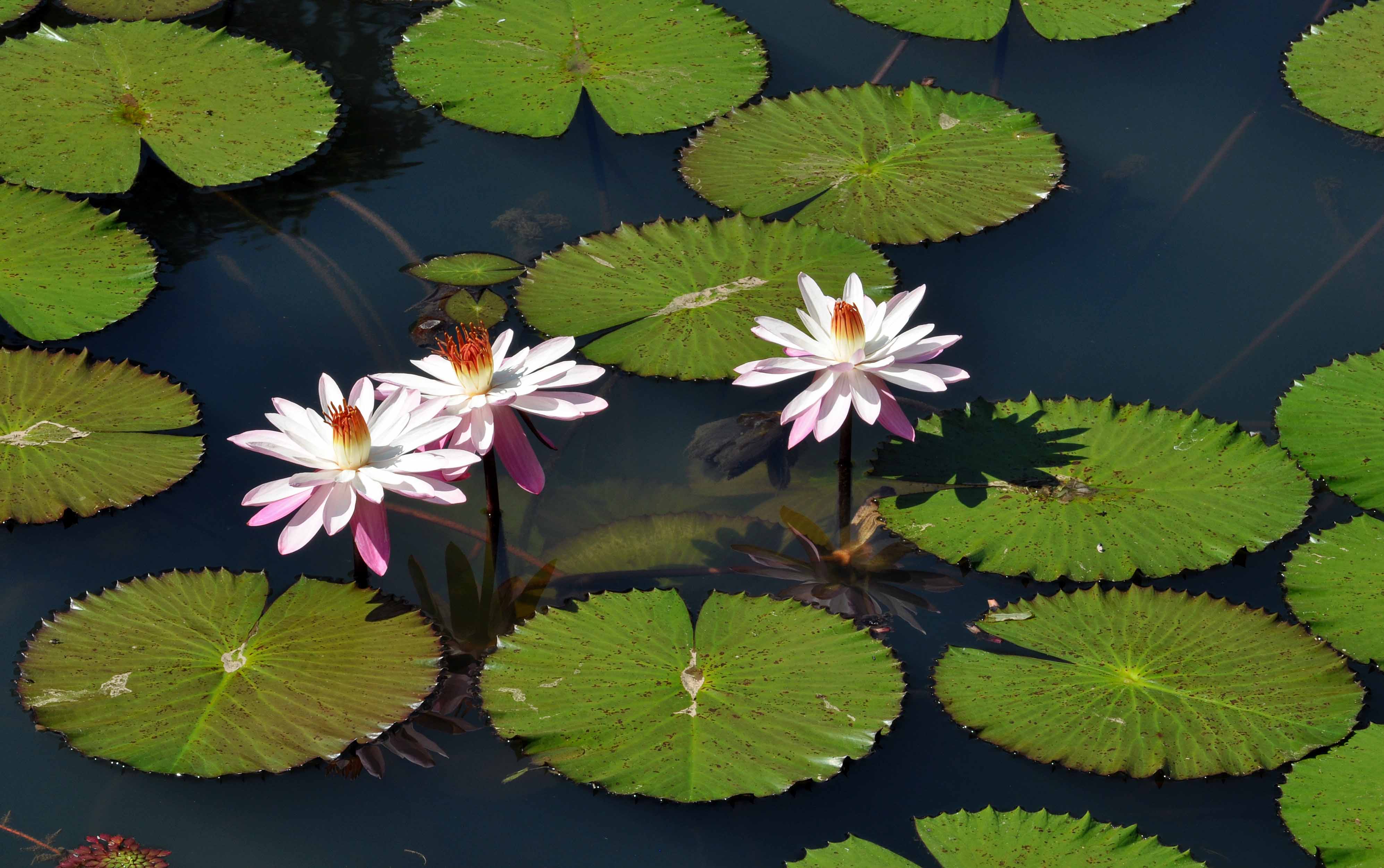
    The smaller, native water lilies were flowering and could be seen in different stages of flower opening.  They were most attractive to bees, which feed on the pollen and nectar.

    Water lilies (Nymphaea sp.)
    Water lilies (Nymphaea sp.)

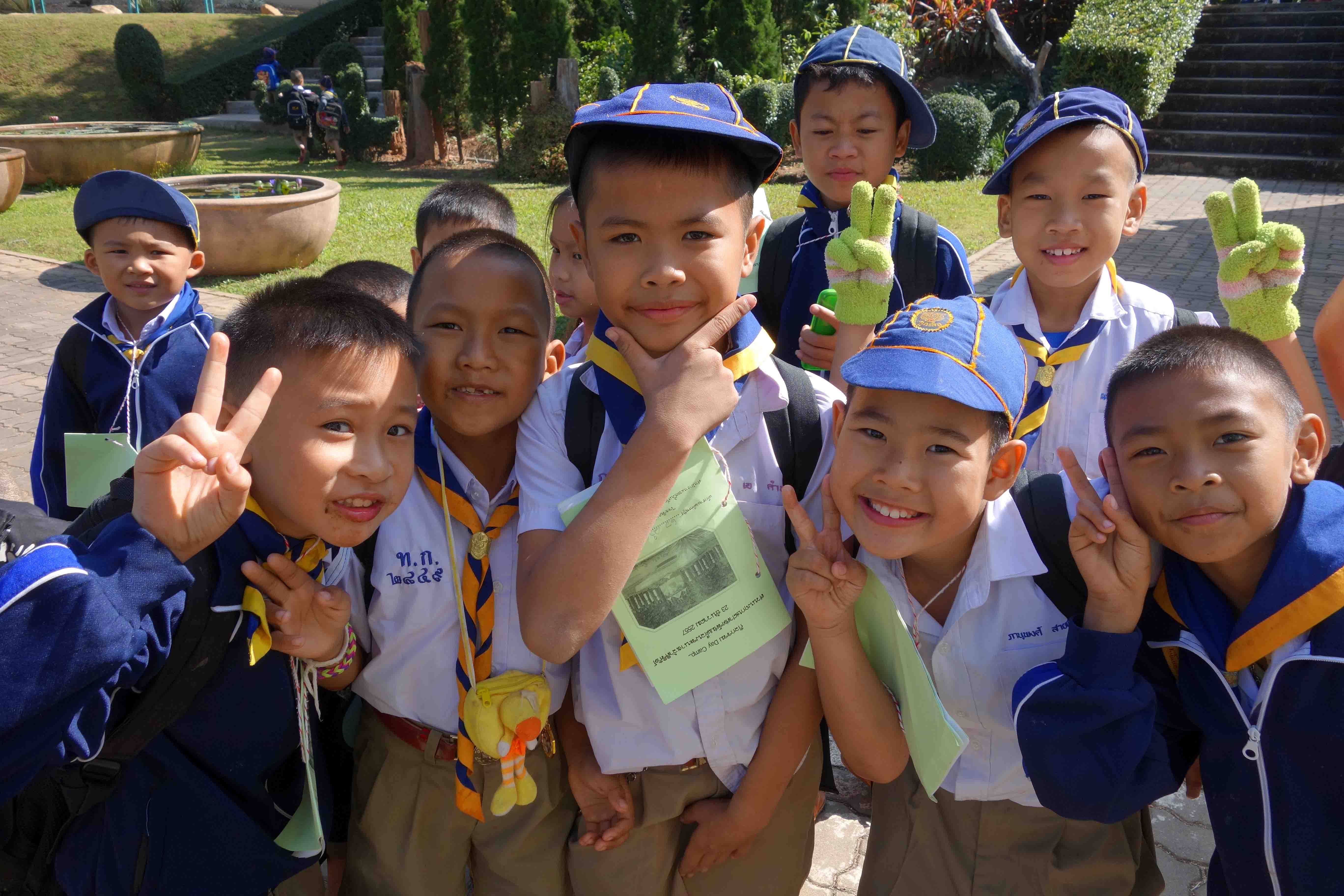
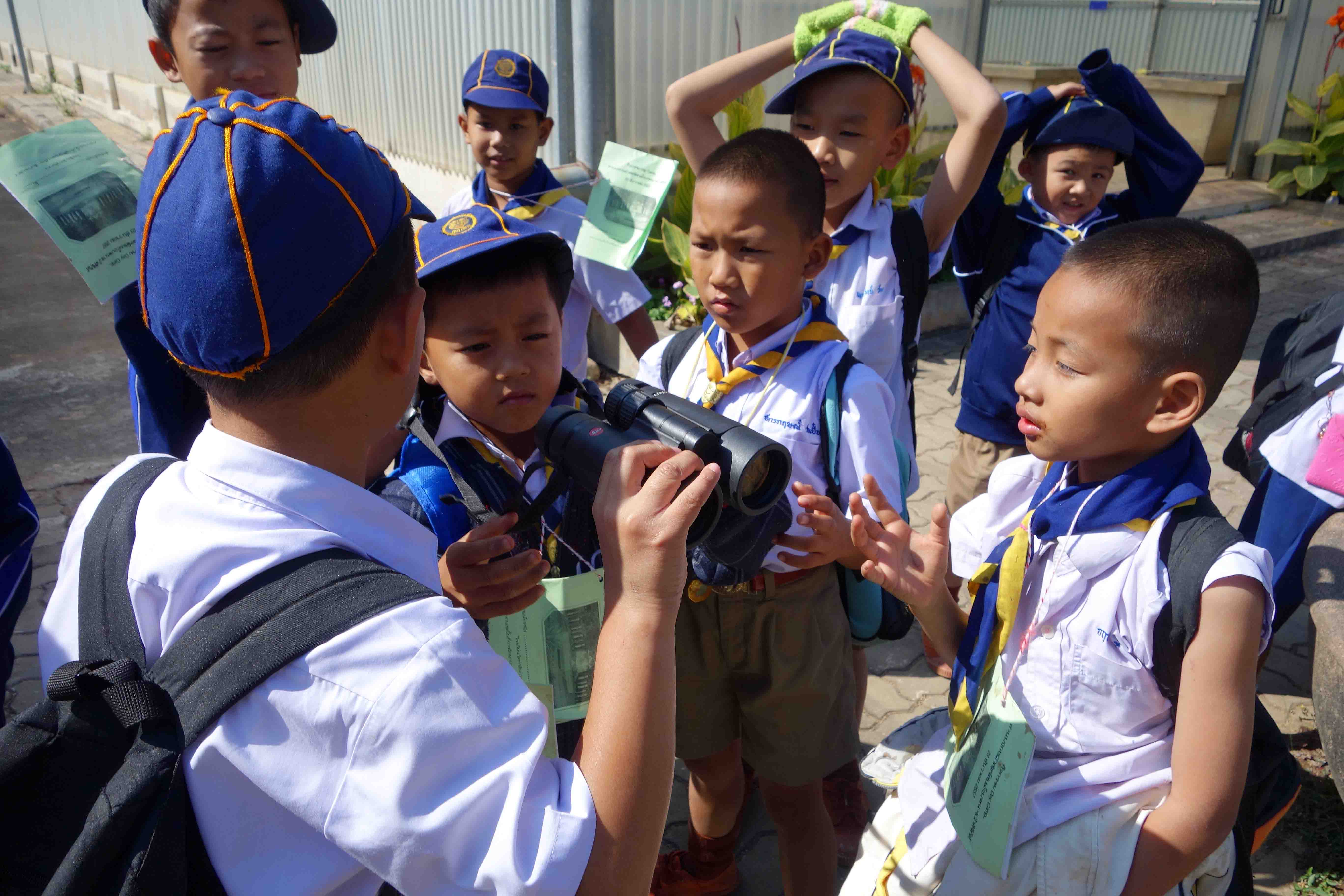
    There were quite a lot of school children visiting the Garden, like these friendly boy scouts, who had all previously had a look through my binoculars (which survived the experience!).

    Boy scouts visiting Queen Sirikit Botanic Garden
    Boy scouts visiting Queen Sirikit Botanic Garden
    Examining my binoculars!
    Examining my binoculars!

    These uncrowded and beautifully maintained gardens are highly recommended.  It must take an enormous effort to keep them looking so nice.  There is much more to this site than I have done justice to here, but I hope this gives a flavour of what is on offer.  There are reportedly, five other satellite gardens maintained by the Botanical Garden Organisation (1) around Thailand (e.g. in Rayong, Phitsanulok, Khon Kaen, Sukhothai and Phangnga provinces).  It they are anything like as interesting as this one, they would be well worth visiting.

    Gardeners working at the Queen Sirikit Botanic Garden
    Gardeners working at the Queen Sirikit Botanic Garden

    1) http://www.qsbg.org/

  • Chiang Mai Sunday Night Market

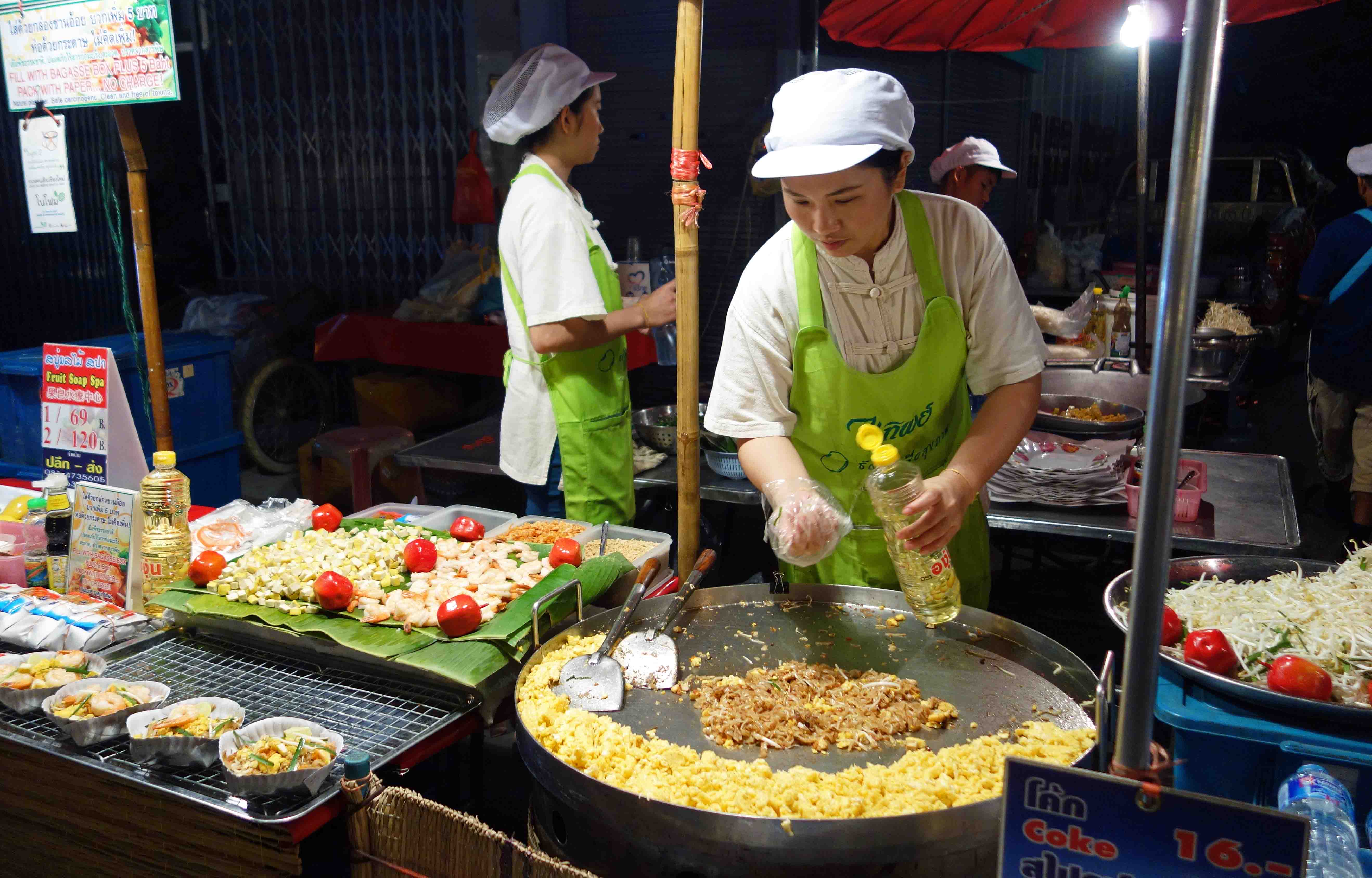
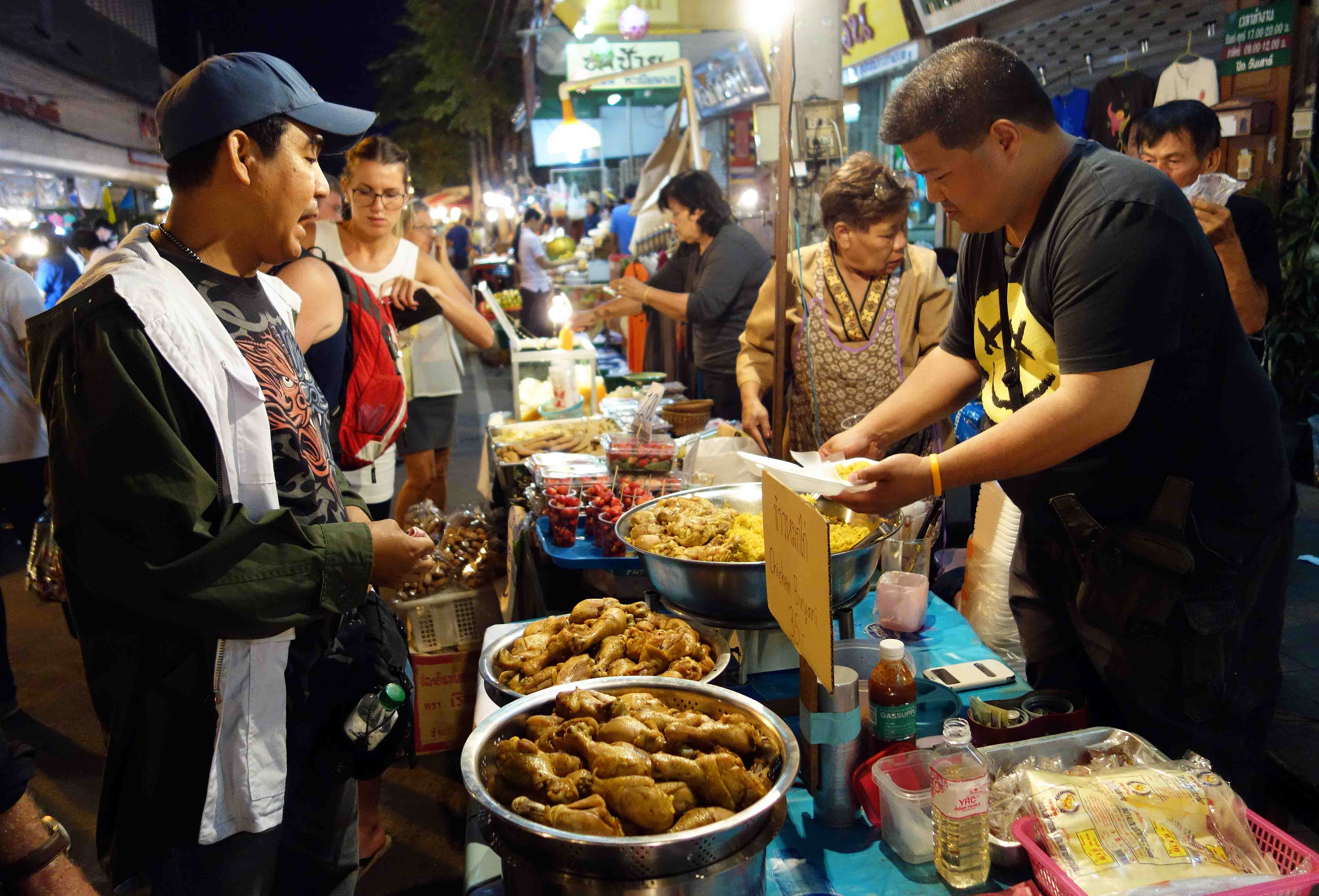
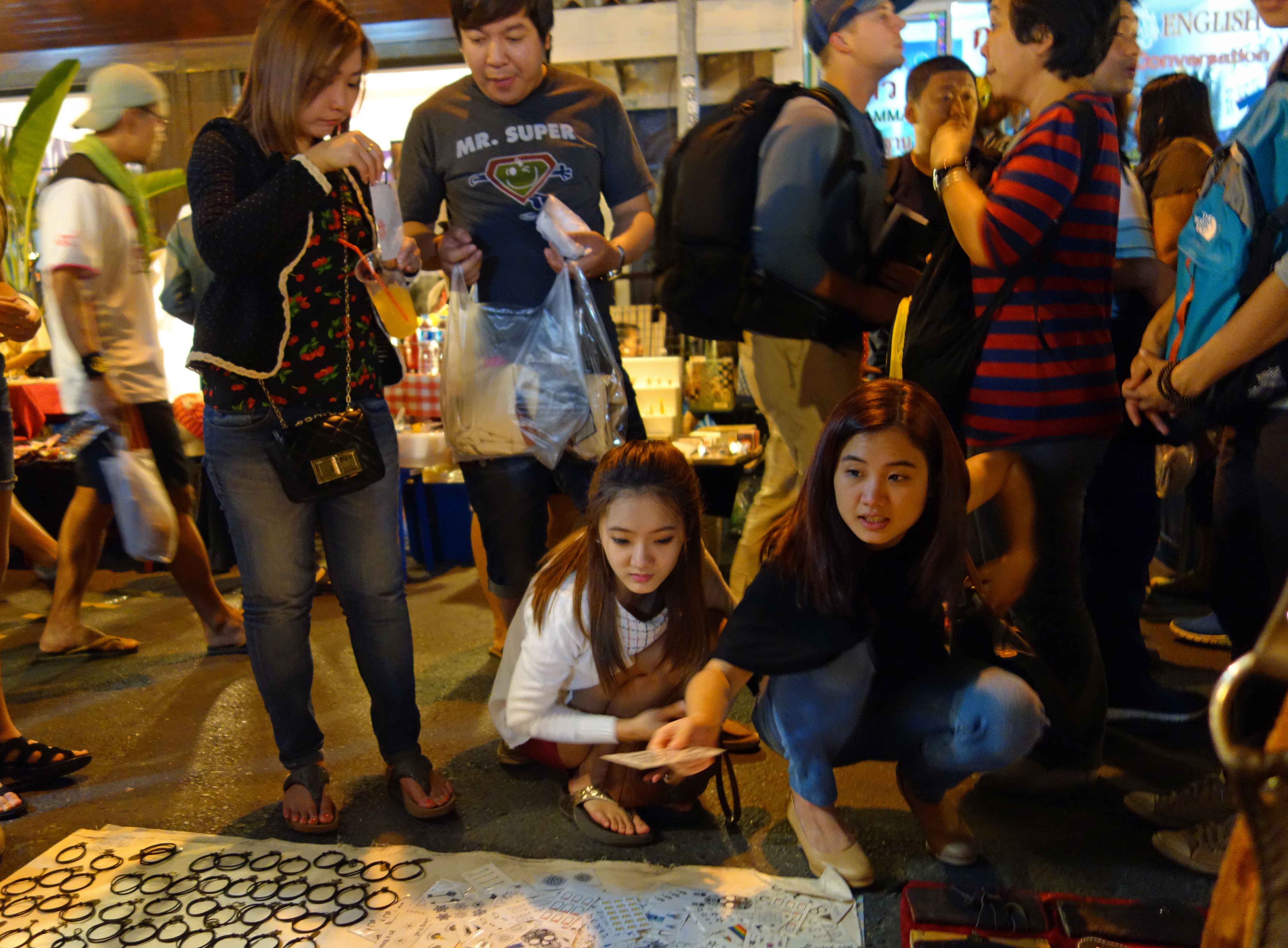
    The Sunday night walking street market in Chiang Mai has become very popular in recent years.  Once a week, a colourful traditional market bazaar takes place along the length of Ratchadamnoen Road (and other side roads) in the Old City.  The area is closed off to traffic and hundreds of market traders set up shop selling food, clothes, traditional goods, handicrafts, art and so on.  I took a stroll through the market recently and was surprised how large it was and how many people there were. High season I guess.  I was most interested in the food stalls which are colourful, lively and photogenic.

    Noodle bar
    Noodle bar
    Fried chicken and strawberries
    Fried chicken and strawberries

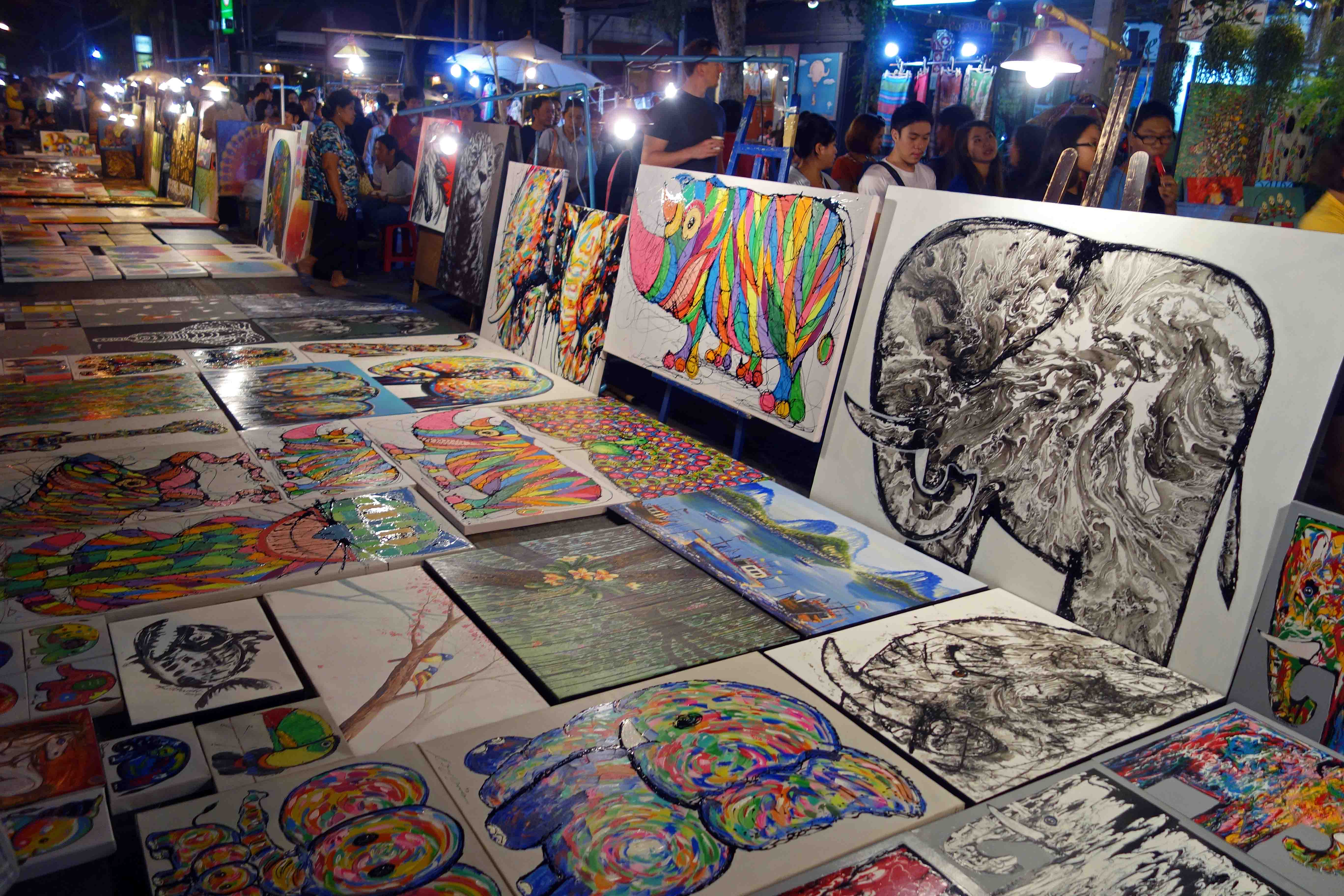
    There was a lot of art for sale.  I quite liked the animals although it was a little bit formulaic, in the sense that certain images were being replicated in numerous similar paintings.  But it is not easy to sell art, and this was a lot better than other examples I have come across.  It a matter of taste I guess.

    Street art
    Street art

    The colourful rhinos were being churned out by someone!  They are nice though, even if not a Thai animal; well I’ve never seen one!

    Colourful rhinos.
    Colourful rhinos.

    The market is by no means just for tourists; there were many Thais enjoying shopping.

    Silk scarf seller
    Silk scarf seller
    This one please!
    This one please!

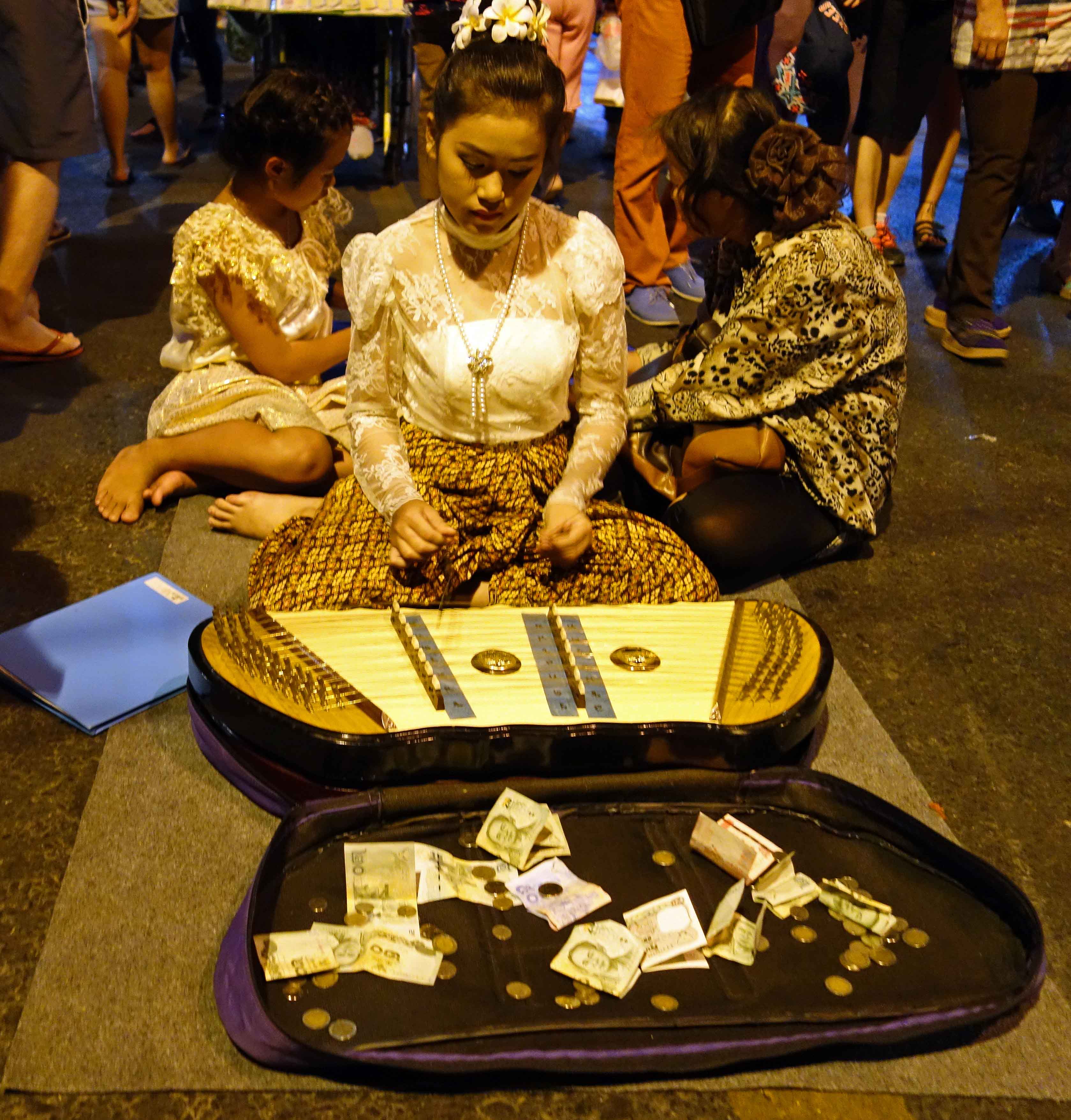
    There were a lot of musicians sitting on the ground and playing their instruments between the market stalls.

    Young musician
    Young musician

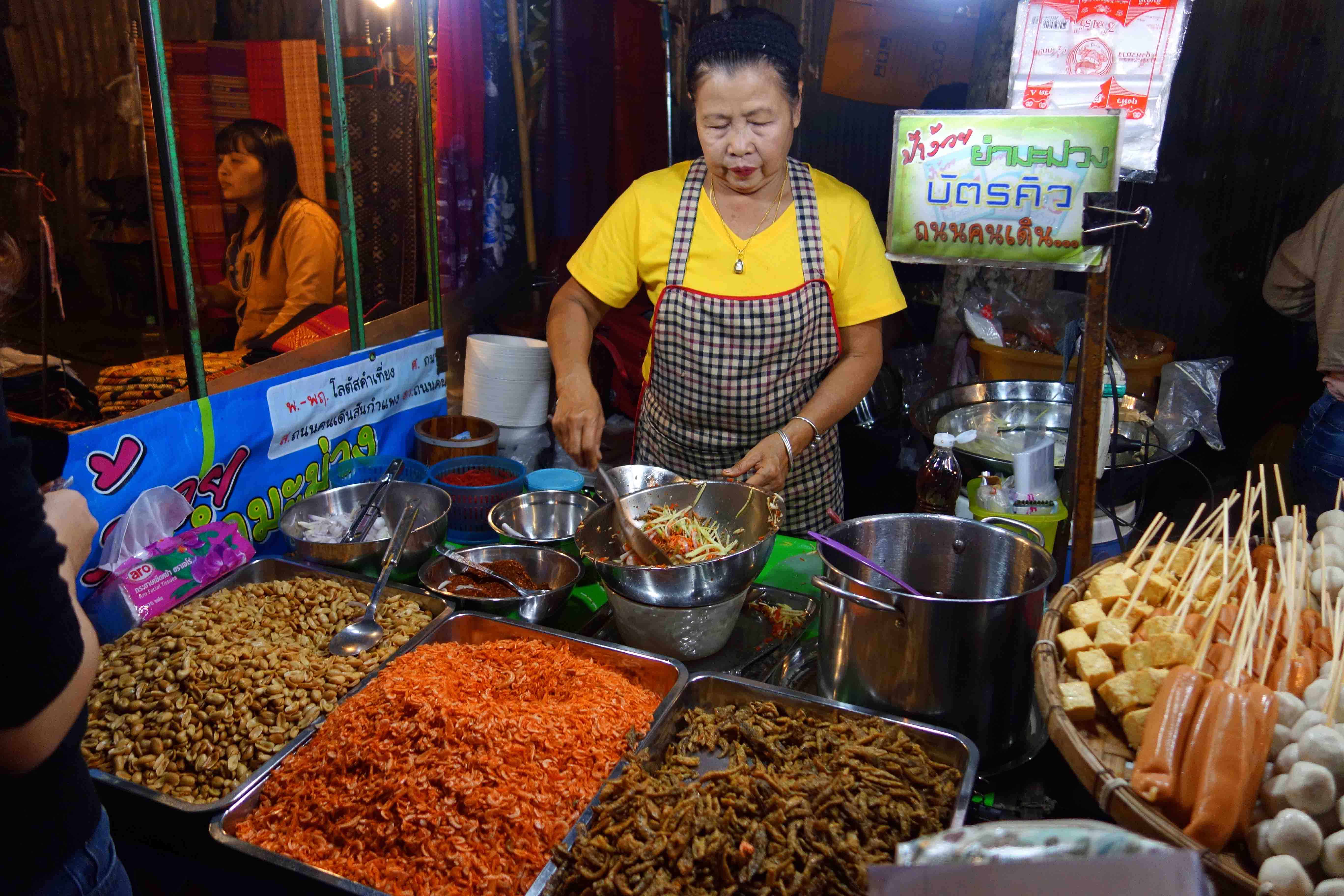
    The food in these stalls looks very tasty and looking at them again now, makes me feel hungry!

    Salad bar.
    Salad bar.

    The market extends into the area around Tha Pae Gate.  This was a fried omelette stand.  I am feeling hungry again!

    Fried omlettes
    Fried omlettes

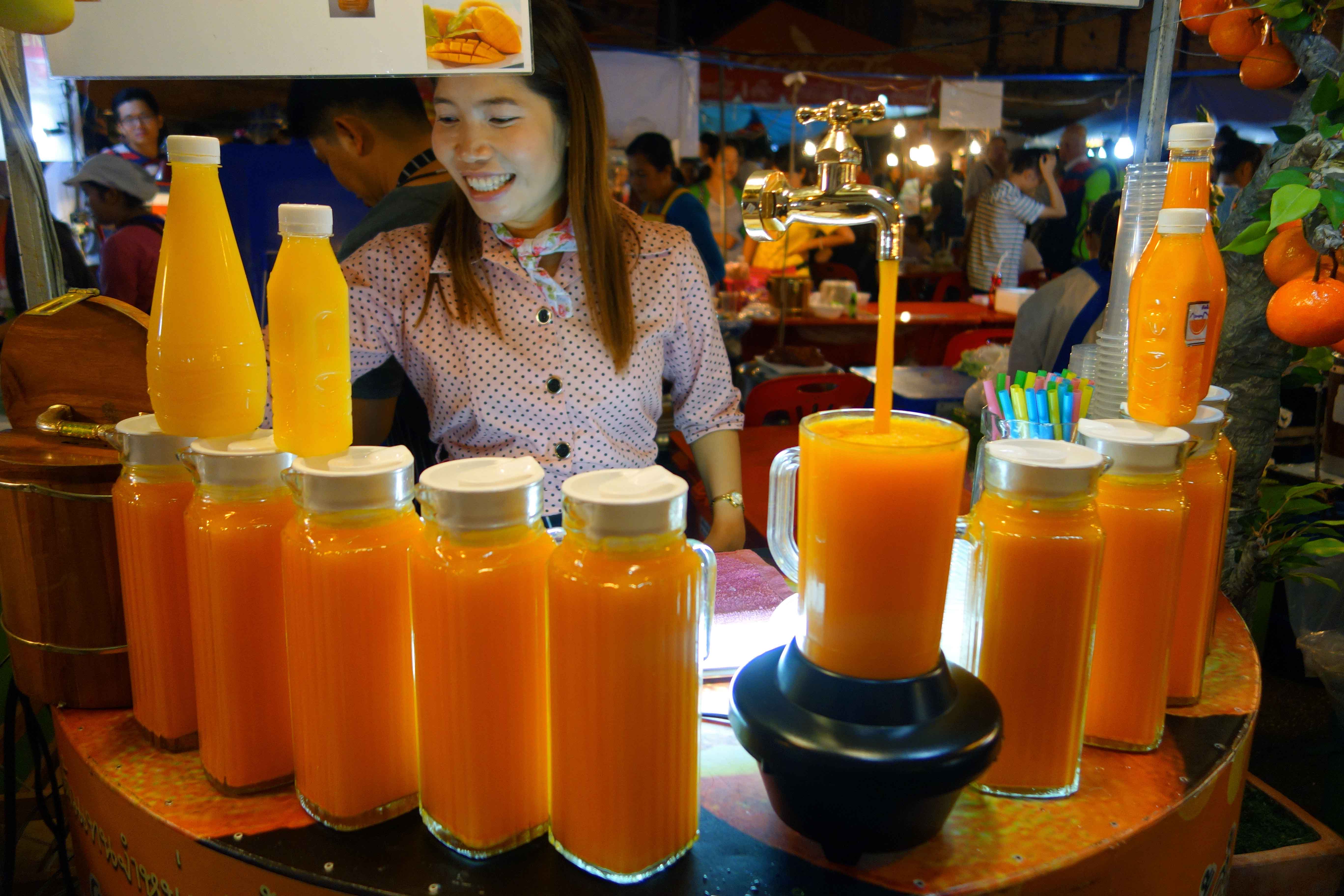
    The orange juice – nam som – stall was fronted by simple but highly effective marketing (the orange juice coming out of the floating tap is not real but the rest of the bottles and jars are), plus a lady with a lovely Thai smile.

    Nam som (orange juice)
    Nam som (orange juice)

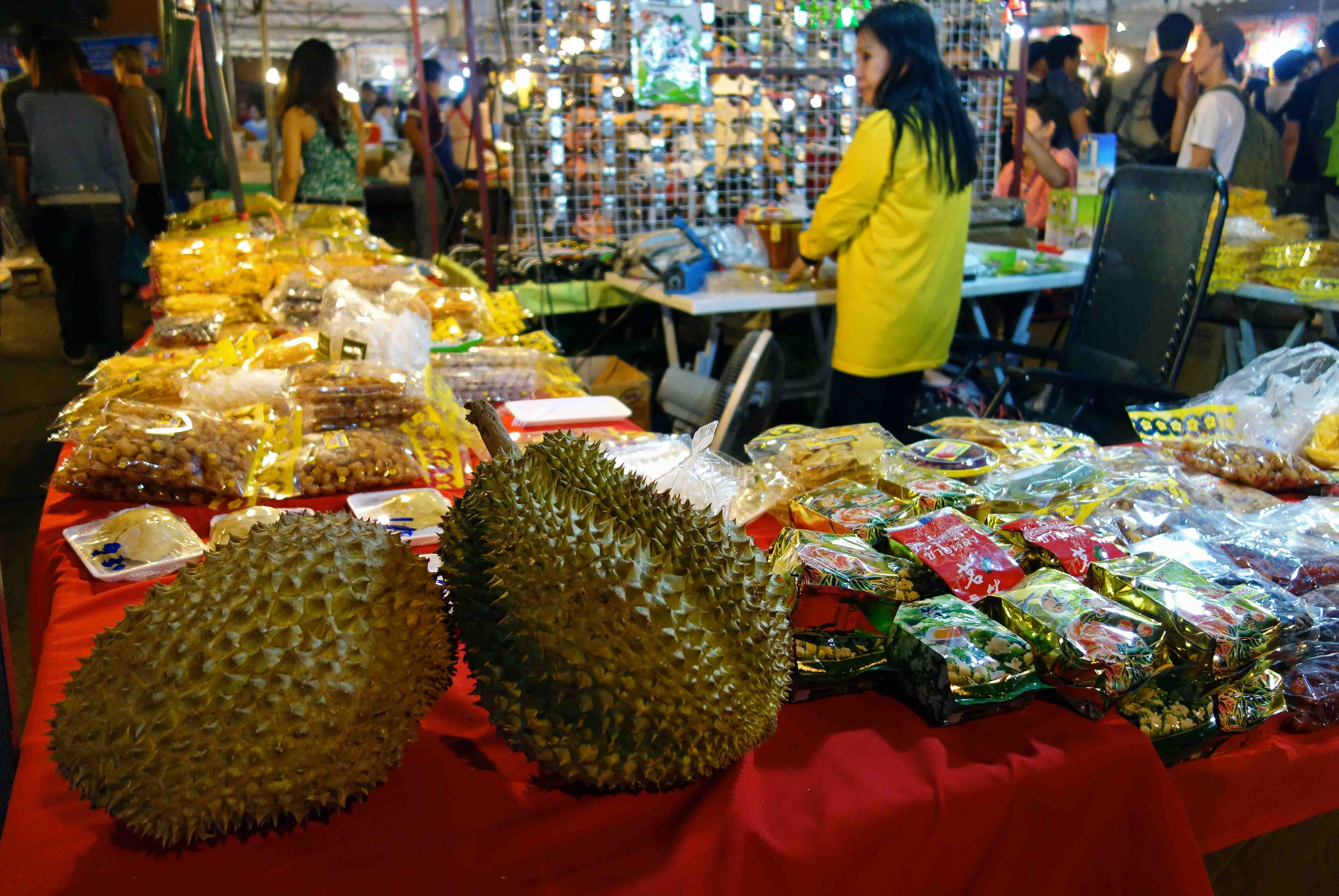
    Finally, I came across these huge prickly fruit which I am pretty sure are durians.  Jack fruits are similar but much less spiky.

    Durian fruits
    Durian fruits
  • Boats in the bay

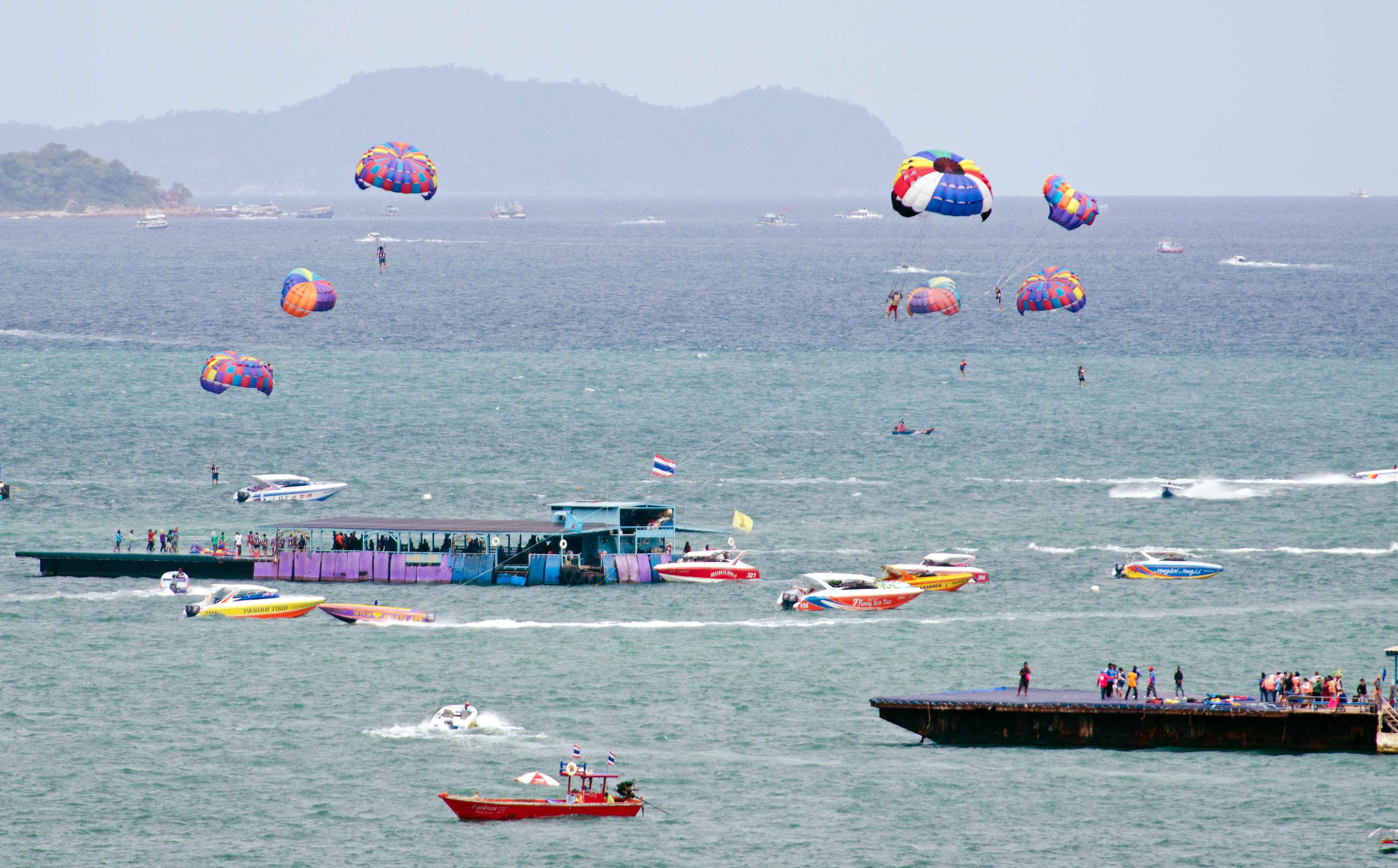
    Paragliding in Pattaya Bay, Thailand
    Paragliding in Pattaya Bay, Thailand

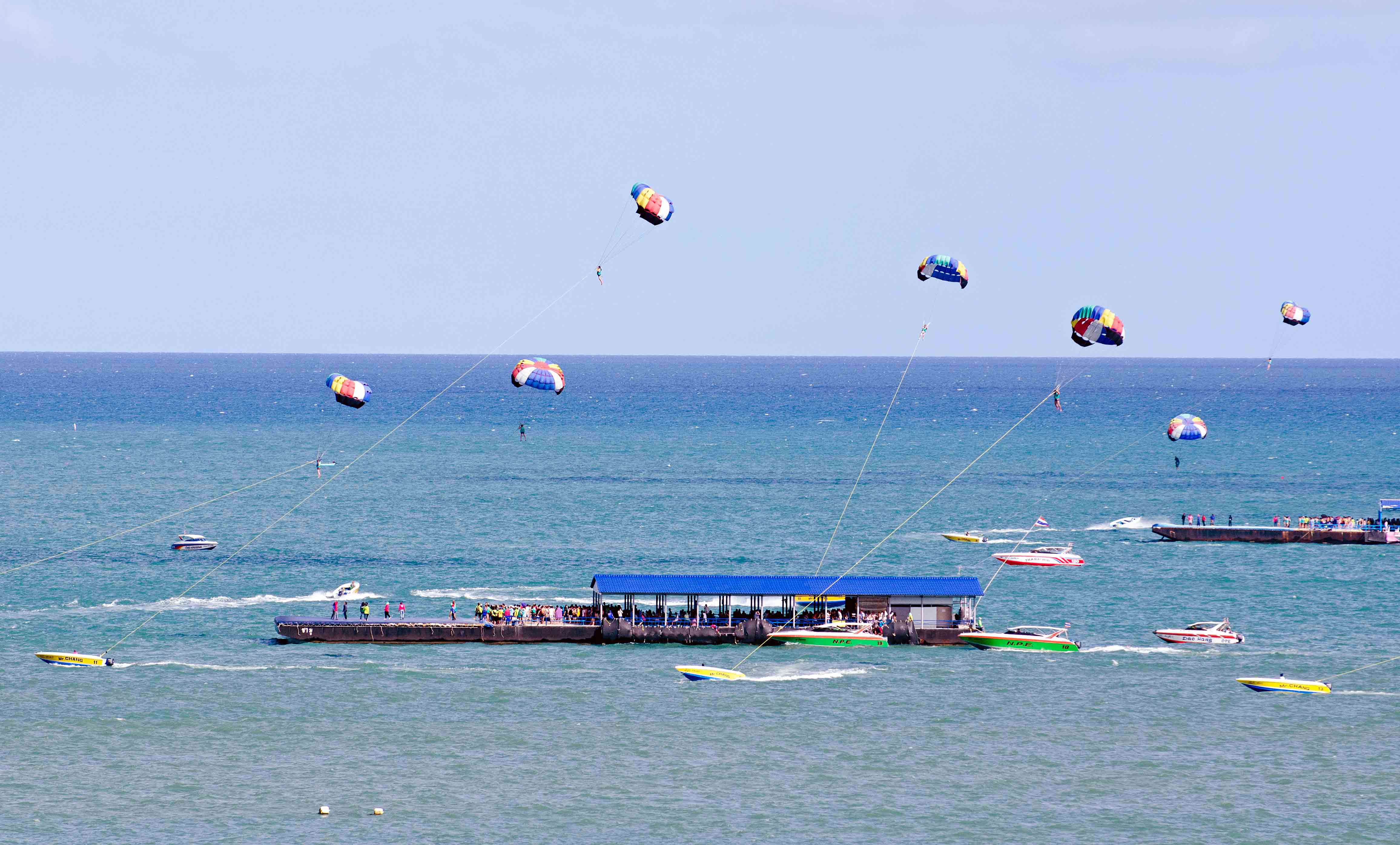
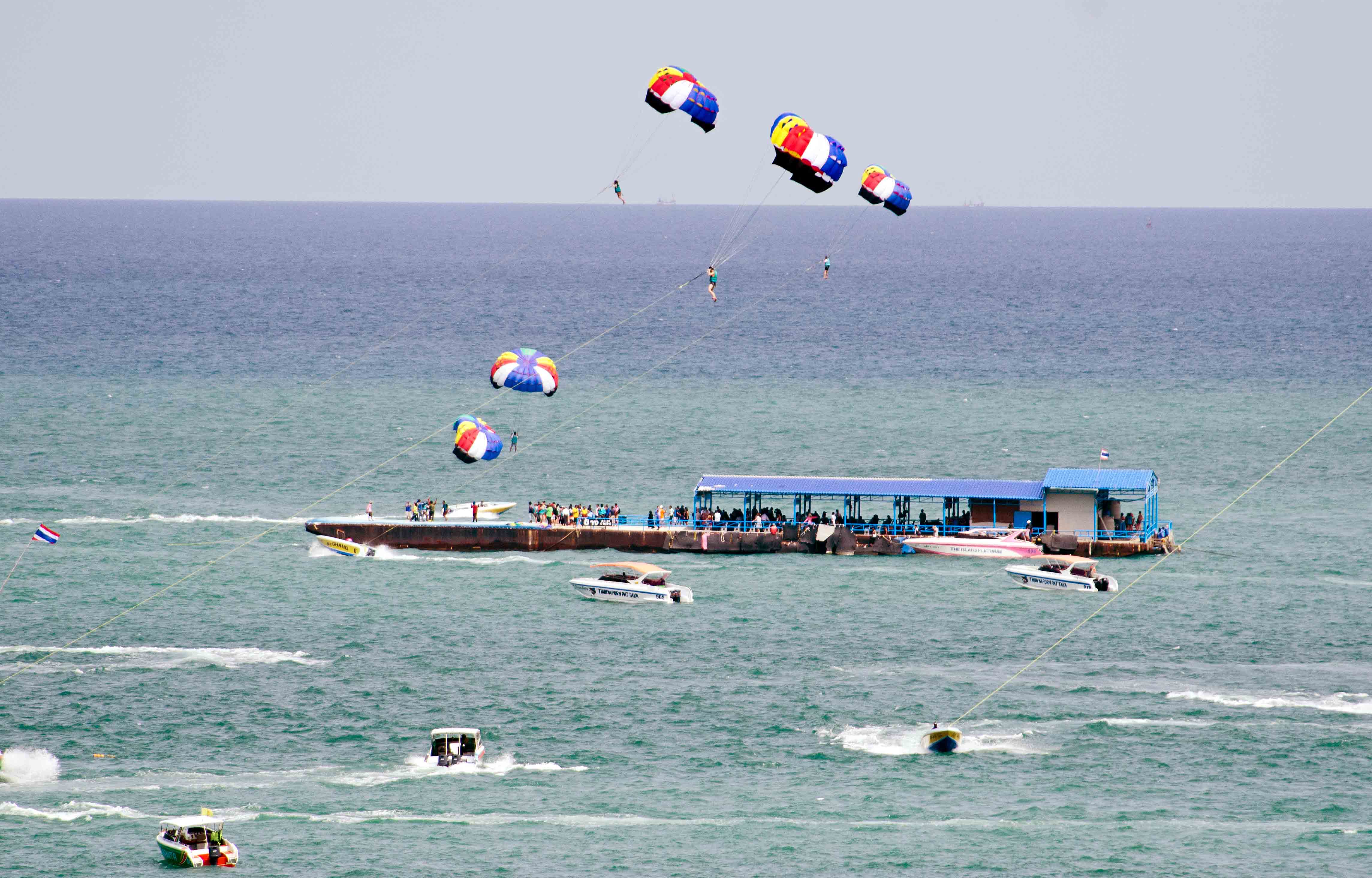
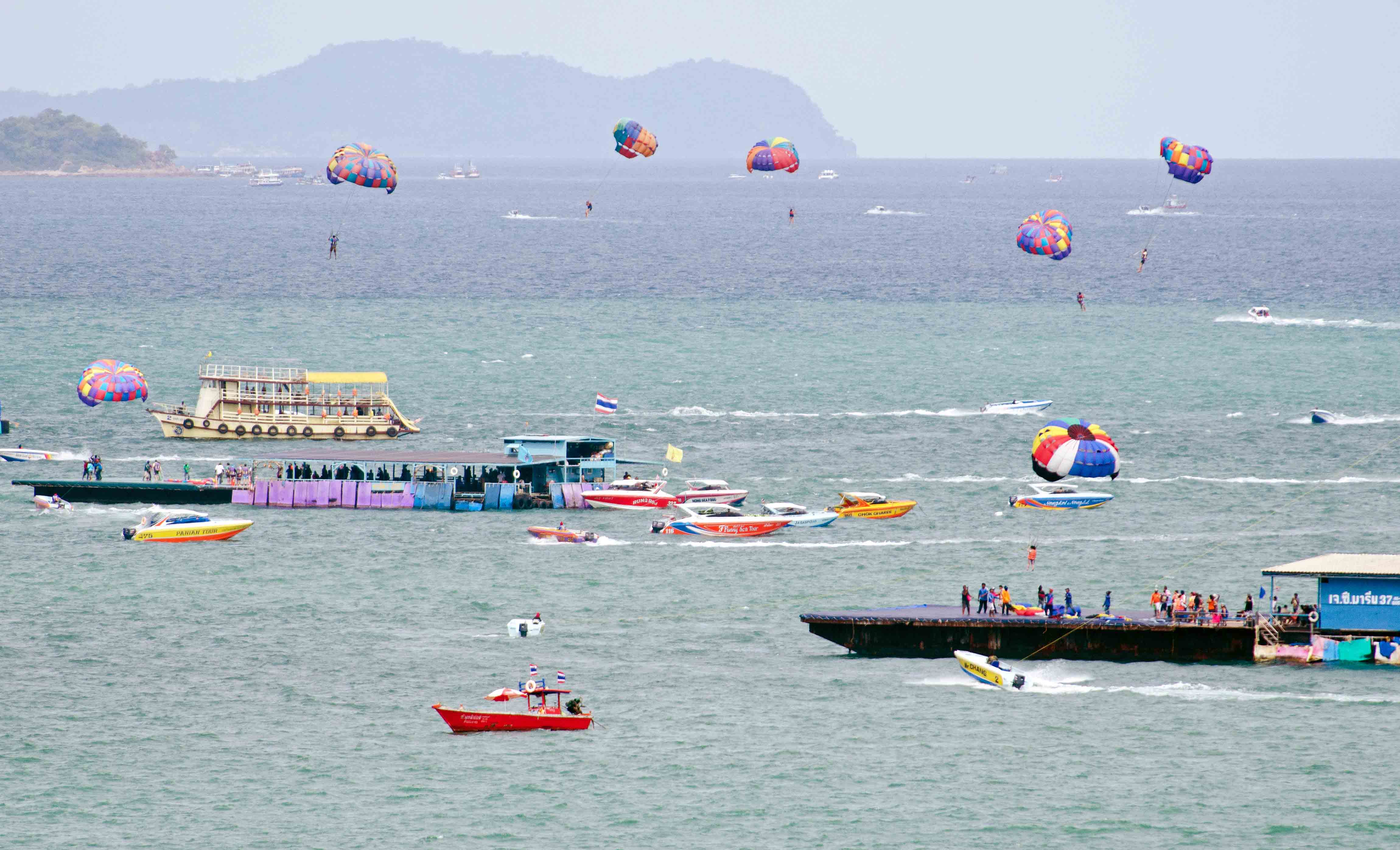
    Every morning – throughout the year I think – motor boats criss-cross Pattaya bay bringing tourists out to floating pontoons from which they get a short paraglide.  There are larger boats taking people out to the floating platforms, and smaller speed boats taking them for short rides dangling from a parachute behind the boat.

    Paragliding in Pattaya Bay, from a pontoon.
    Paragliding in Pattaya Bay, from a pontoon.

    I have never wanted to do this myself, but I enjoy watching the well-rehearsed spectacle every morning from my hotel balcony, when I am staying in Pattaya.  It really is a ballet of the air and – from a distance – everything seems to work like clockwork!

    Paragliding in Pattaya Bay, Thailand
    Paragliding in Pattaya Bay, Thailand any one time, there may be at least 30 or mor colourful parachutes floating

    At any one time, there may be over thirty colourful parachutes floating over the bay, rising and falling as each person get his or her little ride and (I think) a little dip of their toes in the sea!  The skill of the speedboat drives is impressive.  At the end of the ride, the passenger is deposited safely back on the pontoon again.

    Paragliding in Pattaya Bay, Thailand
    Paragliding in Pattaya Bay, Thailand

    This operation is carried out every morning and is a wonder to behold.  Many of the tourists are Chinese and I always admire their spirit of adventure, as well as the fact that they all get up so early on holiday to participate.  All the Brits are fast asleep having been in the bars all night of course!

    Paragliding in Pattaya Bay, Thailand
    Paragliding in Pattaya Bay, Thailand