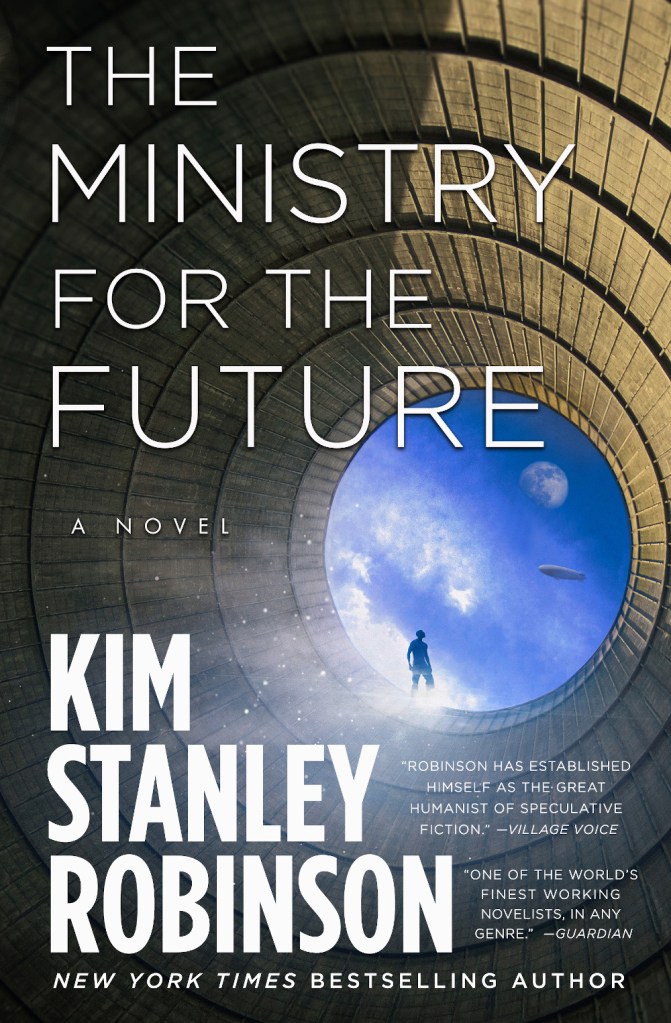
I’m reading Kim Stanley Robinson’s excellent novel, if you can call the unfolding of the pending climate catastrophe a work of fiction, “The Ministry for the Future.” He interweaves scenes of unfolding climate emergencies – a devastating heat wave in India which kills millions – with short vignettes describing our current circumstances. For example, concerning our current, hugely inequitable wealth situation:
“So, is there energy enough for all? Yes. Is there food enough for all? Yes. Is there housing enough for all? There could be, there is no real problem there. Same for clothing. Is there health care enough for all? Not yet, but there could be; it’s a matter of training people and making small technological objects, there is no planetary constraint on that one. Same with education. So all the necessities for a good life are abundant enough that everyone alive could have them. Food, water, shelter, clothing, health care, education.” (Robinson, K., S, 2020, Chapter 16).
In other words, there is enough to go round, but probably not enough for everyone to live a high status, high consumption, high-rolling lifestyle. I.e. we can’t all live like rich westerners. There’s the rub. We are already using up the Earth’s resources at a totally unsustainable rate. The rate at which we consume natural resources now far exceeds the planet’s capacity to renew them. We are consuming the future!
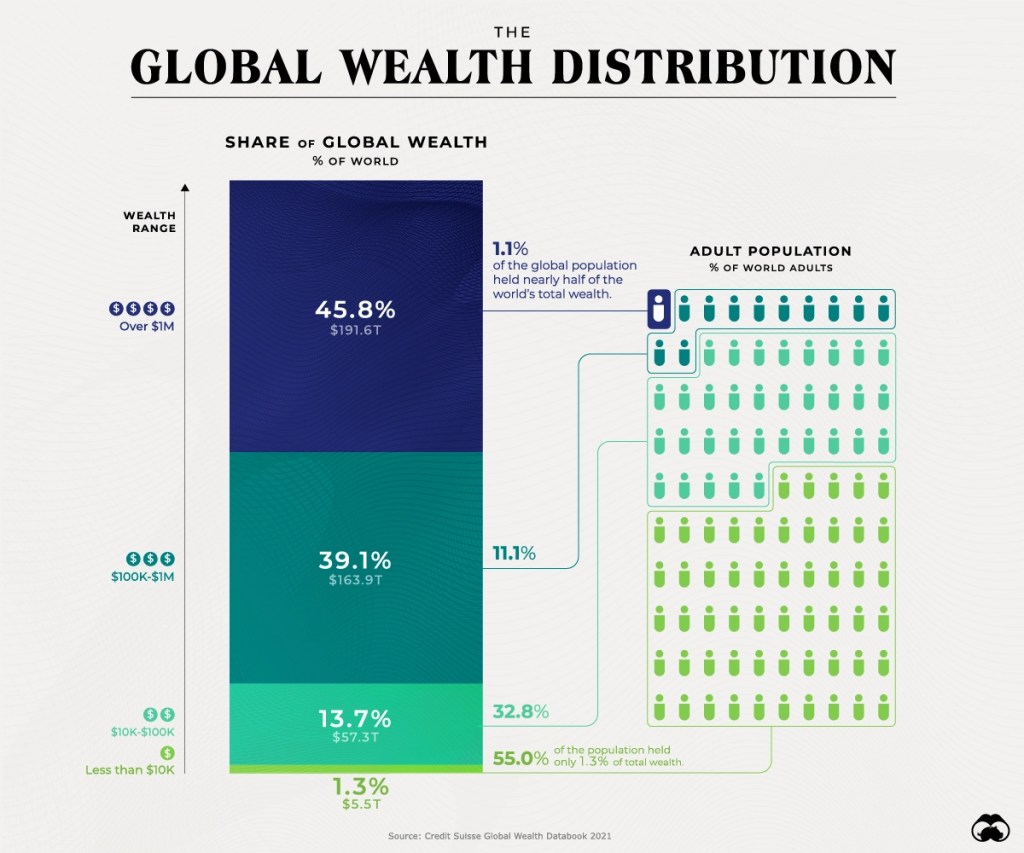
Its worth reminding ourselves just how unequal things are in terms of global wealth distribution. The current distribution of wealth is roughly as follows:
- half of the world’s net wealth belongs to the top 1%, and
- the top 10% of adults hold 85%, while the bottom 90% hold the remaining 15% of the world’s total wealth.
The following graphic illustrates it very clearly.
Another report puts it this way (the inequalities even stagger the bankers!):
“The level of financial inequality around the world is staggering. According to a new Credit Suisse report, 47.8 percent of global household wealth is in the hands of just 1.2 percent of the world’s population. Those 62.5 million individuals control a staggering $221.7 trillion.”
Global wealth means all the money and other assets that exist in all areas of the world considered together. And it’s growing fast. Net worth has tripled since 2000, and it’s projected to rise by 39% over the next five years, reaching USD 583 trillion by 2025.
For simplicity, lets call global wealth $500 trillion and the world population 8 billion. That’s USD 62,500 average wealth per adult. That’s a lot less than we have (on average) in the UK, about $214,000 – i.e. a total wealth of about $15 trillion, divided by 70 million people – but a lot more than the average African: about $4,195 according to my calculations (a total wealth of about $6 trillion shared by 1,430 million people).

Radom1967 • CC BY-SA 4.0 https://en.m.wikipedia.org/wiki/Wealth#/media/File%3ATotal_wealth_per_capita%2C_1%2C_OWID.svg
So, is the global average wealth, of about $62,000 dollars (some sites put the figure at about $85,000) enough for everyone to have an adequate existence? Kim Stanley Robinson thinks it is. He thinks there is enough for all. Enough for everyone. Here’s how he puts it:
“So there should be no more people living in poverty. And there should be no more billionaires. Enough should be a human right, a floor below which no one can fall; also a ceiling above which no one can rise. Enough is a good as a feast—or better.” (Robinson, K., S, 2020, Chapter 16).
But how do we get there? Personally, I think we can continue to grow our global wealth by technical innovations; coupled with sustainable lifestyles. But getting people to share their wealth is not going to be easy! Global inequality – ‘the unequal distribution of resources, opportunities, and power that shape well-being among the 8 billion individuals on our planet’ (to quote Oxfam) – is growing. Reducing inequalities, if not down to zero, at least to a just and more equitable level, is going to be a huge challenge; but one we need to address if we are going to avoid the conflict and confrontation that continued gross inequality will undoubtedly bring.
We still need to reward hard work, risk and investment, but we need to eliminate all the injustices and unfairness of gross disparities in access to income and wealth, and all that goes with that.
Kim Stanley Robinson puts that challenge like this:
“Arranging this situation [described above] is left as an exercise for the reader” [!]. My exclamation mark.
Can we do it? We have to. Either that, or move to another planet.
Links
All of the World’s Wealth in One Visualization
 Ray Cannon's travel and photography blog
,_2018.jpg#mw-jump-to-license)

Leave a comment