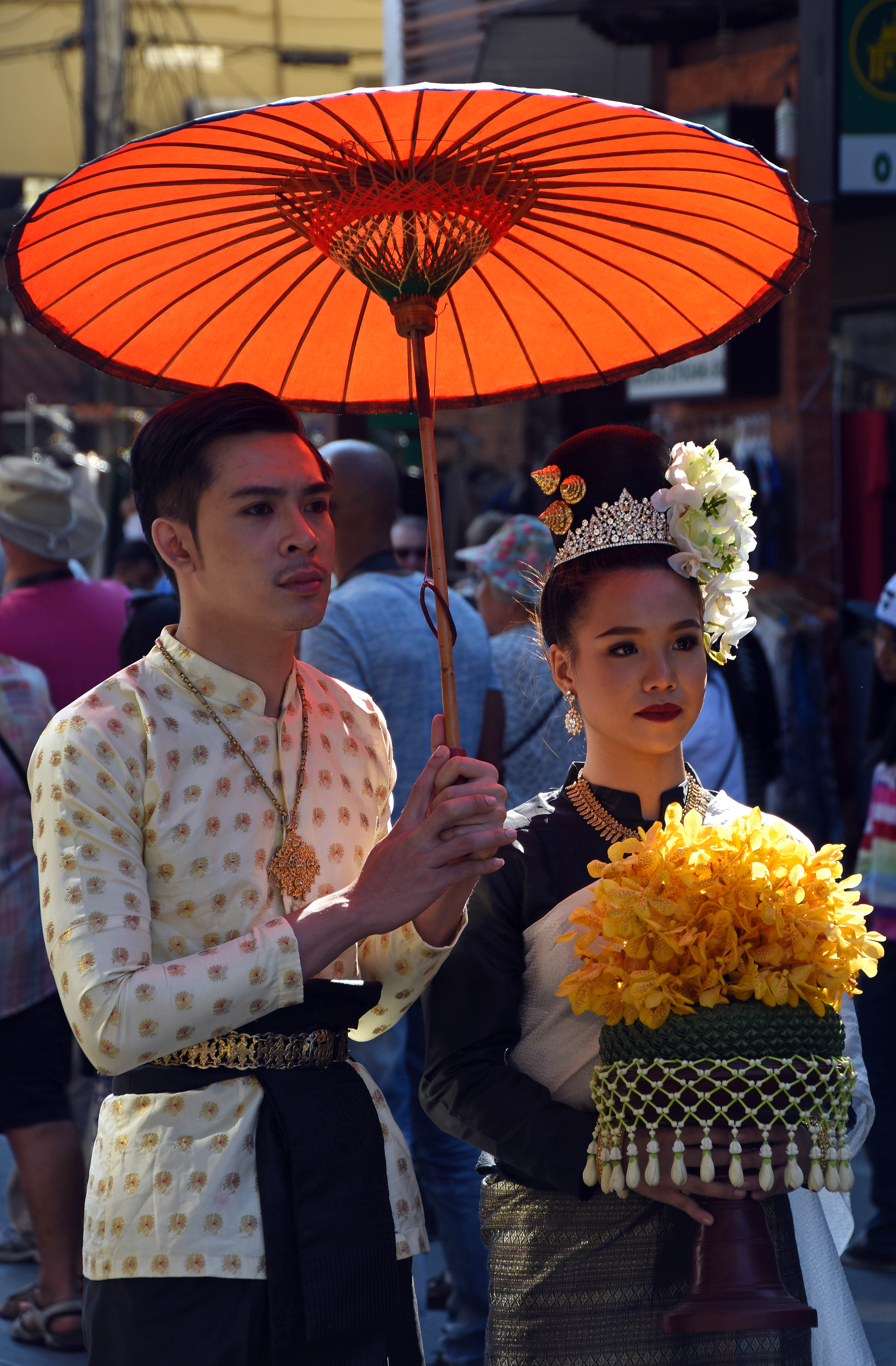
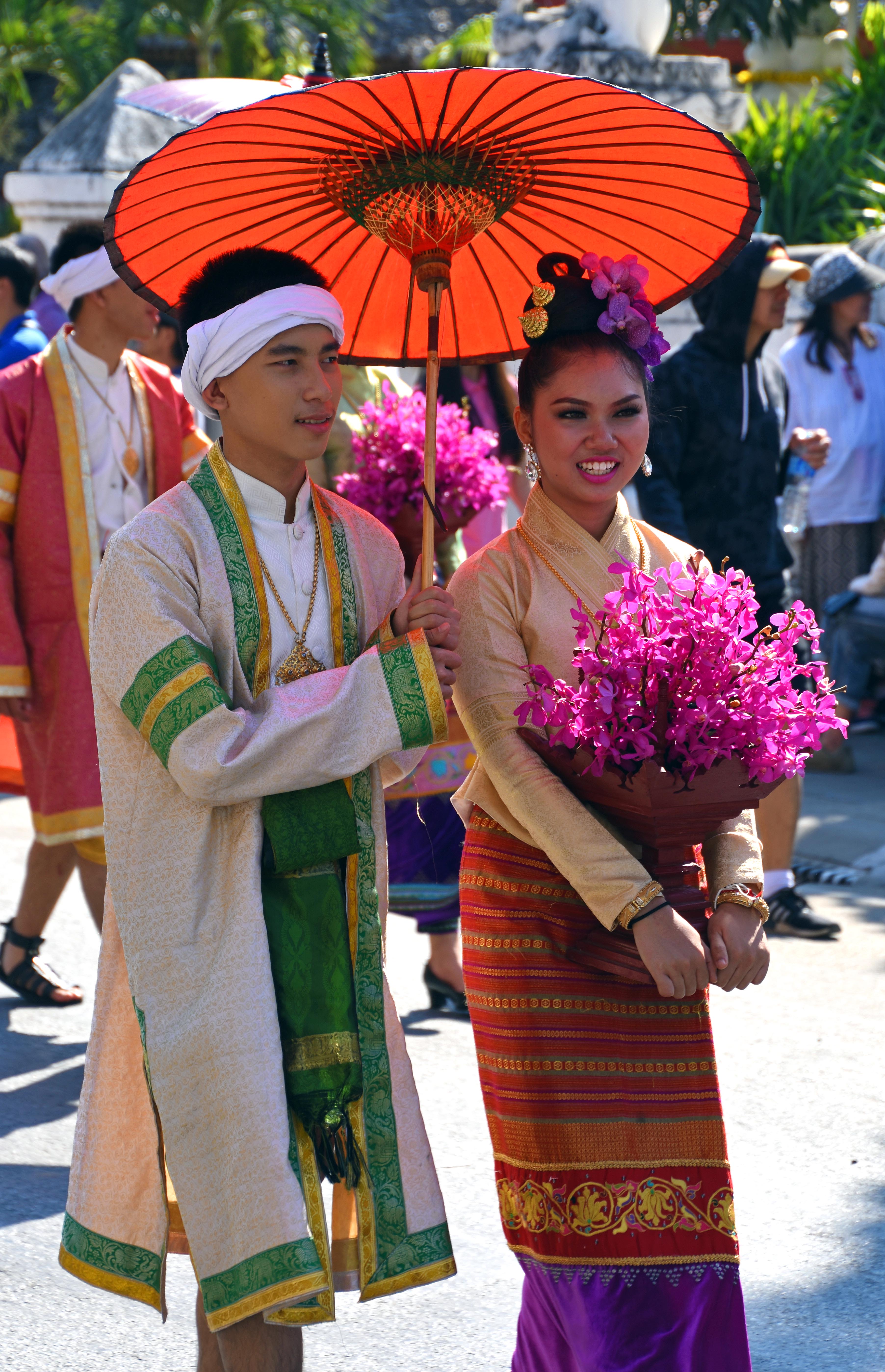
I had the pleasure of viewing the 41st Chiang Mai Flower Festival this year. The parade took place on 4th February 2017, on what was a beautiful, albeit very hot day. The parade starts early in the morning – about 8am – from Nawarat bridge over the Ping River, and follows a traditional route along Thapae road, Kotchasarn road, Changlor road, Arak road and ends at Nong Buak Haad Park.
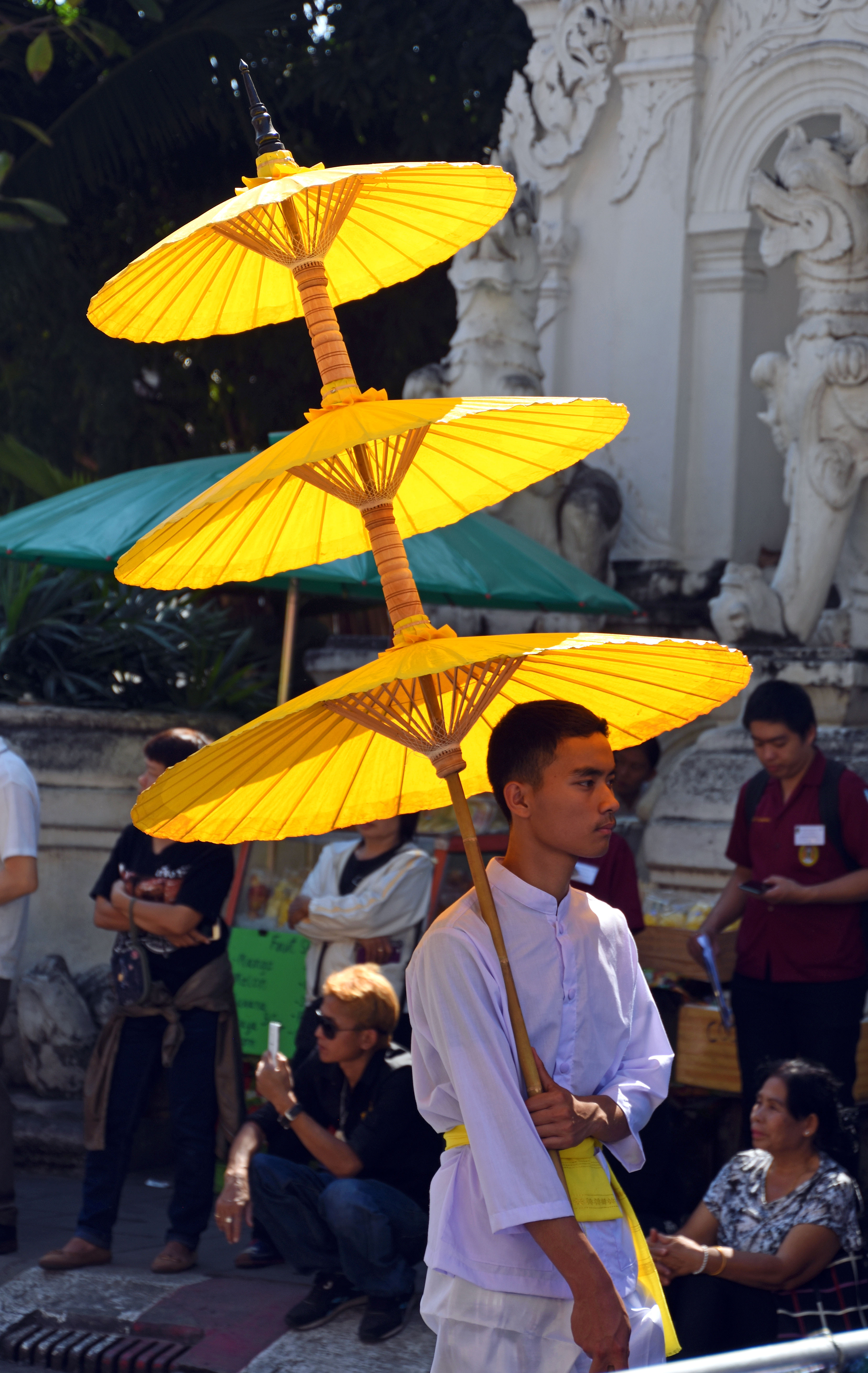
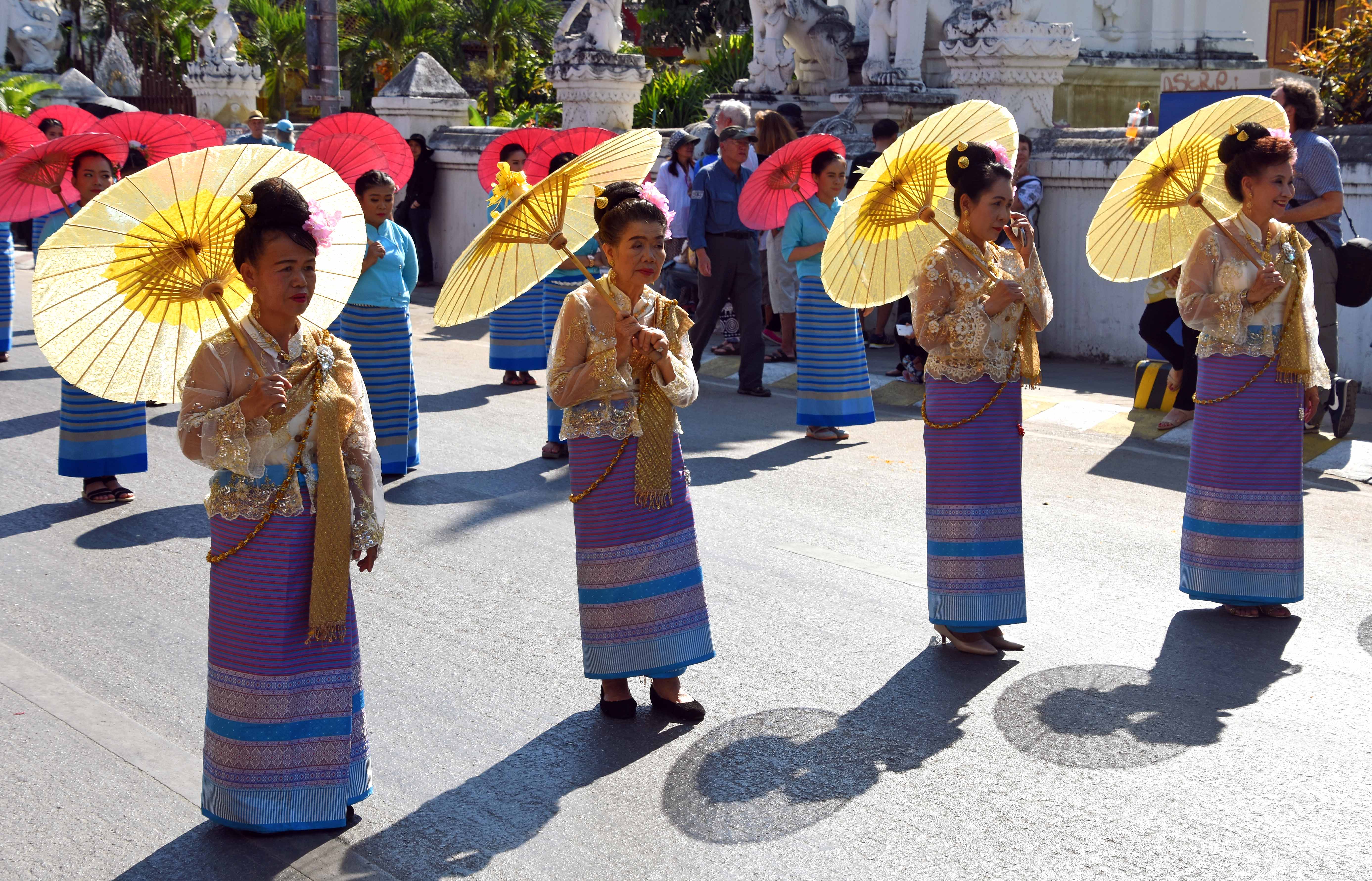
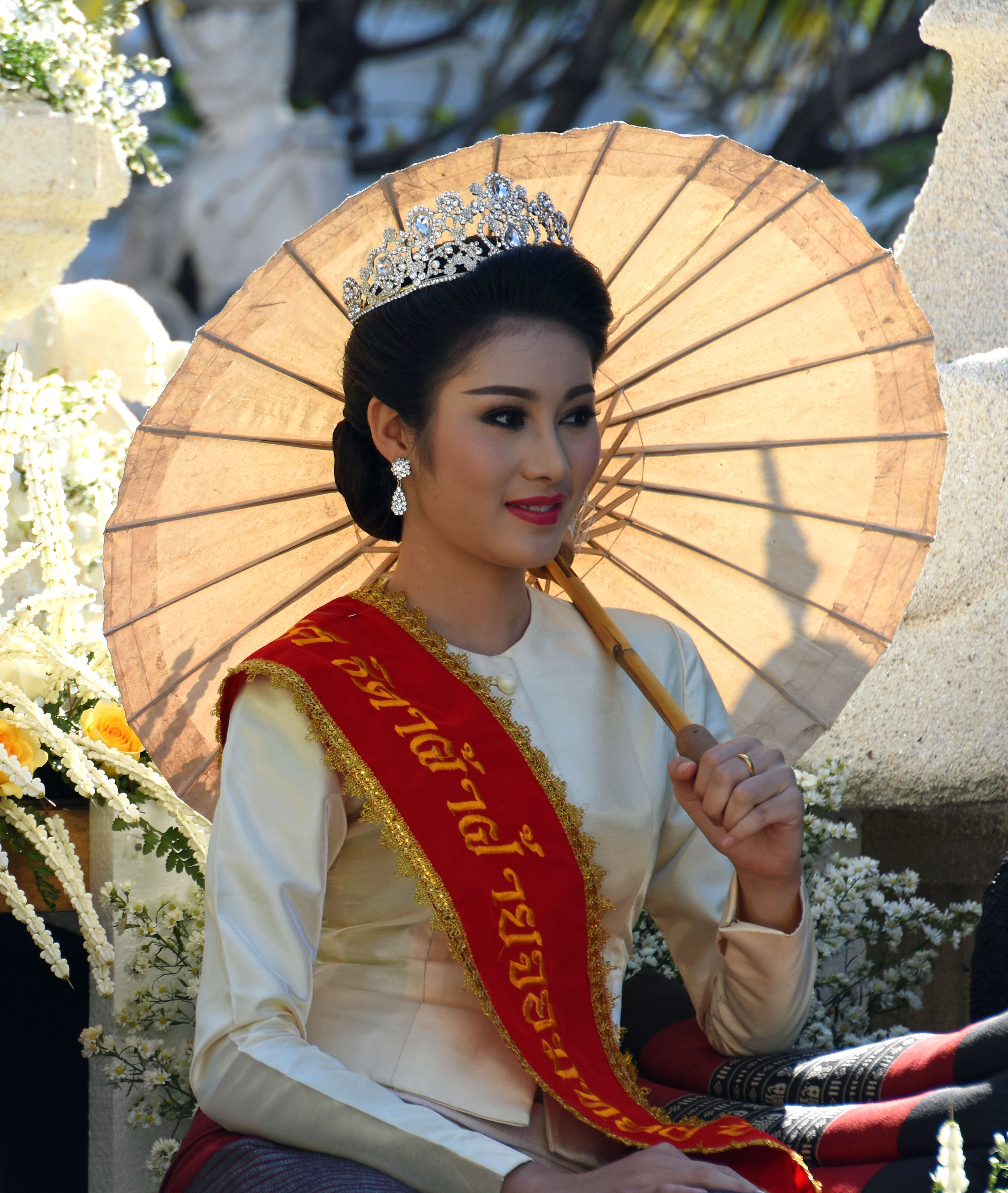
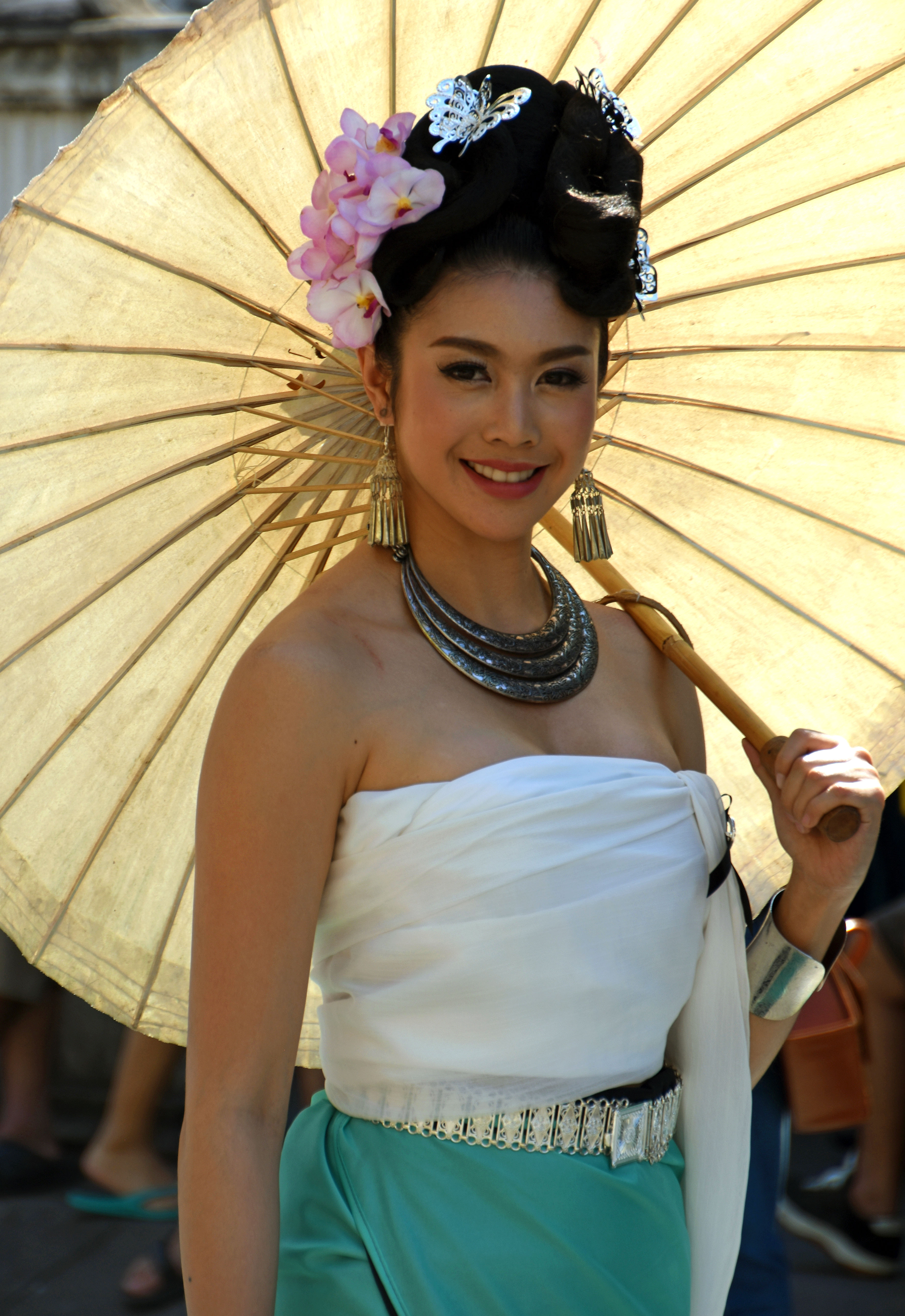
Traditional umbrella
This was the third flower festival that I have seen in Chiang Mai over the years. It is a wonderful celebration of Thai culture, with thousands of participants dressed in traditional as well as modern costumes.
Traditional Thai costume and hand movement
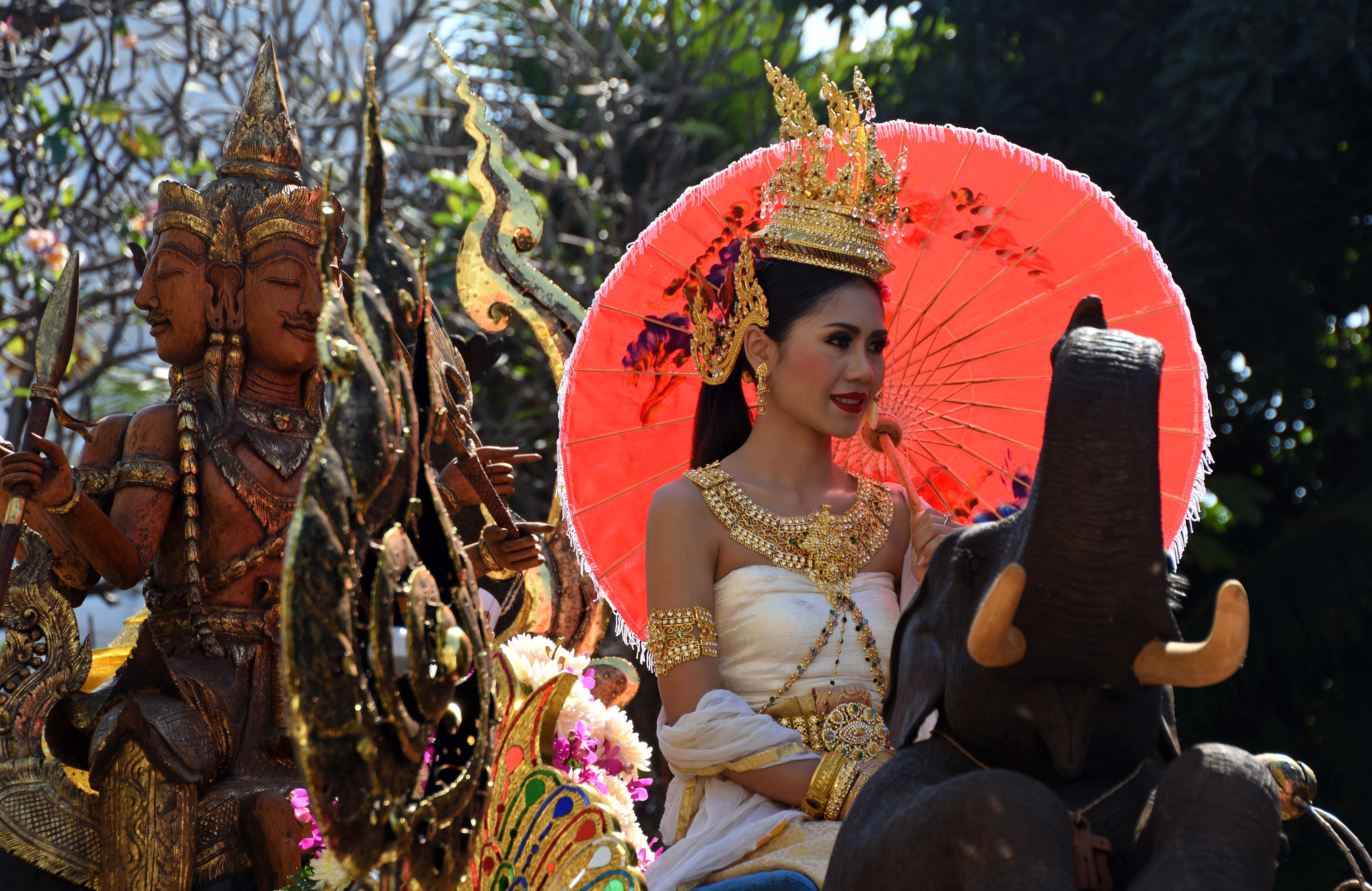
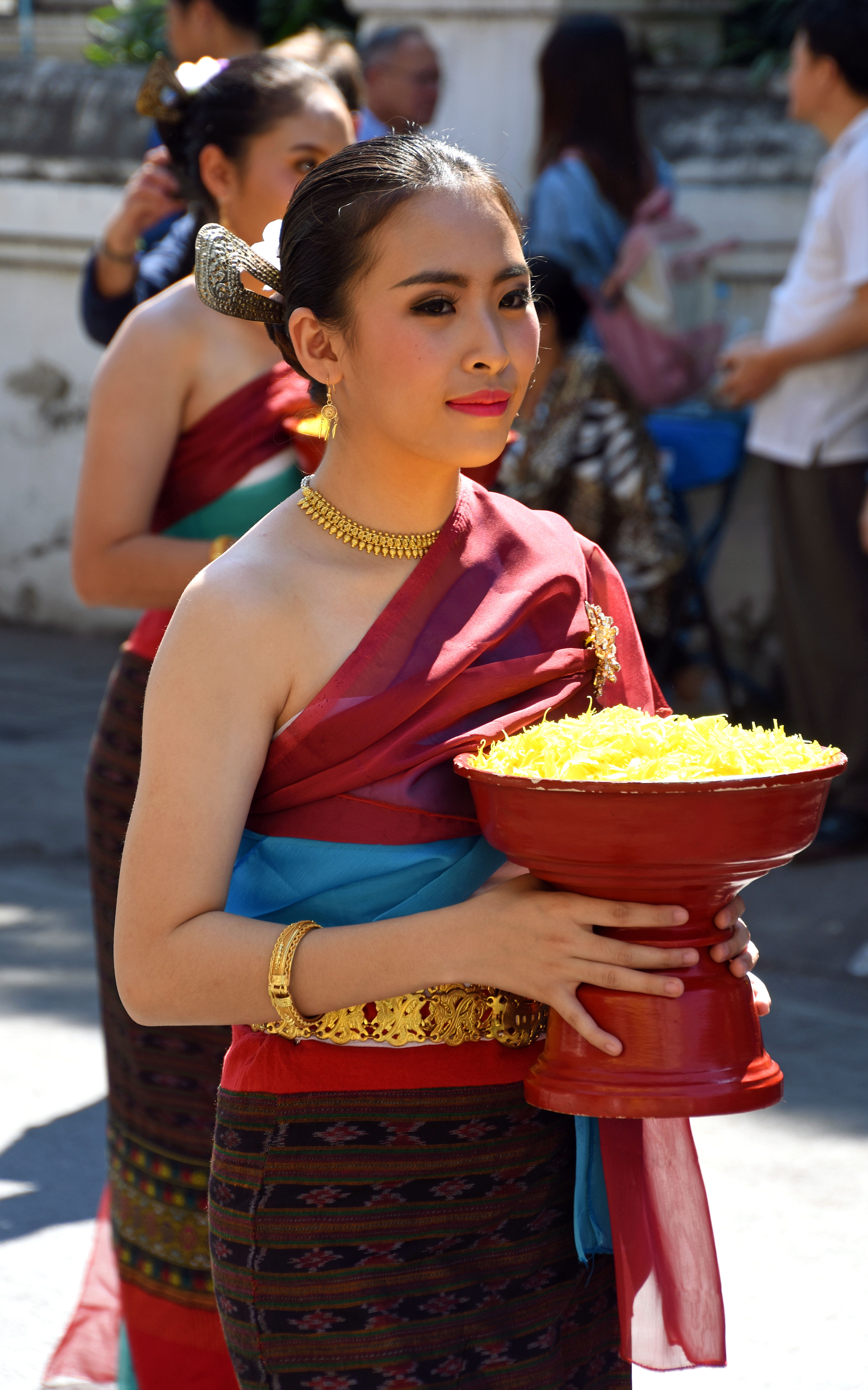
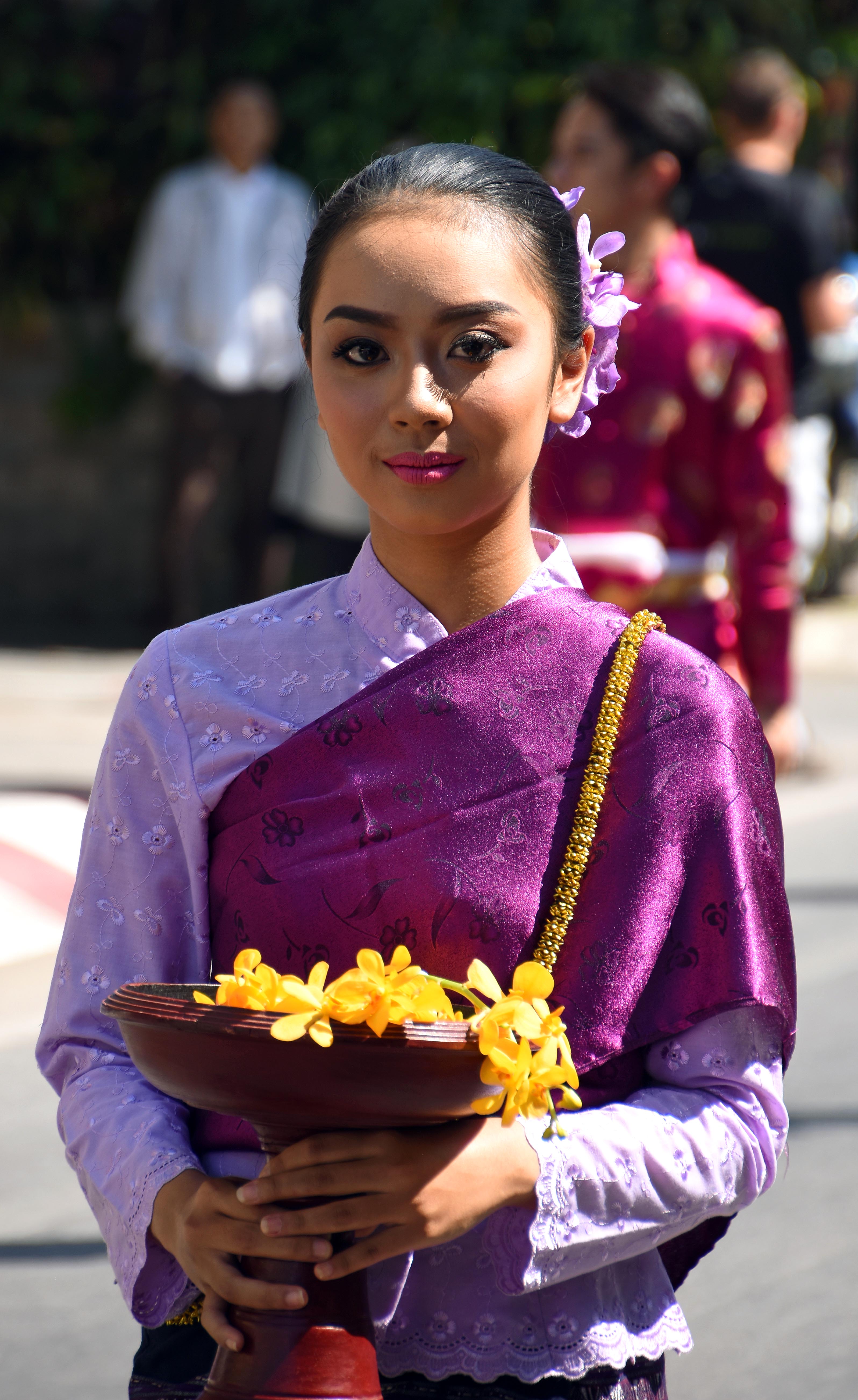
I personally love to see the traditional Thai costumes with the beautiful silks and ornate jewelry. A variety of different pots and bowls containing flower petals were carried by many girls.
Girl in traditional Thai costume holding offeringsLadies in blue silk costumes carrying pink costumes.
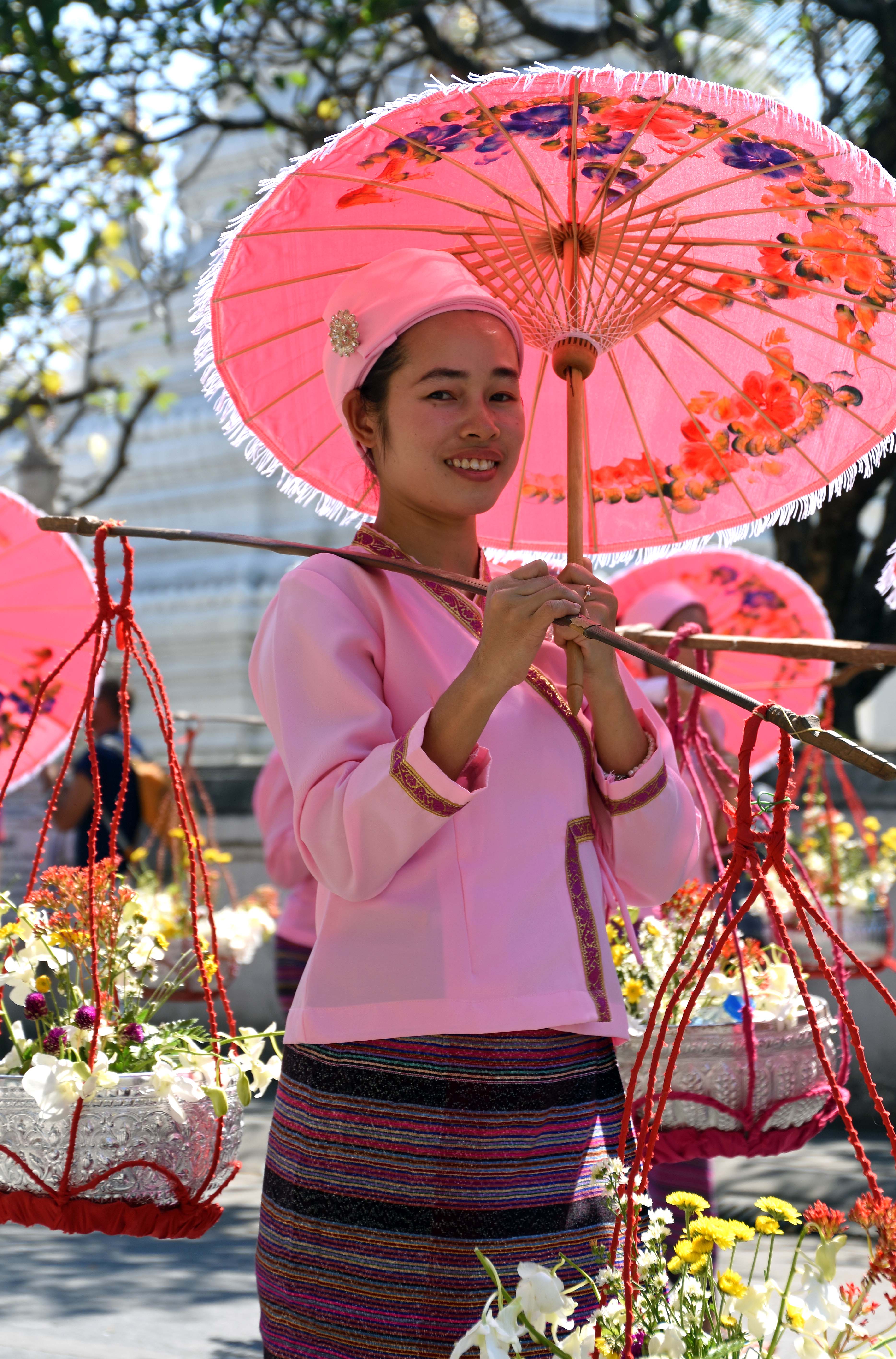
The traditional Thai umbrellas provide a wonderful contrast to the costumes, as well being as a very a light and practical sun shade. I made sure that I was on the bright side of the street so that I could try to catch the light shining through the umbrellas.
Older ladies participating in the flower parade.
A few years ago, 2014 I think, when I last viewed the flower festival, the organizers arranged for the parade to begin at about 3 pm, rather than the usual 8 am. The purpose being to save the participants from the searing sun as the parade processes, slowly – and in fits and starts – along the route. It takes about 4-5 hours, I think, for the parade to pass, and in temperatures in the low 30’s (deg C) – and with very high radiant heat – the marchers really do suffer. Indeed, if you were not born and bred in Thailand, I doubt you could survive it! Yet the girls and boys, men and women, remain beautiful and ever smiling, despite being roasted in the sun.
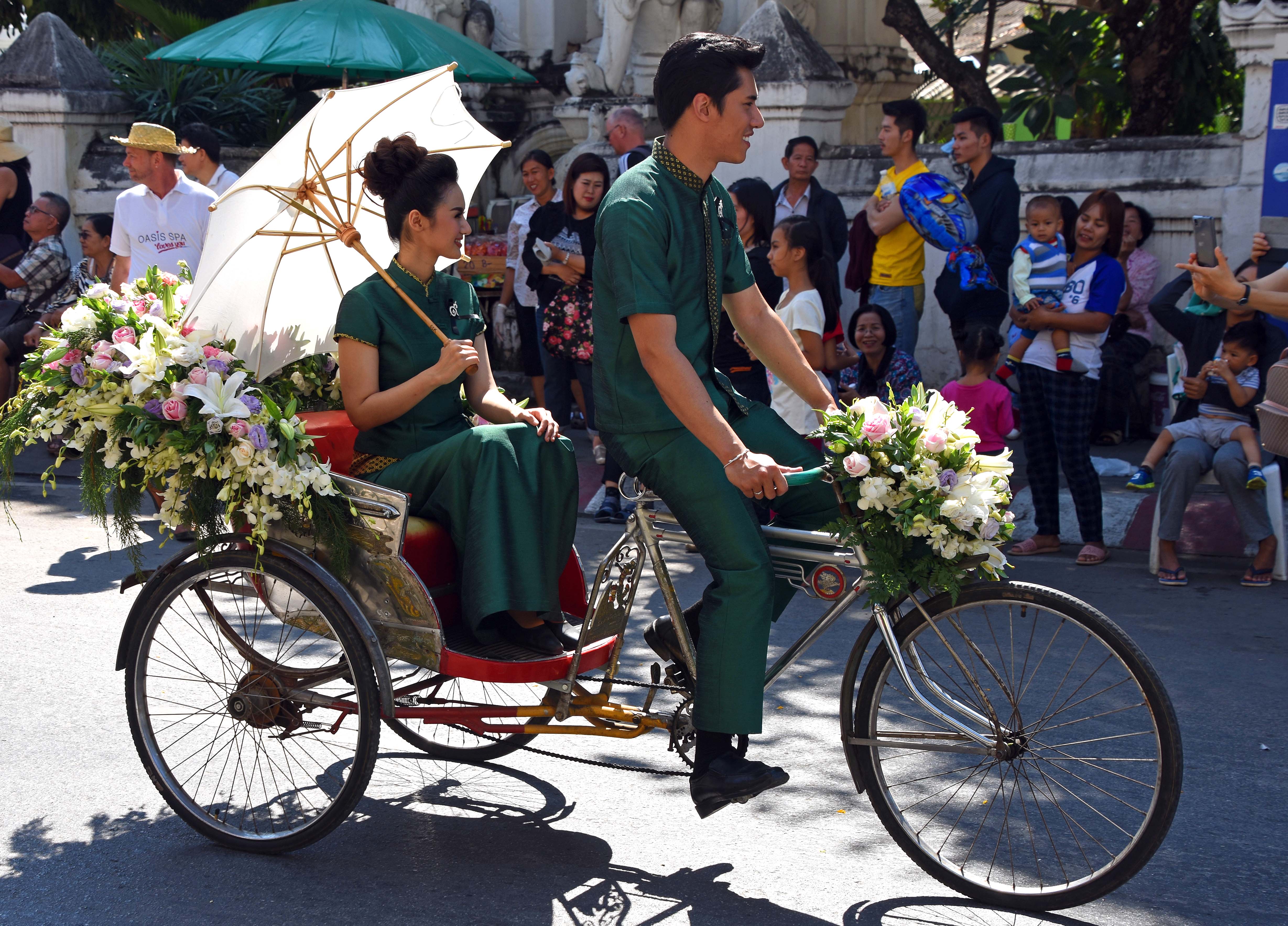
Bicycle riders with umbrella
Whilst the late start in 2014 was no doubt a relief for the marchers, it was a loss for photographers, as the sun soon moved down below the buildings and the majority of the parade passed by in the shade. Perhaps, the organizers make a decision about the start time based on the predicted temperature for the day? Anyway, the parade reverted back to the morning start this year.
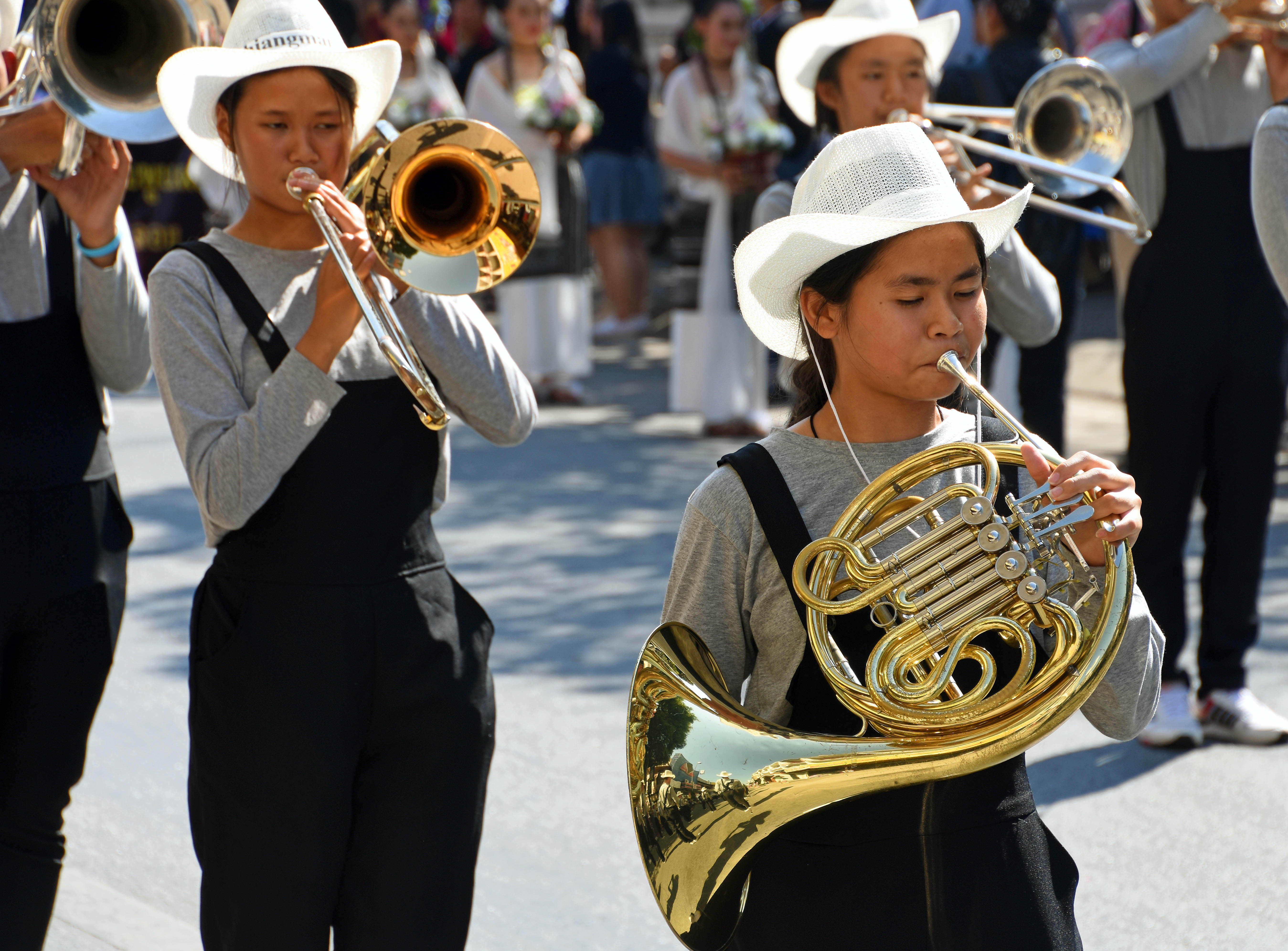
Reflections in brass; school band
Nevertheless, it was still a very hot day on 4th Feb this year and even though I was only taking photographs, I had to find some shade every now and then, to recover my cool! For many of the participants, particularly those without umbrellas, there was no such relief from the sun. Yet they remained calm and composed and smiled at every one of the thousands of photographers lining the route. They really were amazing.
One really has to take ones hat off to the participants who managed to look so calm and demure in such hot temperatures, despite it being the so-called winter season in northern Thailand.
There were numerous occasions when the parade ground to a halt, and the participants had to stand in the sun for ages until the whole procession got going again.
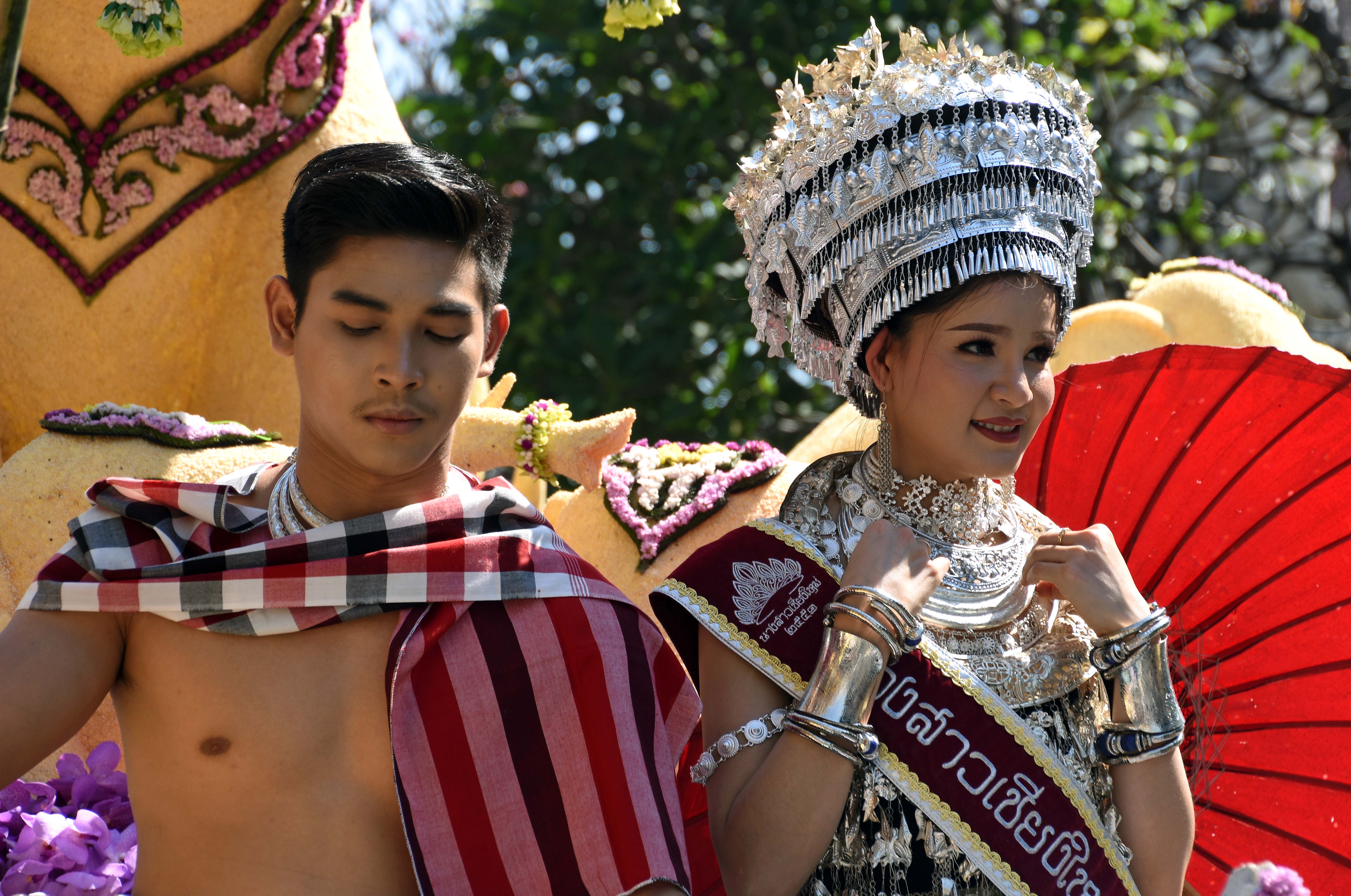
Girls in colourful Hill tribe costumes
I don’t know for sure, but it seems to me that the parade is much bigger than it used to be. There are large numbers of flower floats, school bands, participants from different schools, colleges, farms and so on. It has become a huge draw from tourists from around the world. This year I could help but notice how many tourists there were from China, as well as from countless other countries around the world.
Beautiful girl carrying umbrellaTraditional costumes on a flower float
The girls and boys on the flower floats had an easier time than the walkers, but many also had no protection from the sun.
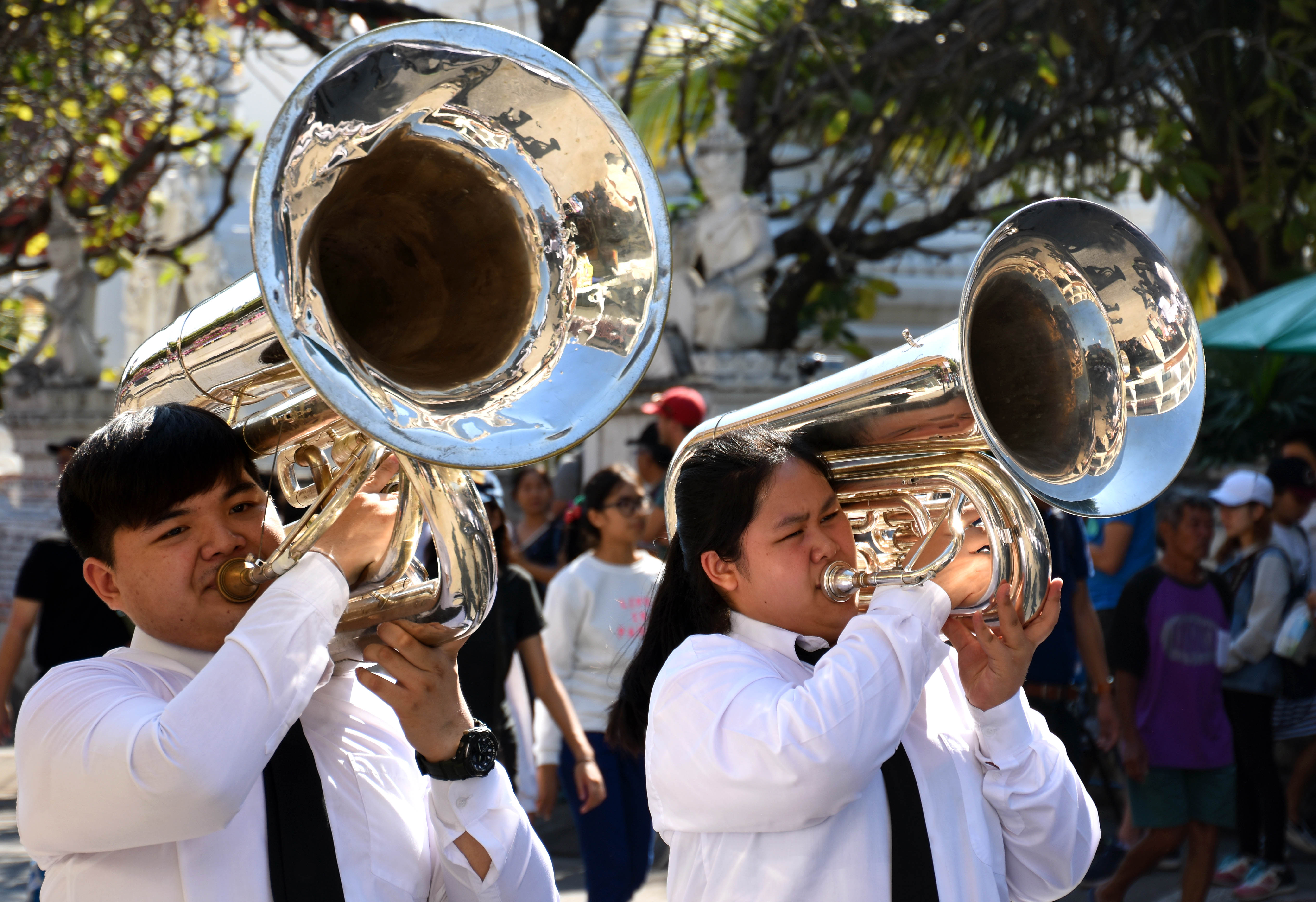
School brass bands
I loved the school and college bands. They played with such gusto!
The parade itself is only one event in the Flower Festival. It is followed by in late afternoon by the the Miss Chiang Mai Flower festival, which goes on into the evening when the new Flower Festival Queen is chosen. I did not stay to see who won, but there was no shortage of beautiful girls (and handsome boys) as the following sequence of photographs shows.
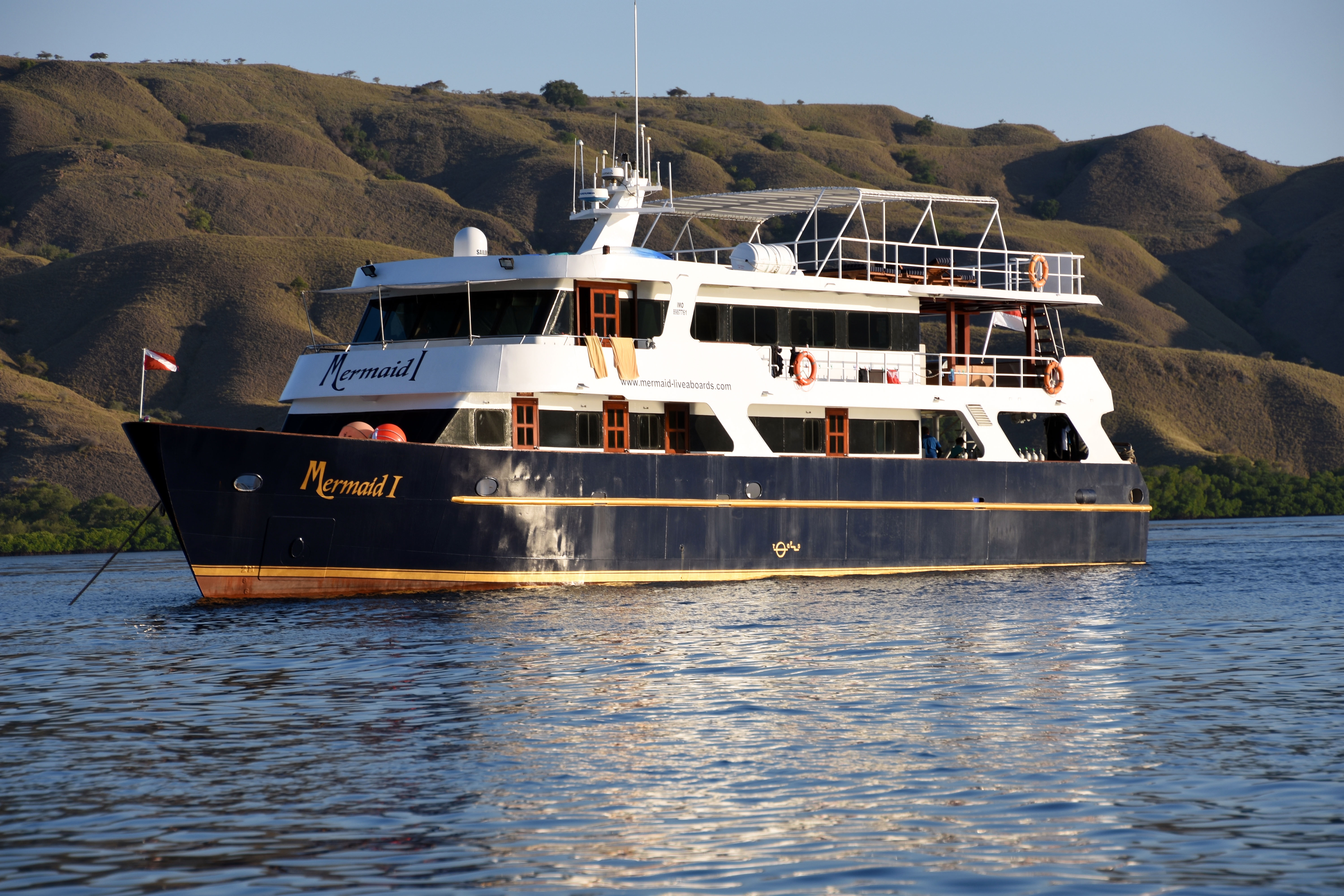
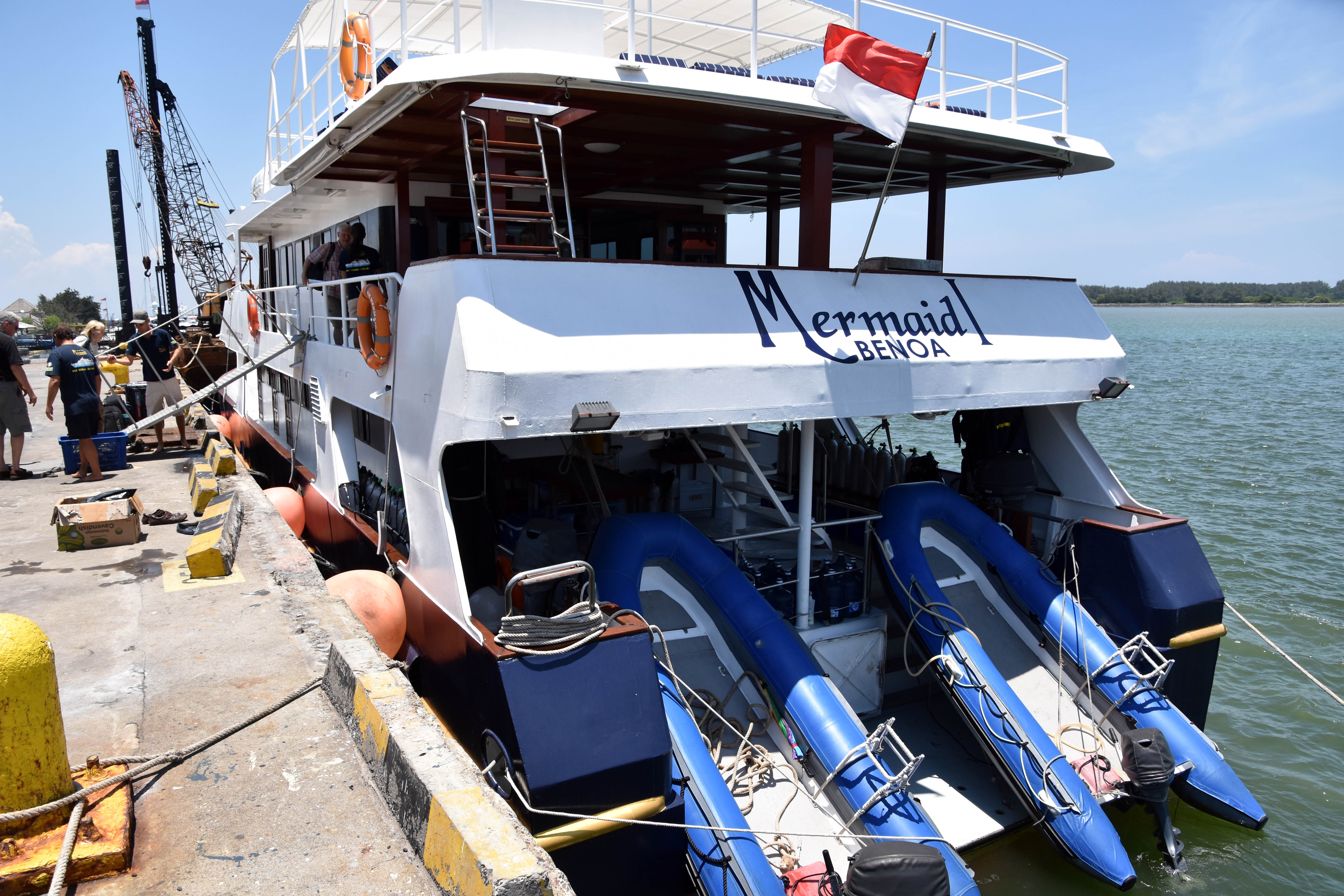
I recently had the pleasure of cruising from Bali to Flores – via the Komodo National Park – aboard the very well-appointed little ship, Mermaid I (1). This liveaboard dive vessel is usually chartered by divers to explore the water of Komodo and Raja Ampat in Indonesia, but our trip had a different mission: we were on the look out for cetaceans, led by the very knowledgeable marine biologist Chas Anderson (2). I booked the holiday through Wildwings and thoroughly enjoyed the 10 days we spent – snorkelling, bird-watching and cetacean sighting – in Indonesian waters (3).
Mermaid I at Benoa Port, Bali
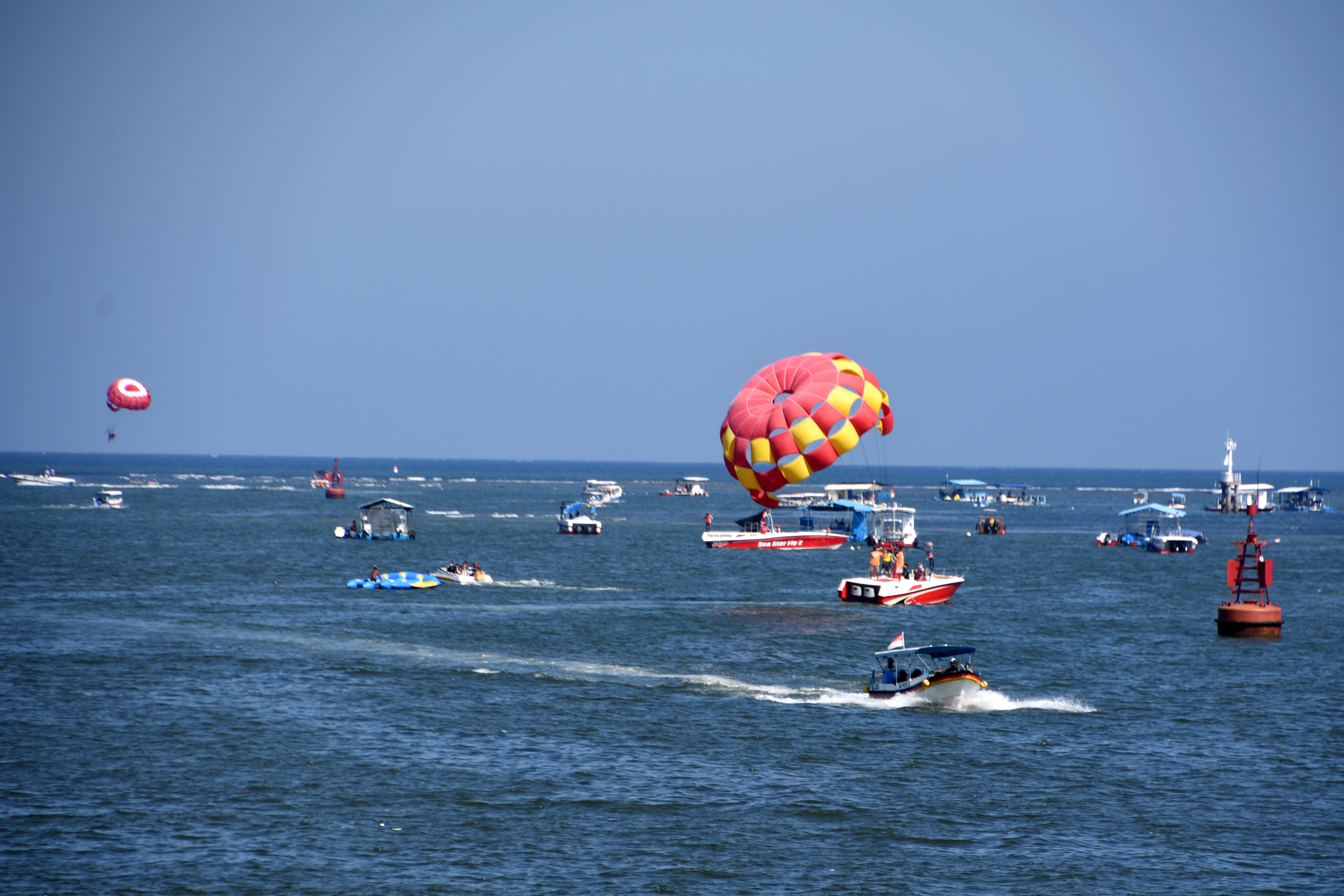
We boarded Mermaid I at Benoa Port, Bali, and set sail out into the waters of the Badung Strait – between Bali and the small island of Nusa Penida – and then further on into the Lombok Strait. There was a buzz of boating activity going on as we left the harbour.
Pleasure craft and para-gliding outside Benoa Port, Bali
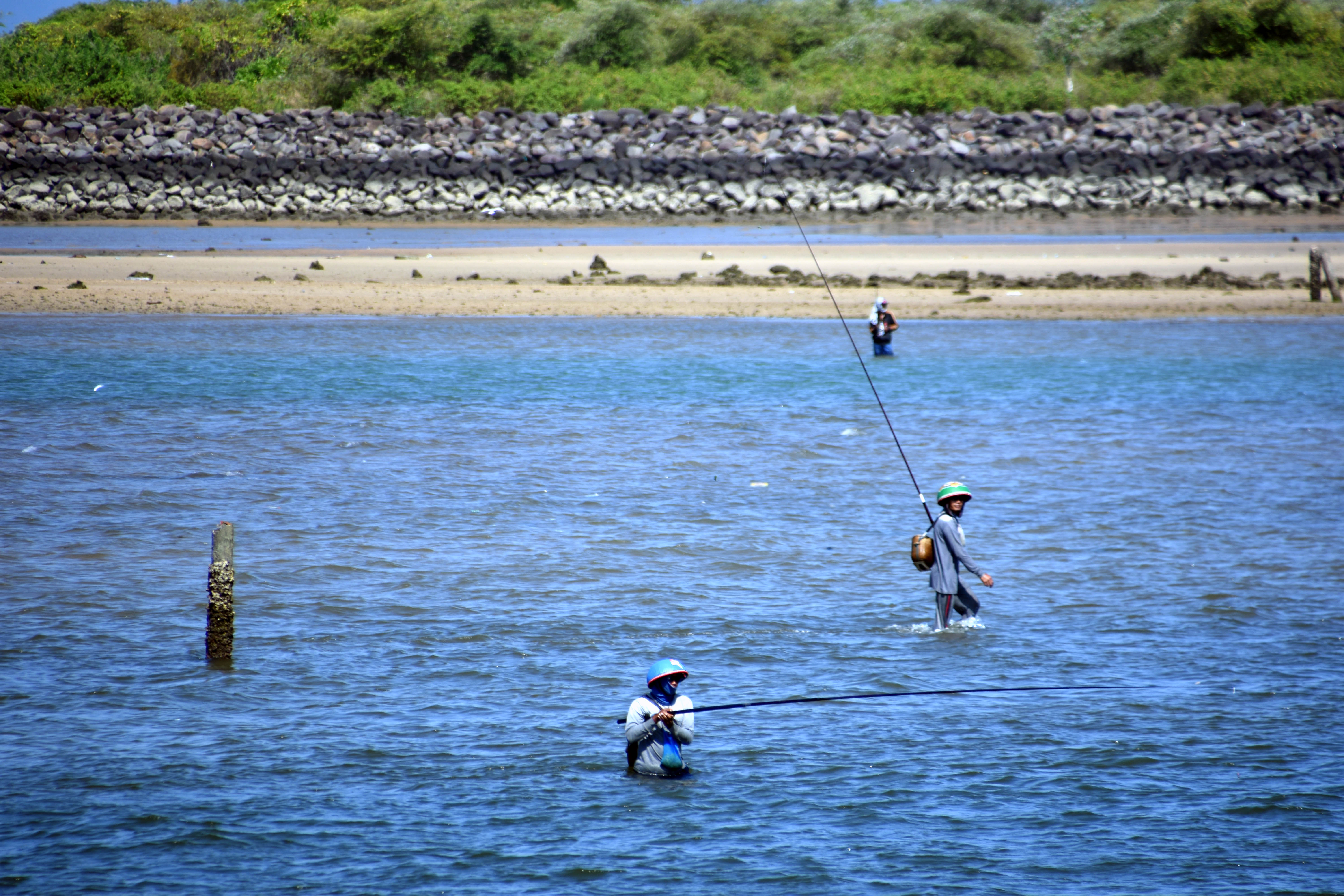
But what was more interesting, were the local fisherman standing waist-deep in the water with their long fishing rods and wicker baskets to keep the fish.
Fisherman in the sea outside Benoa Port, Bali
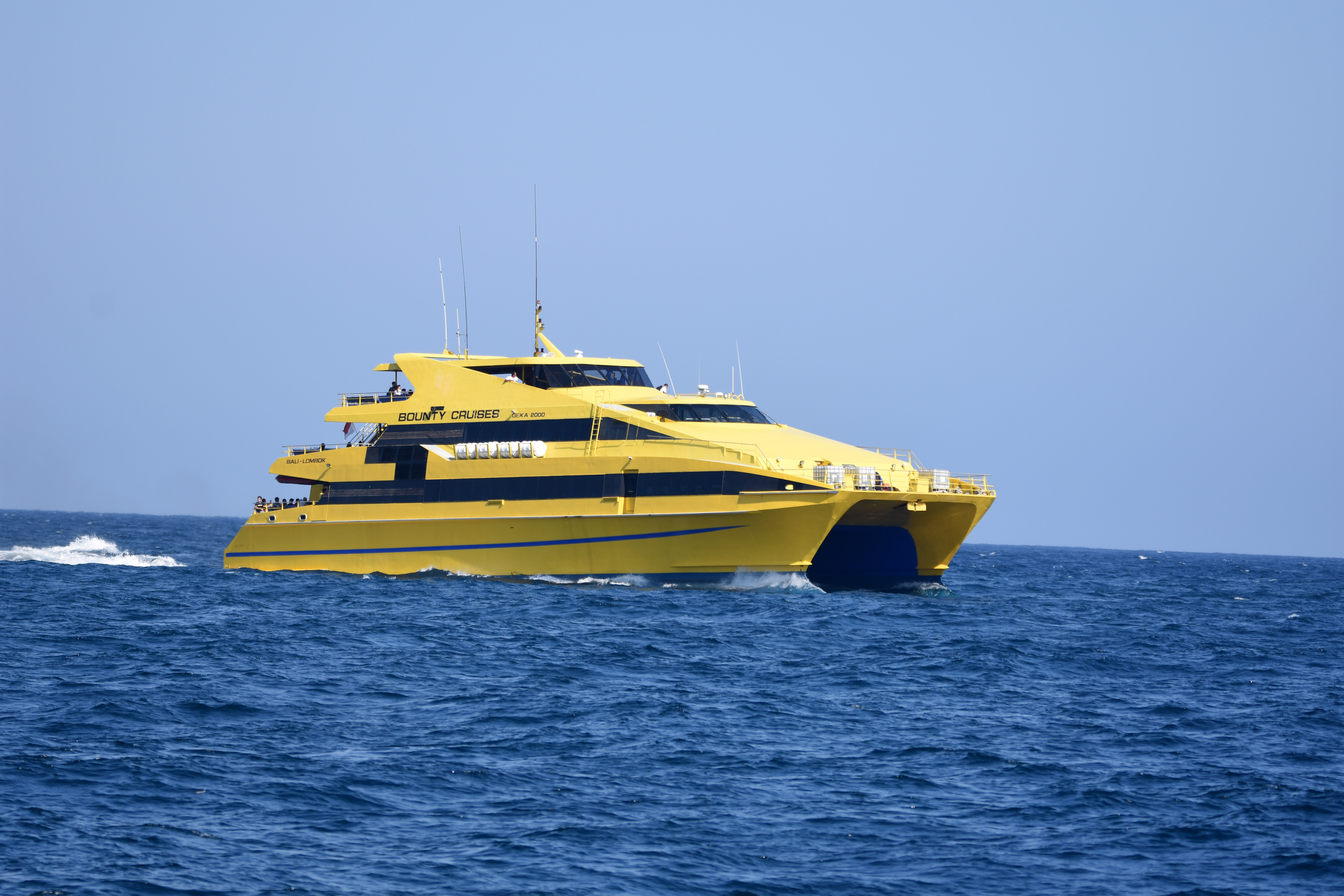
The famous faunal boundary – called Wallace’s Line – runs down the Lombok Strait, between Bali and Lombok, and is a line separating birds and animals of two separate ecozones: Asian (or Indomalayan) and Australasian. Today there are plenty of modern boats whisking tourists across this narrow, but deep strait, that still remains a barrier for many species.
Catamaran travelling from Lombok to Bali
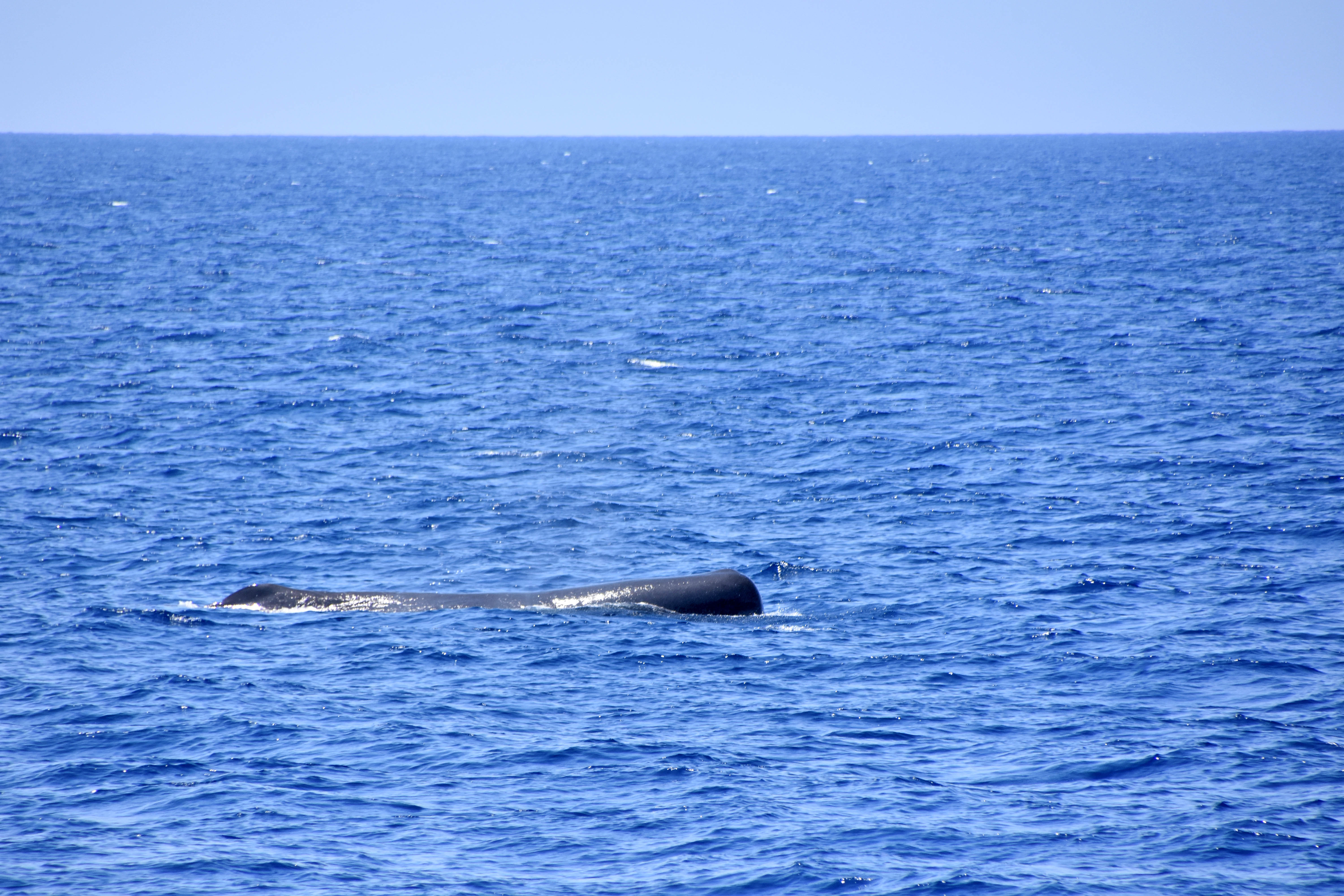
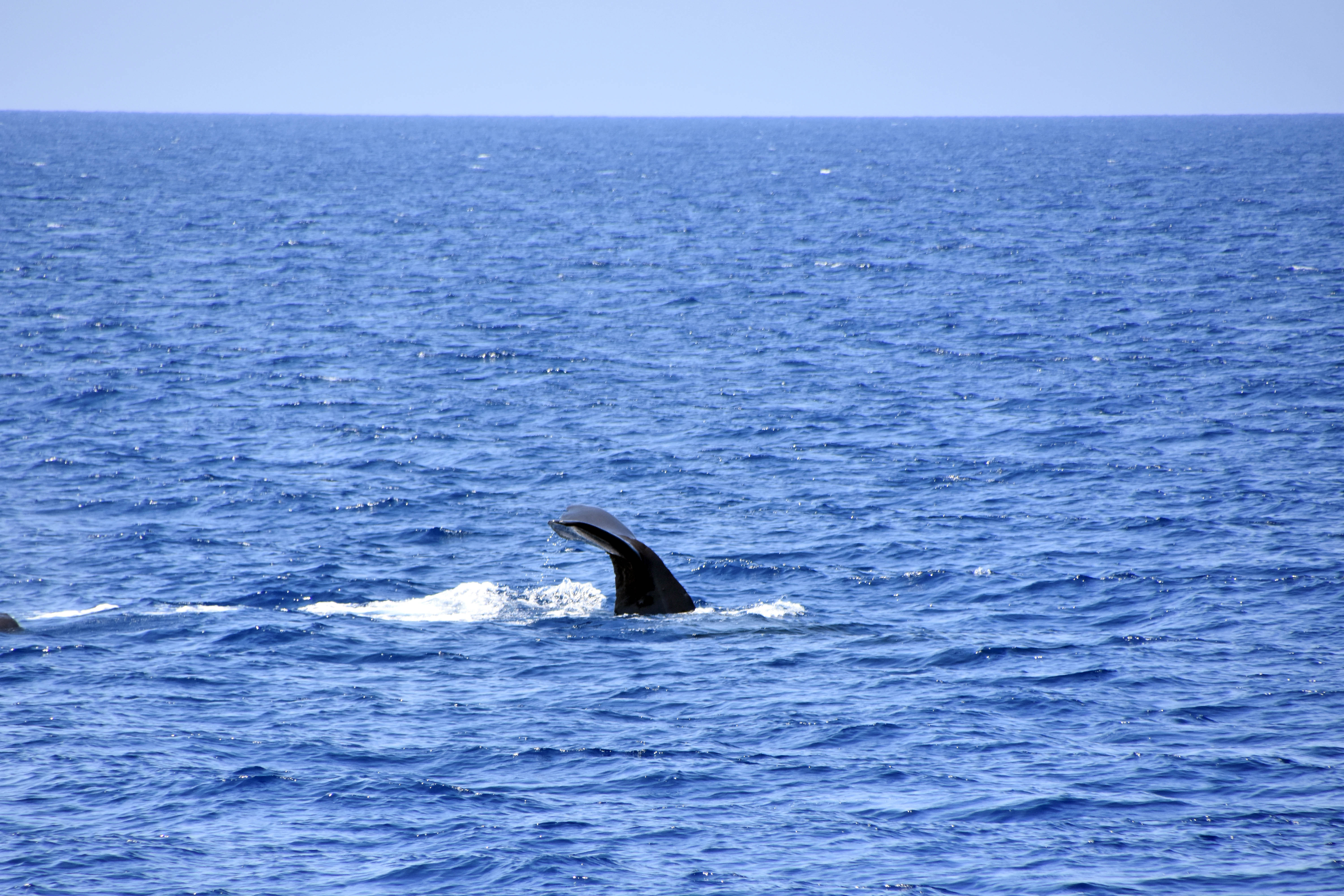
We sailed east, passing to north of the large island of Sumbawa, heading towards our first landfall: the small island of Satonda. On the way, we were fortunate enough to come across a large sperm whale; these cetaceans make deep dives – as far as 3,000m – in pursuit of large squid and fish. This individual flashed its flukes and dived down as we approached slowly towards it.
Sperm whale (Physeter macrocephalus) on the surfaceSperm whale (sperm whale (Physeter macrocephalus) diving
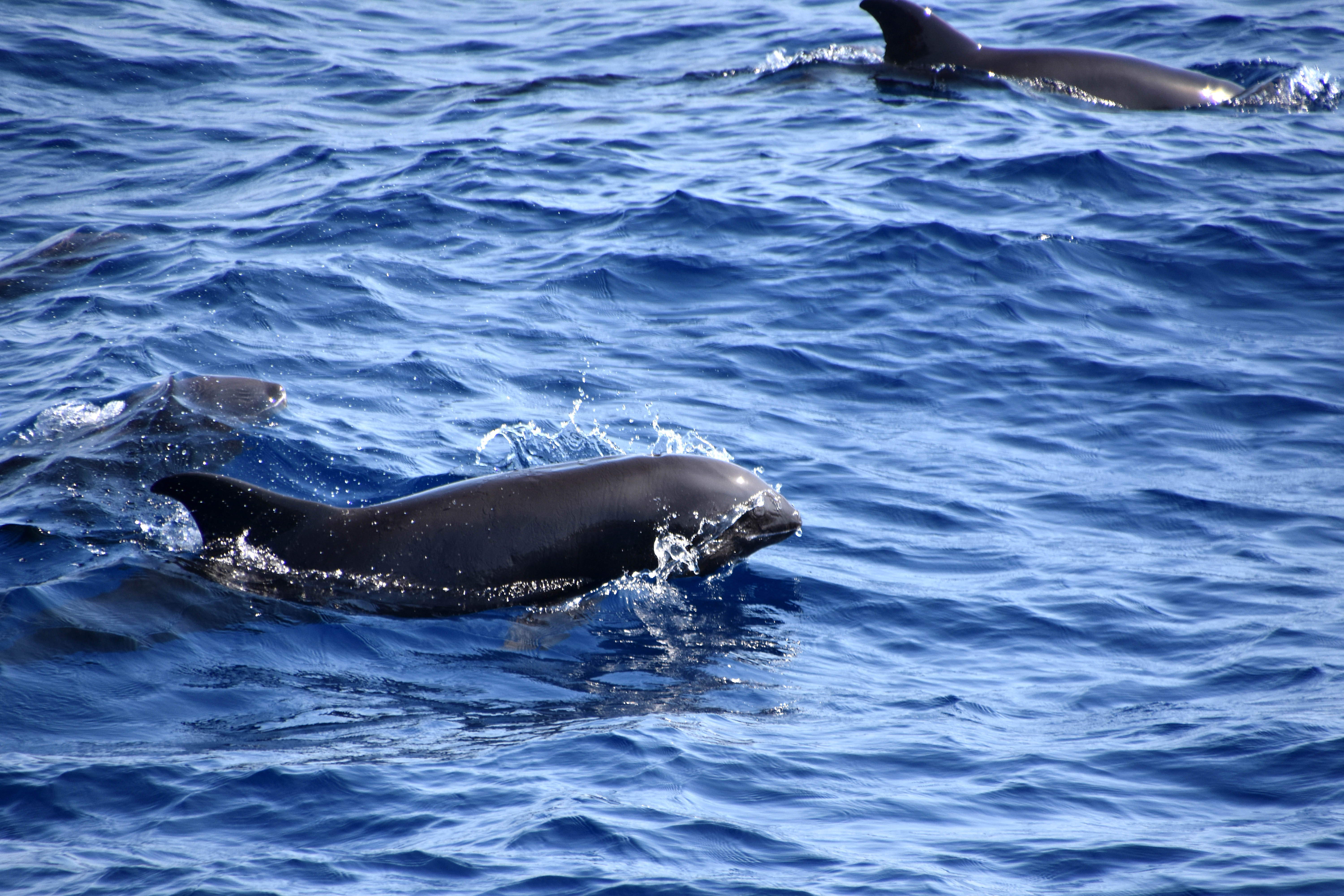
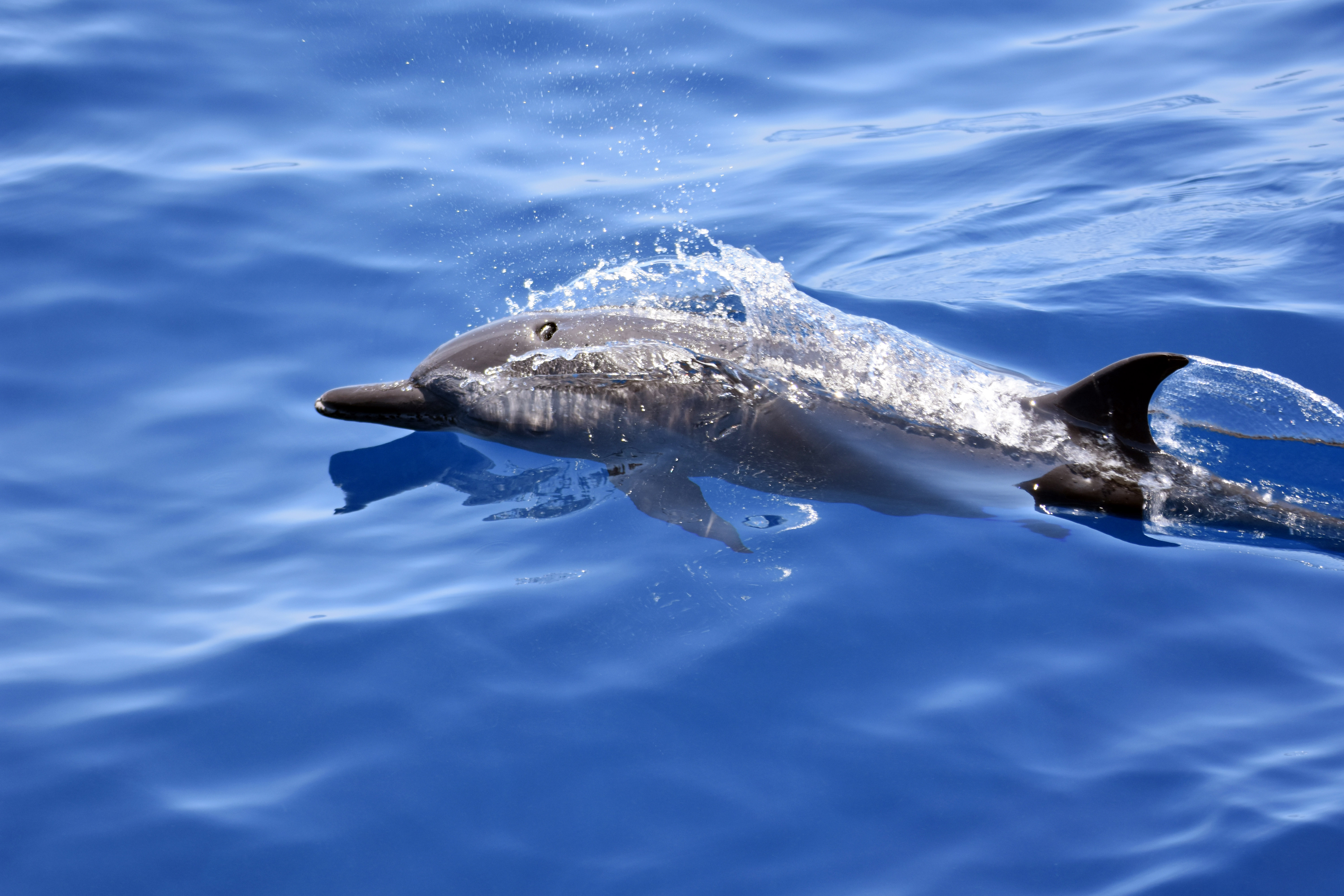
On the way to Satonda Island, we saw many different types of dolphins, including Melon-headed whales (Peponocephala electra) with their rounded heads (below).
Melon-headed whales (Peponocephala electra)
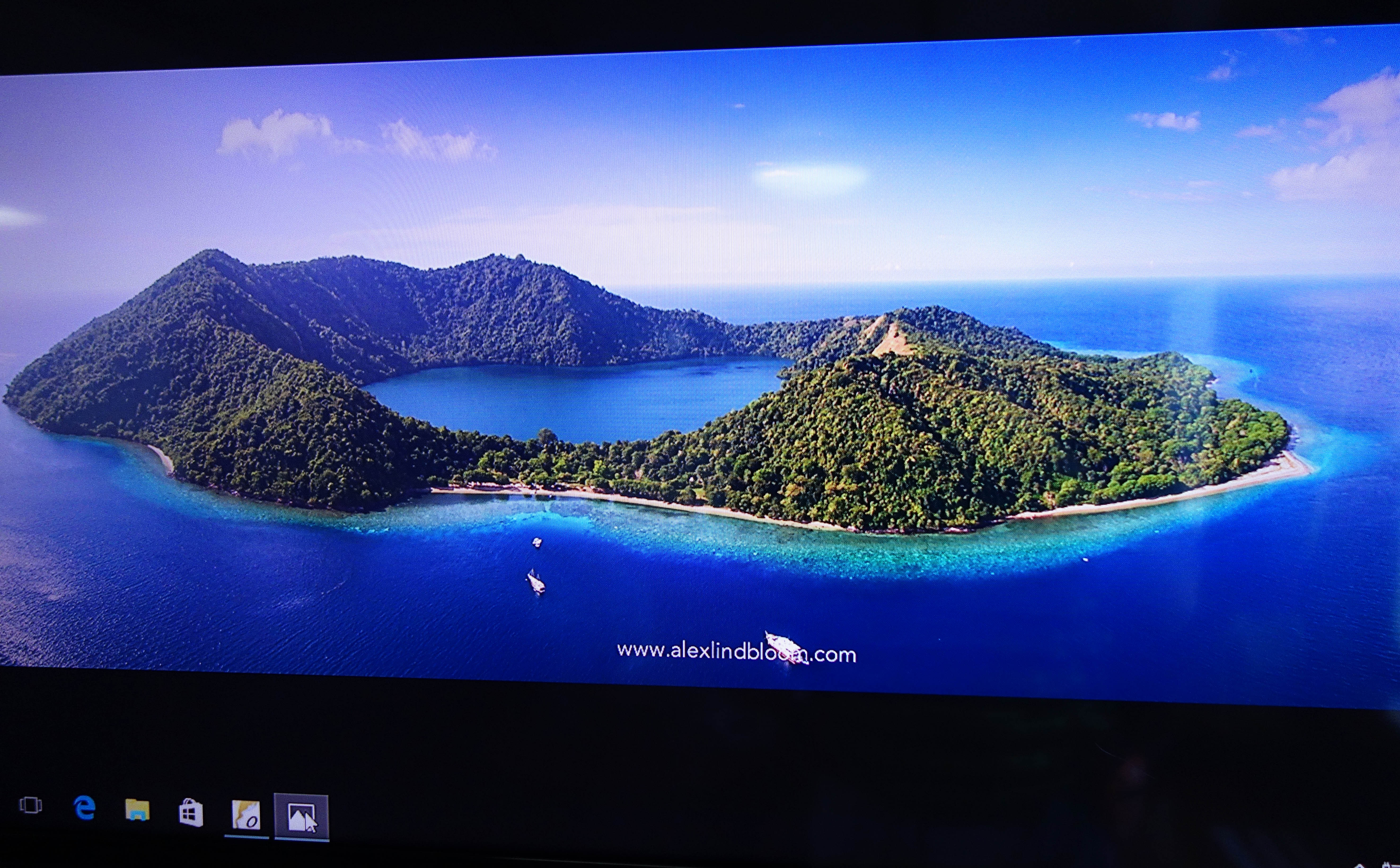
Satonda Island is the top of an extinct volcano with a lake where the crater used to be. I took this screen shot (below) off the introductory talk on Mermaid I.
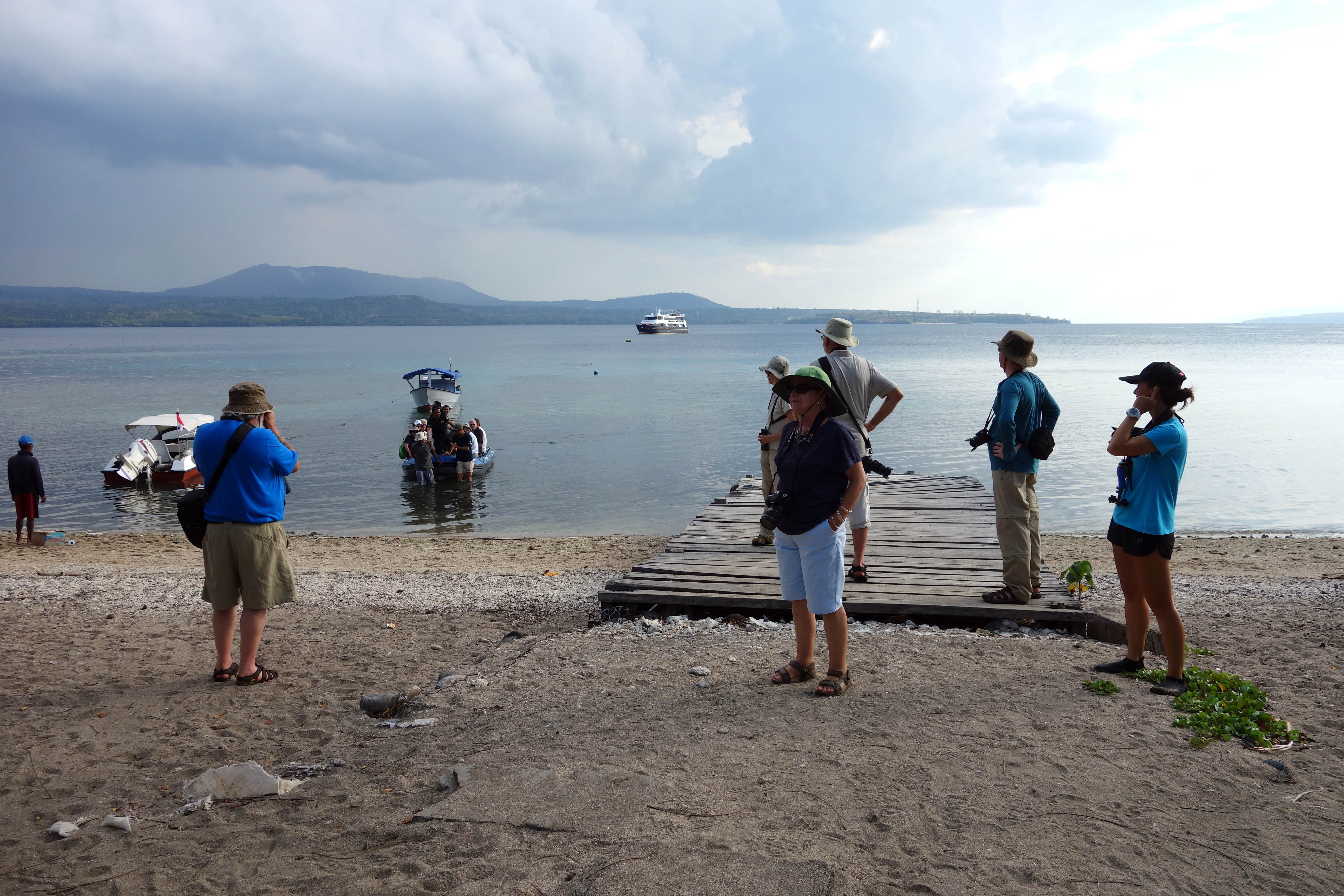
We decamped and spent an enjoyable couple of hours walking on this island, looking out for birds and butterflies.
Landing on Satonda
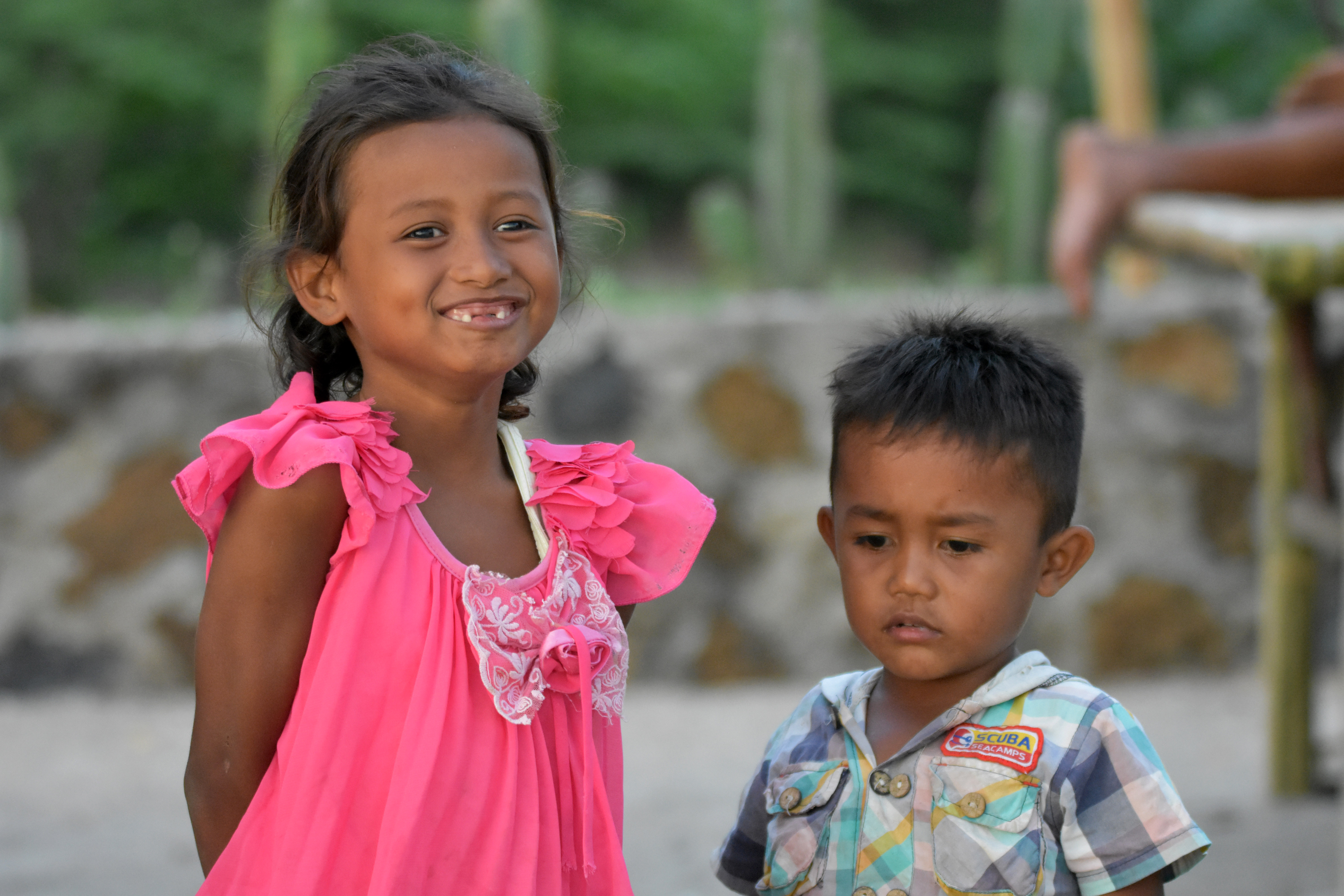
There are no villages on this island, which is a protected area, but there are a few families (of park guards) living there, including these delightful children.
Children on Satonda Island, Indonesia
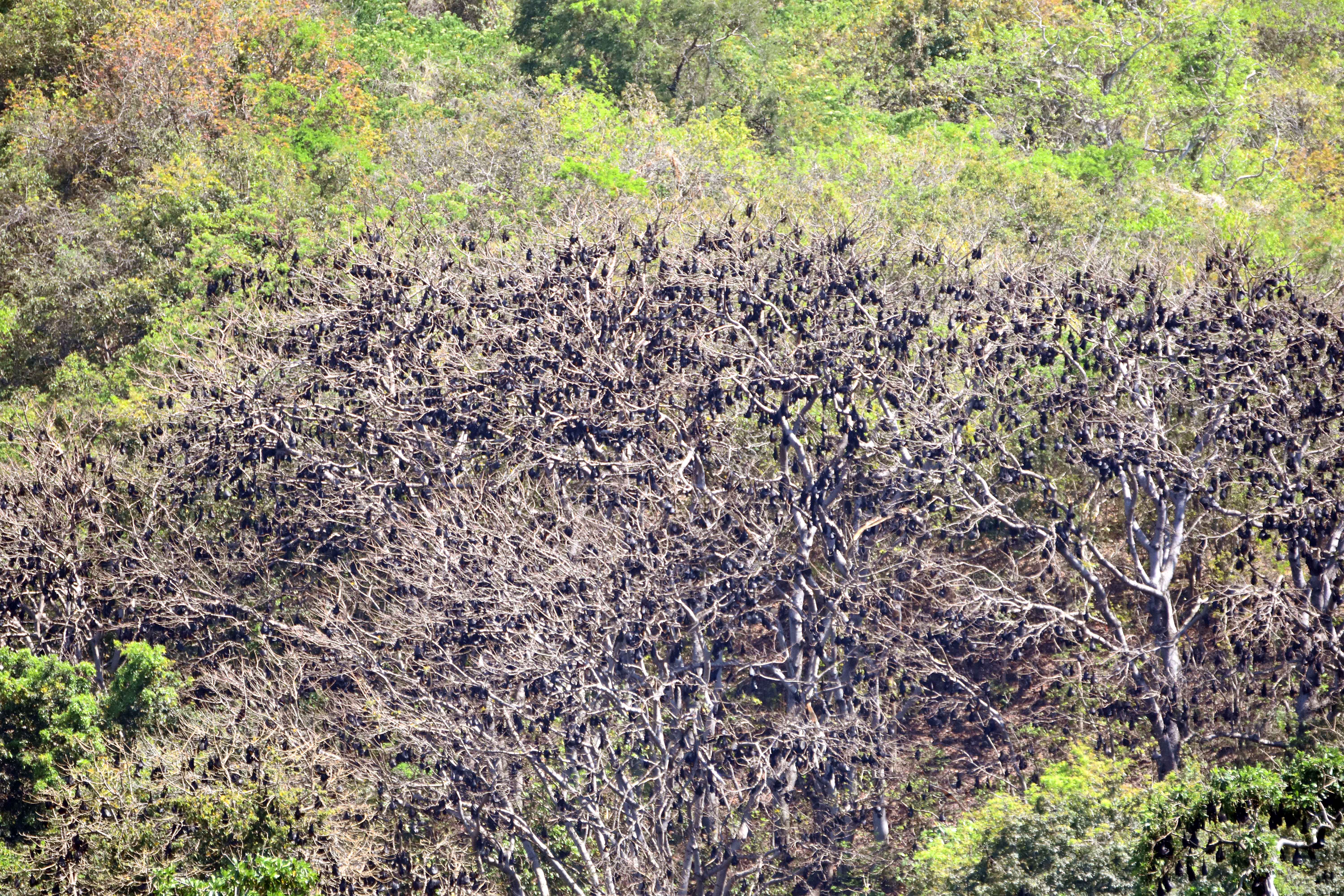
The main residents on Satonda are fruit bats, of which there must be tens, if not hundreds of thousands. Alas, we did not get to see them close up, but we did see their roosting colonies, which covered the trees on one part of the island (below). They fly off each night across the waters to the much larger islands of Moyo and Sumbawa. Unlike their smaller, insect-feeding relatives, these bats feed on fruits, so are seen as pests by some farmers. Happily they can return to their safe island home and escape retribution for their light-fingered ways. After all they were there first, long before humans arrived and started planting fruit trees!
Colony of fruit bats roosting on Satonda Island, Indonesia
After leaving the island behind us, we returned to our lookout posts, searching the seas ahead for dolphins (and birds for some).
On the lookout for birds and dolphins in front of the bridge of Mermaid I
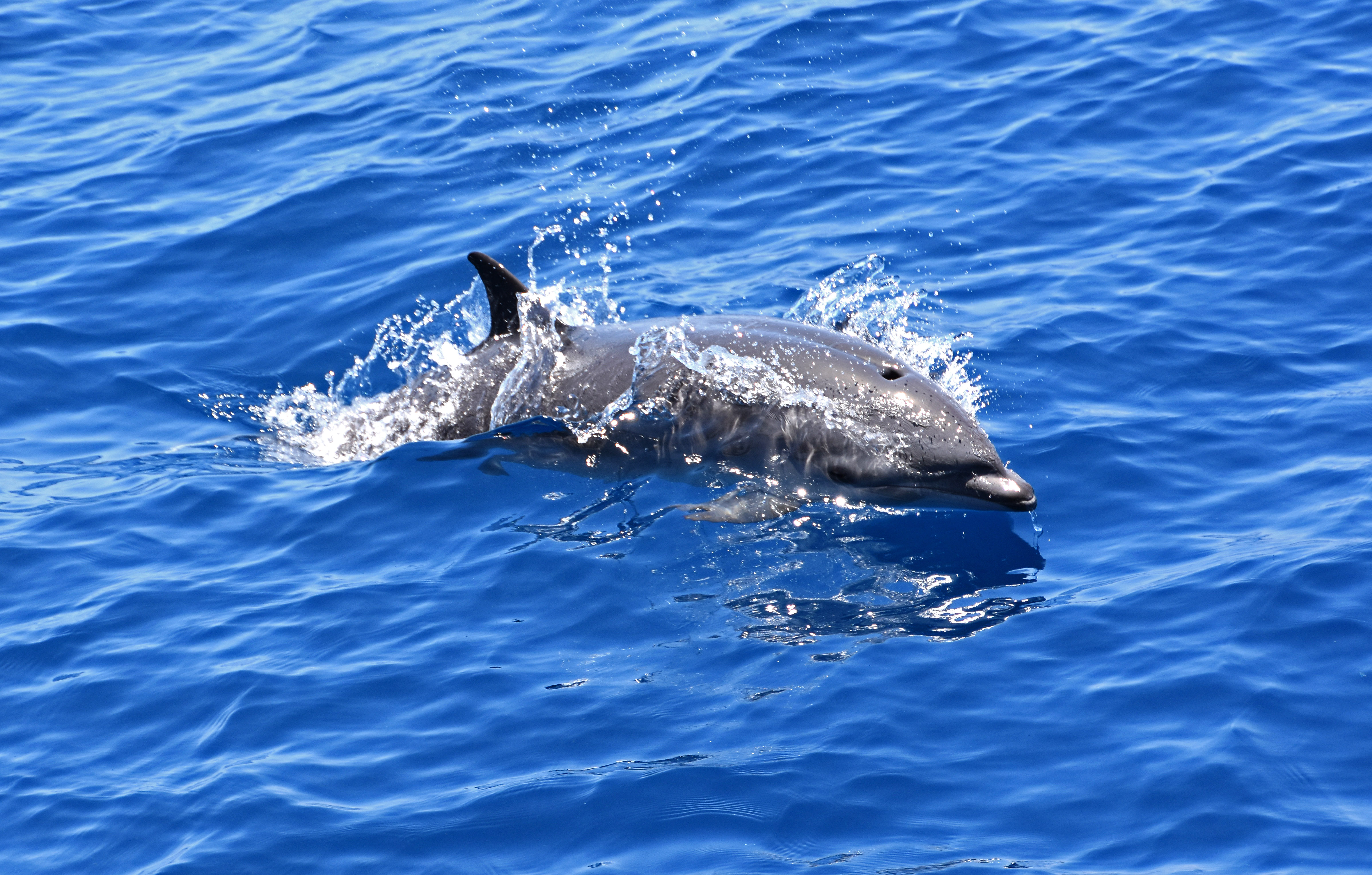
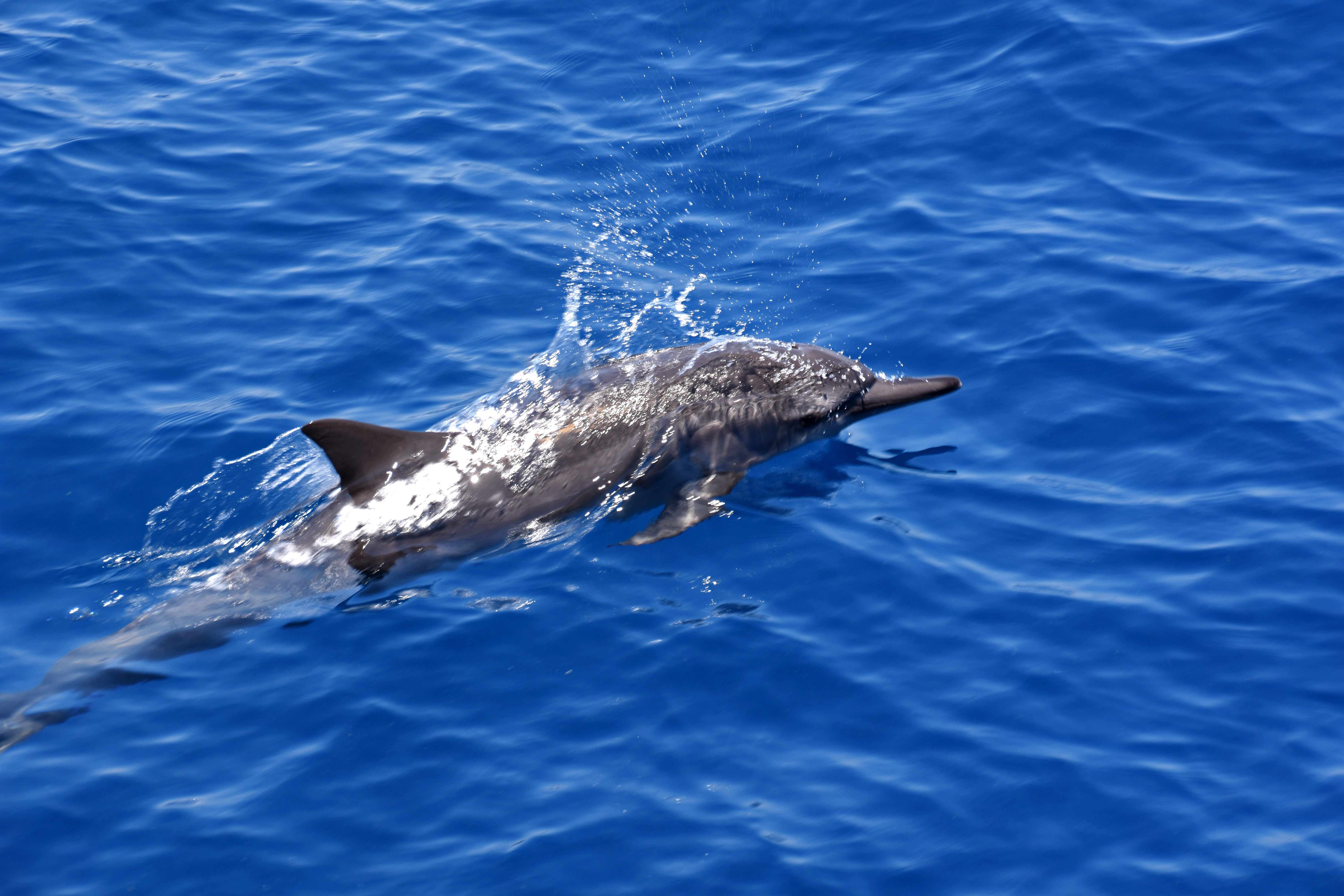
We did not have to wait long and were rewarded with sighting of a number of dolphins species, including: Frazer’s, Pantropical spotted and Spinner dolphins.
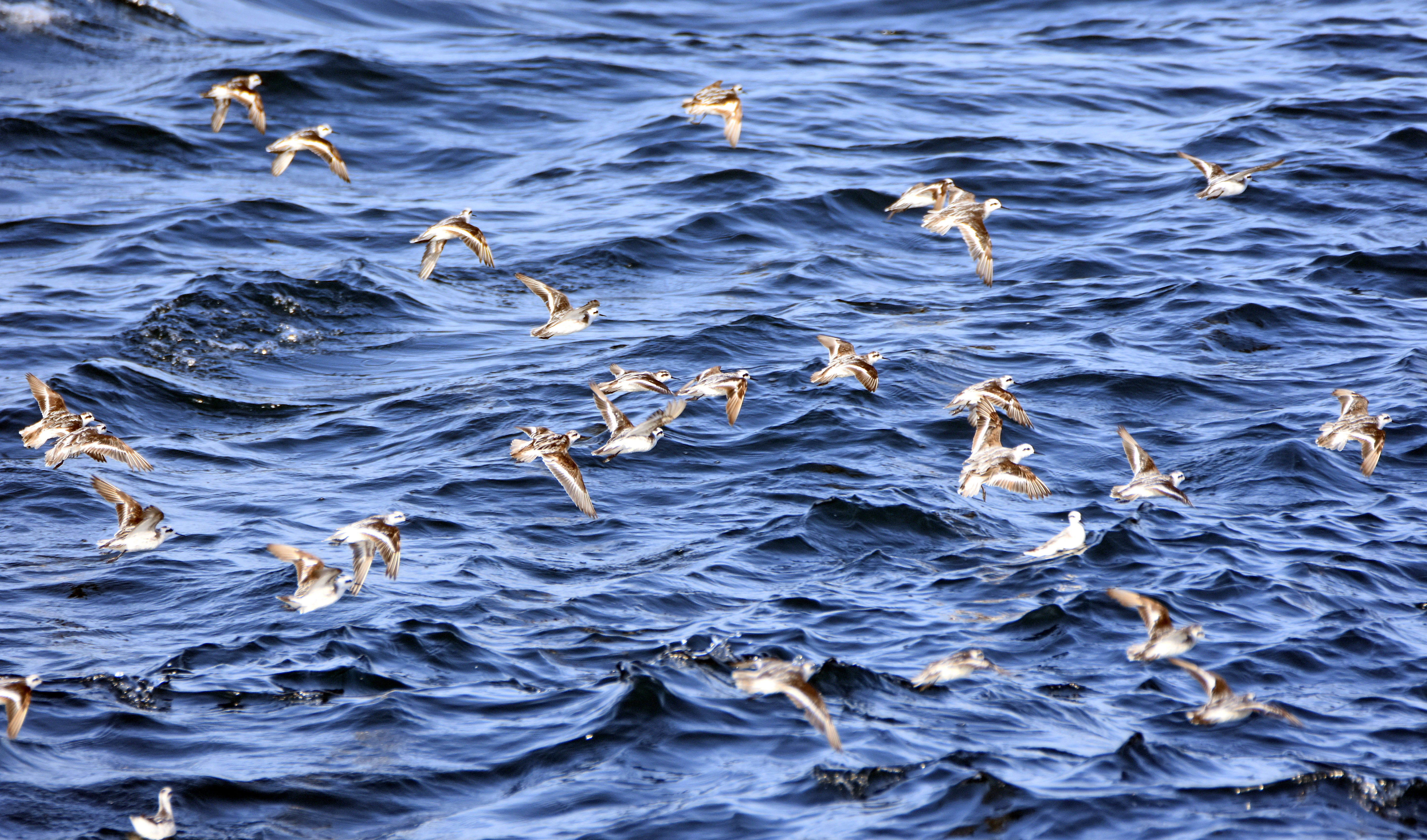
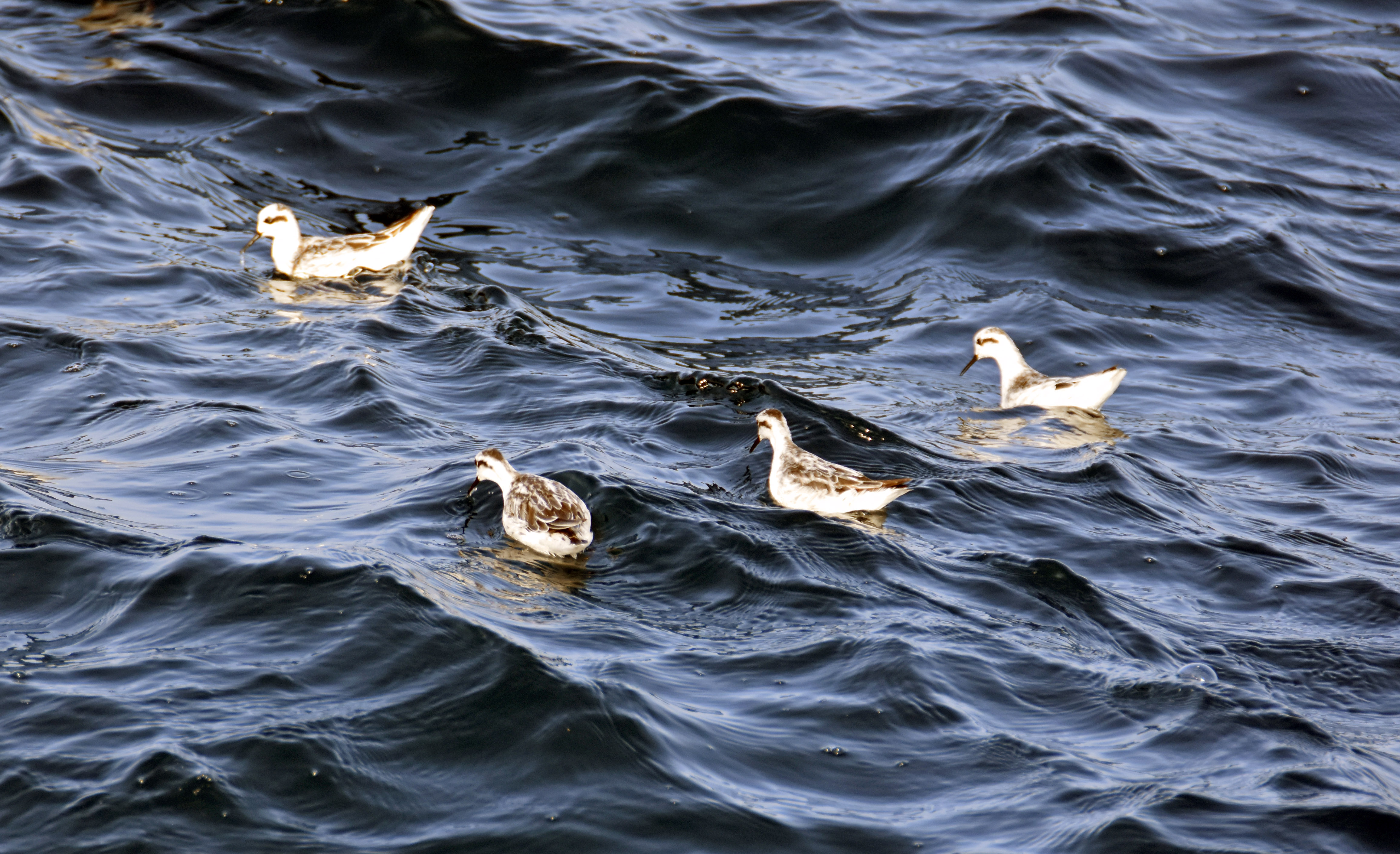
There were also lots of sea birds, especially Red-footed and Brown boobies, which I will save for a separate blog! One species which was very abundant, was the red-necked phalarope (Phalaropus lobatus). This little wader spends the northern winter in these tropical waters and we came across flock after flock of these birds (below). They seemed to me to be wonderfully adapted to oceanic life, bobbing away on the surface, pecking at tiny marine invertebrates.
Red-necked phalaropes (Phalaropus lobatus)Red-necked phalaropes (Phalaropus lobatus) feeding at the surface
It was very interesting to sail along the northern coast of Sumbawa, which seemed to be largely uninhabited, past the huge volcano of Tambora (2,851m). It exploded in 1815 in what was the largest volcanic explosion in recorded history!
Mt Tambora on Sumbawa Island, Indonesia
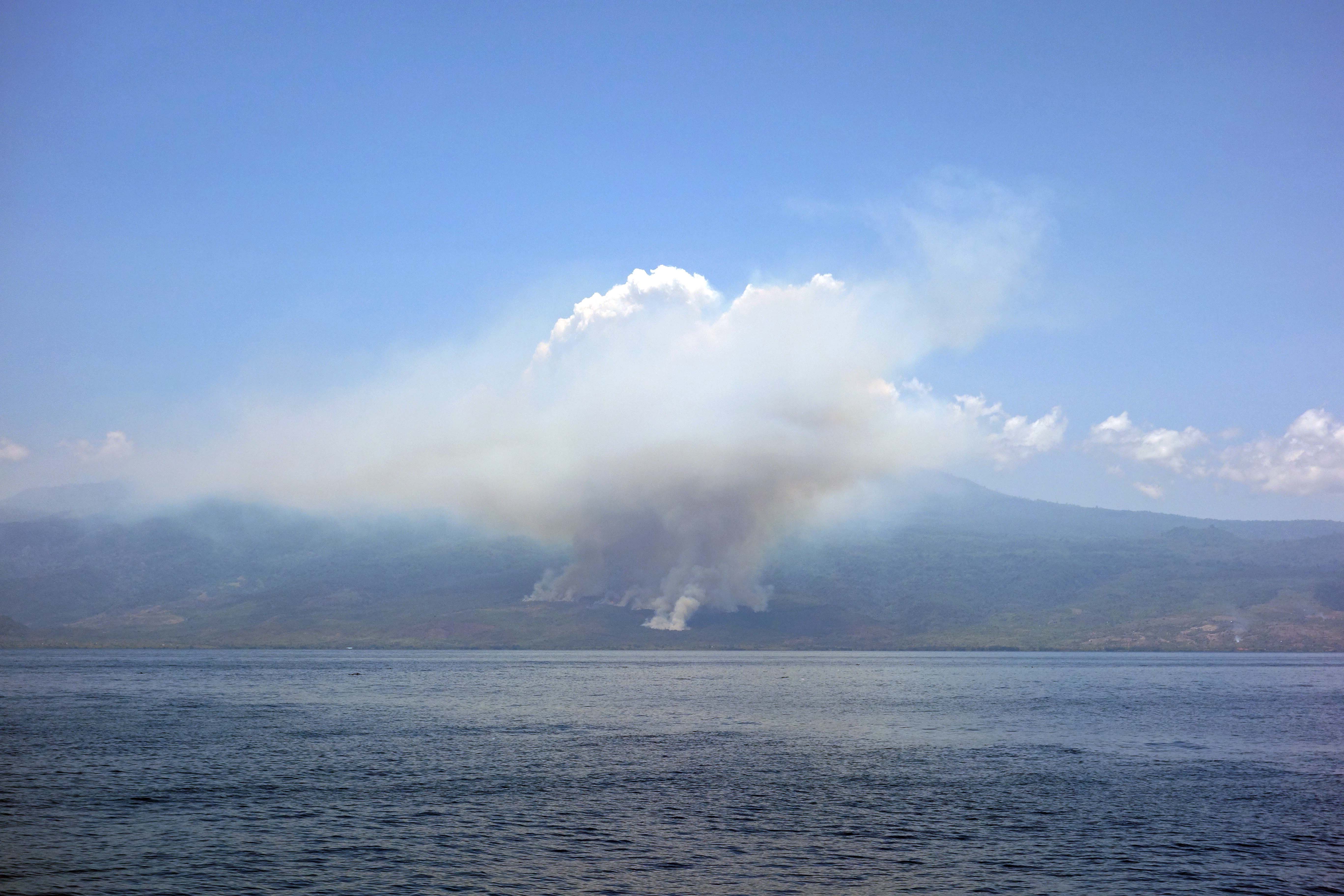
Although this part of Sumbawa looked very unpopulated, there was alas, evidence of burning, which was disappointing to see.
Burning on Sumbawa in October 2016
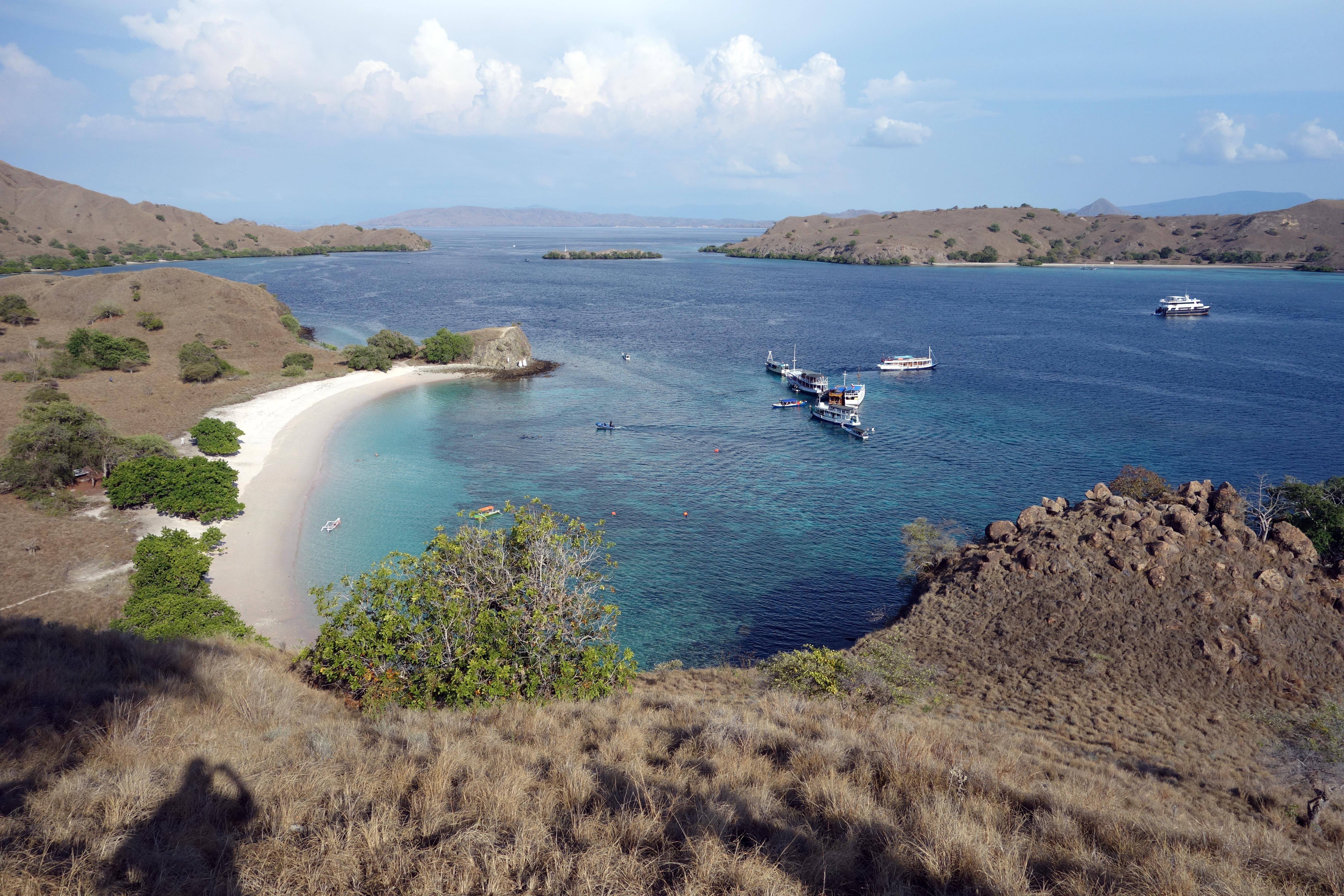
The highlight of the trip was of course the Komodo National Park, which fully lived up to expectations. There were lots of opportunities for snorkelling, usually once or twice a day, as well as excursions on islands in the archipelago that lies between Sumbawa and Flores. The largest of these islands are Komodo and Rinca, and we were able to visit both of them. Although it was quite hot, it was nice to get off the ship and go bird watching on dry land for a change.
Going ashore on Komodo Is
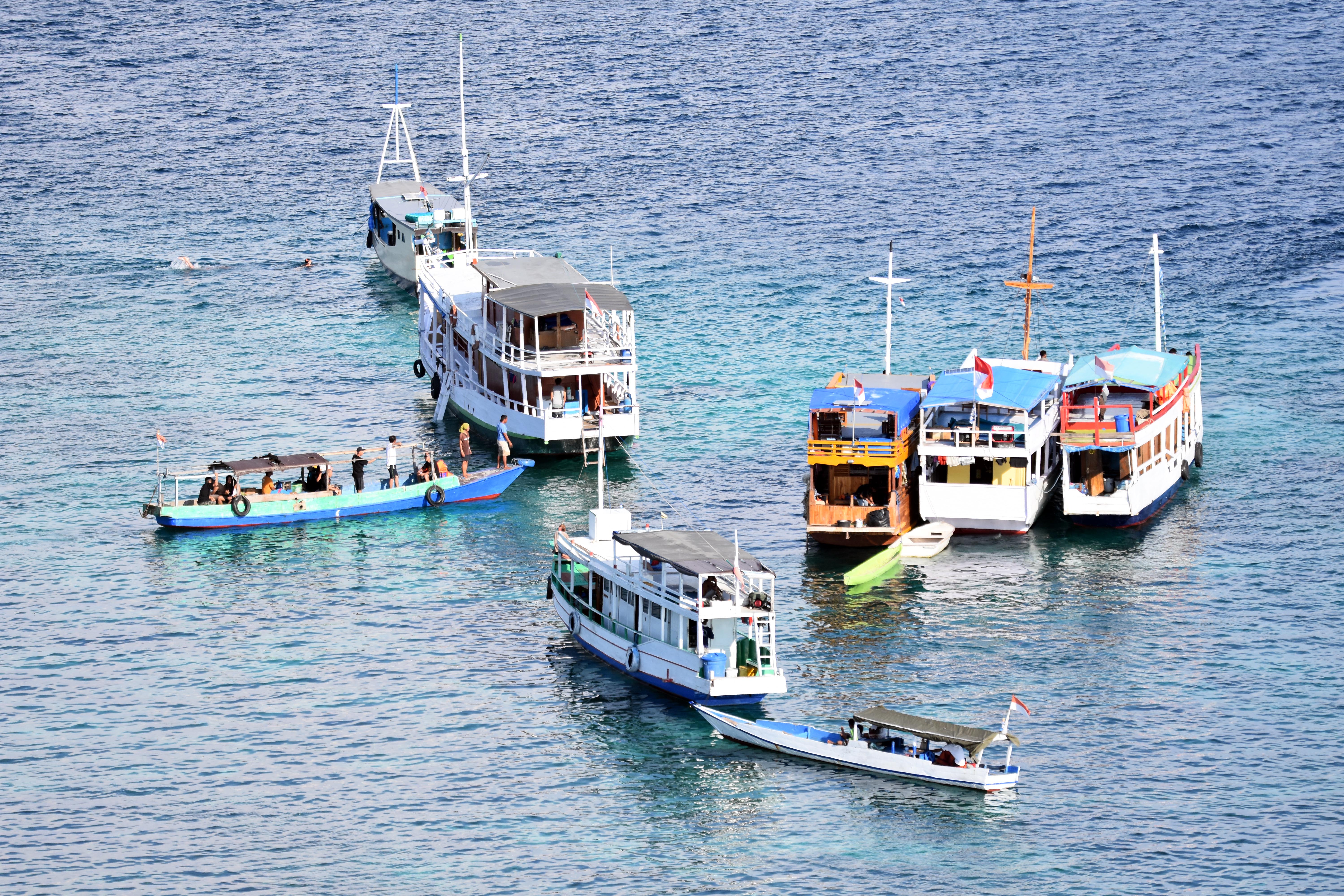
Most of the boats which visit these islands come from the nearby island of Flores, especially from Labuanbajo. I felt rather privileged to be on our smart little ship, although I guess we were paying for it!
Local tourist boats off Komodo
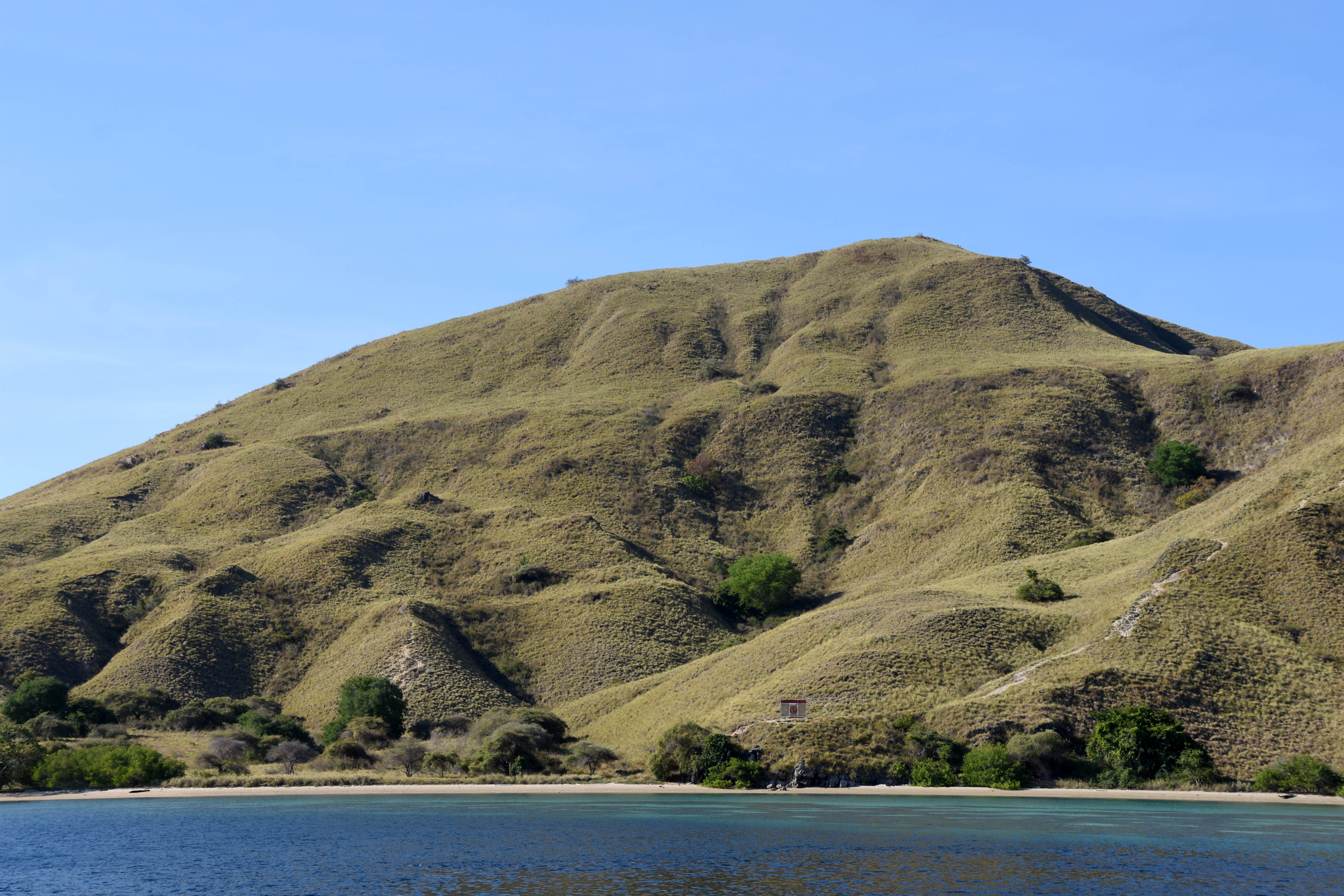
I particularly enjoyed walking about on the tiny island of Gili Lawa, just north of the main Komodo island.
Gili Lawa Island
Here we saw a number of birds, including Collared kingfisher, Zitting Cisticola, Pied Bushchat and the rather beautiful, White-breasted Woodswallow (below).
White-breasted woodswallow (Artamus leucorynchus)
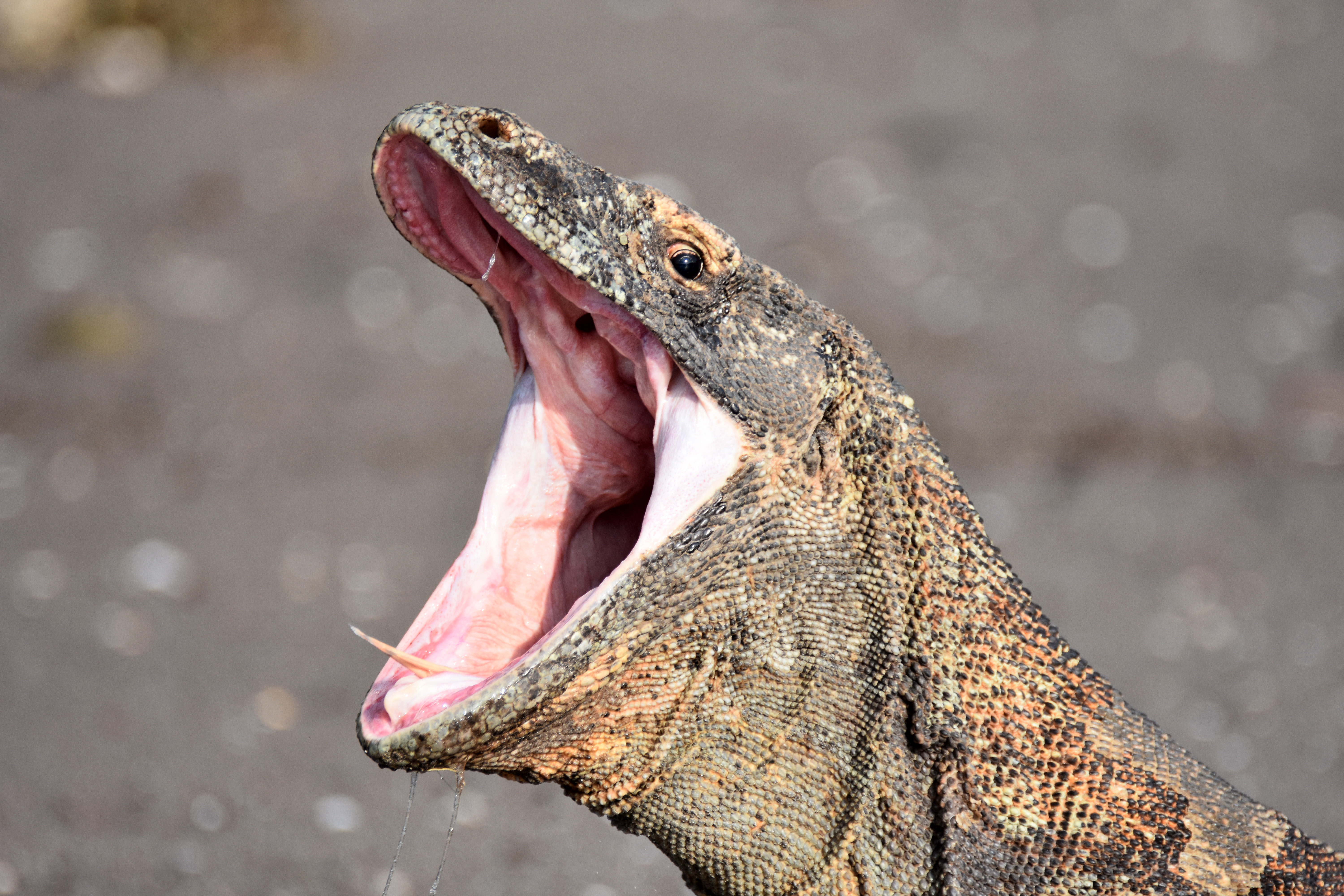
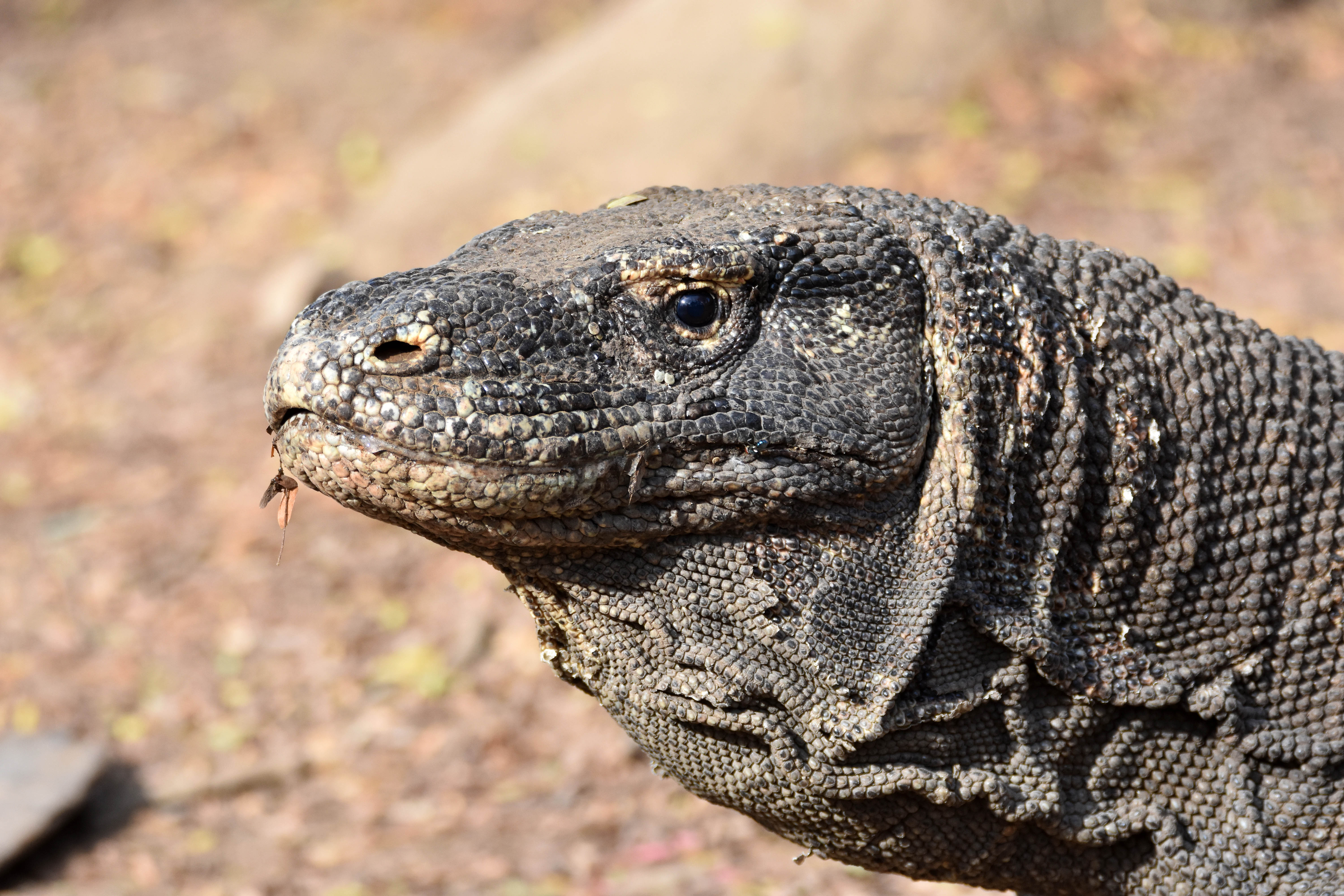
These were of course, sites were there were no Komodo dragons, otherwise it would not have been possible to wander about by ourselves (accompanied by a member of the crew). The first dragons we saw were on Rinca island. I have written about these reptiles in a separate blog on my Nature Notes site (4). They are impressive beasts, but not my favourite animal, although they cannot help the fact that they have poisonous saliva and carnivorous habits!
Komodo dragon (Varanus komodoensis) on beach with mouth open
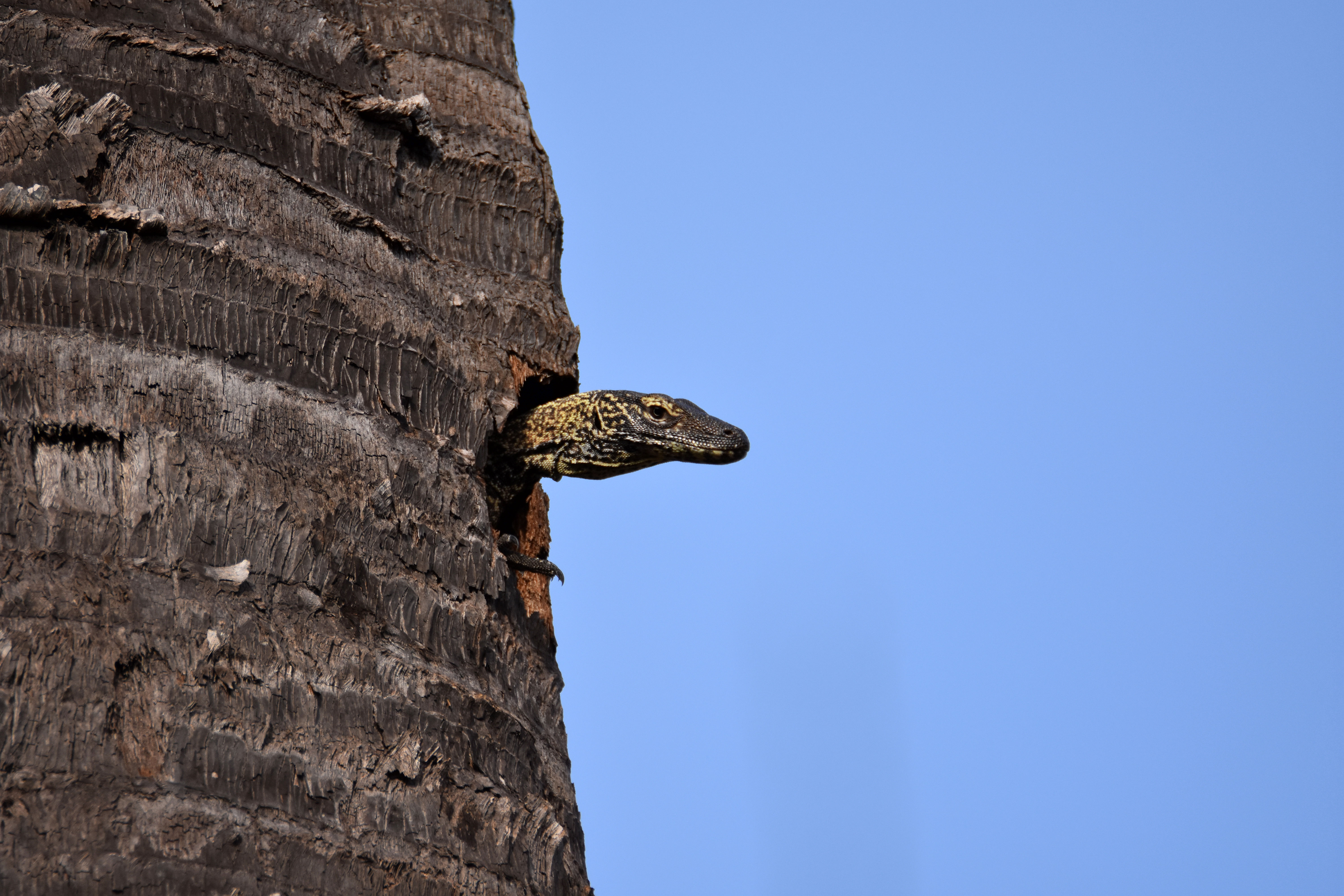
The young dragons were somewhat more appealing, until we saw one kill a rat and swallow it whole! They themselves live in trees to avoid being swallowed whole by the large dragons. You see what I mean about them not being very cuddly!
Baby Komodo dragon in a palm tree.
You are well looked after by guides and guards when you go ashore on Rinca and Komodo Islands. They walk in front and behind you carrying sticks to ward off any overly curious dragons. But for the most part, the dragons seemed to recognise that tourists were not their usual prey item, or perhaps they just weren’t hungry! People do live in villages on these islands, alongside the dragons. Not something I would like to do, I must confess.
Local guide on Komodo Is
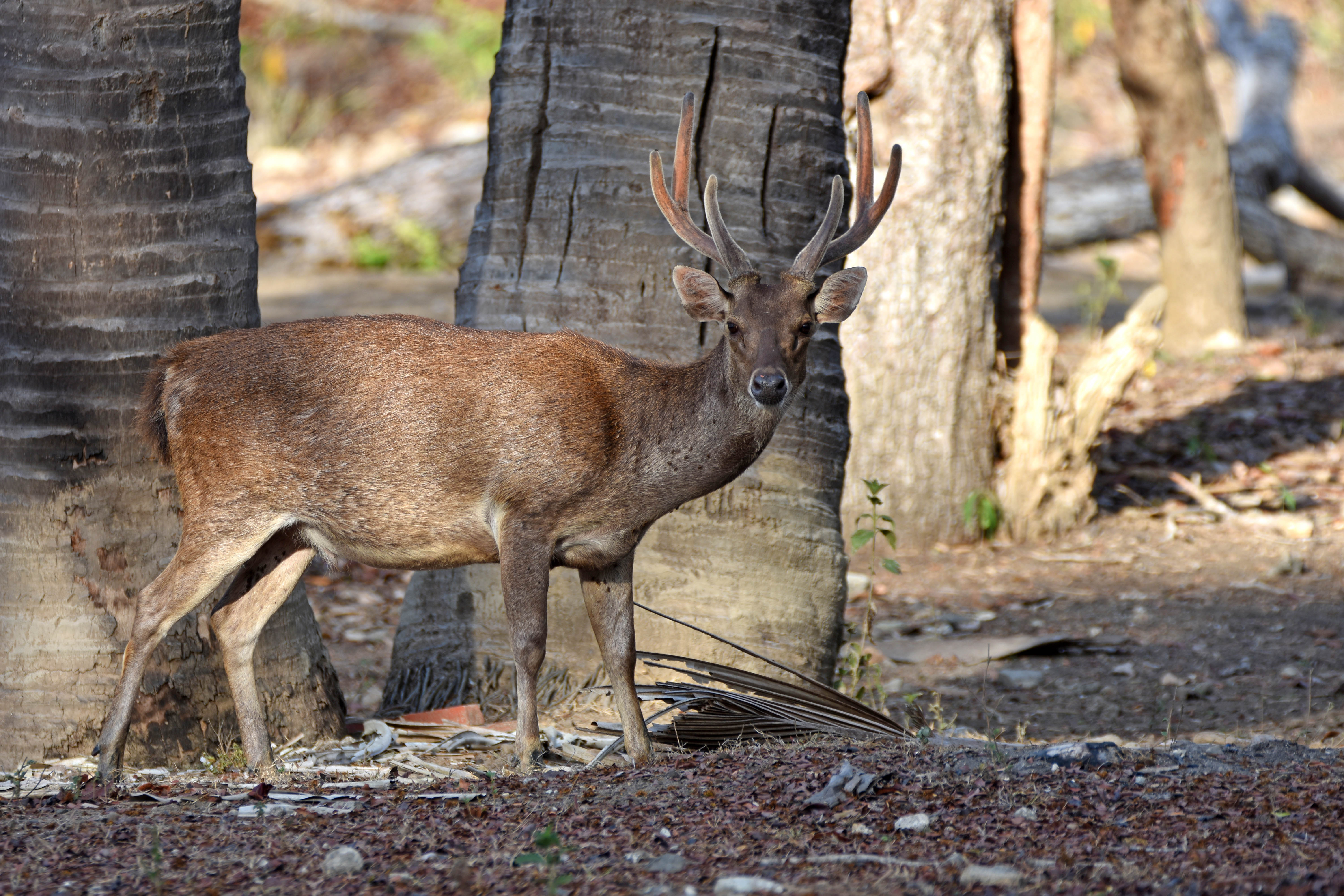
What the Komodo dragons do like to eat, together with water buffalos, are the endemic Timor Deer. I felt rather sorry for these beautiful creatures, but perhaps it is just the old and sick ones which get taken. They did not seem at all concerned about the presence of the dragons.
Timor deer on Rinca Island
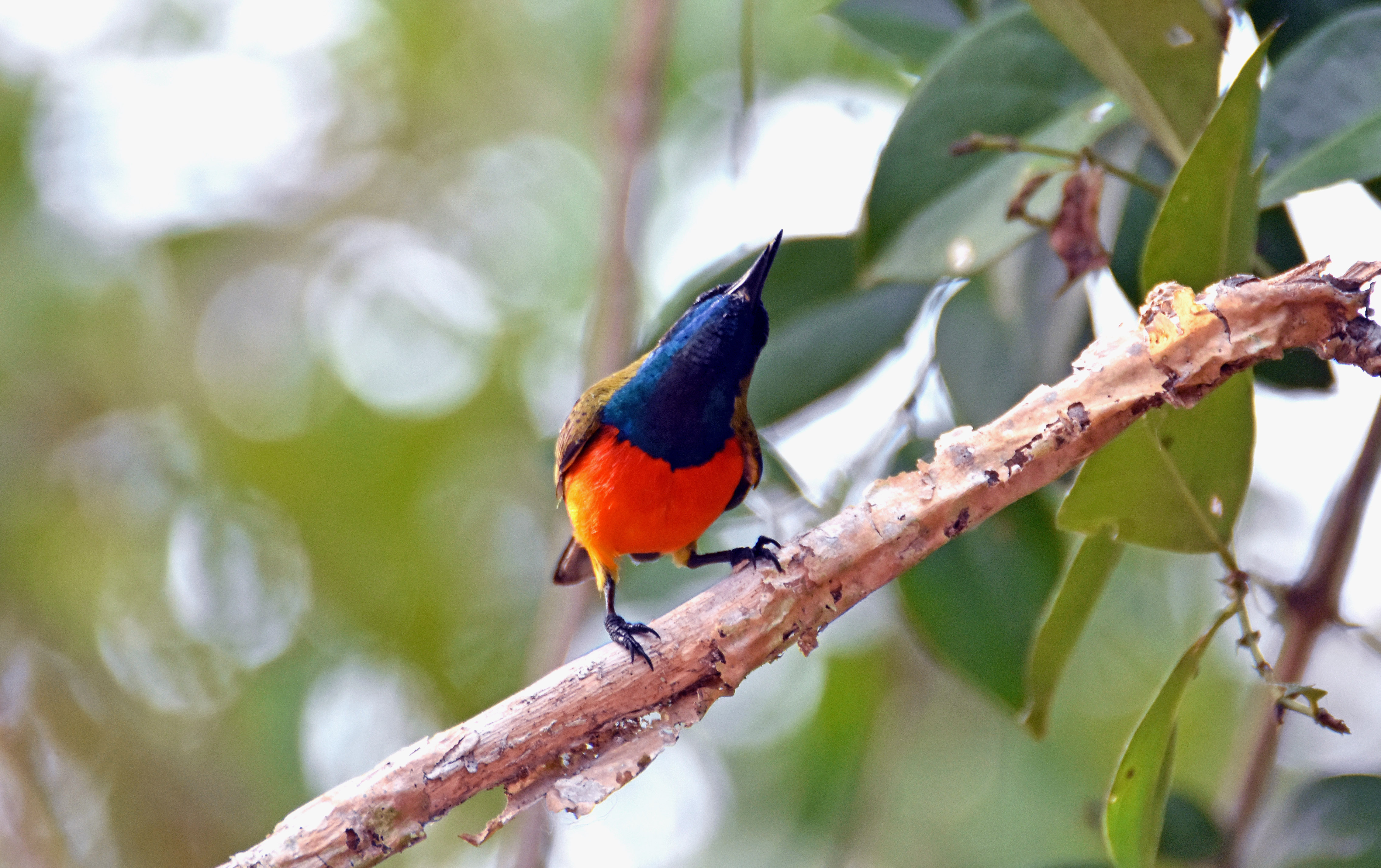
These islands are quite dry but nevertheless support a good many bird species. One of the highlights for me was the Flame-breasted sunbird. This one did not stay around for very long, just long enough for me to grab a quick shot of it before it flew off.
Flame-breasted sunbird (Cinnyris solaris)
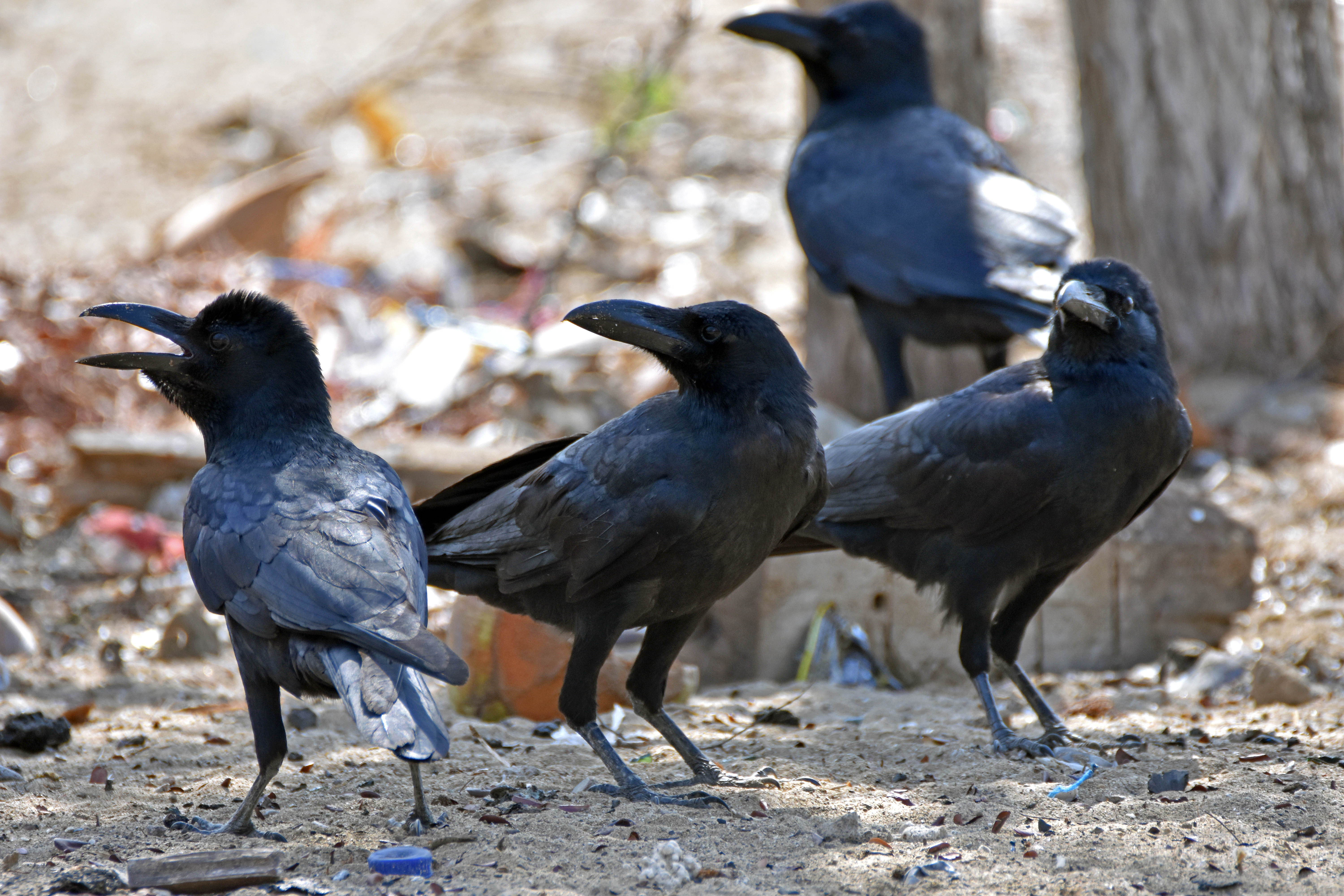
One very noisy and garrulous inhabitant of these islands, are the Jungle or Large-billed crows. These large members of the crow family really have attitude! They strut around like they owned the place; perhaps they do!
Jungle or Large-billed crow (Corvus macrorhynchos)
They did not look as though they were at all concerned to be living on an island with dragons. They are obviously too fast and able to fly off before any dragon could catch them.
Komodo dragon (Varanus komodoensis) on Komodo
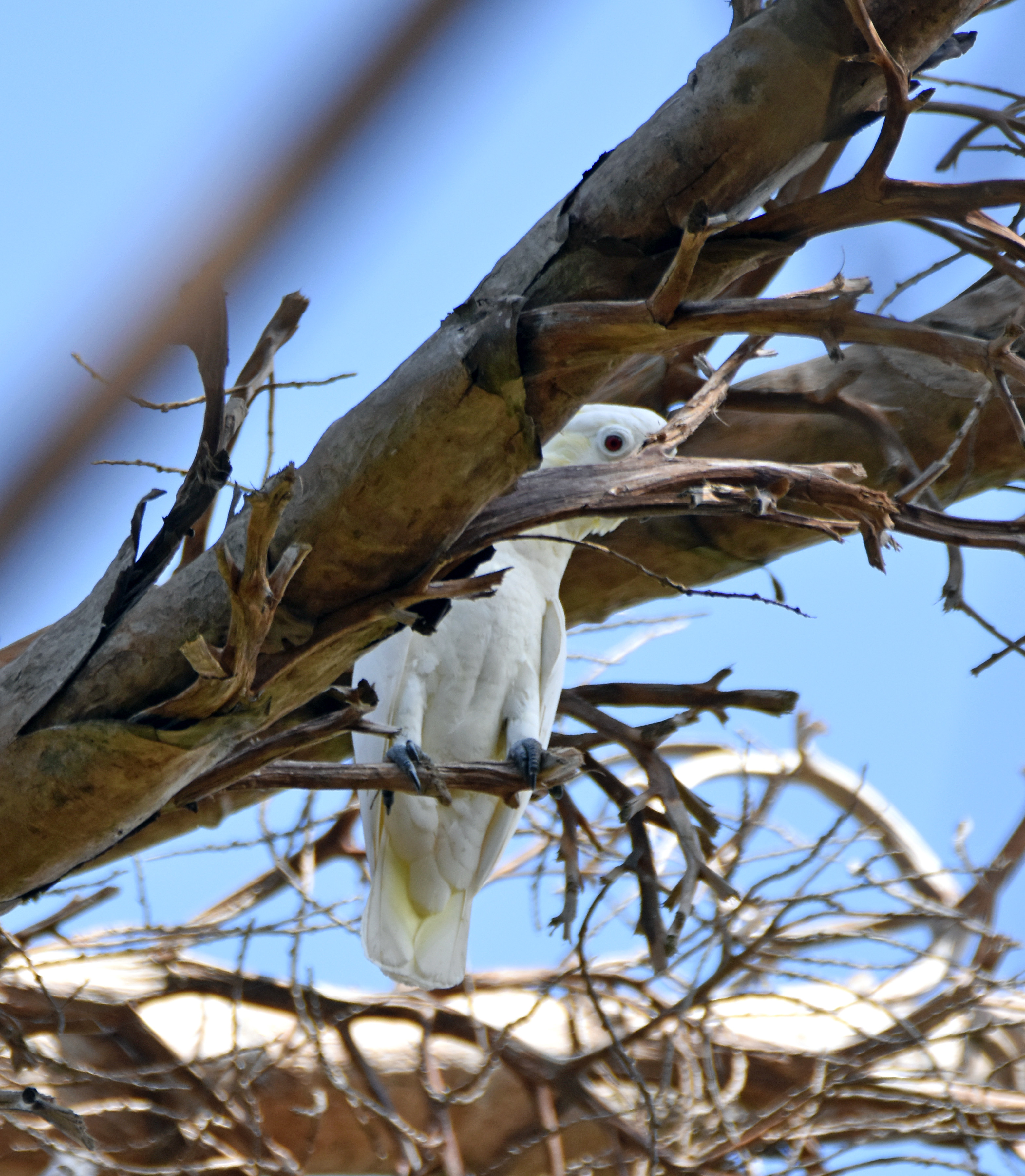
It was also nice to see plenty of Yellow-crested cockatoos on Komodo Is, although they were a little shy. Here’s one peeping through the trees (below)! These birds have been driven to local extinction in many parts of S E Asia by trapping for the pet trade. Here at least, they seem to well-protected and relatively abundant.
The yellow-crested cockatoo (Cacatua sulphurea) on Komodo
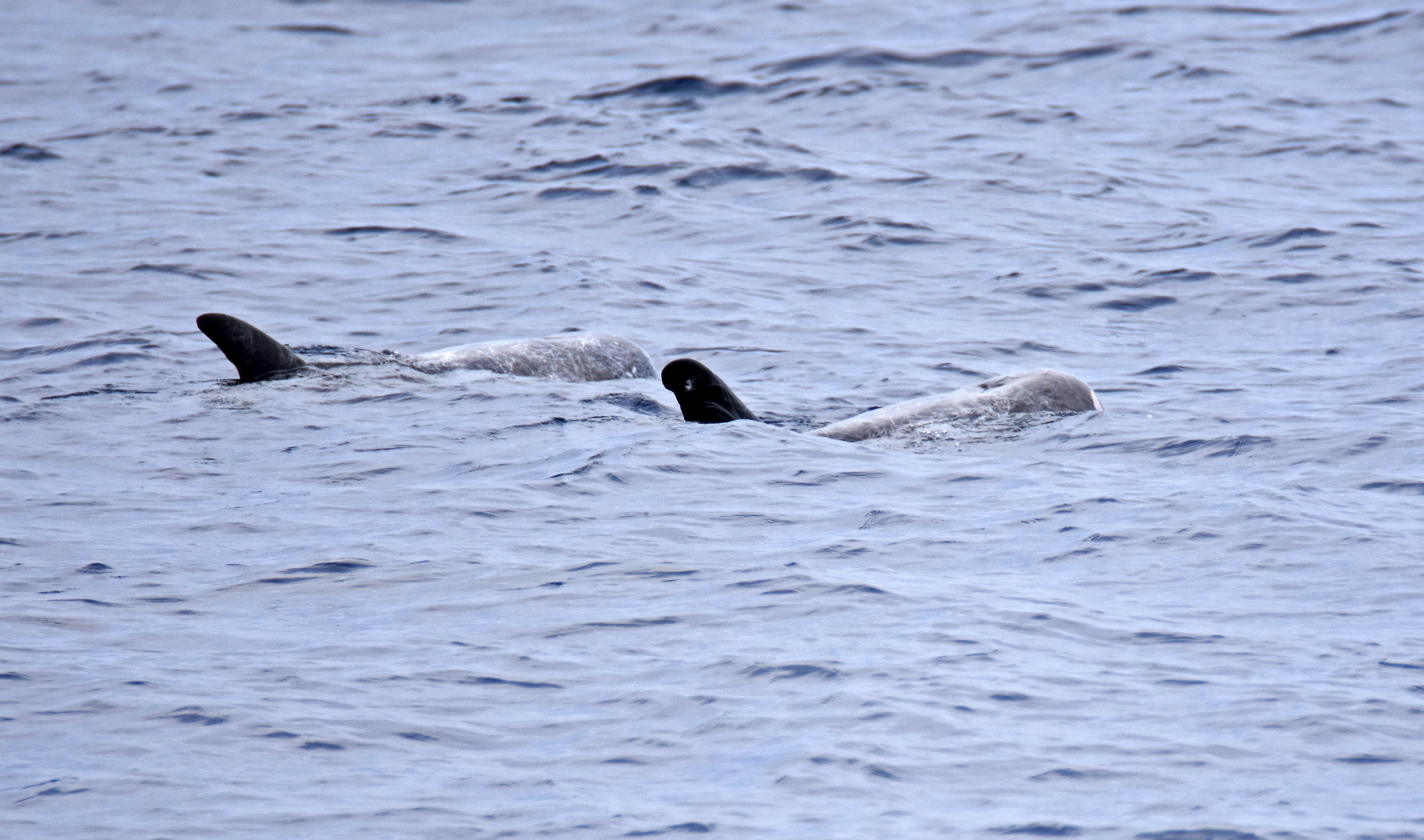
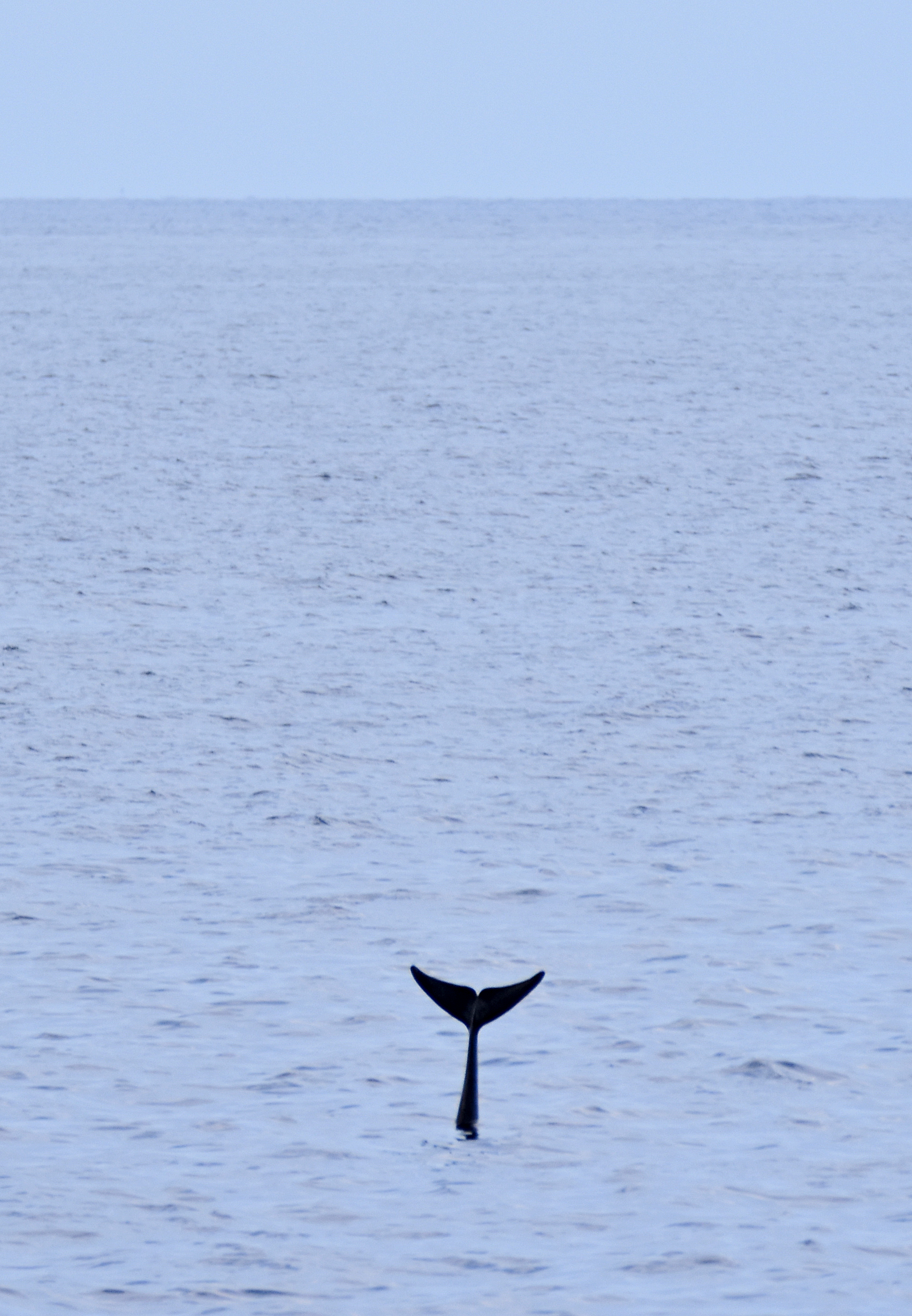
Finally, it was time to leave the Komodo national park and sail further east to our point of departure, at Maumere, on Flores. Not before we ventured south out into the open ocean, where we came across another sperm whale. We also came across the rather strange, highly scarred, Risso’s dolphin, which have a habit of waving their tails in the air. No doubt communication to each other, but what were they saying?
Risso’s dolphin (Grampus griseus) showing their highly scarred bodies – caused by fighting?Risso’s dolphin (Grampus griseus) tail waving
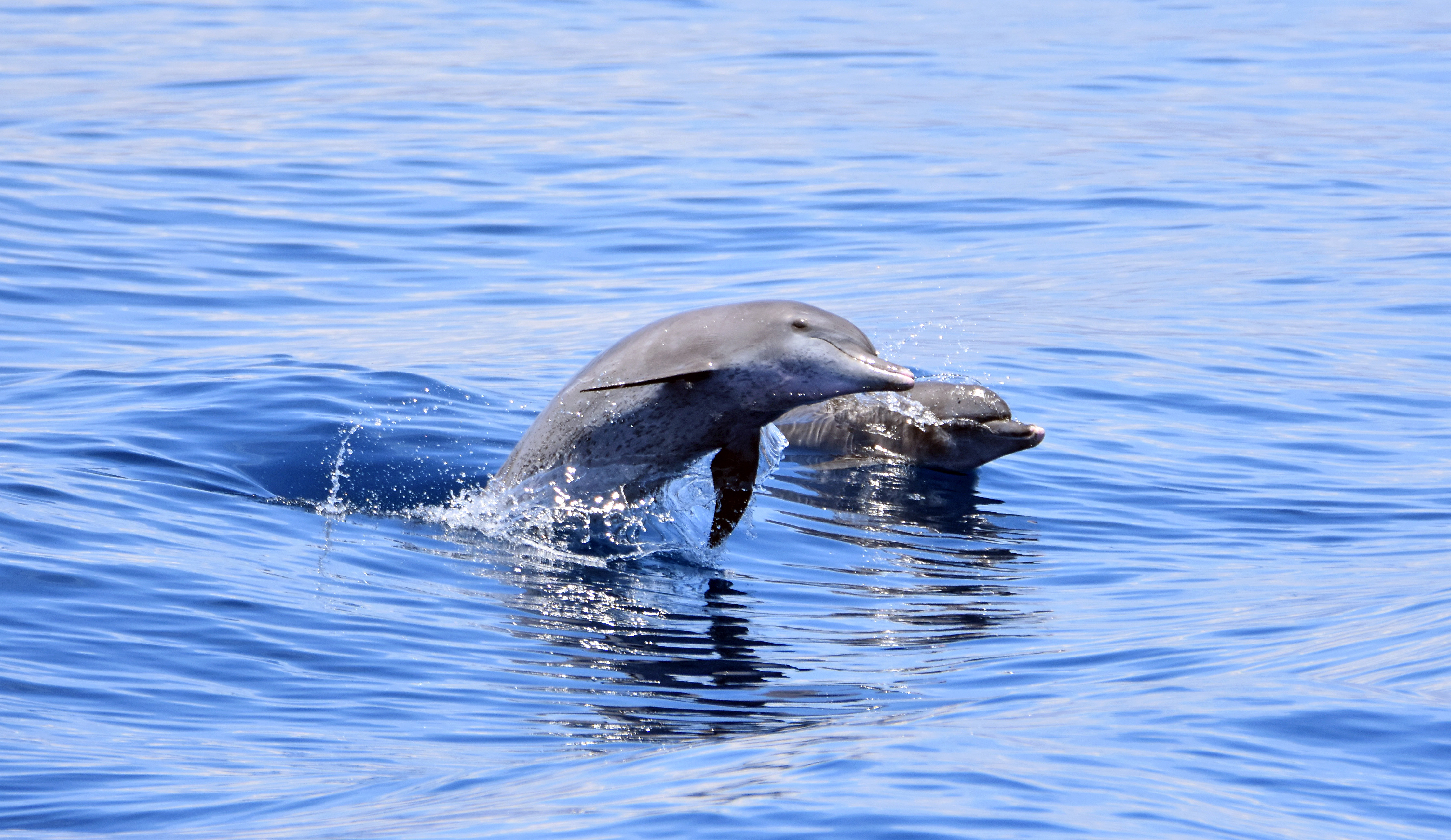
On they way back, cruising along the north coast of Flores we came across some Bottle-nosed dolphins. Sitting at the back of the ship I managed to get this lucky shot (below). Photographing dolphins is not easy! They are very fast-moving and I managed to miss them leaping out of the water on most occasions; but this time I got lucky.
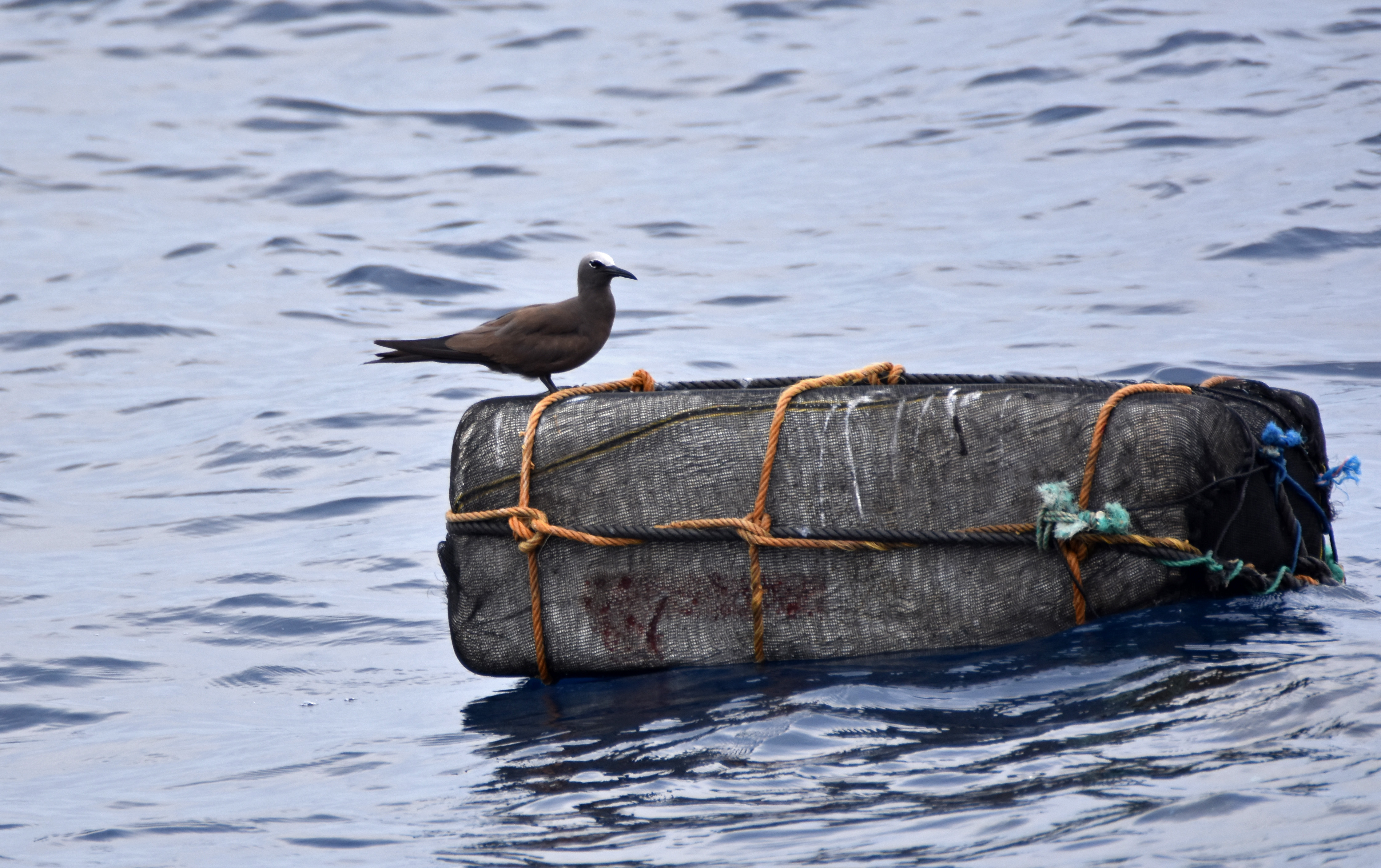
There were also some very nice Brown noodies sitting on fishing floats as we came into the port of Maumere.
Brown noody (Anous stolidus)
Dear reader, I hope you enjoyed this snap shot of my travels in this region, but I don’t want you to think it was a complete idyll. One of the persistent negatives was the ubiquitous presence of plastic pollution. We are filling up the seas with plastic and it is not a pretty sight. Even in the national park waters one came across plastic pollution and it is only going to get worse unless we take some drastic measures to stop producing plastic and discarding it carelessly. I’ll say no more. There are plenty of good websites devoted to highlighting this problem.
Plastic pollution
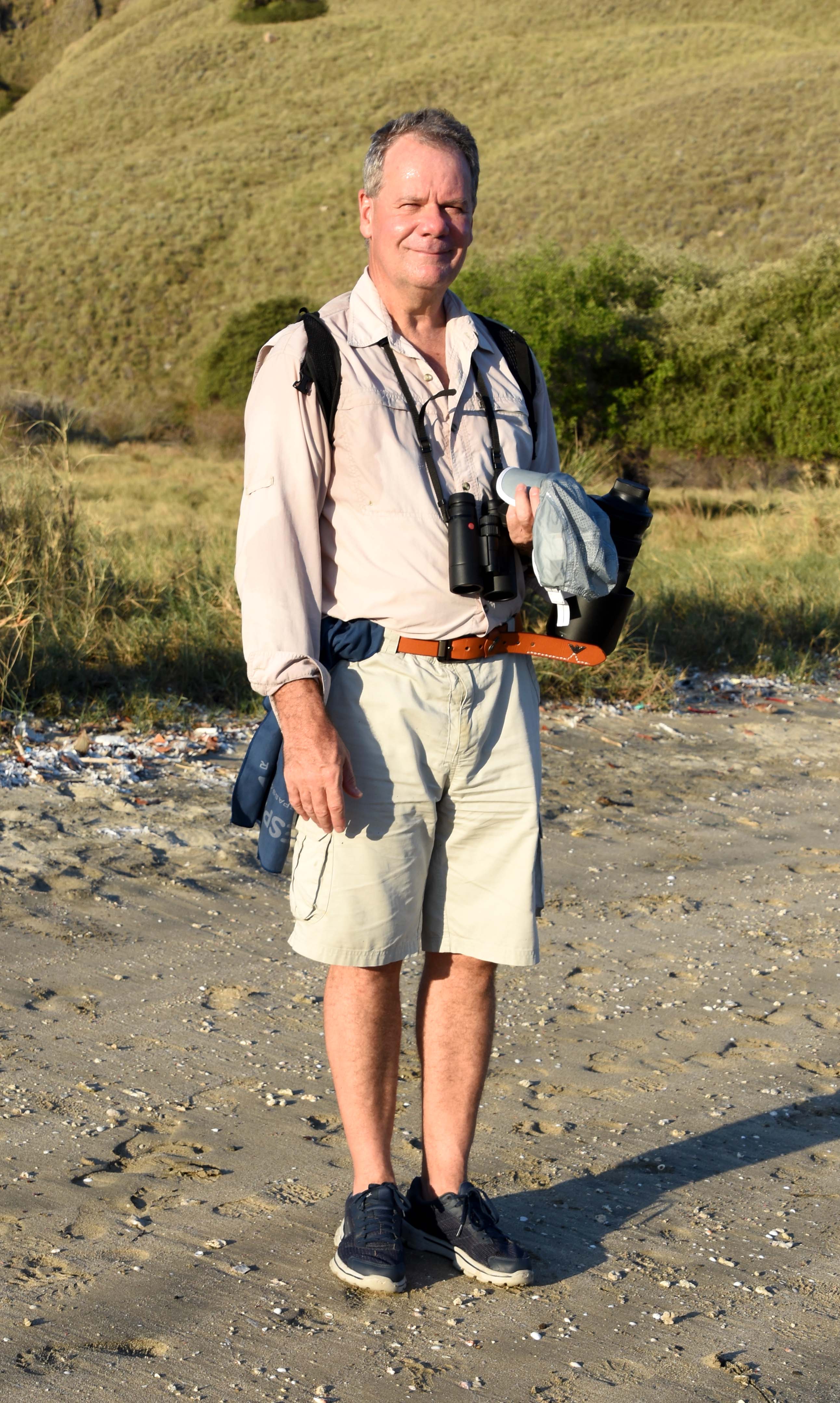
I would recommend a visit to Komodo NP. It is a world-famous location but was not over-run by tourists and from what I could see, the Indonesians seemed to be doing a good job of protecting and managing it. I’ll finish with a photograph of myself, looking hot but contented after a spell of bird-watching.
Like many people, I love going to the zoo, but I am also acutely aware that for many animals confinement must be a torture. The only justification then, for creatures which suffer from being locked up, must be that there is no habitat left for them, or they are threatened with severe poaching or extinction, so that they are being bred for eventual reintroduction.
Tibetan or Sichuan takin (Budorcas taxicolor tibetana) male – protected but still threatened by poaching
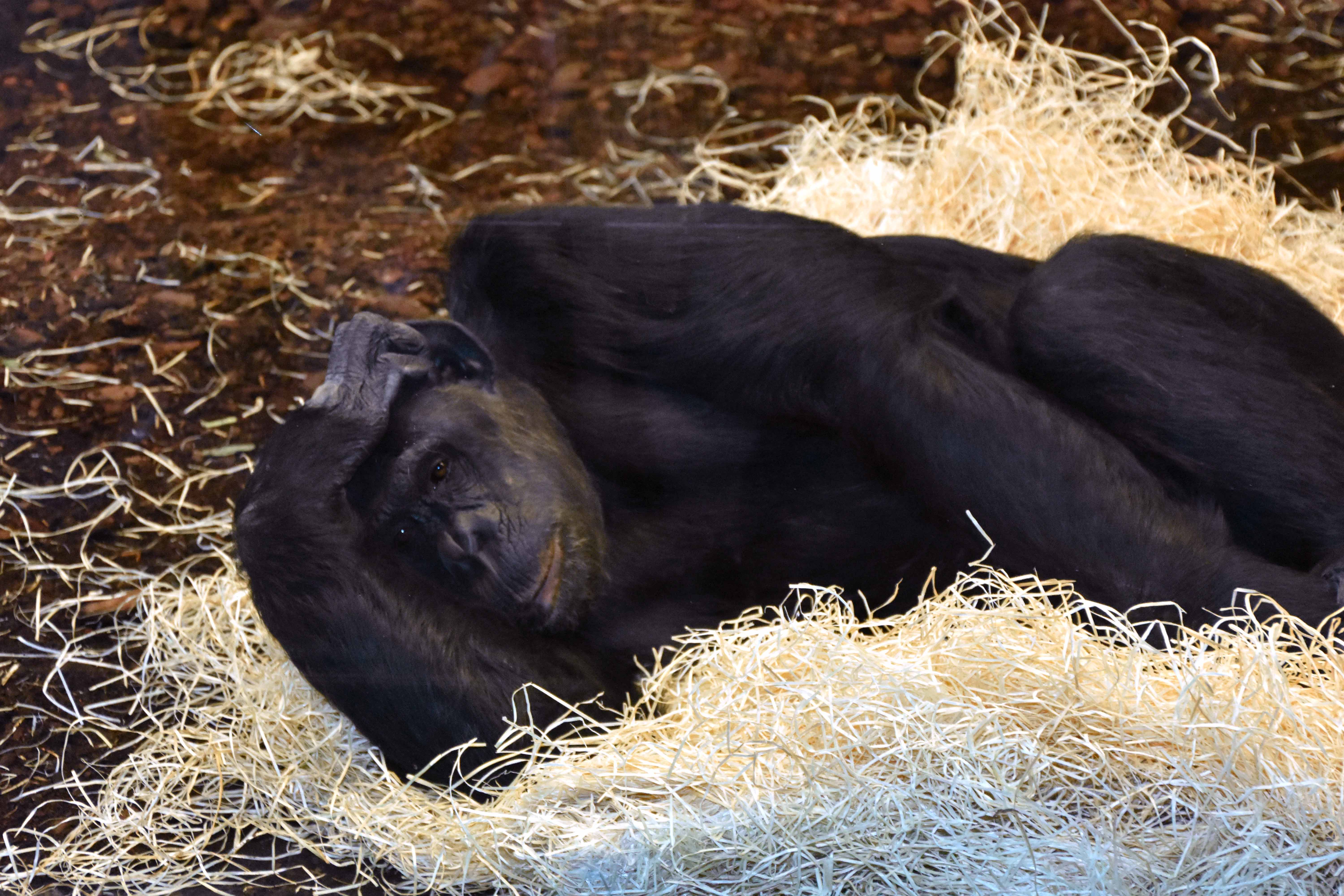
In the best zoos, animals are kept for our education and amusement. Hopefully, through awareness and a little education people become will become more concerned about the species they see and therefore more likely to help with their conservation. We are animals and we have a certain ability to empathize with other animals if we care to. There is also a lot of anthropomorphizing that goes on in zoos, but that is half the fun. It’s hard not to identify with the feelings of an animal like this chimpanzee, seemingly lost in its own thoughts, lying on a nice bed of straw.
Chimpanzee Berlin Zoo
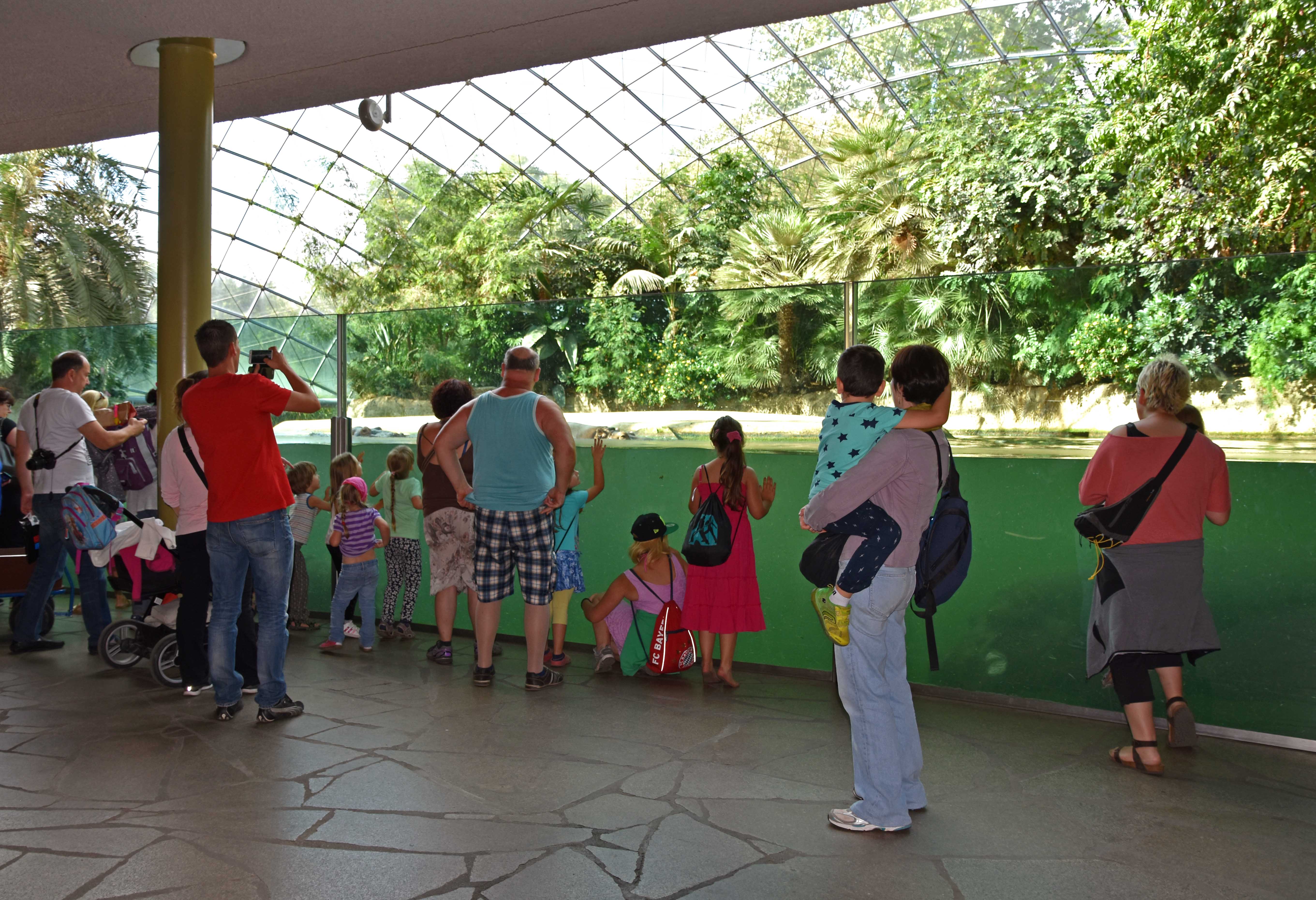
Any way, zoos are here to stay, and the good ones use their ticket money to do conservation work. Berlin Zoo is undoubtedly a fine zoo and one of the most visited in Europe with over 3 million entries per year (1). Their 18,600 animals look well looked after and they are quite innovative in how some of the animals are displayed. Like the hippos, which can be seen strolling along under water, through a glass-fronted panel on their pool (below). (2)
The hippo tank Berlin Zoo
Berlin Zoo was first opened in 1844, being the first zoo in Germany. The animals were donated by Frederick William IV, King of Prussia. The zoo was virtually destroyed during World War II, and reportedly only 91 of 3,715 animals survived (1). Fortunately, things have improved since those days and I would recommend it to anyone with an interest in animals.
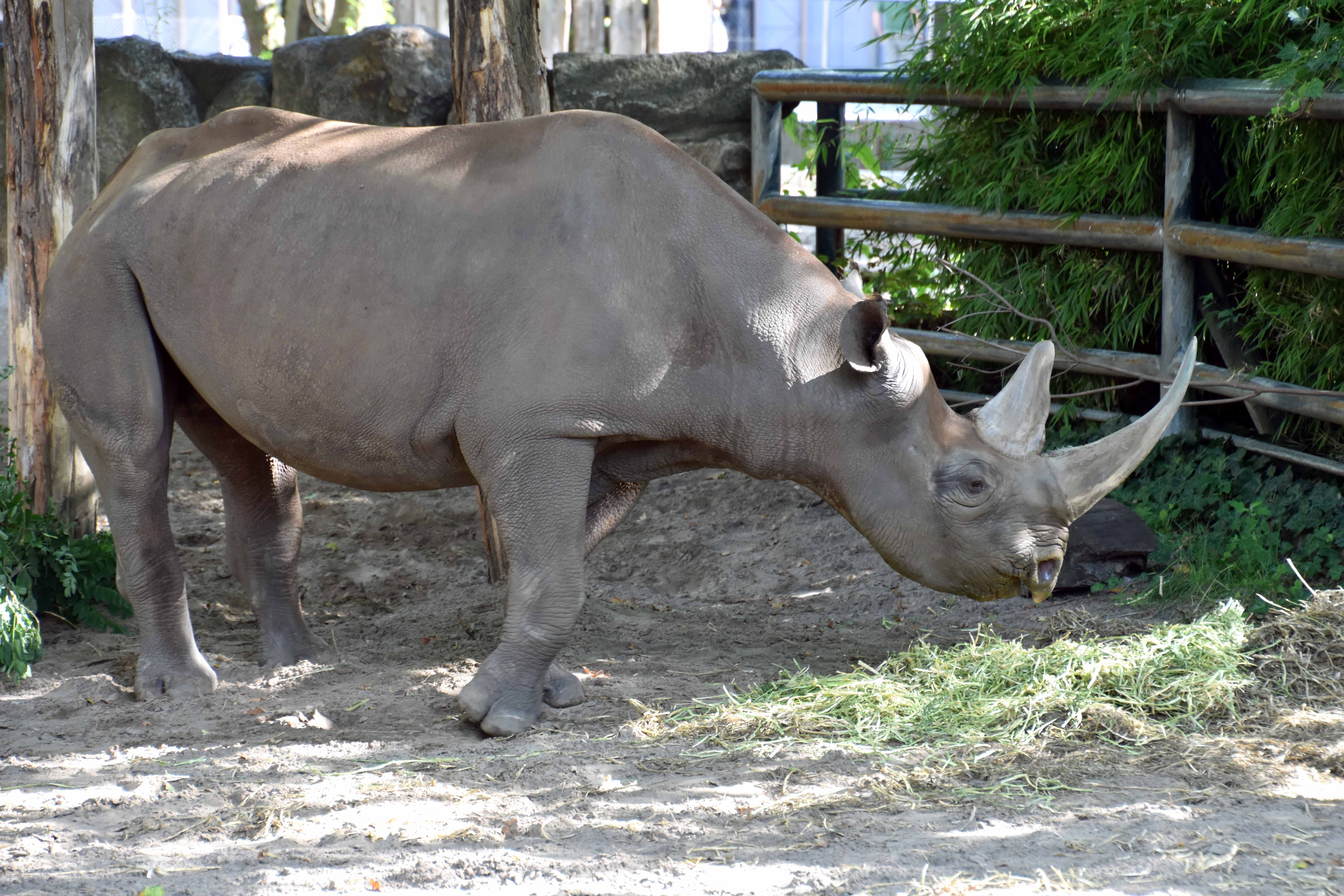
Black rhinos (Diceros bicornis) are critically endangered as a result of poaching for their horns. Despite the fact that the horn is just composed of keratin – the same as our hair and fingernails – there are enough stupid, superstitious and downright evil people around who will pay huge sums of money to get hold of it.
Black rhinoceros (Diceros bicornis) Berlin Zoo
Much of the demand for rhino horn is said to emanate from Vietnam (3), where depressingly, it is seen as a status symbol. The ignorance and stupidity of people – human beings – never ceases to amaze me. Anyway, at least this individual with his (or her?) beautiful horn is safe from the poachers.
Black rhinoceros (Diceros bicornis) Berlin Zoo
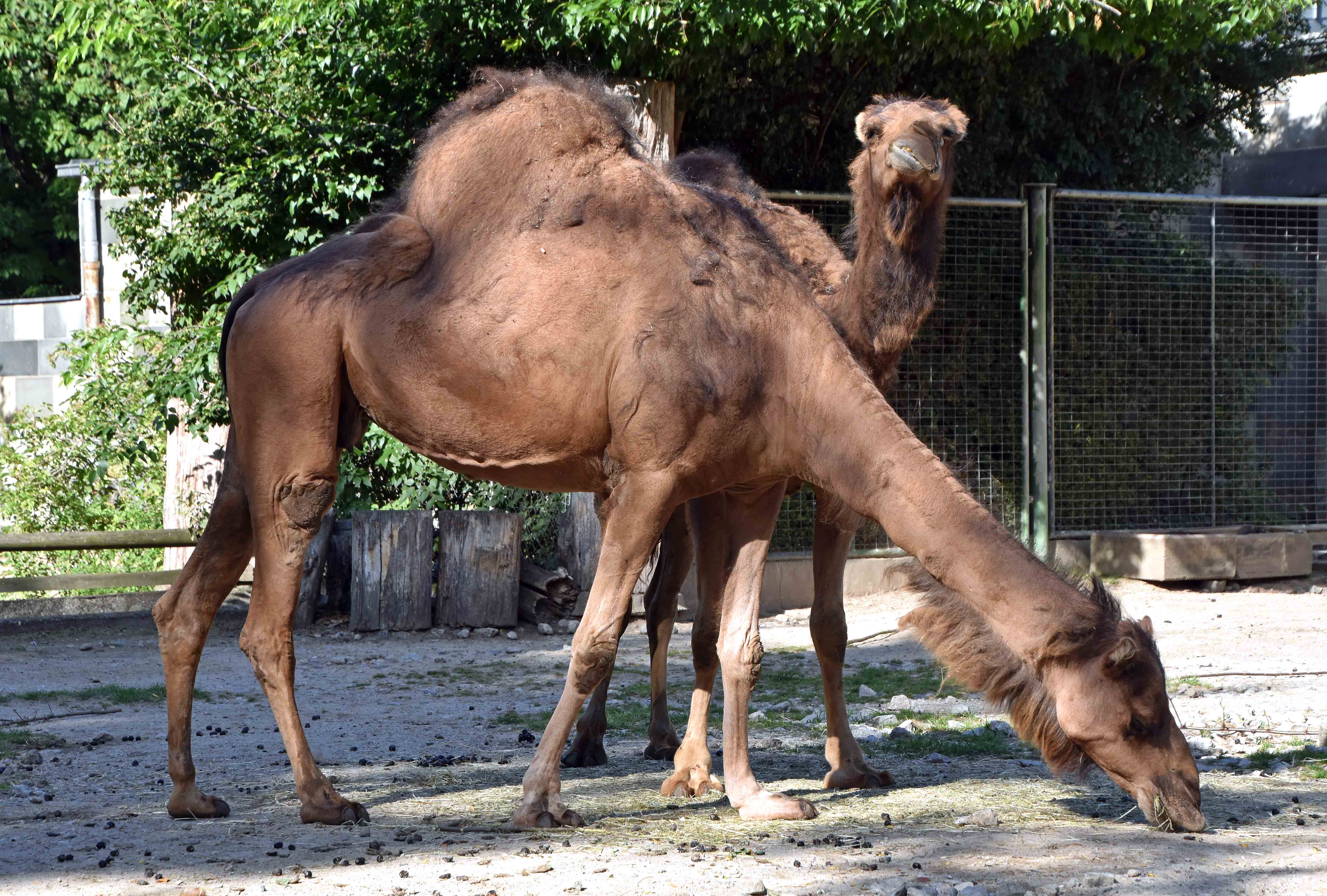
The Dromedaries or Arabian camels (Camelus dromedarius) looked happy enough.
Dromedary or Arabian camel (Camelus dromedarius) Berlin Zoo
When I passed by later I noticed the camels were having a bit of a lie down!
Dromedary or Arabian camel (Camelus dromedarius) lying down
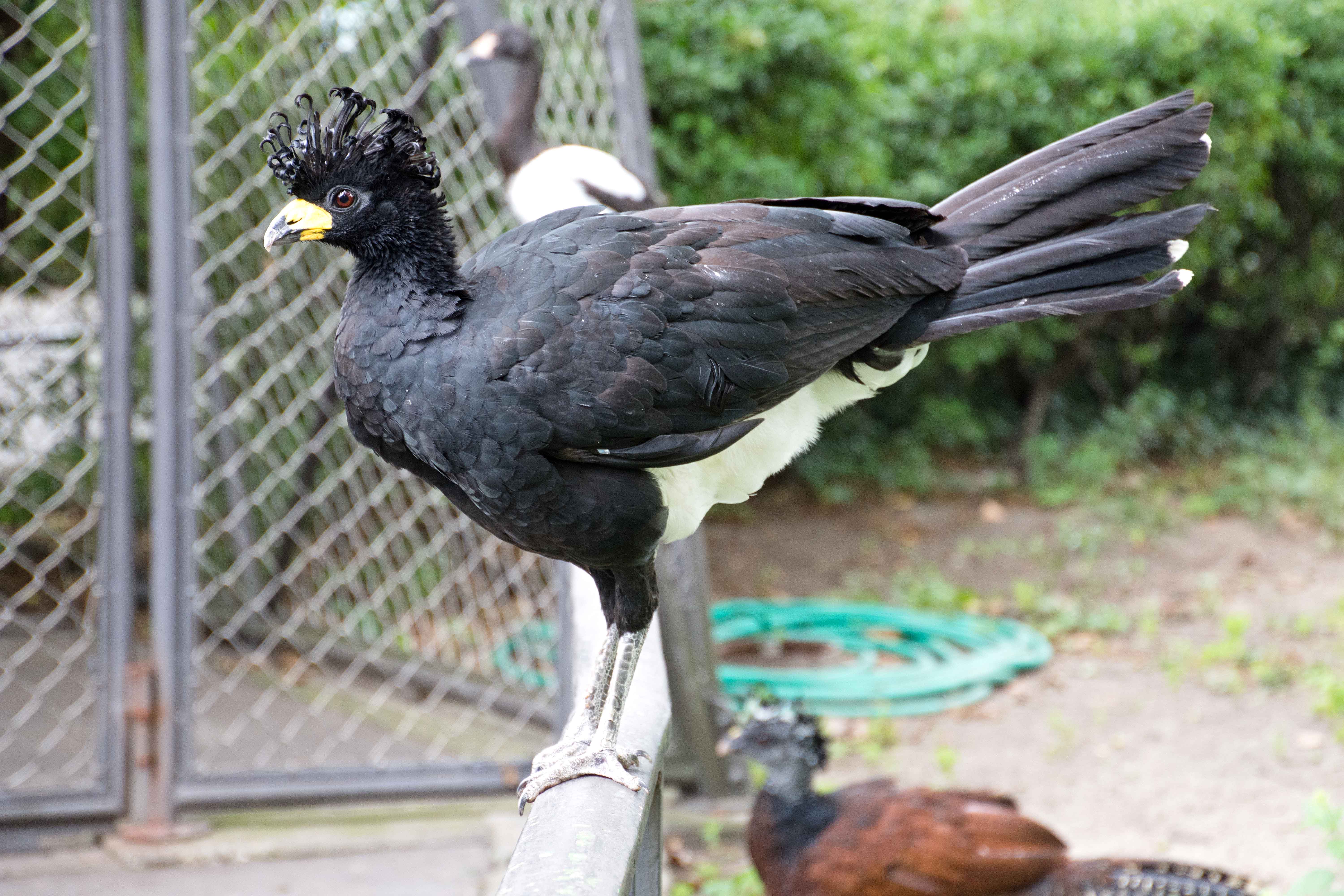
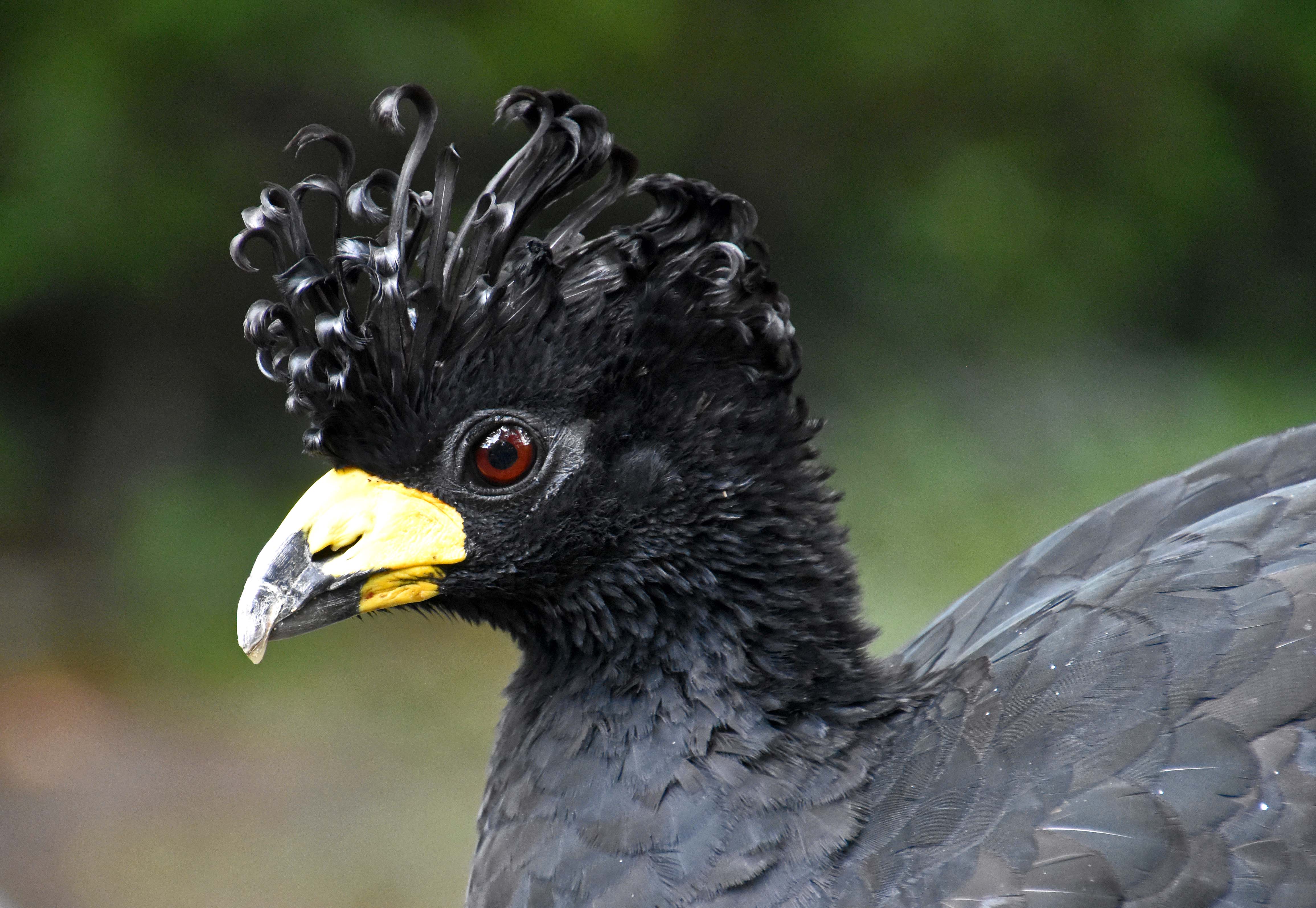
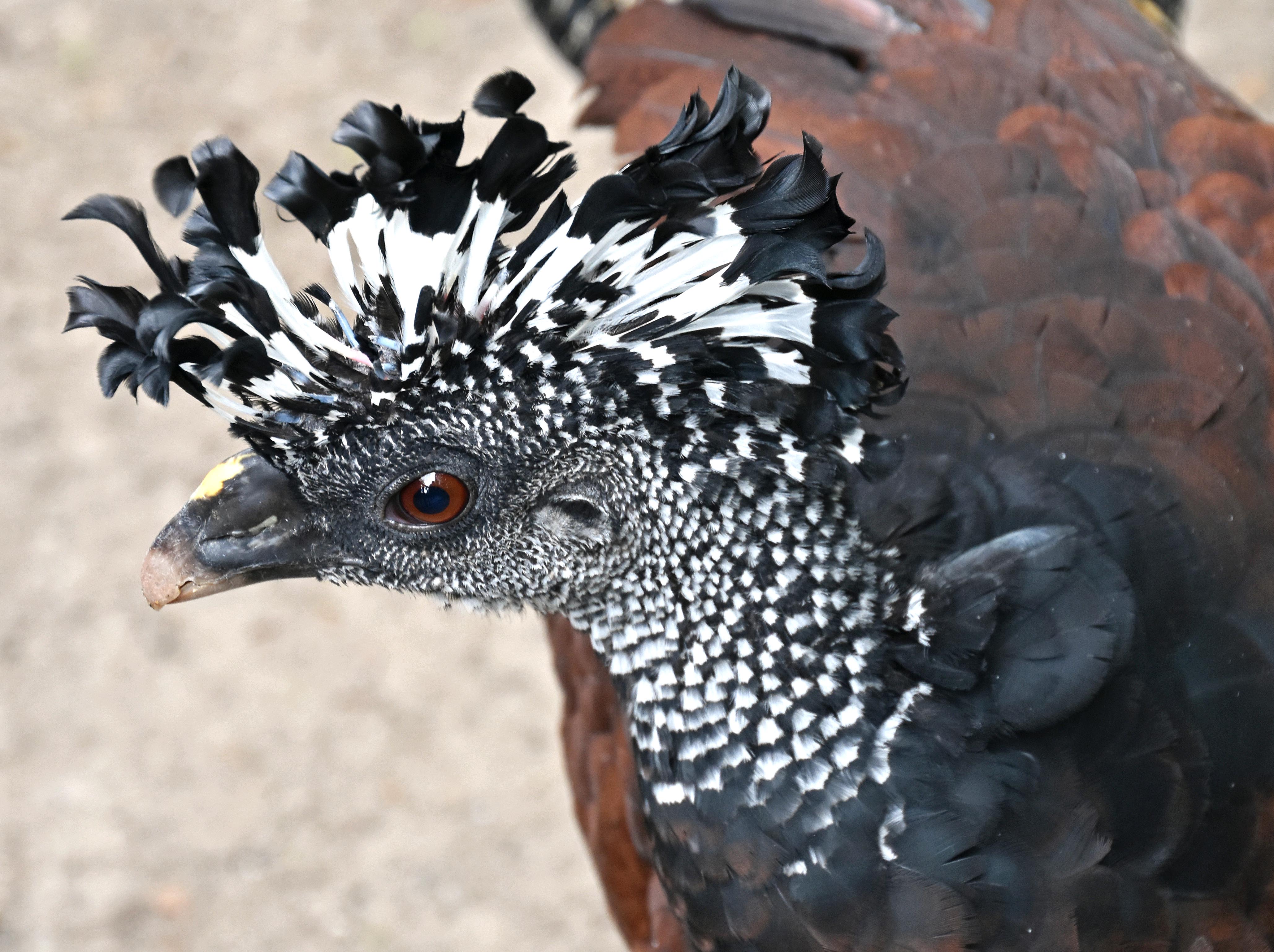
There are a number of bird houses in Berlin Zoo where it is possible to walk through the enclosures and experience being inside with the birds. In one house, there were a pair of curassows waiting to greet ever visitor, no doubt looking for something to eat between meals.
Bare-faced curassow (Crax fasciolata) male standing on a railing
They were remarkably tame and had clearly adjusted well to captivity; perhaps they were bred in captivity. Both male and female had beautiful head feathers.
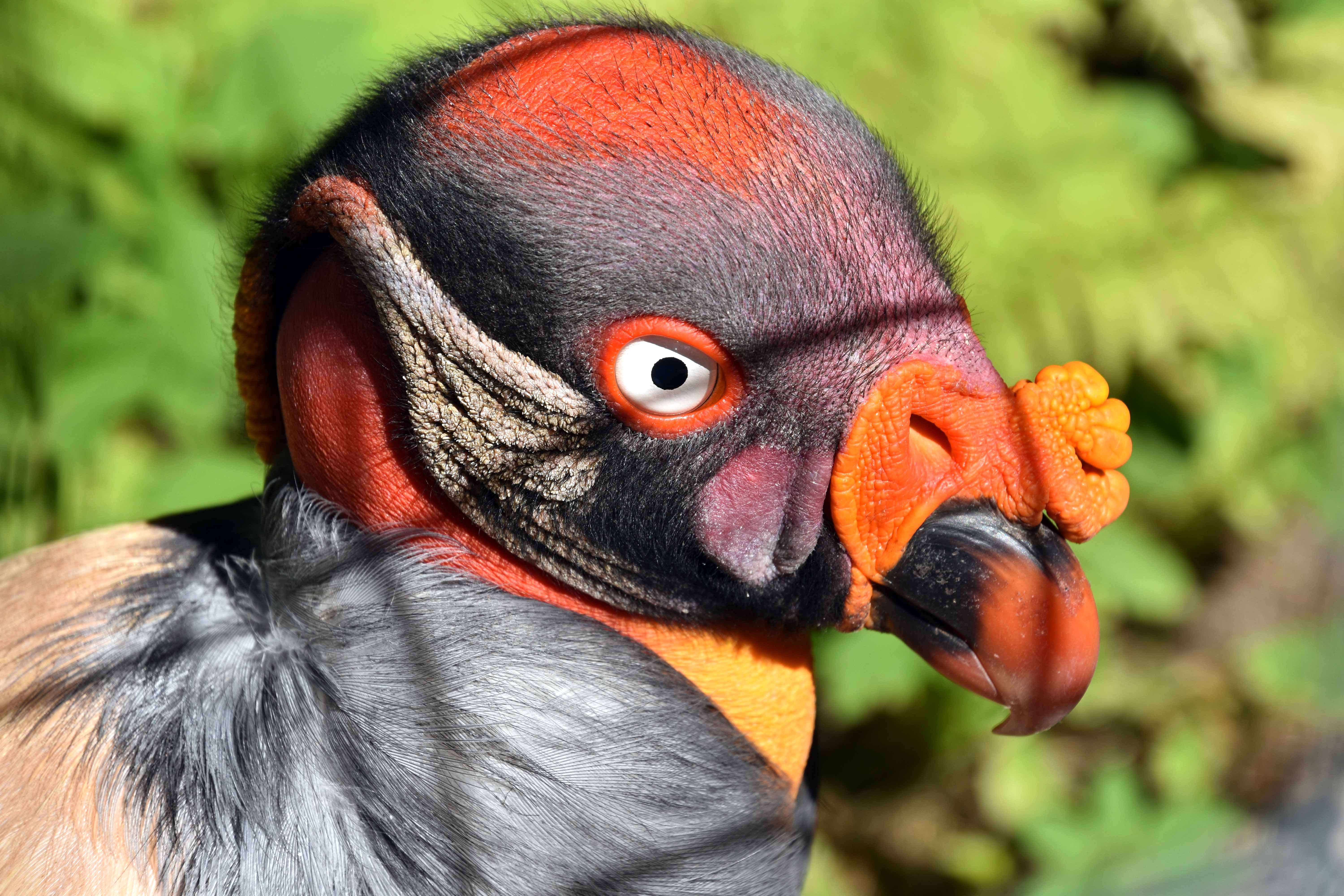
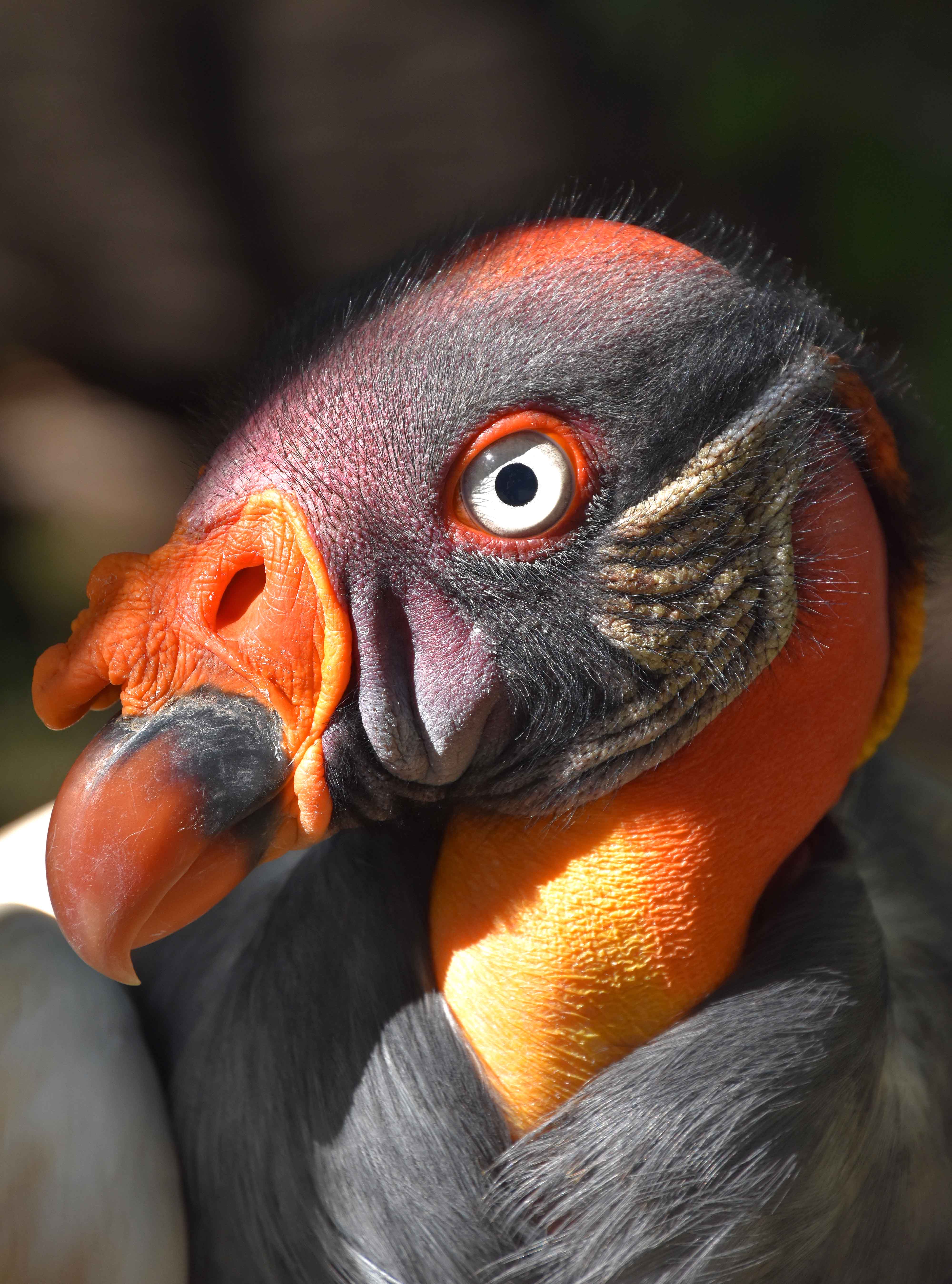
Another bird which seemed very relaxed and at ease with the stares of visitors was the King vulture (Sarcoramphus papa).
King vulture (Sarcoramphus papa) Berlin Zoo
The bird did not seem to mind the fact that I had my camera right up against the cage trying to capture an image of it without the shadows from the fencing!
King vulture (Sarcoramphus papa) Berlin Zoo
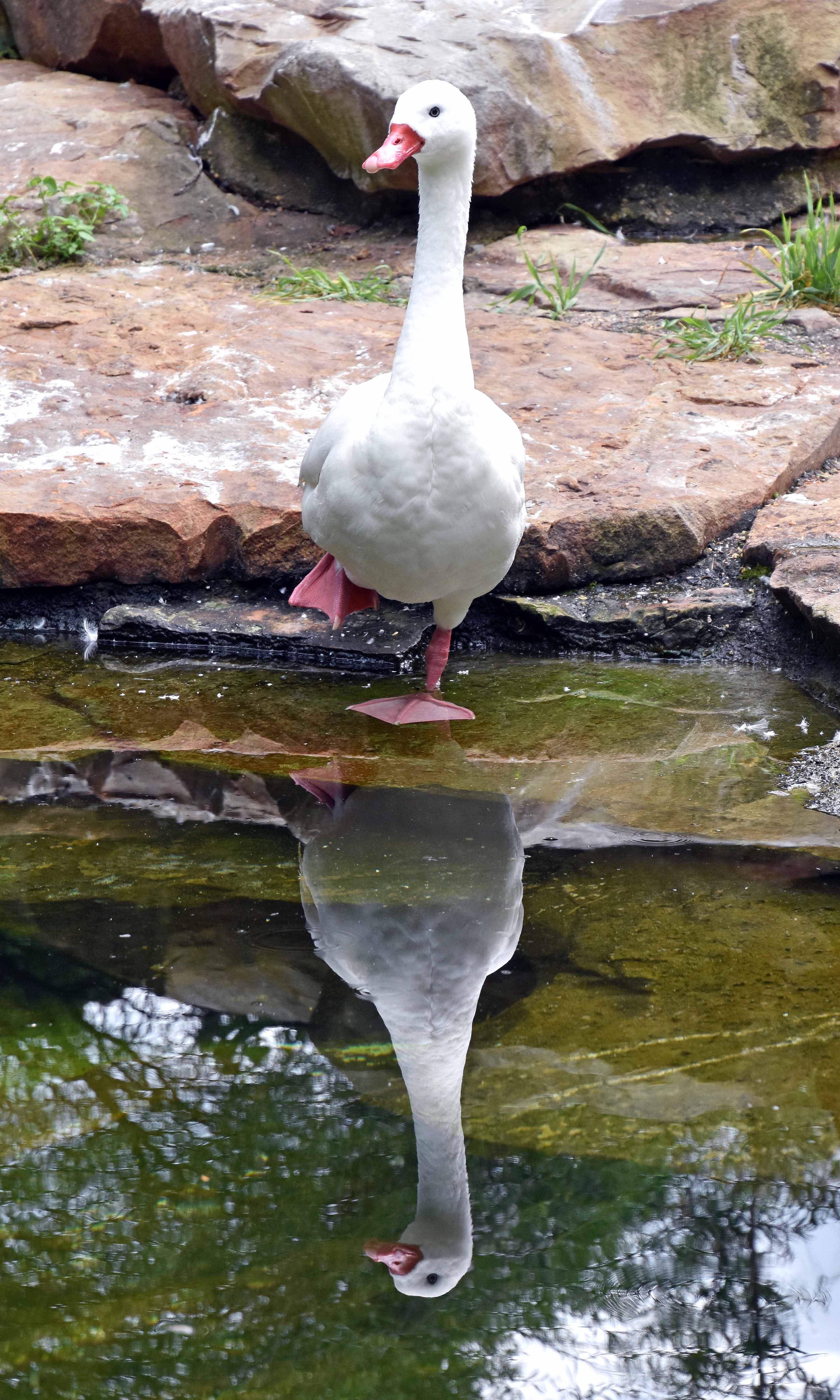
A Coscoroba swan (Coscoroba coscoroba) was resting one leg, but I couldn’t help noticing that its wings had been clipped, presumably to prevent it trying to fly back to South America, where it originated from.
Coscoroba swan (Coscoroba coscoroba) Berlin Zoo
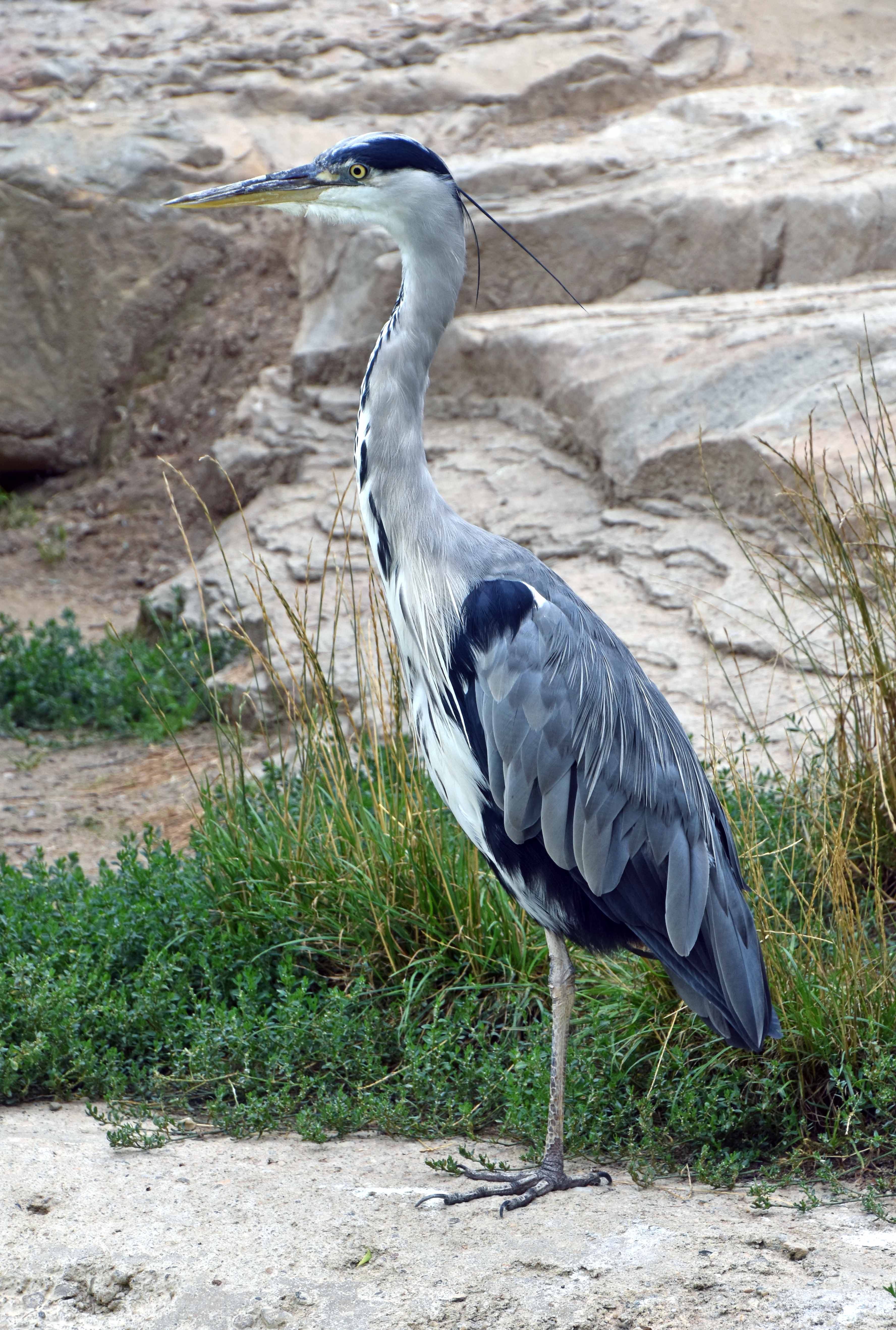
Some birds are free to come and go, like this elegant Grey heron (Ardea cinerea), waiting to see if there are any spare fish in the seal enclosure. Doubt it!
Grey heron (Ardea cinerea) at Berlin Zoo
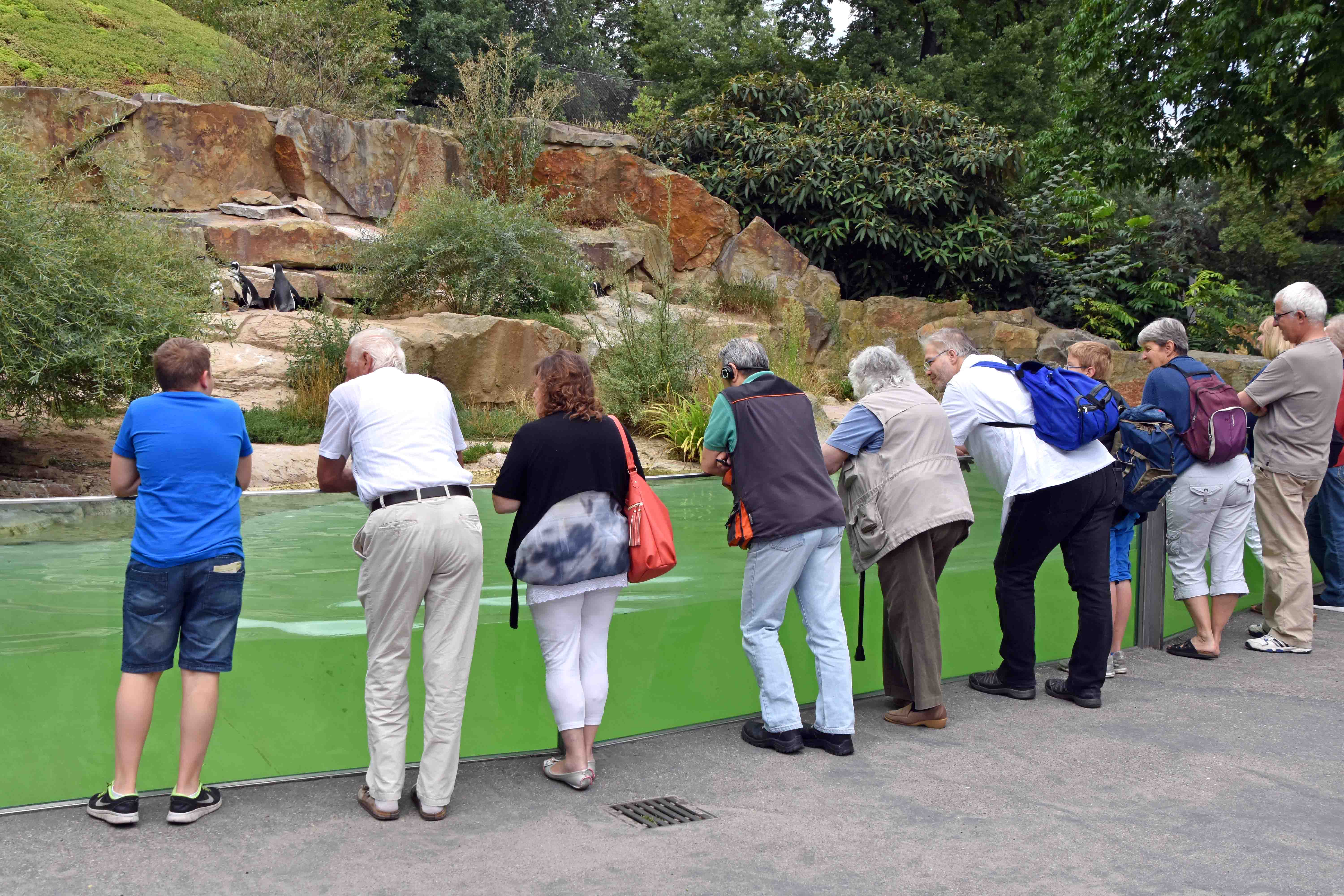
The nice thing about Berlin zoo is that, for the most part, it is possible to get quite close to the animals – like these people (below) watching penguins – and there are some great glass fronted tanks.
People watching penguins at Berlin Zoo
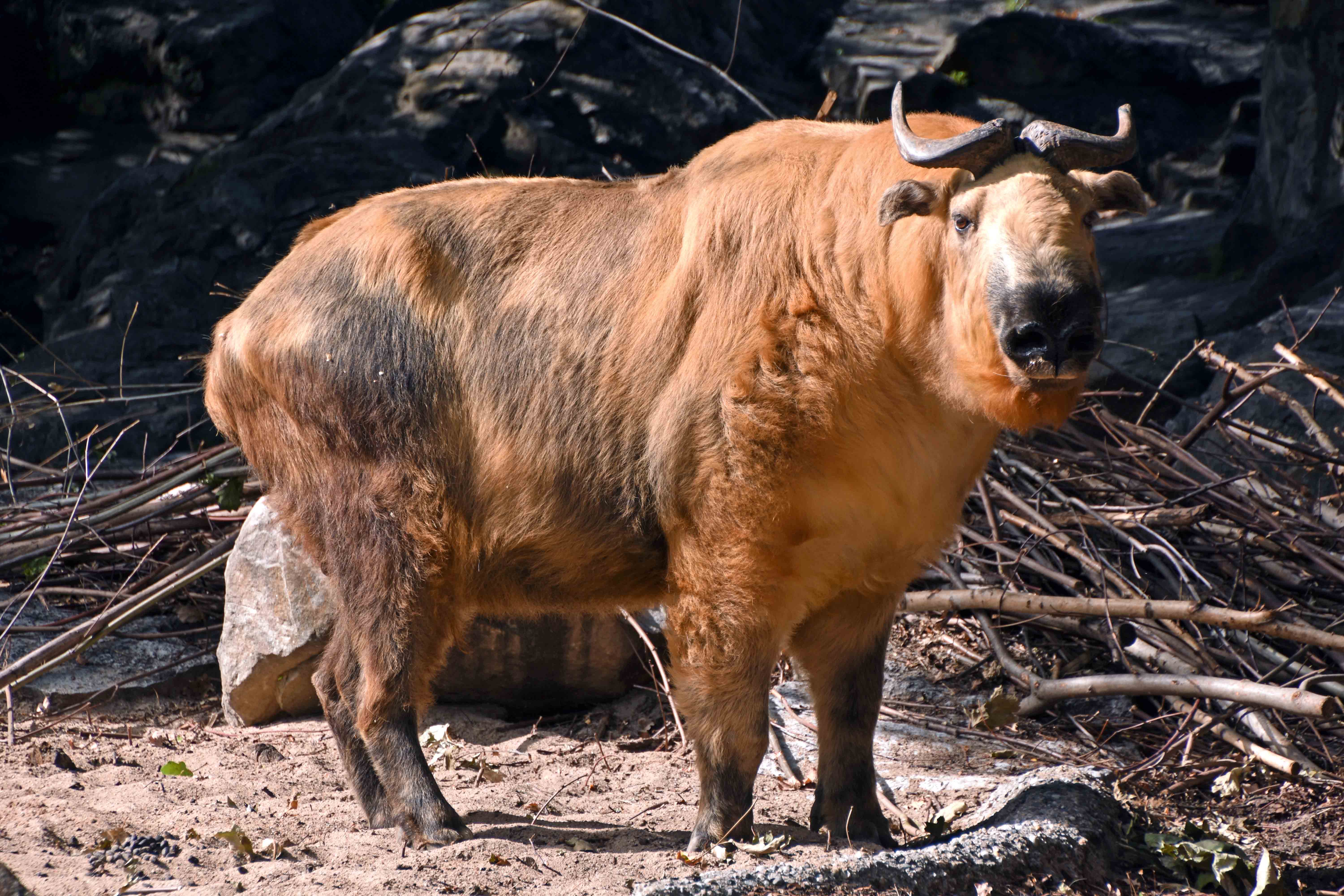
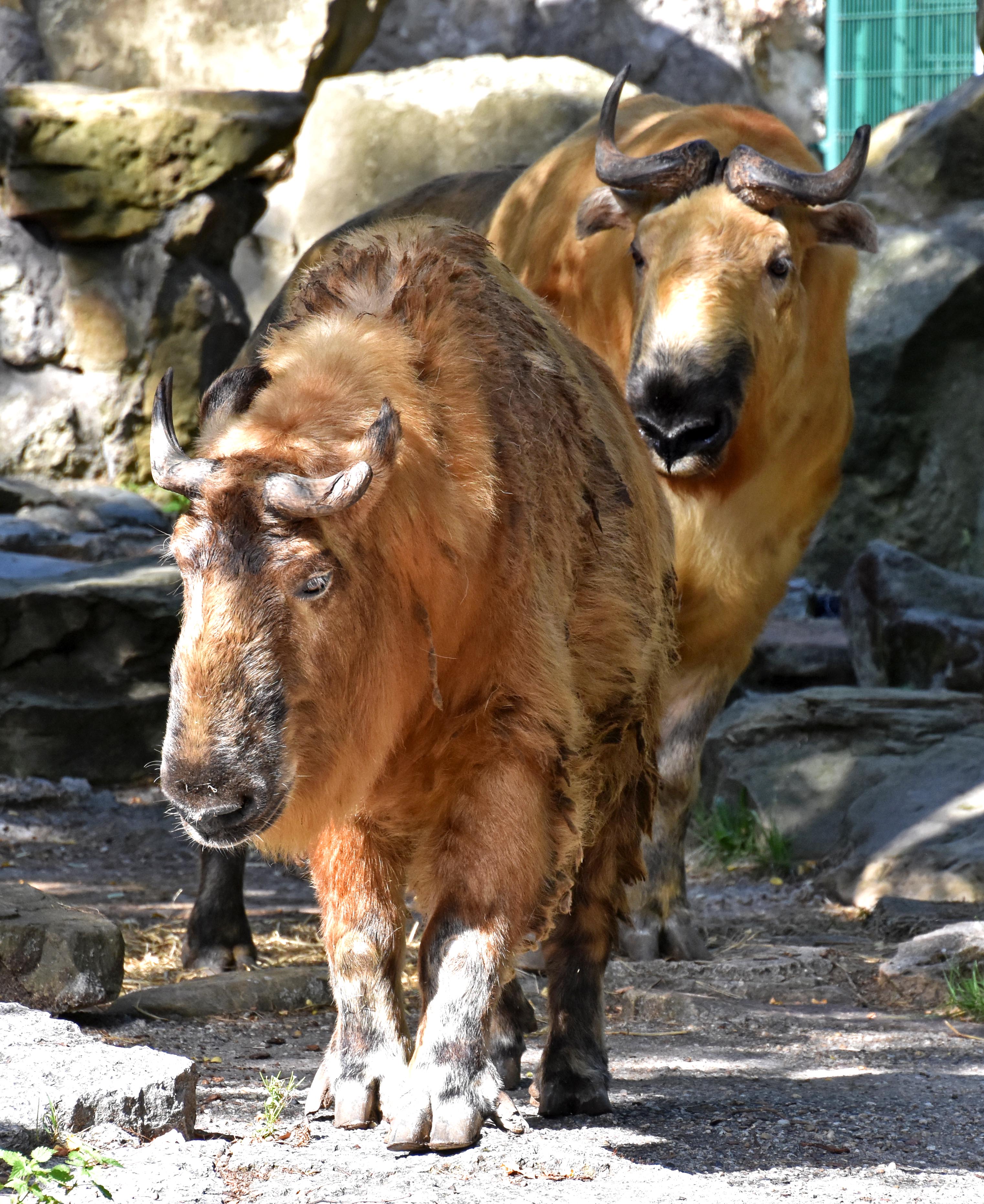
It’s always interesting to come across animals that you have never heard of. I had never come across this magnificent animal called a Tibetan or Sichuan takin (Budorcas taxicolor tibetana) – pronounced tah-kin – before. It is called a goat antelope and there are four subspecies; this one is found along the eastern margin of the Tibetan plateau and is well adapted to live in the cold Himalayan mountains with its thick fur and broad nose used to warm up the cold air it breathes in.
Tibetan takin (Budorcas taxicolor tibetana) male
Although protected, the Sichuan takin is still threatened by poaching for it valuable fur alas. A magnificent animal.
Tibetan takins (Budorcas taxicolor tibetana) male following the female
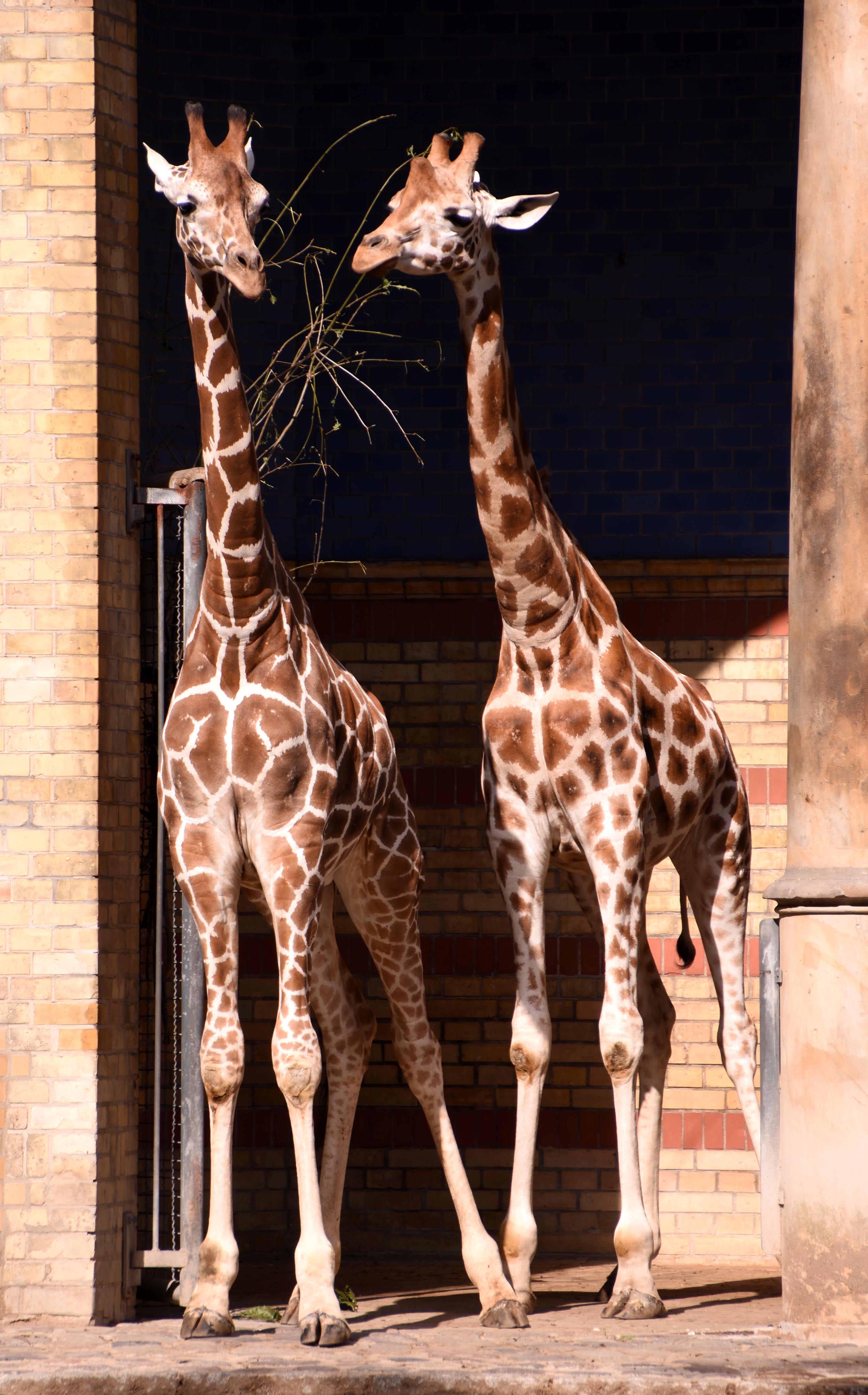
I particularly enjoyed watching these two giraffes cavorting about in the sunshine. Although they were different subspecies – one was a Rothschild and the other a Reticulated giraffe – they were clearly pals and enjoyed each others company.
Giraffes (Giraffa camelopardalis) Berlin Zoo
The Reticulated giraffe was much more skittish and went racing around the paddock. When they came back together the other one gave it a playful butt with its head, as if to say, you silly thing!
Giraffes (Giraffa camelopardalis) Berlin Zoo
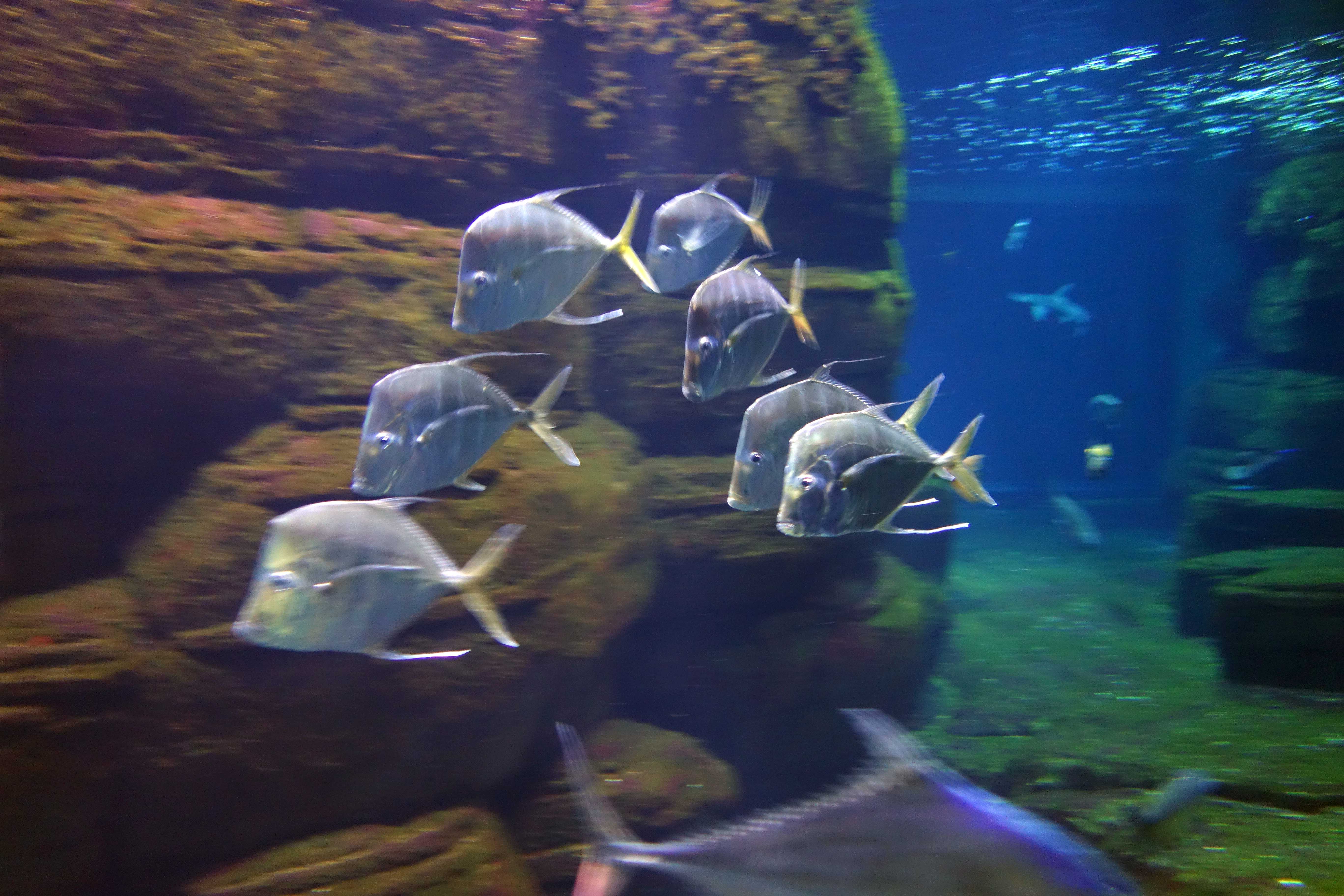
There is an excellent aquarium attached to the zoo with three floors of fish, reptiles, amphibians, invertebrates and so on. I particularly enjoyed the large tanks, like this one full of Indian threadfish (Alectis indica) which raced round and round and round!
Indian threadfish (Alectis indica) in large tank
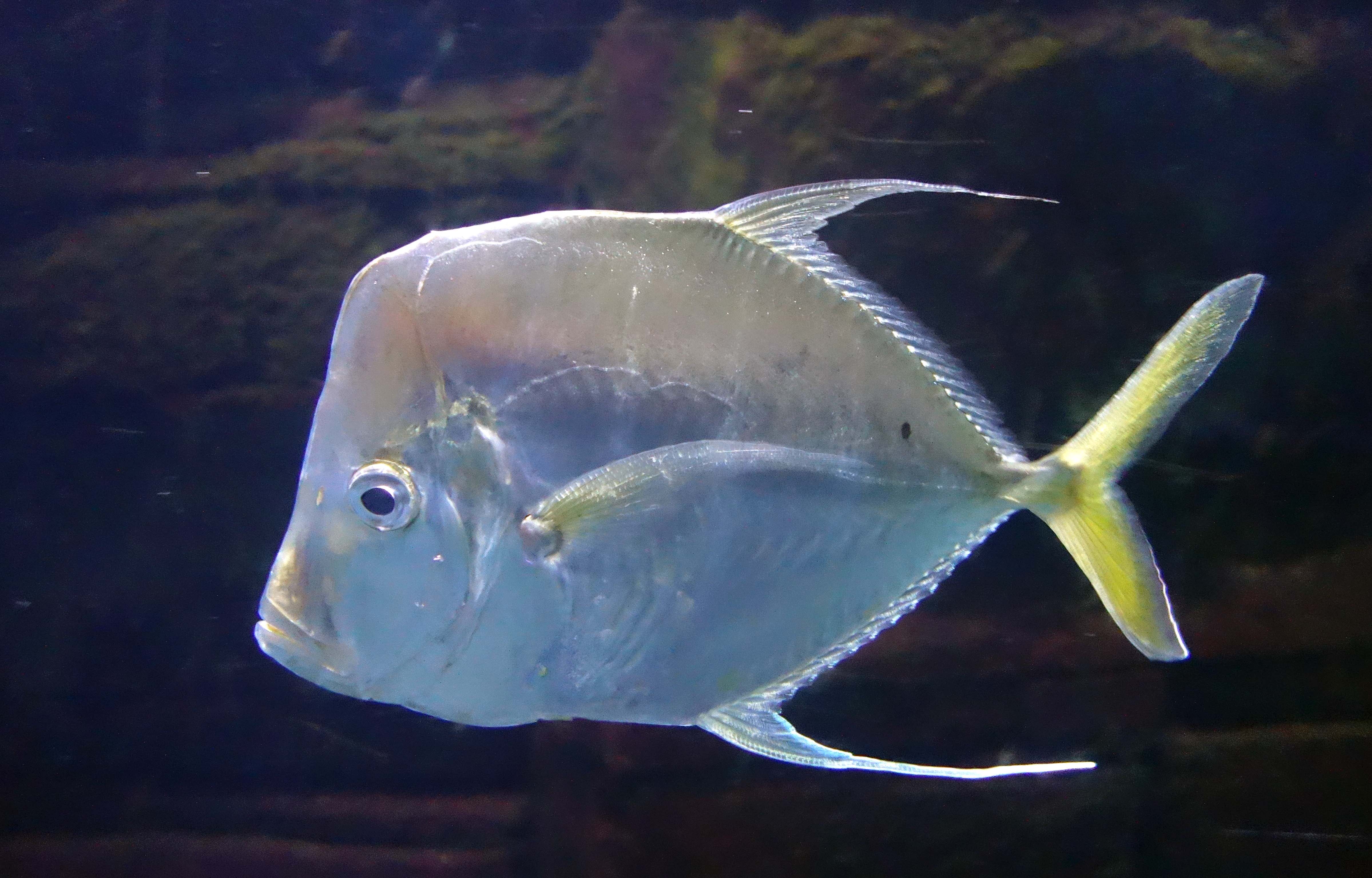
These fish, also called diamond trevally, are a member of the jack family, which unfortunately for them are important commercial and game fish.
Indian threadfish (Alectis indica) Berlin Zoo
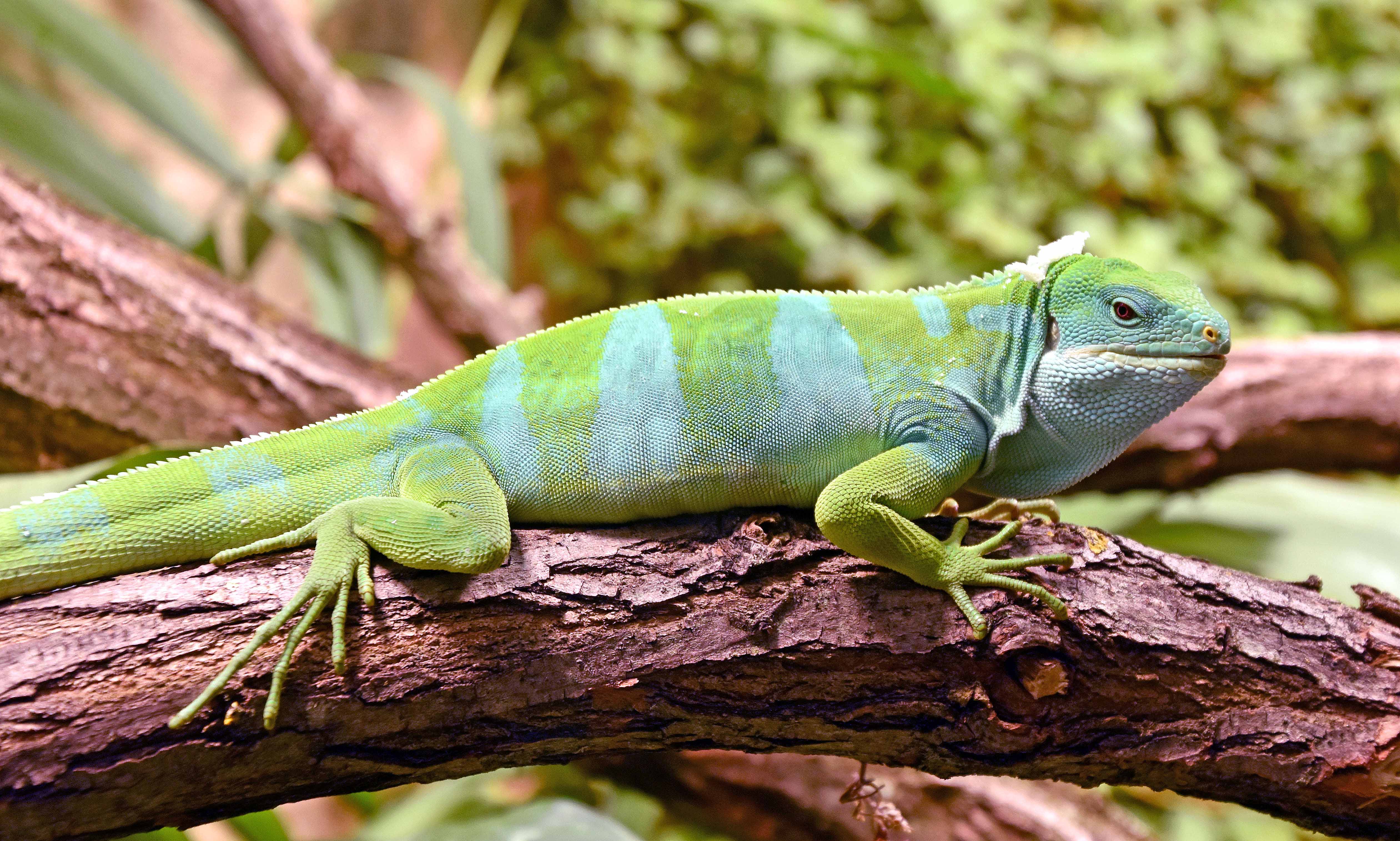
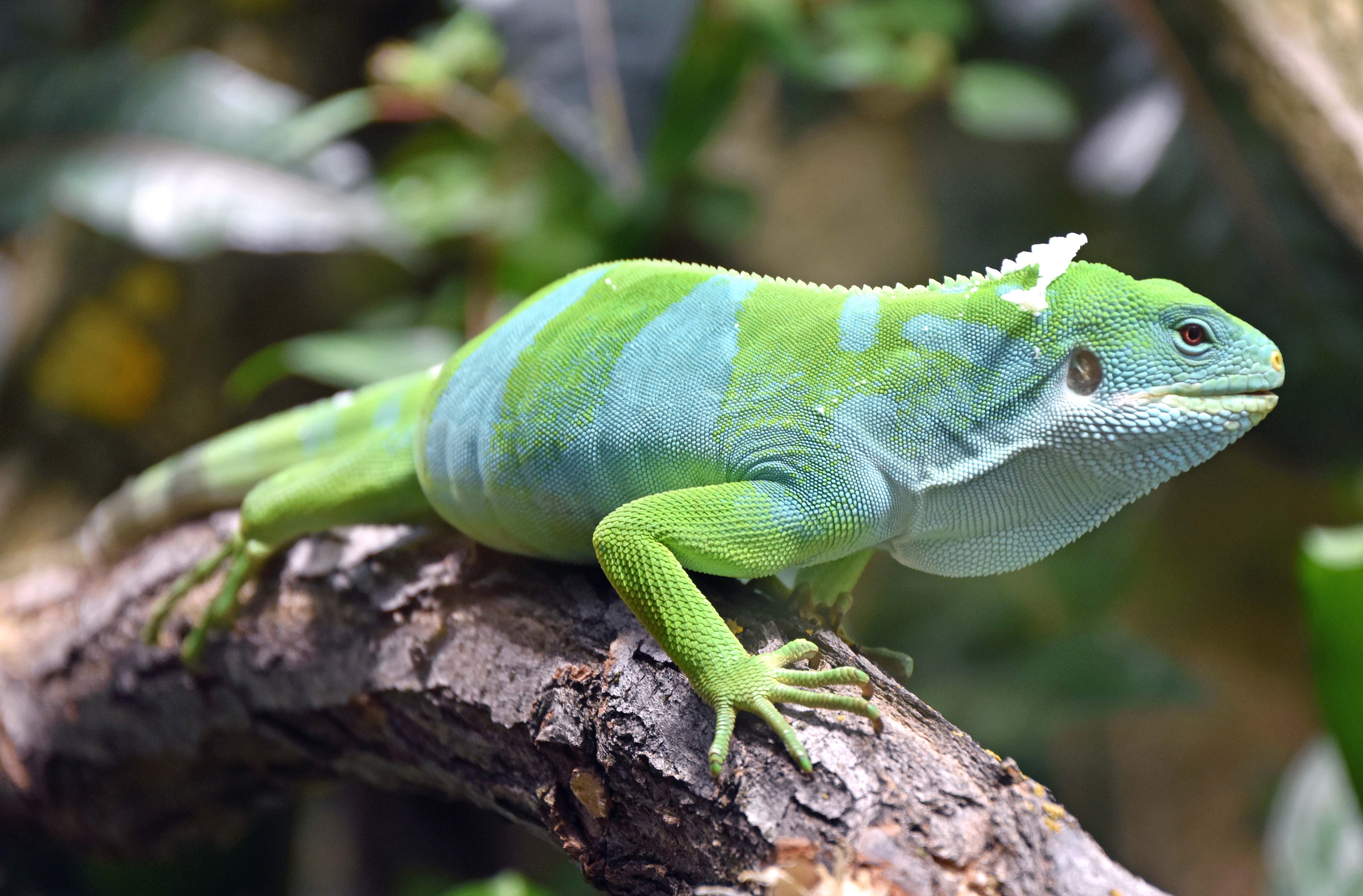
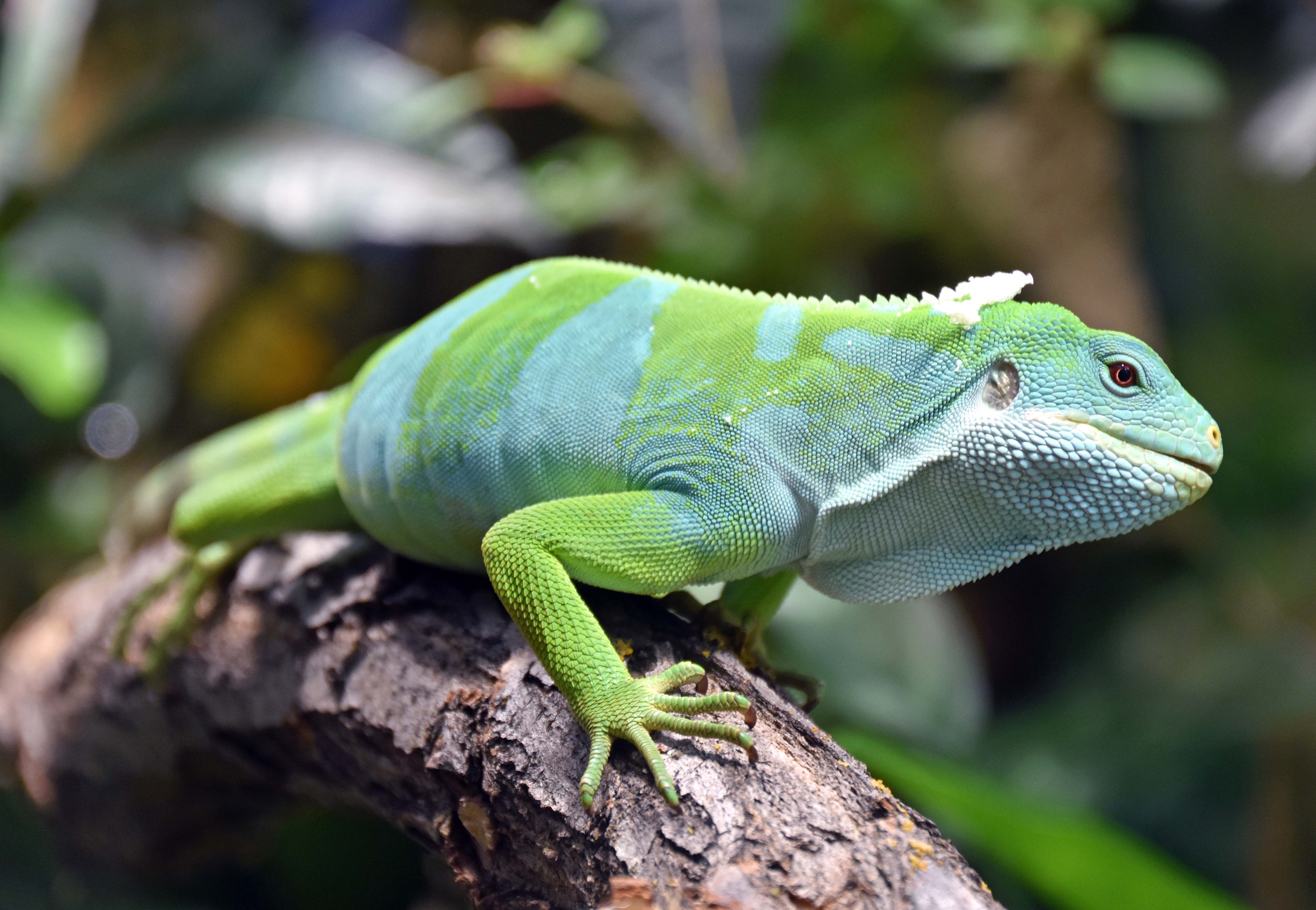
Not all of the reptiles were easy to see, but this beautiful Fiji banded iguana (Brachylophus fasciatus) – shown below- was showing right in front of the glass. It is endemic to some of the south-eastern Fijian islands, where it is reportedly declining due to depredations by introduced species, including cats, rats and the mongoose. As a consequence it is classified as Endangered by the IUCN (Red List of Threatened Species)(4). According to Wikipedia, the Fijian government maintains that the entire zoo population of Fiji banded iguanas was obtained illegally or descended from smuggled animals. I’m not sure what this means; do they want them back? If the population has declined by 50% and remains endangered, it might be a good idea to keep some in zoos, as long as they are well looked after.
This individual Fiji banded iguana was newly moulted so the colours were very fresh and vibrant. The male has the pale-blue bands and emerald-green colouration shown in these photos.
Fiji banded iguana (Brachylophus fasciatus)
These iguanas can live for up to 25 years in captivity apparently. Perhaps their long lifespan is down to the fact that they don’t do much! The tympanic membrane is very clear in these photos.
Fiji banded iguana (Brachylophus fasciatus)
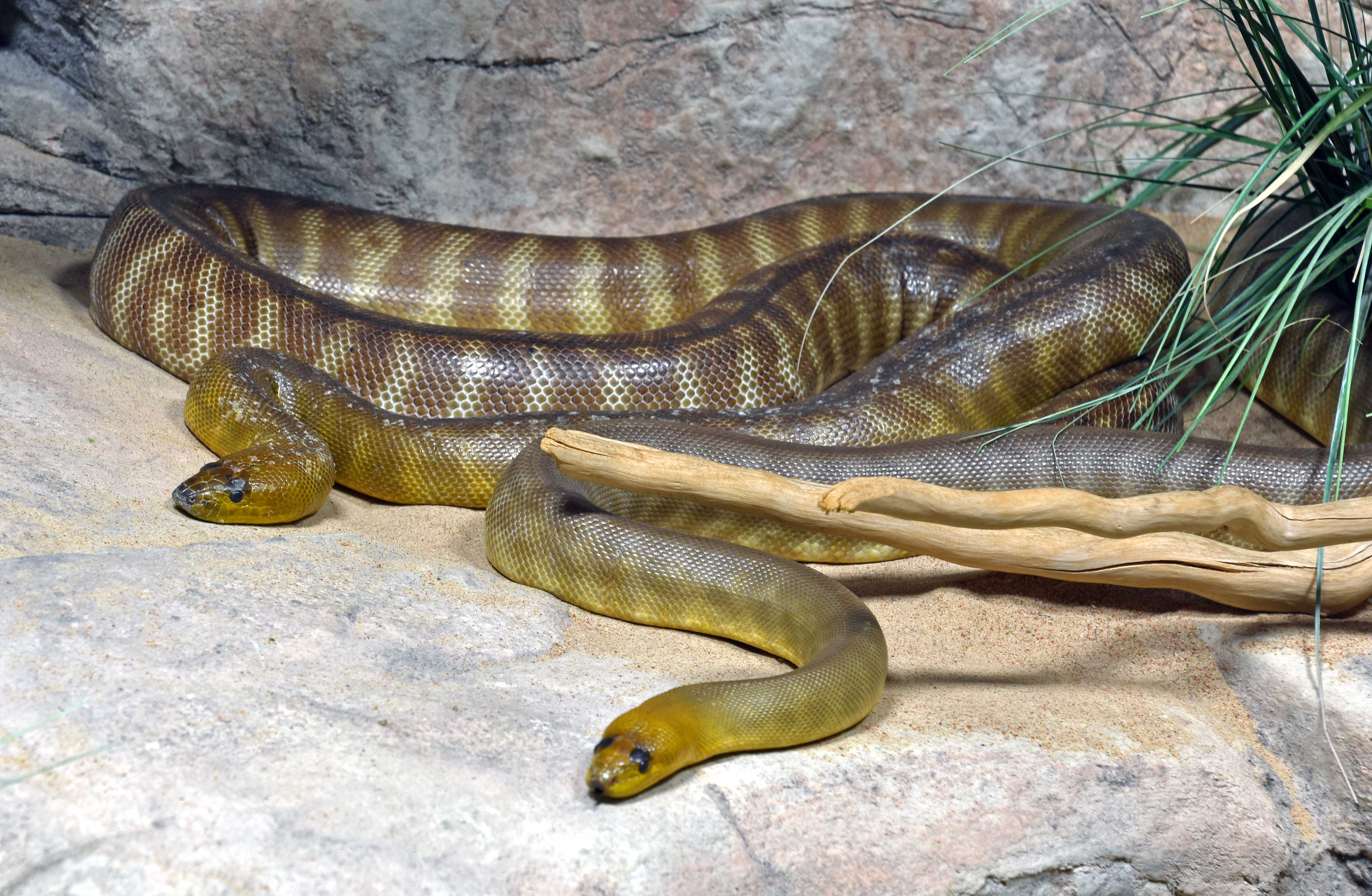
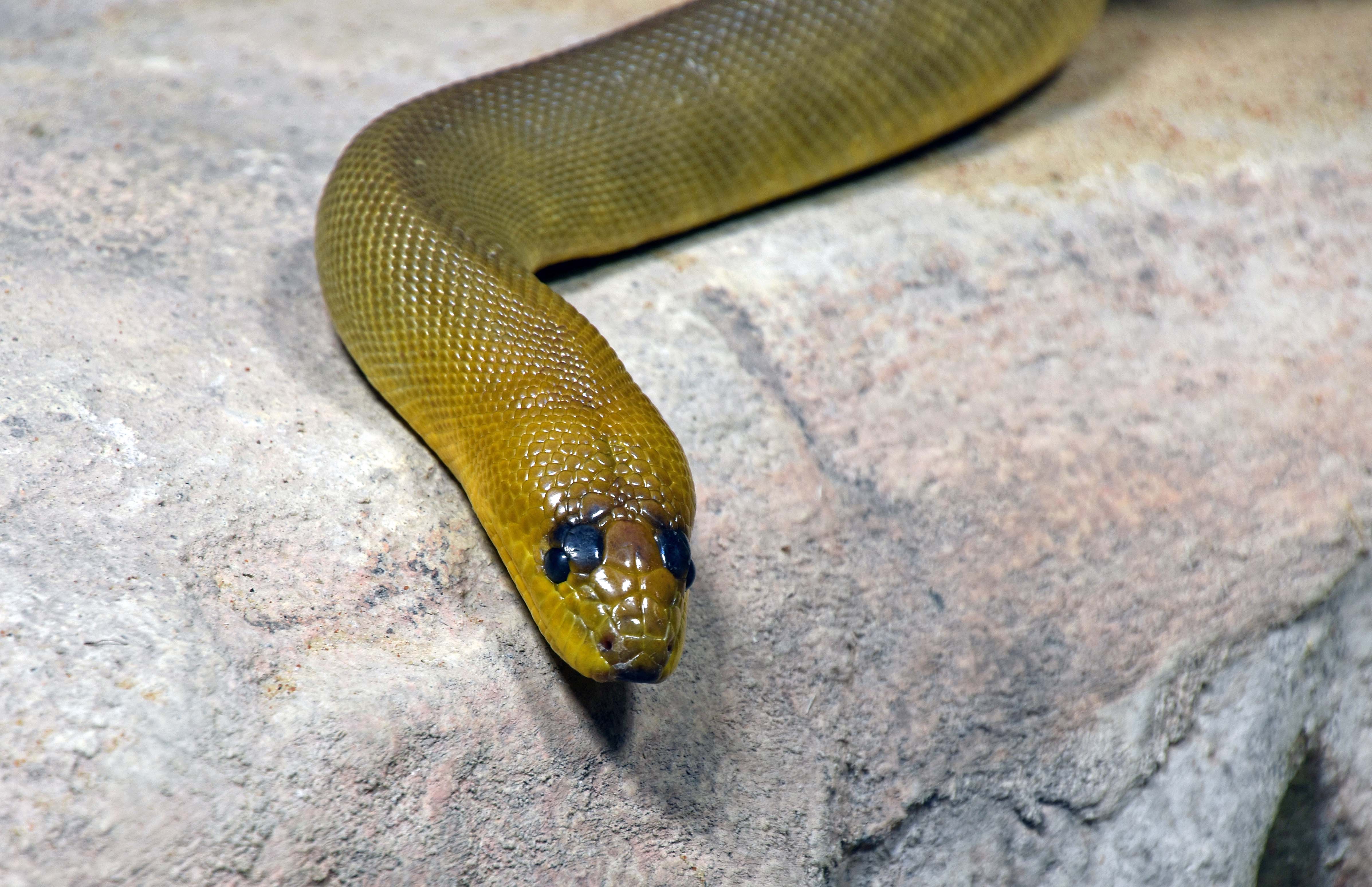
The Woma python also known as Ramsay’s python (Aspidites ramsayi) is a rather strange but elegant looking snake from Australia.
Woma pythons (Aspidites ramsayi)
They are said to be rather docile and ‘easy to handle’ in captivity. They have nice black eyes and markings above the eyes.
Woma python (Aspidites ramsayi)
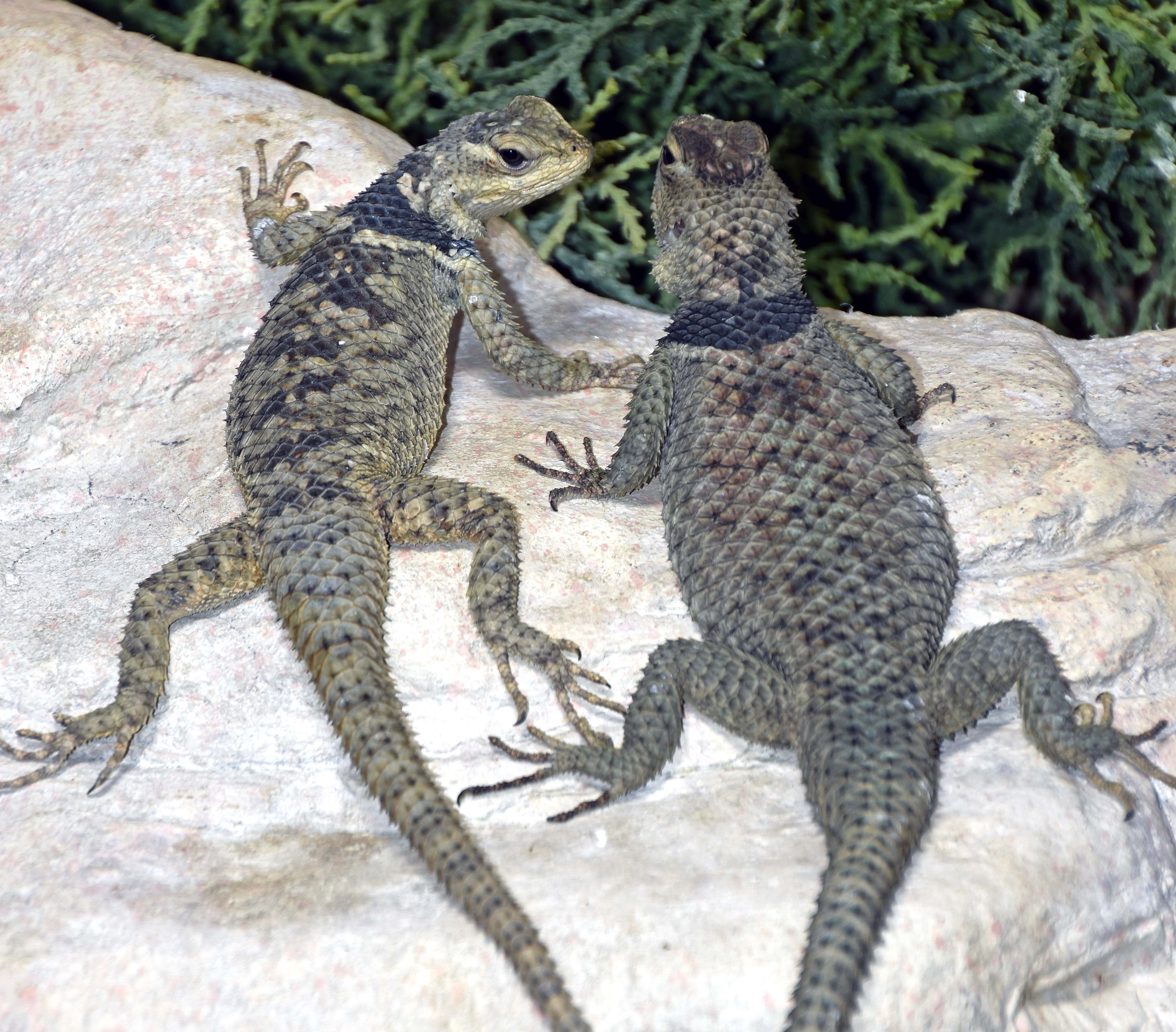
These blue spiny lizards (Sceloporus serrifer) are native to southern Texas and Mexico; they are often kept in zoos. They have a nice blue collar around their neck and shoulders (below).
Blue spiny lizards (Sceloporus serrifer)
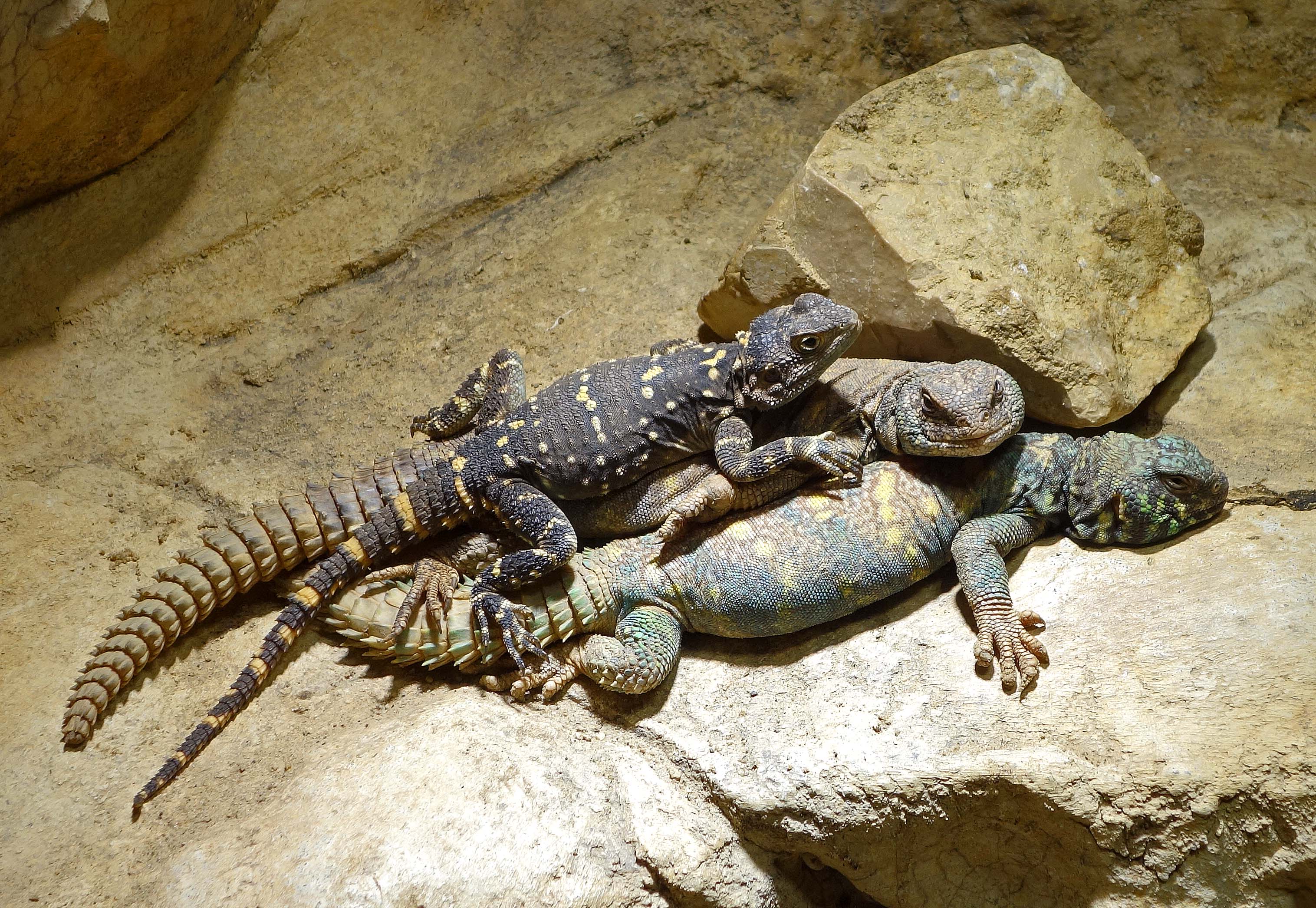
There was a nice pile of reptiles – a Black Agama on top of two Ornate spiny-tailed lizards – keeping each other warm, or company.
Black Agama on top of two Ornate spiny-tailed lizards
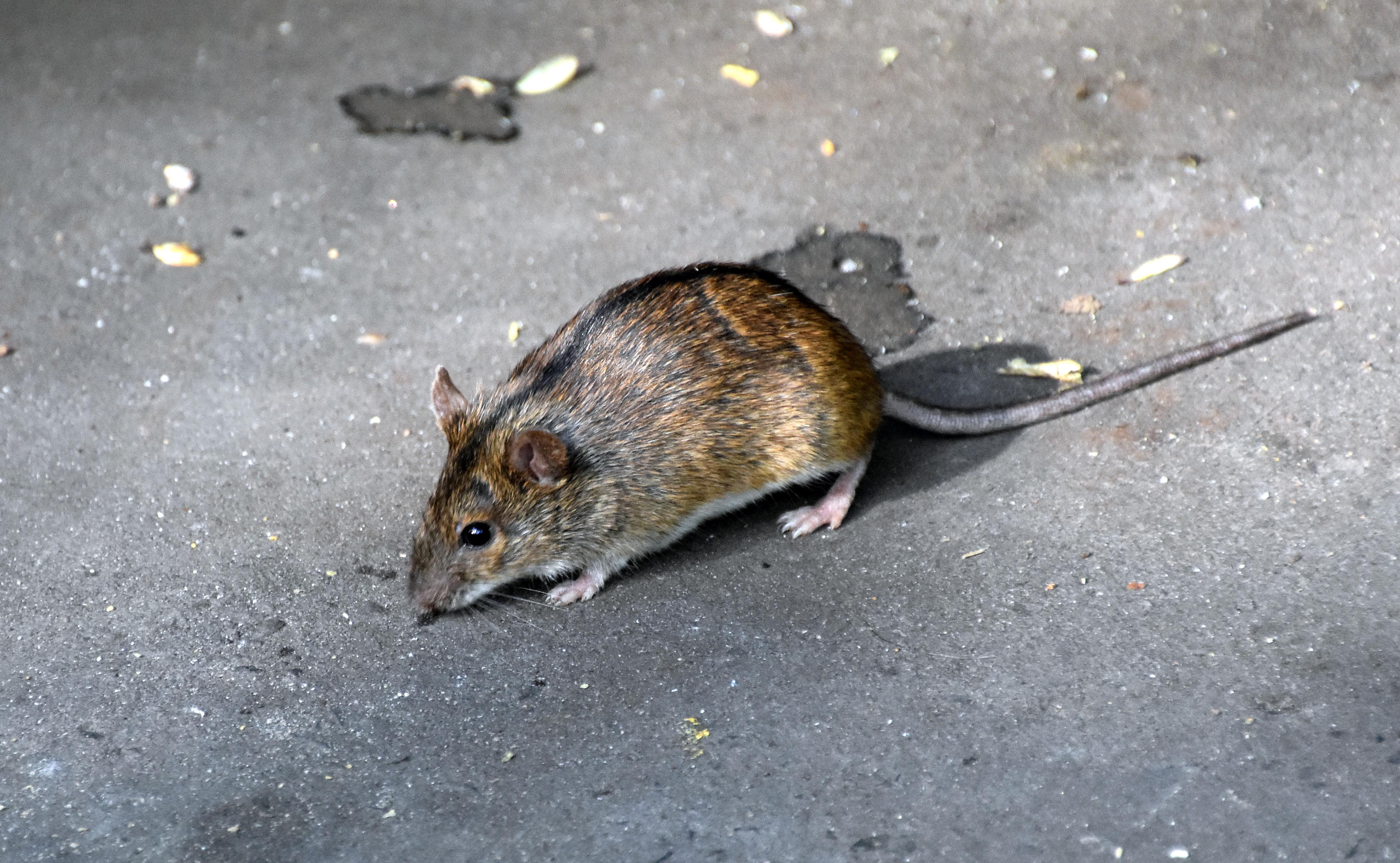
As I was on my way out, a Striped field mouse (Apodemus agrarius) popped out from under a hedge looking for scraps. This mouse has a dark stripe running along the length of its back; it occurs in eastern Europe, with western populations extending into Germany in the north and N Italy in the south. He was here of his own volition; feeding on the waste left by us greedy humans! Nice to see him/her though.
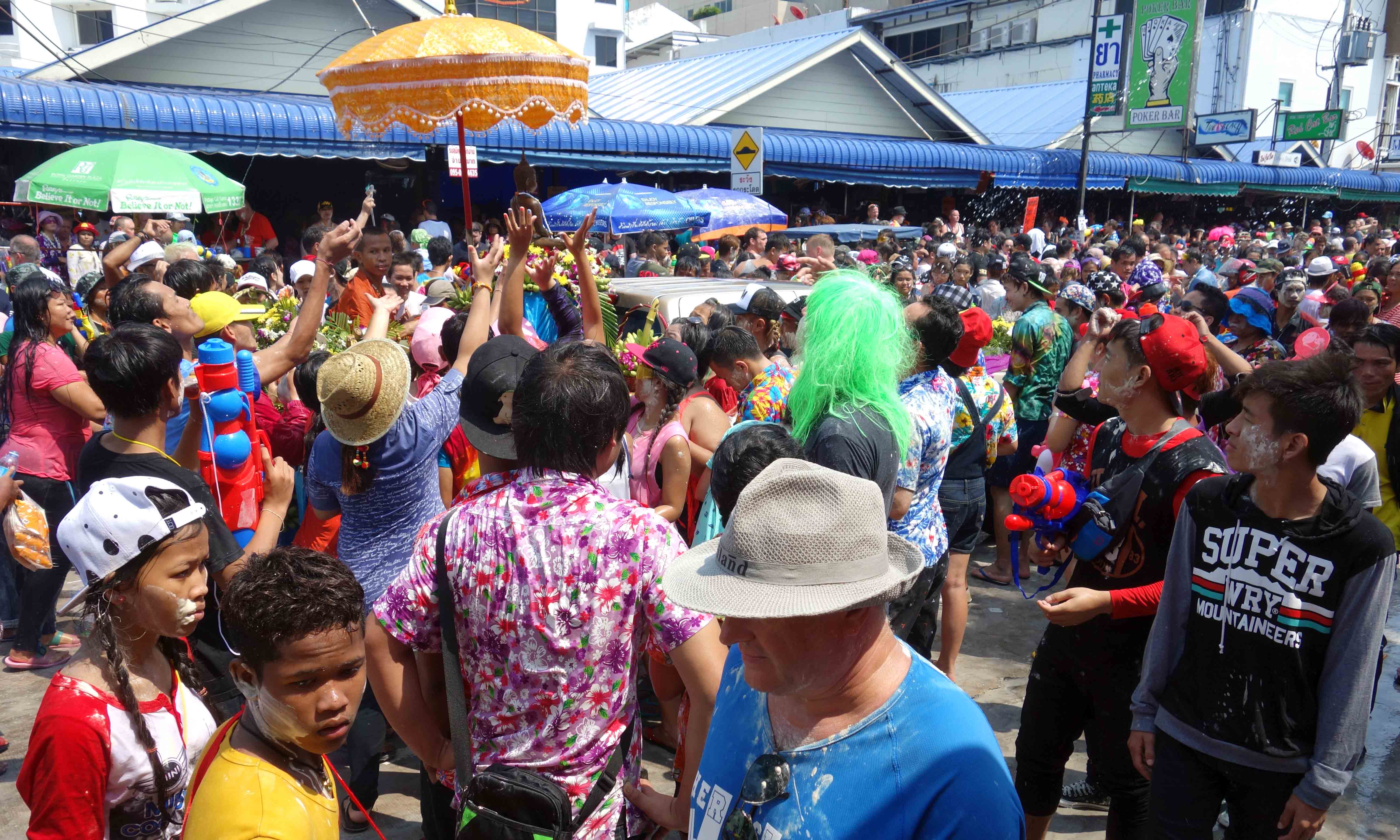
Depending upon your age and inclination, the Thai New Year Songkran water festival is either your worst nightmare, or a lot of wet fun! Personally, I do enjoy it in moderation, but eventually get fed up of being continually doused in water and need to retreat to my hotel.
Getting wet along Beach road, Pattaya
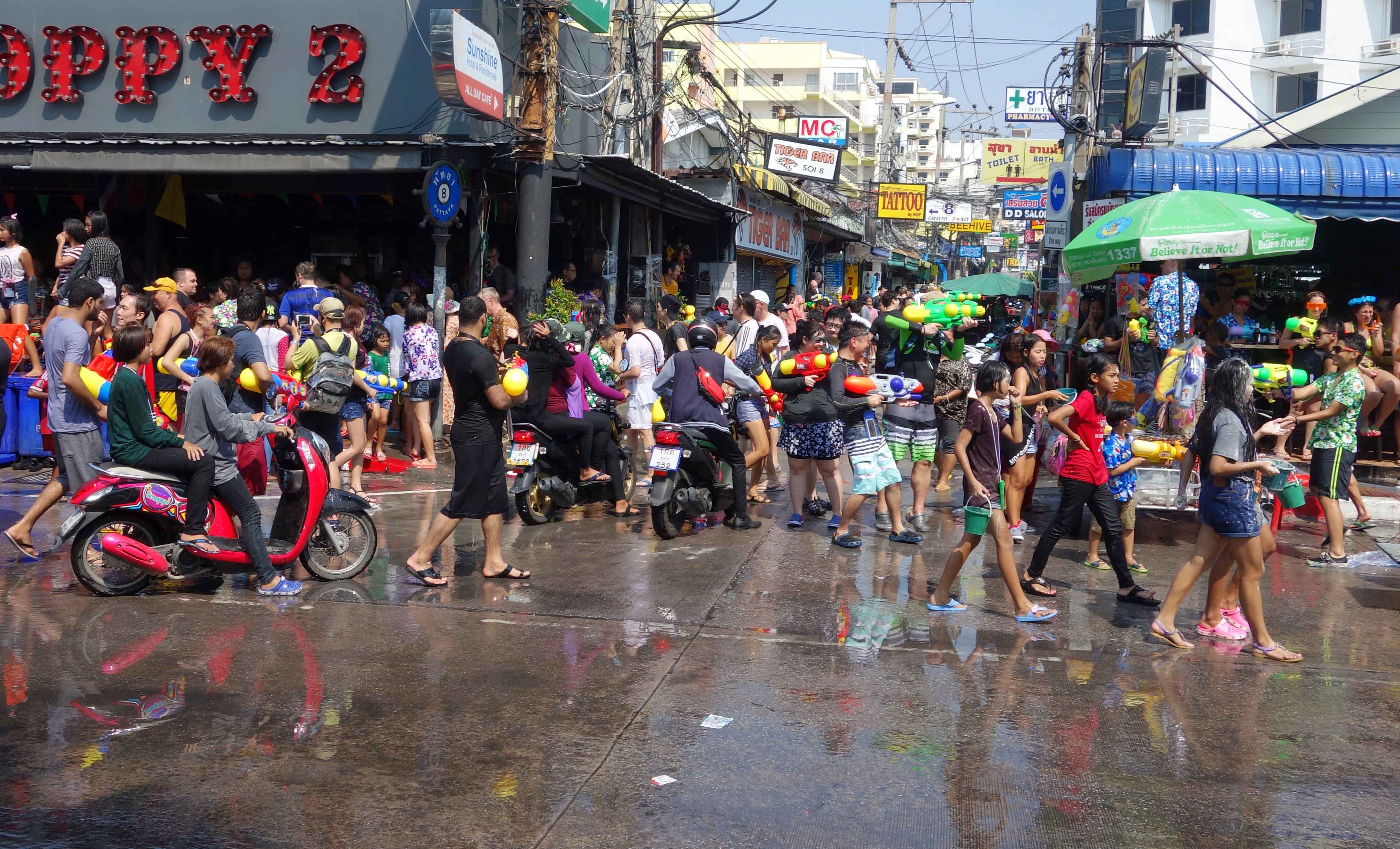
Officially, Songkran only lasts three days in most of Thailand, but in Pattaya it goes on for a full nine days, which spanned the 10-19th April this year (2016). The extended days are called “Wan Lai” and this is when the all out water fights really get going.
Water fights by Soi 8, Beach Road, Pattaya
Fortunately, the action is largely localised so it is still possible to get about without getting too soaked. Unless you catch a songtau (pick-up style open backed taxi) that is; these are subjected to continual dousings by people throwing buckets of water. So I find it is easier to walk!
Wet revellers on 19th April, Pattaya
What started out as a traditional festival celebrating the Thai New Year, and marked by the throwing and sprinkling of water, has rather degenerated into an all out orgy of water fights. The availability of large, powerful and cheap plastic water pistols has facilitated the process.
Tourists armed with water pistols
The really big party is held on the last day, 19th April this year, in Pattaya. People come from all over Thailand to participate. It is a family day, with lots of food stalls along the beach road.
Plenty of refreshments available
Children of all ages enjoy the day, which was particularly hot this year in Thailand.
Family fun
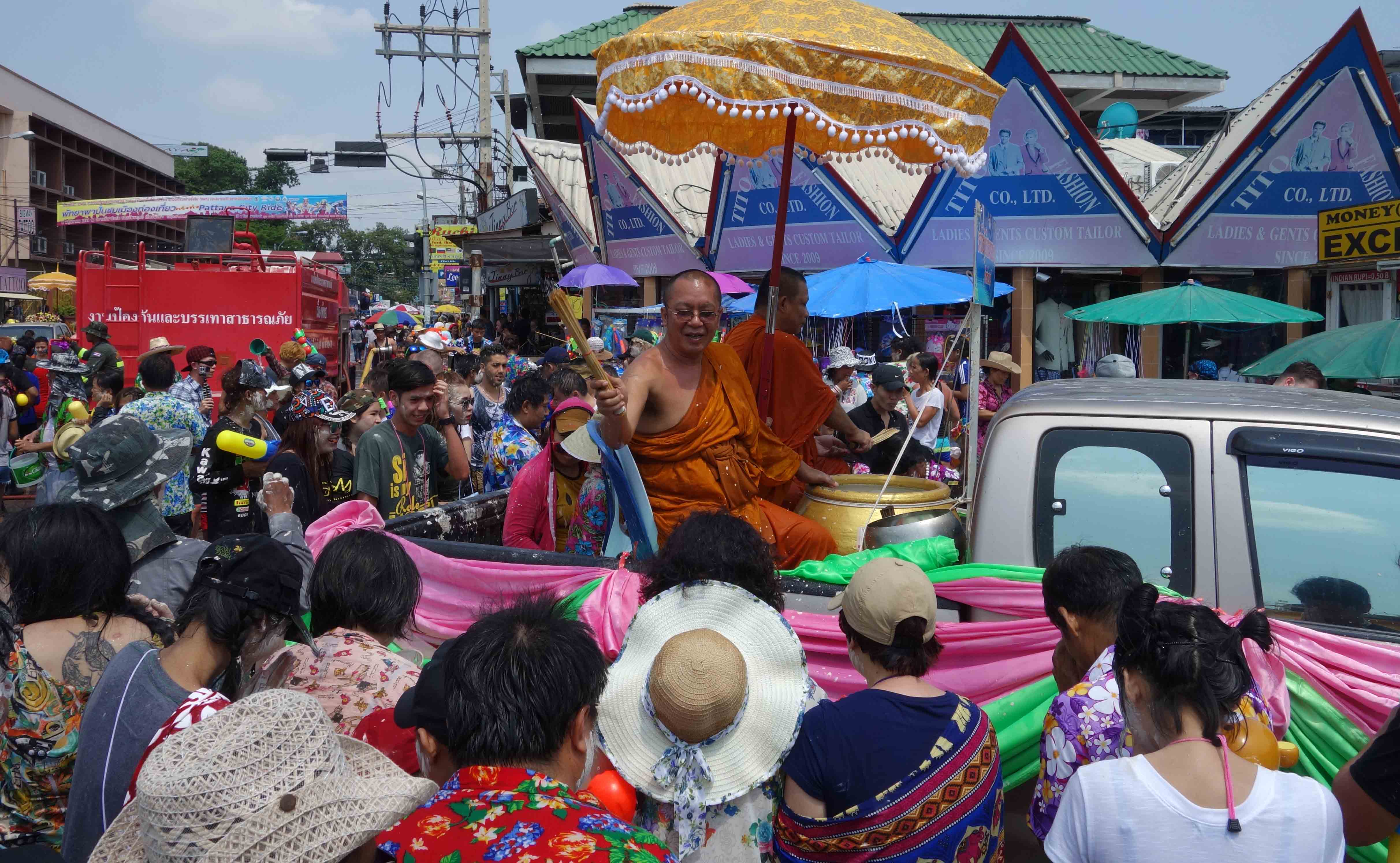
Songkran is a family occasion and traditionally a way to show respect to your parents for example, by water pouring over their palms. Paying reverence to ancestors is also an important part of the Songkran tradition, and Buddhas appear in many shops, malls and hotels, which people anoint by pouring flower scented water over the statue. Buddhist monks also anoint devotees with water as a sort of good luck blessing.
Buddhist monks blessing people with water
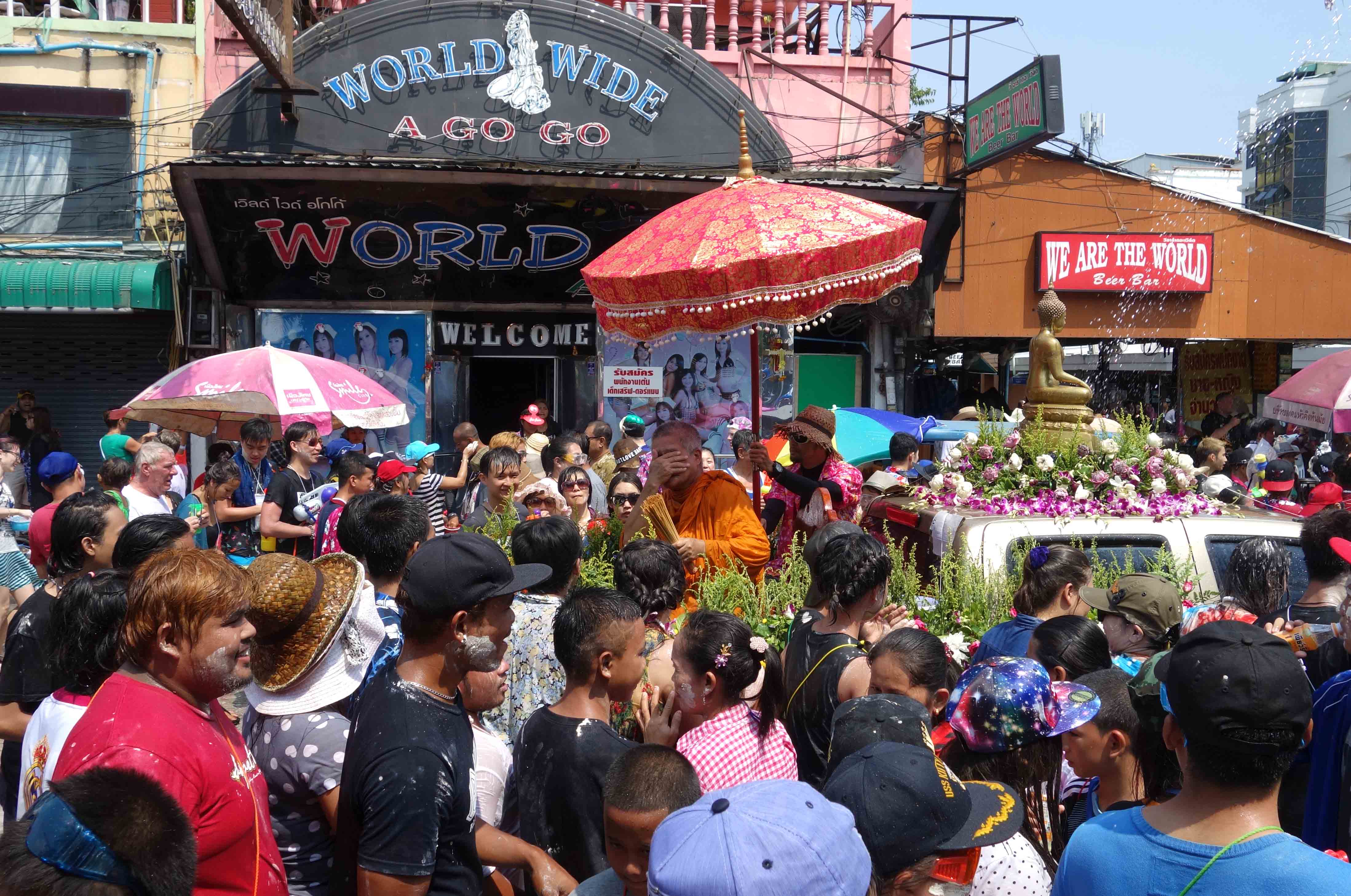
In the following picture, the monk appears to be covering his eyes as he passes by a GoGo bar! But it is just a coincidence.
Monk delivering watery blessing along Beach Road, Pattaya.
I rather like these images, because for me they capture some of the apparent contradictions of Thai society. Thais are tolerant and fun loving; they tend not to be as judgemental as Westerners (I think).
Monk blessing th crowd on 19th April 2016, Beach Road, Pattaya.
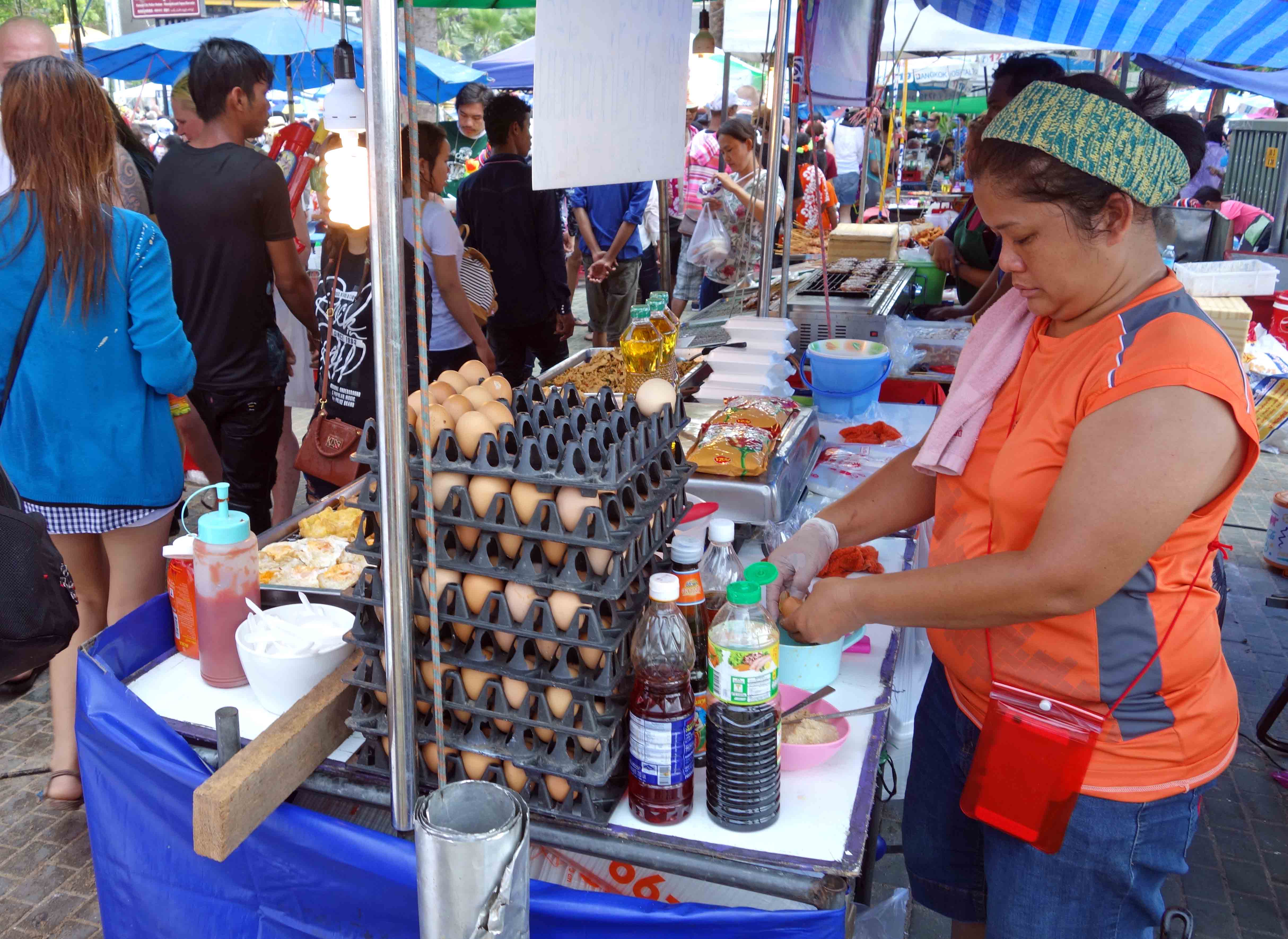
As always in Thailand, lots of delicious food was available to fortify the participants. I do admire these ladies, surely the backbone of Thai culture, who prepare these meals from small portable kitchens all over the country.
Lady cooking eggs to fortify revellers
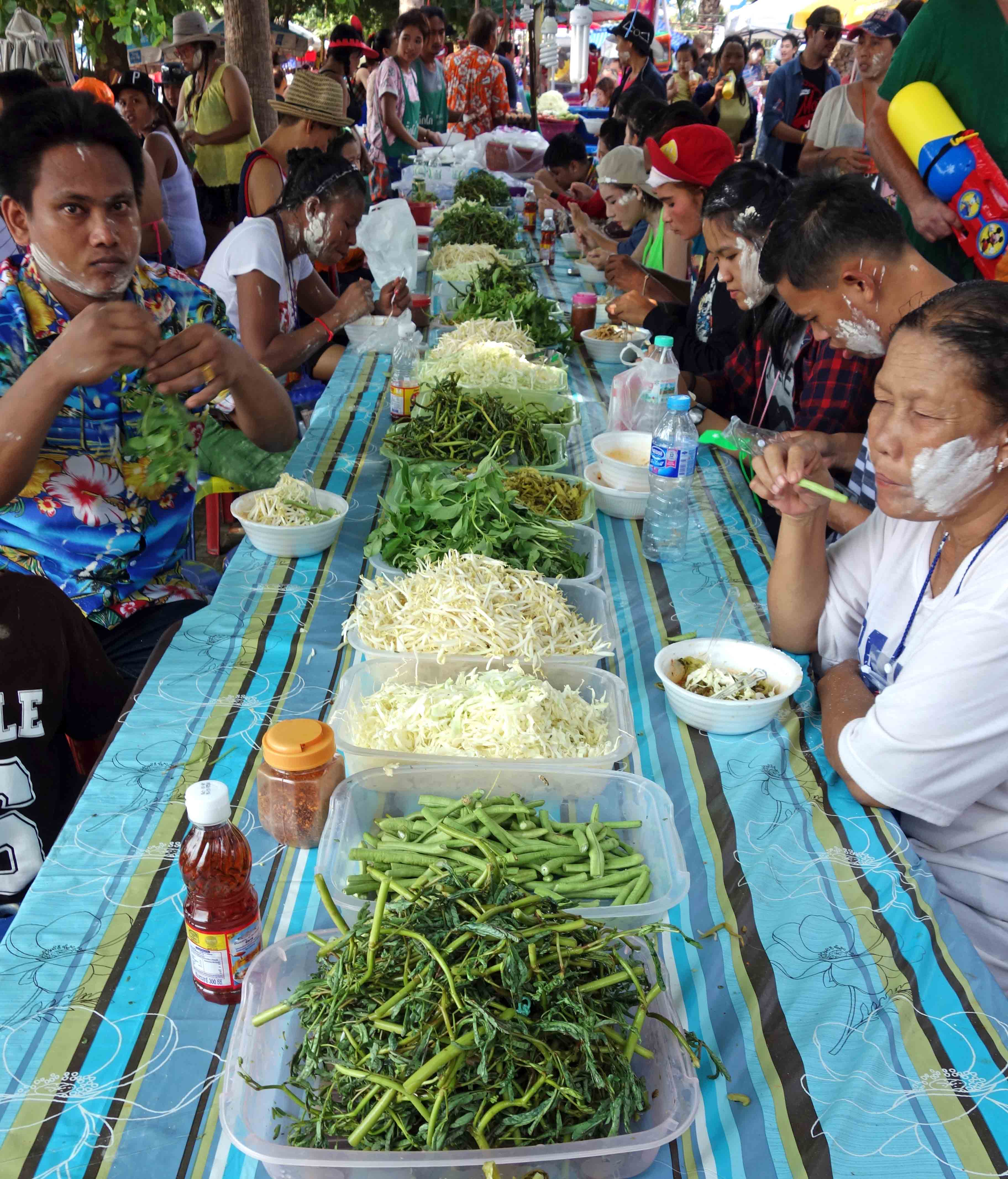
The salads were amazing!
Delicious vegetables on the table for customers to enjoy by the beach, Pattaya
Songkran is a noisy, very wet, fun time. For those with sufficient stamina it is fun to be continually drenched with water on a very hot day. Being blasted with very loud pop music is also part of the experience! It helps to be young! This throng of mainly young people were enjoying the music of a band playing in the Central Mall, Pattaya, whilst being drenched with water from fire hoses.
Crowd at Central Mall, Pattaya, on 19th April 2016Fire hose
These youngsters were enjoying themselves!
Boys with water pistols
Oh I forgot to mention the face paint (wet powder)! The protective glasses are a good idea as some of the water pistols are very powerful.
Girls with face paint and protective glasses, 19th April 2016, Pattaya
This man seemed to be getting into the spirit of the occasion. His dancing reminded me of a bird!
Dancing man, Pattaya
Would I go again to Pattaya at this time of year? Maybe not, as I am a bit of an old git(!), but it was fun to see it once.
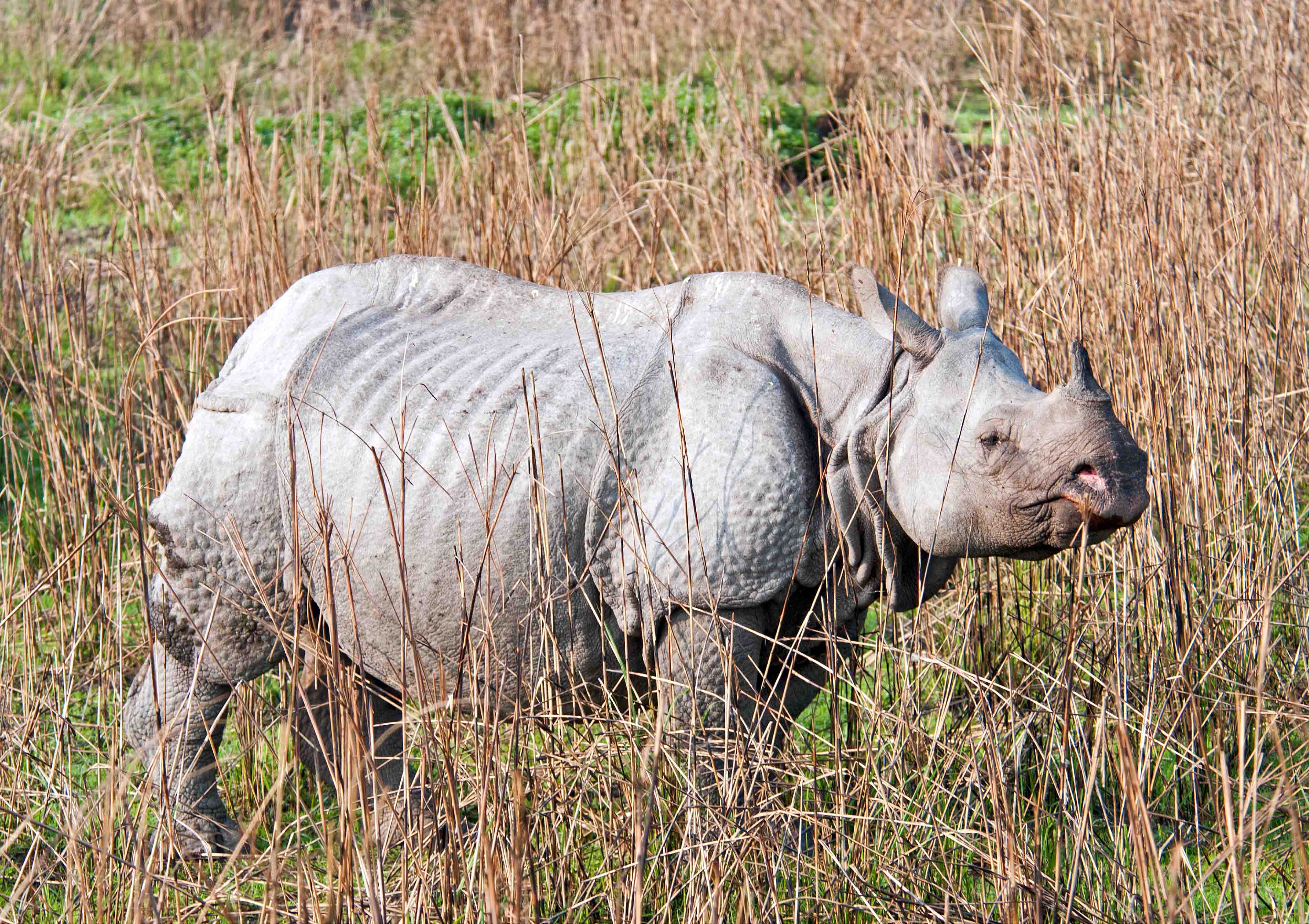
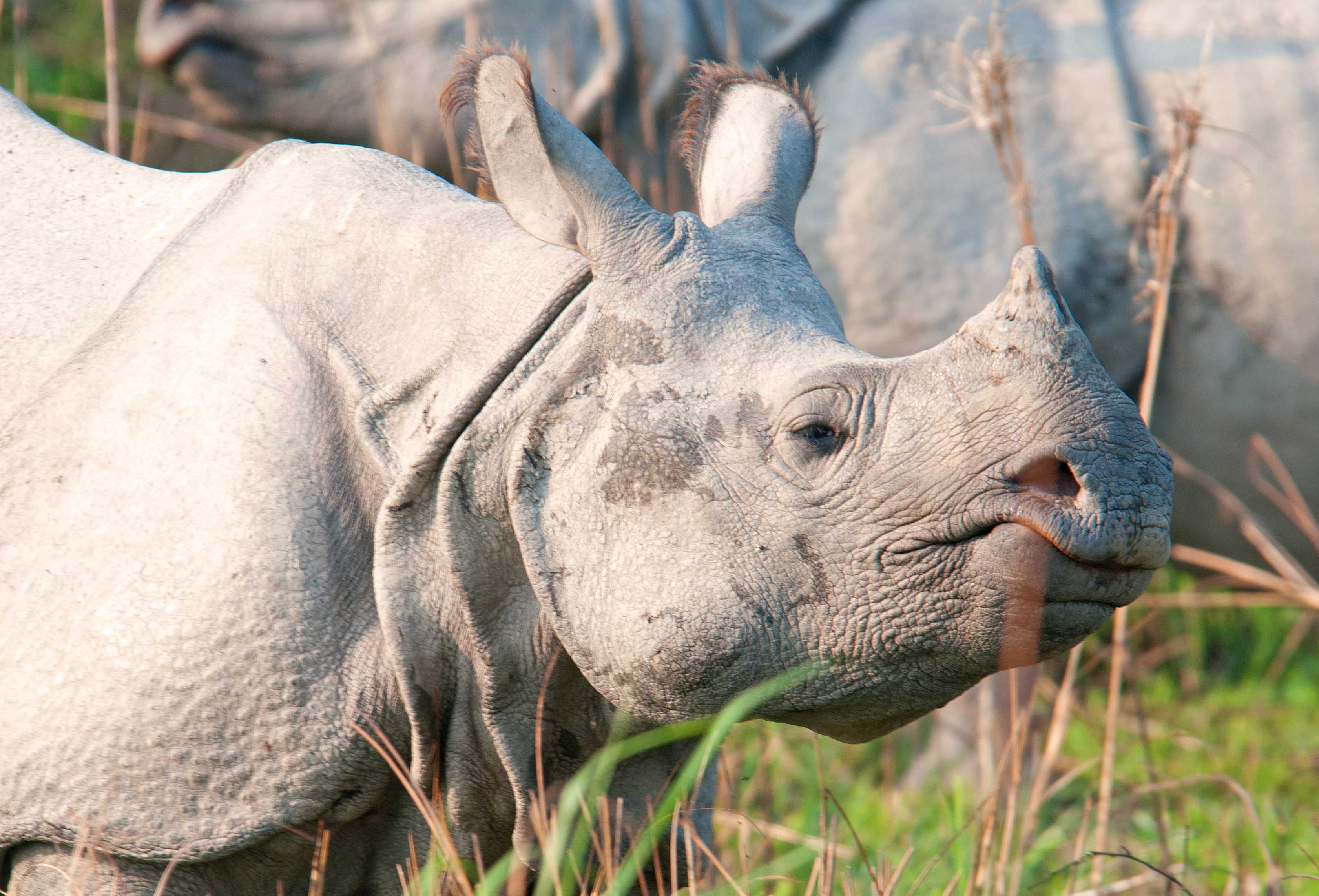
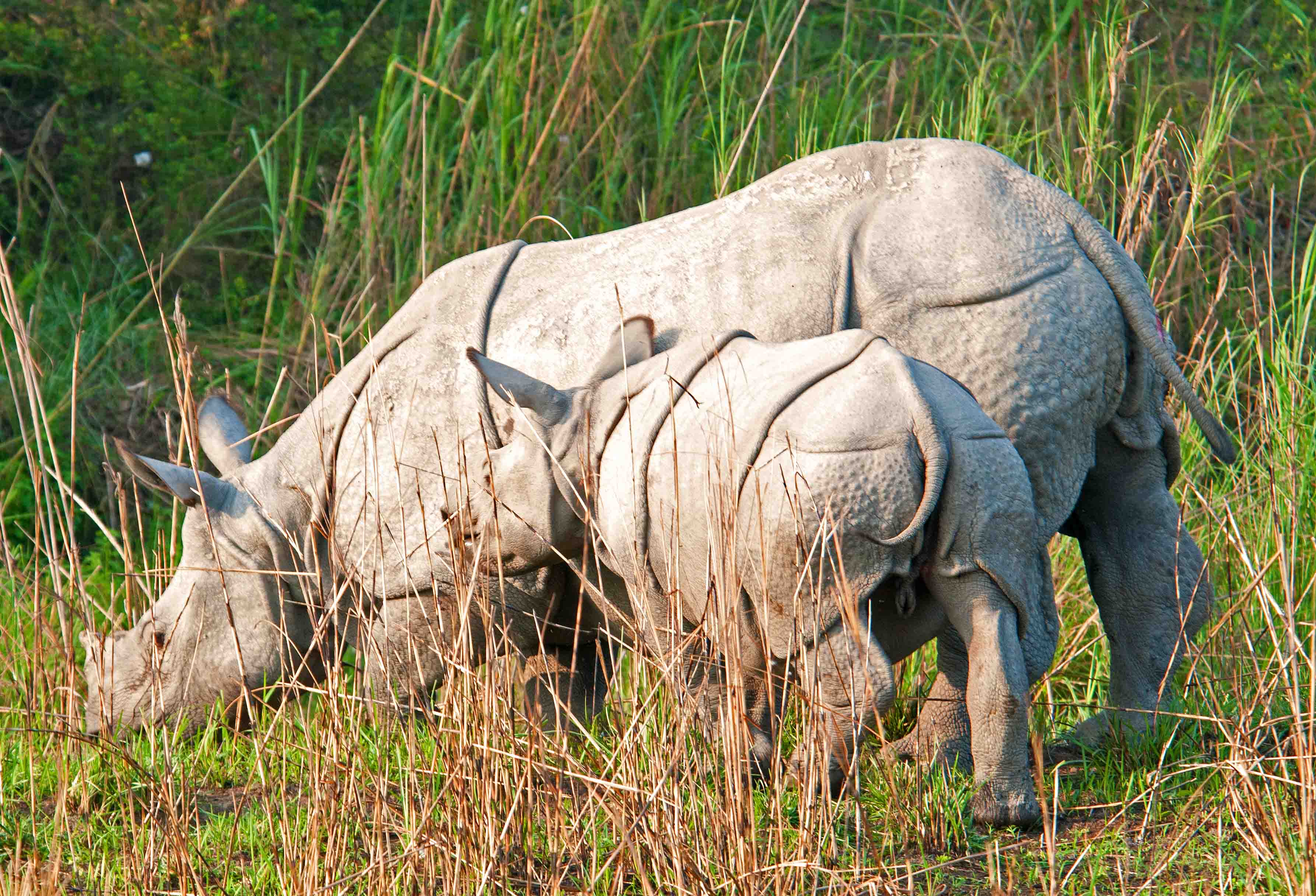
Kaziranga National Park covers an area of 430 sq kms along the southern bank of the river Brahmaputra, in the province of Assam, in NE India. The park is famous for having the largest remaining population of the Great Indian one horned rhinoceros (Rhinoceros unicornis). These magnificent mammals are amongst the largest rhinos in the world, with some males weighing up to 2.7 tonnes (ref 1).
Indian rhinoceros (Rhinoceros unicornis) juvenile
The horn of the Indian rhino is often relatively small compared to that of African rhinos, but that does not stop some being killed for it. As most people know – apart from the fools who purchase it – rhino horn is just keratin, the same material as our fingernails. Any suggestion that it has any special properties is complete nonsense. Nevertheless, these wonderful animals are killed because there is a demand for the horn in traditional Chinese medicine. The current worldwide surge in demand for rhino horn has been primarily driven by demand for horn in Vietnam according to WWF (ref 2). It is hard to believe that people could be so ignorant as to pay huge sums for this totally useless product – only useful to the rhino – and thus threaten its existence.
Indian rhinoceros (Rhinoceros unicornis)
Although not on the awful scale seen in Africa, where rhino poaching has reached a crisis – at least 1,312 rhinoceros were illegally killed in Africa in 2015 – Indian rhinos are regularly killed by poachers. Official figures for the numbers of rhinos poached in Kaziranga NK in recent years are as follows: 2012 (11), 2013 (27), 2014 (27), 2015 (17) (ref 3). Although, these numbers are relatively low compared to the total population, I am sure that without the heroic efforts of the forest guards, many more would be killed. Poachers are willing to risk their lives to hunt these animals (refs 4, 5).
Indian rhinoceros (Rhinoceros unicornis)
The rhinos are counted every two years in Kaziranga, and the estimate carried out over 24-27 March 2015, yielded a total of 2,401 ± 100 (ref 3). Of the adults, there were more female rhinos (882) than males (663). The total for the species as a whole in India and Nepal is 3,555, according to WWF (ref 1). So it is clear just how important Kaziranga NP is for the preservation of this species, as well as for the many other animals in the park. The good news, is that despite the threat of poaching the rhino population is increasing, with numbers up considerably from a figure of 1,672 in 1999.
Indian rhinoceros (Rhinoceros unicornis) mother and calf
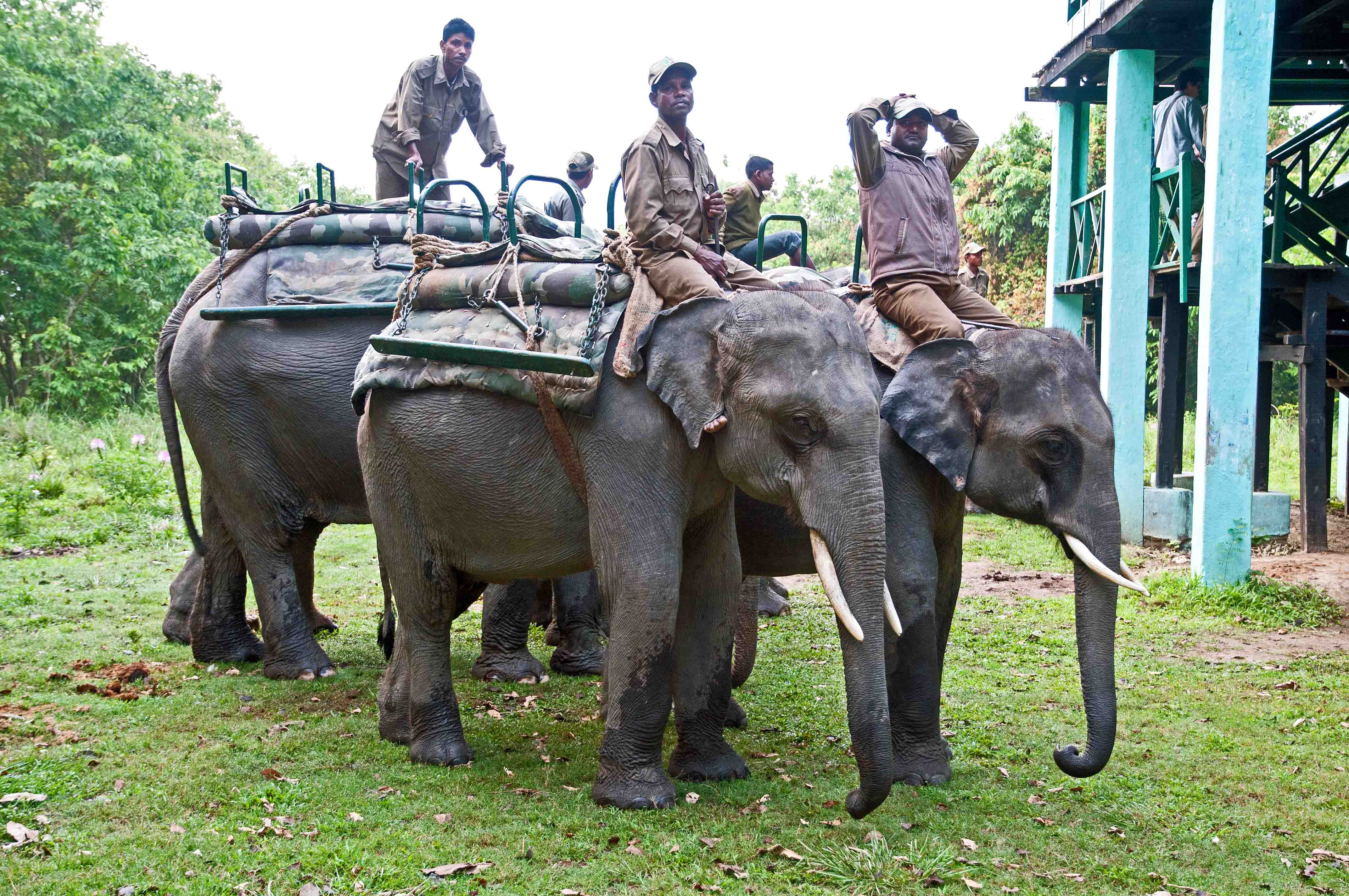
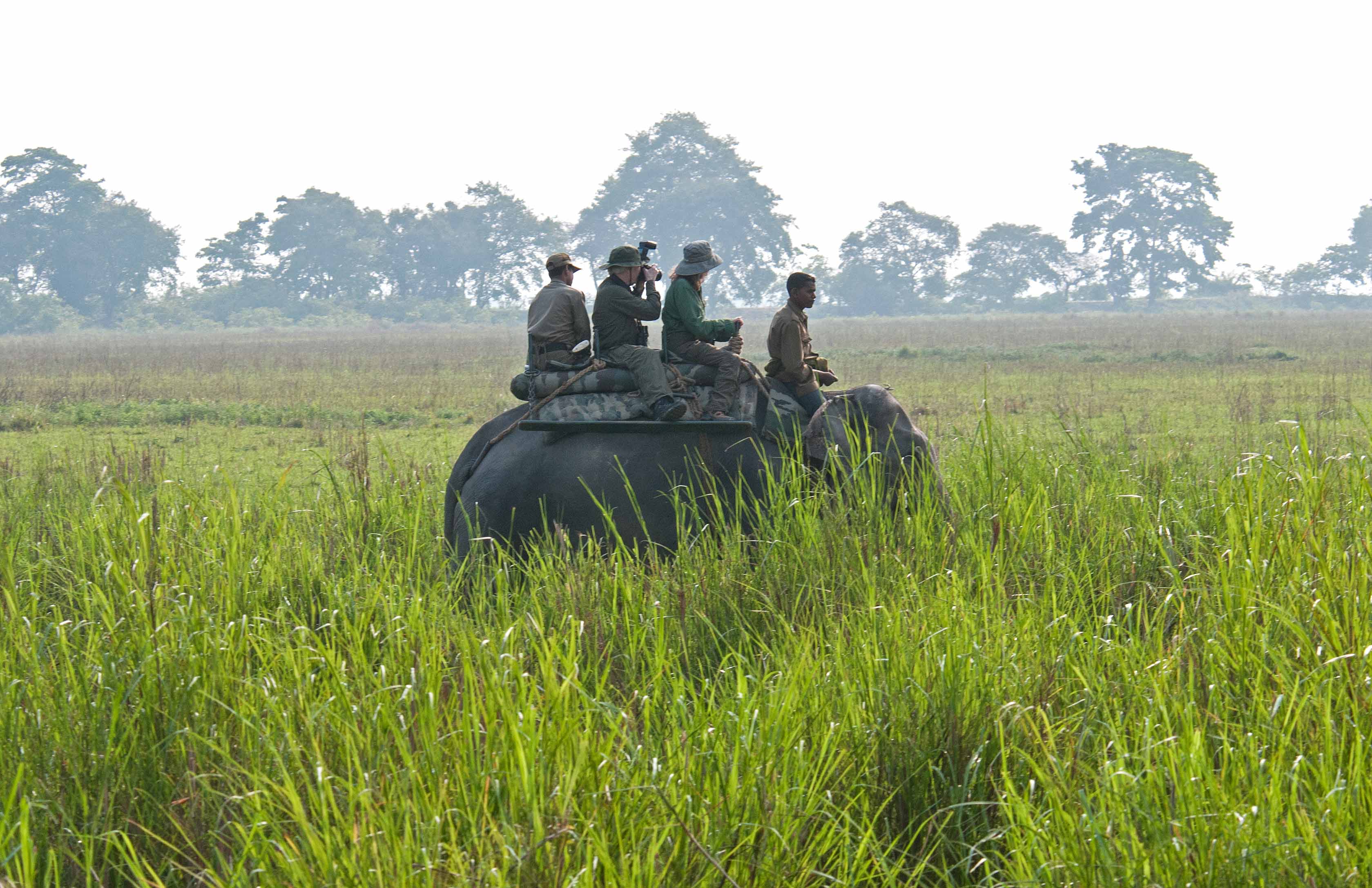
The best way to see and photograph the rhinos is on top of an elephant. The working elephants and their mahouts wait patiently for tourists to climb aboard them (below).
Elephants and Mahouts
Whilst sitting atop an elephant is certainly the best and safest way to view the wildlife, I found it surprising uncomfortable! My legs did not open wide enough to straddle the wide body of the beast!
Riding on an elephant
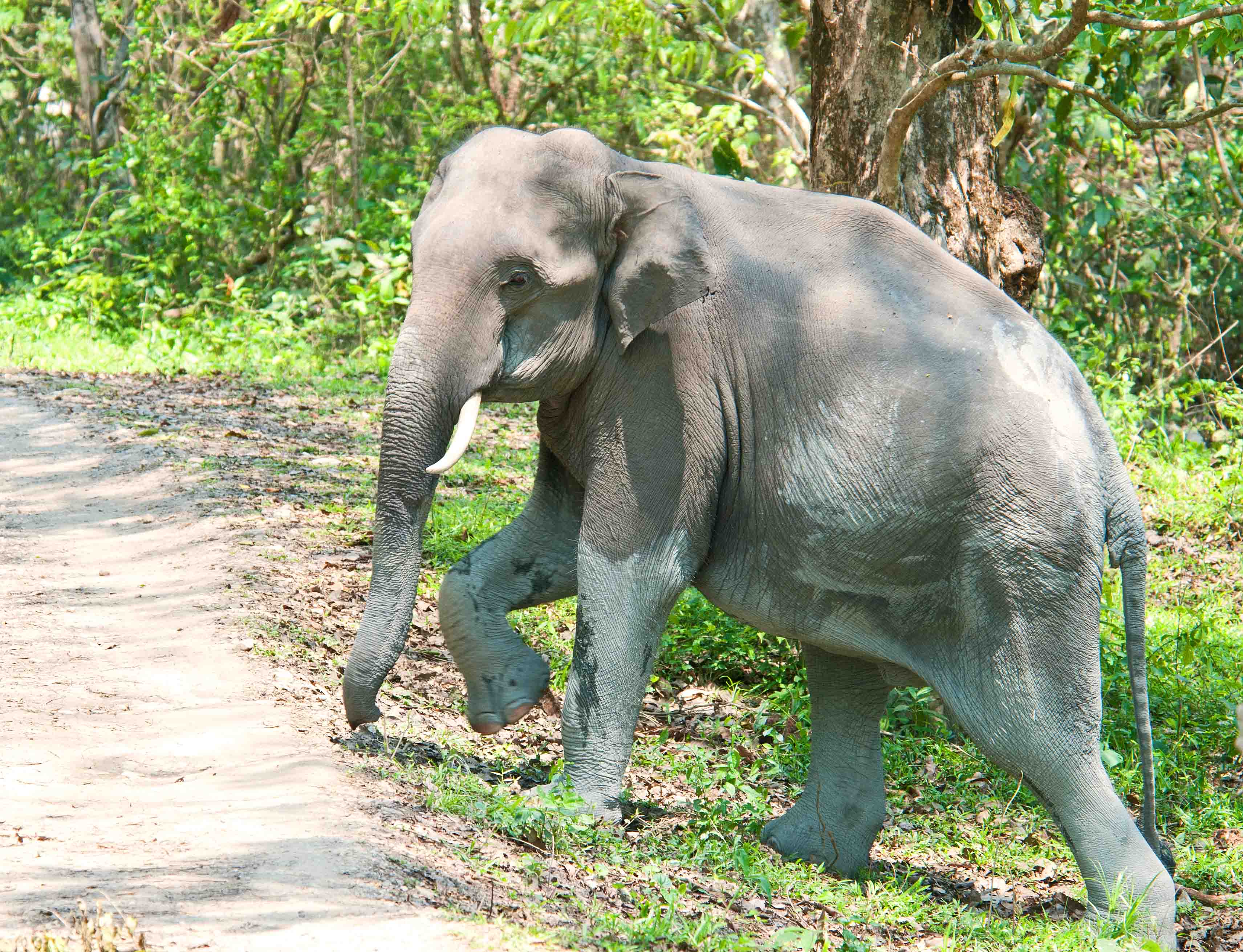
A total of 35 mammalian species have been recorded from the park. Apart, from the rhinos, two other iconic species which can be seen in abundance are Indian elephants (Elephas maximus indicus) and Wild water buffaloes (Bubalus arnee). There are well over a thousand wild Indian elephants in the park, and it was a joy to see them up close, such as crossing the road (below).
Indian elephant (Elephas maximus indicus) crossing road in Kaziranga NP
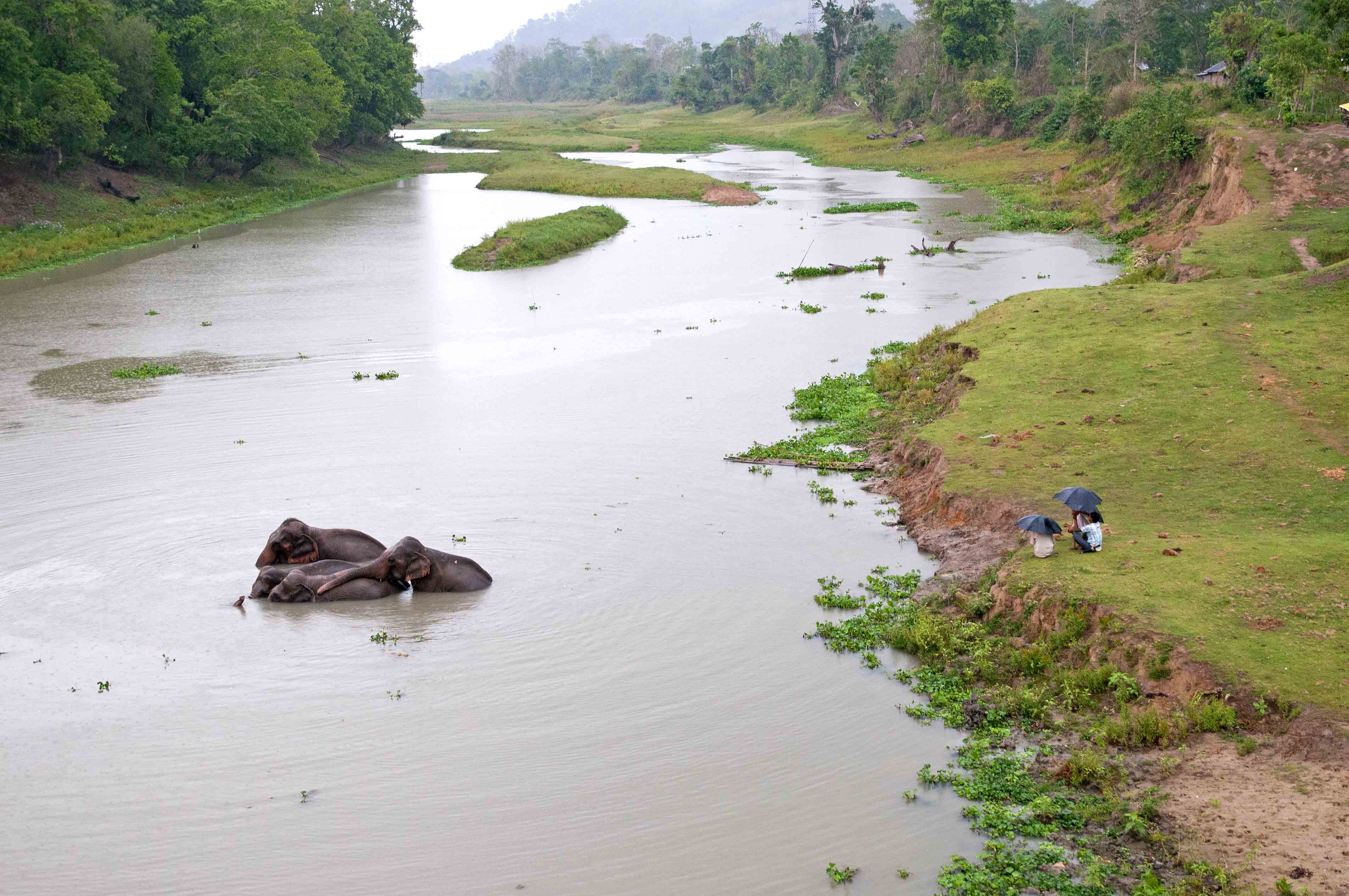
I felt a bit sorry for the working elephants, but they seem to be well cared for and it was nice to see them having a bath in the river.
Elephants bathing in the rain
Without the elephants to ride on, it would not be possible to walk through the elephant grass, or wade through the marshes. Did I mention the tigers?!
Elephant ride through long grass in early morning
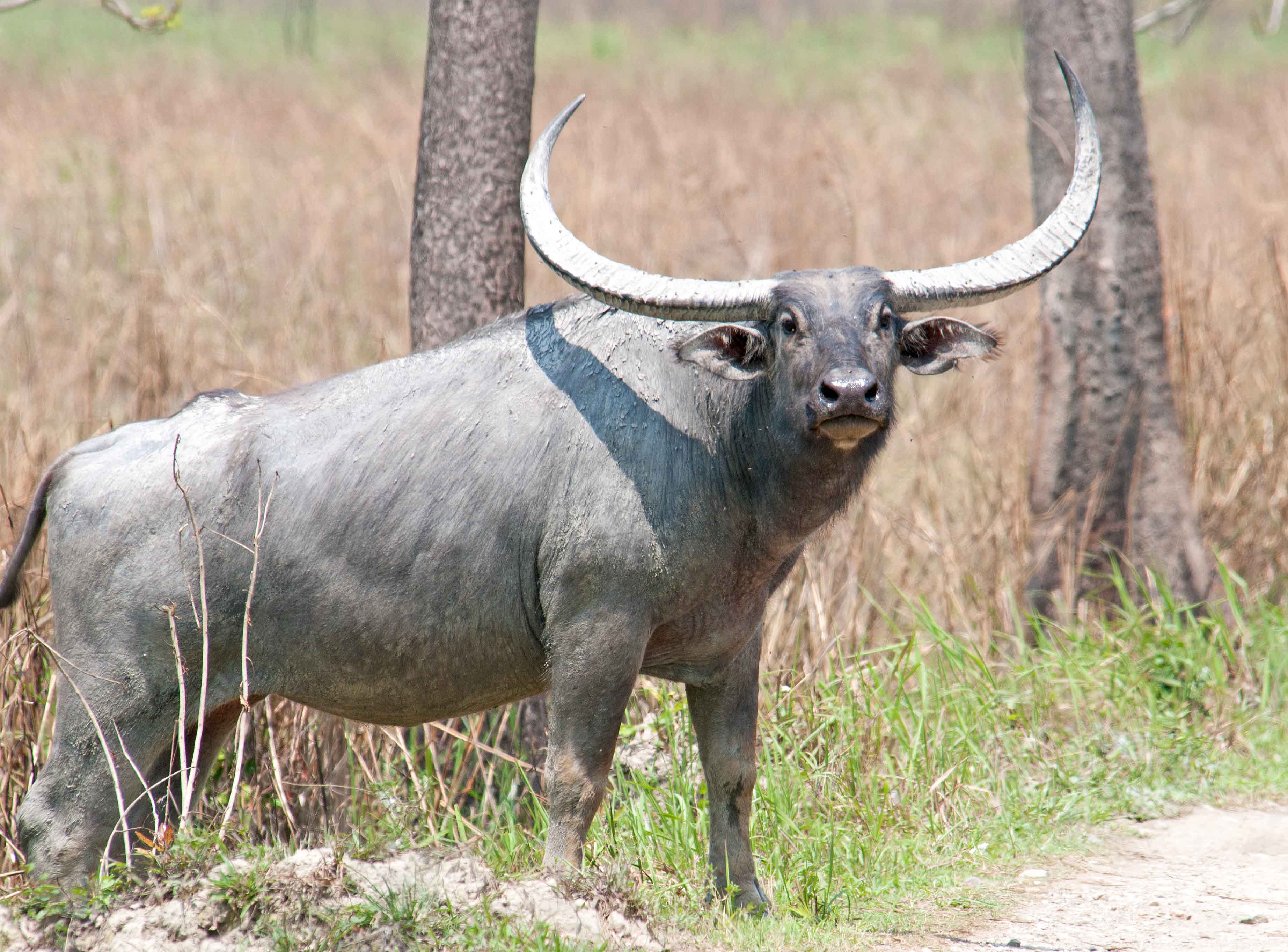
My next favourite mammal was the wild water buffaloes, of which there were 1,666 in 2001, so maybe more today. These are much bigger and more feisty than the domestic water buffalo (Bubalus bubalis), with which they can interbreed. The males have an impressive set of horns.
Wild water buffalo (Bubalus arnee) male crossing road
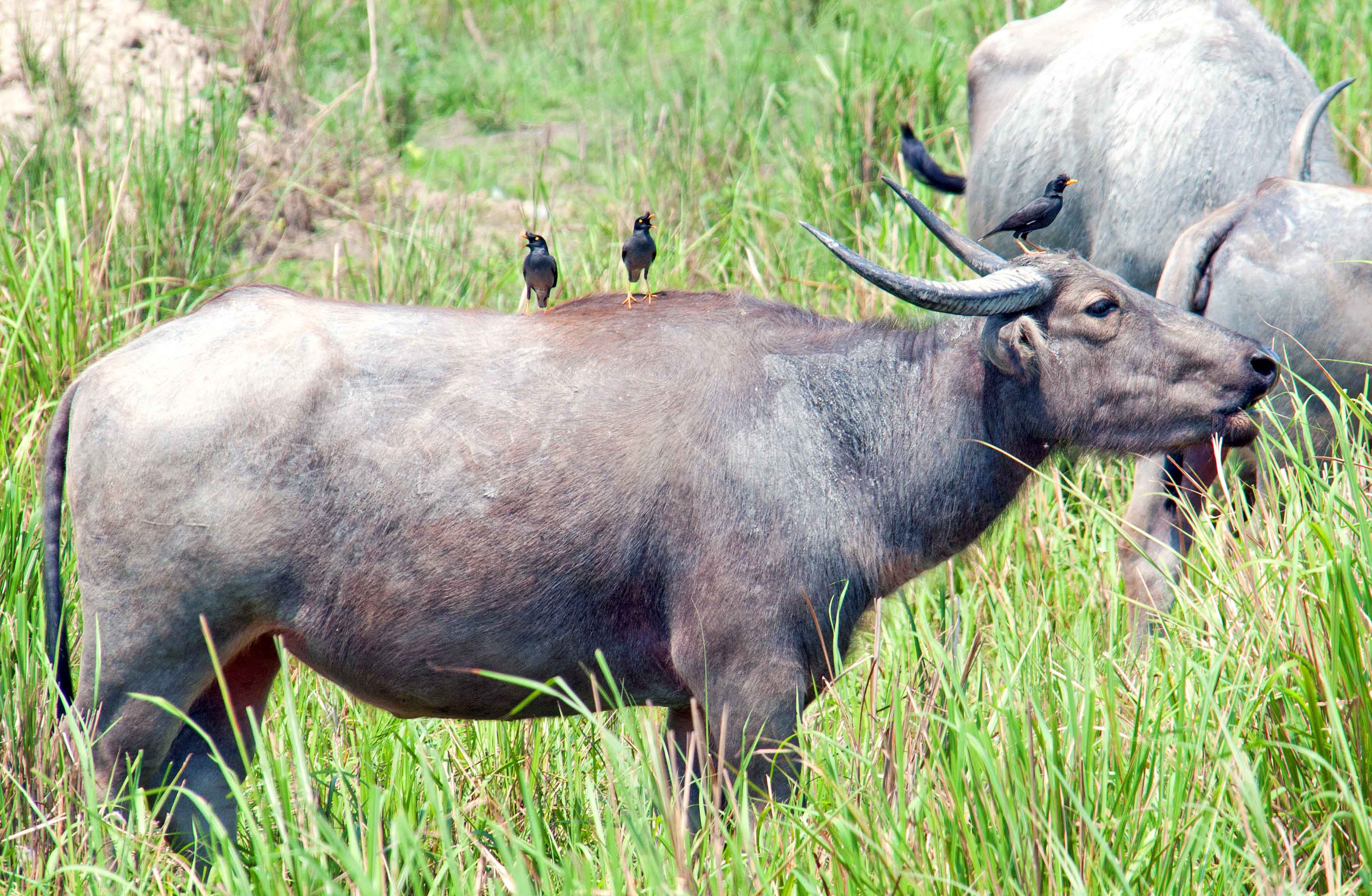
They are a sort of mobile snack shack for flocks of Jungle myna birds, which perch on top of them, looking to ticks I suppose.
Wild water buffalo (Bubalus arnee) with Jungle Mynas
It was great fun to see these wild buffaloes enjoying a mud bath! This photo also shows the close association between buffaloes and cattle egrets; the birds follow the buffaloes around pouncing on any insects disturbed by the large bovids.
Buffalo mud bath
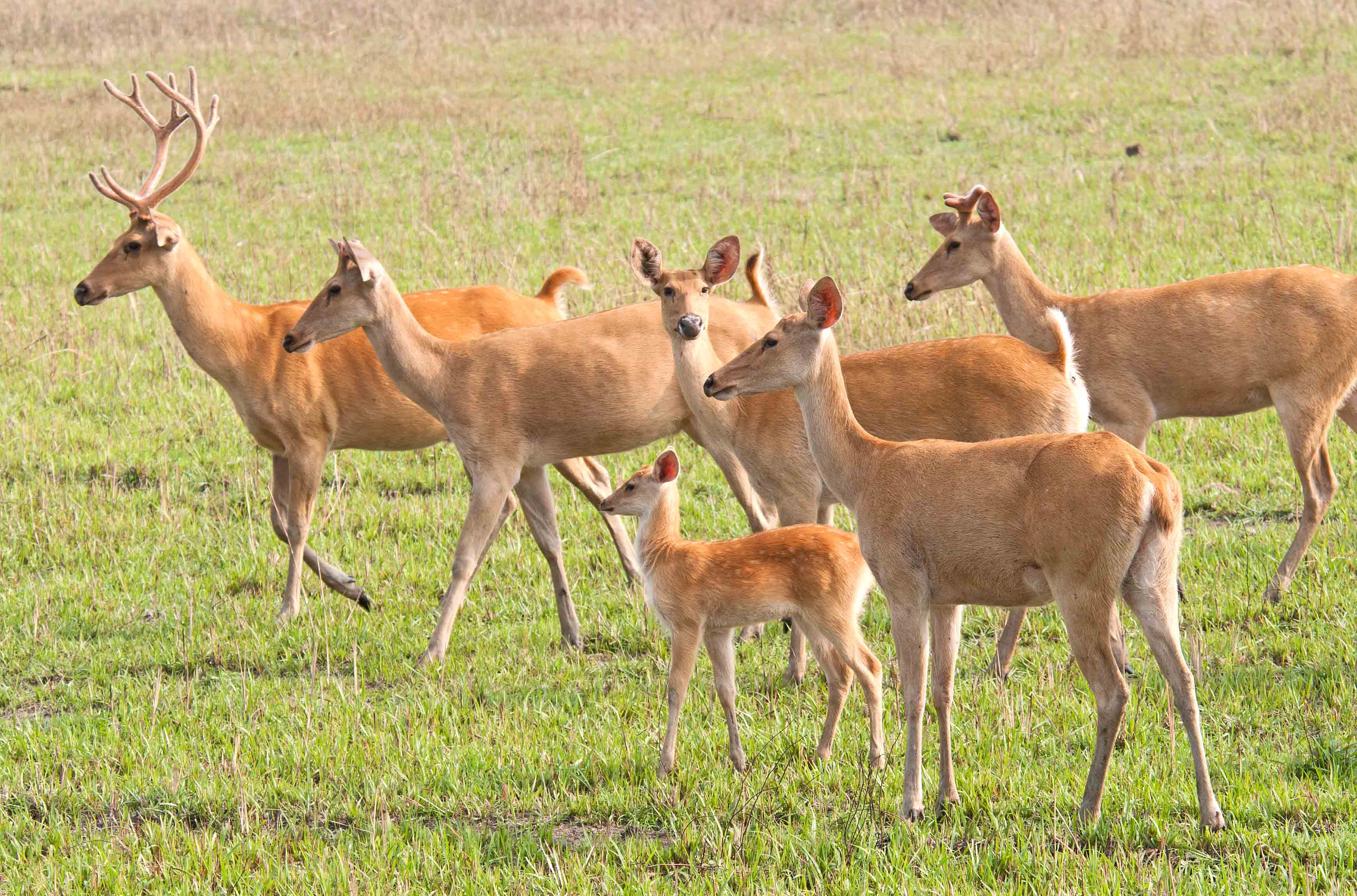
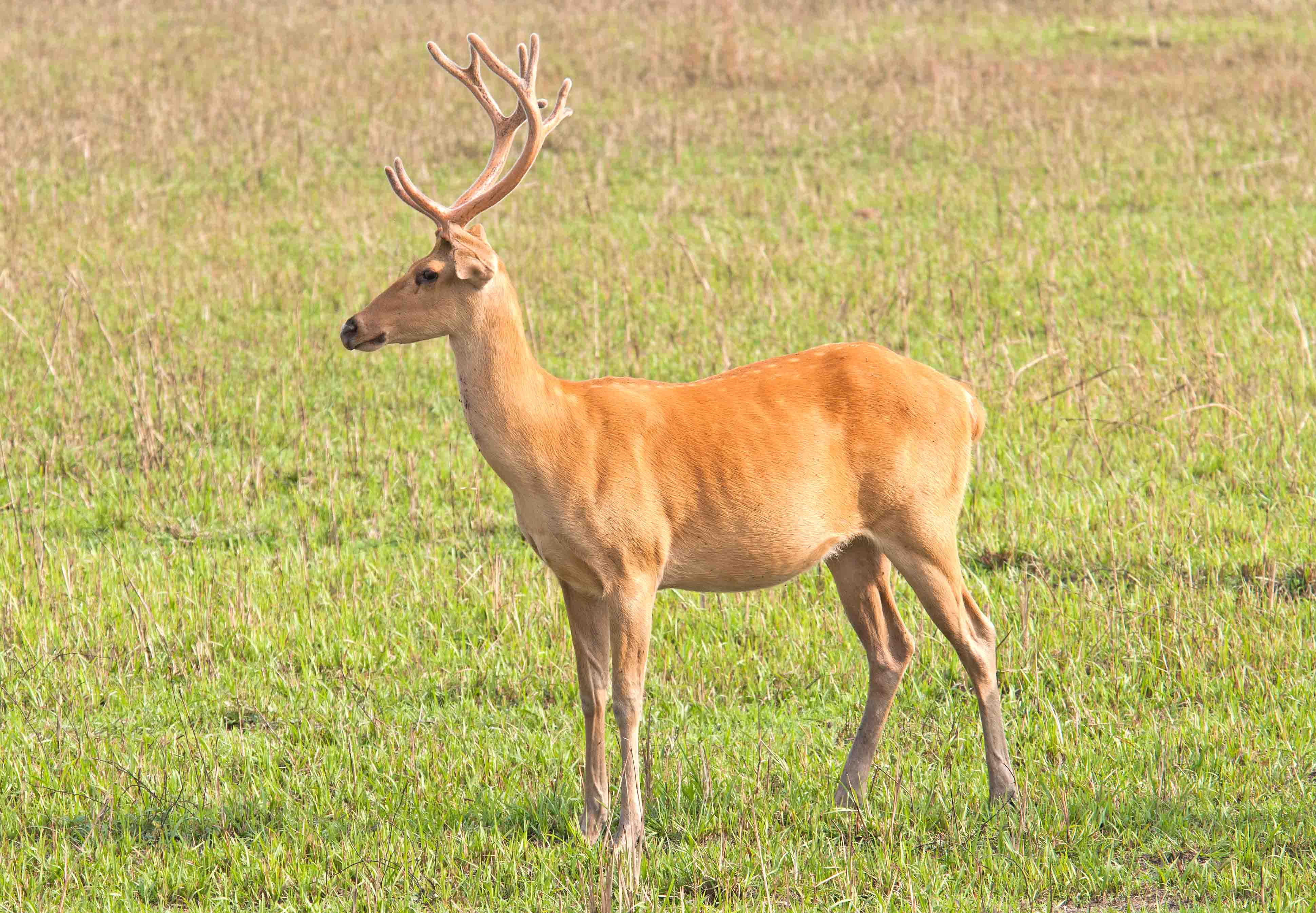
There are a number of species of deer in the park, but for me the most beautiful were the barasingha (Rucervus duvauceliisyn.Cervus duvaucelii), or swamp deer.
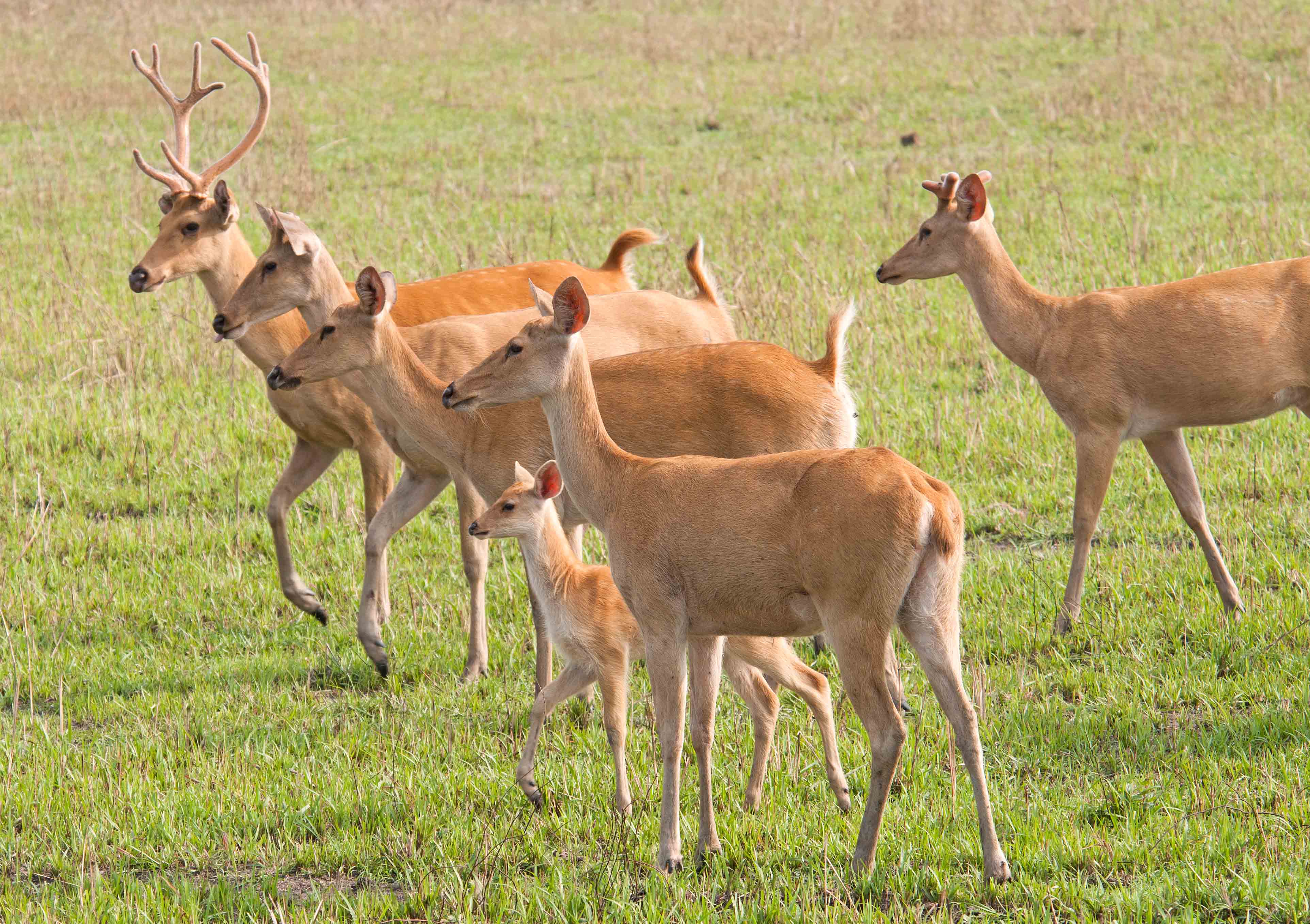
There are three subspecies of this lovely deer in India, and the ones present in Kaziranga NP are Eastern swamp deer, R. d. ranjitsinhi (Grooves 1982), of which there are reportedly about 700 present. The females are smaller than the males – stags can weigh up to 280 kg (below) – and the young deer are spotted (see above).
Eastern Swamp deer (Rucervus duvaucelii ranjitsinhii) male
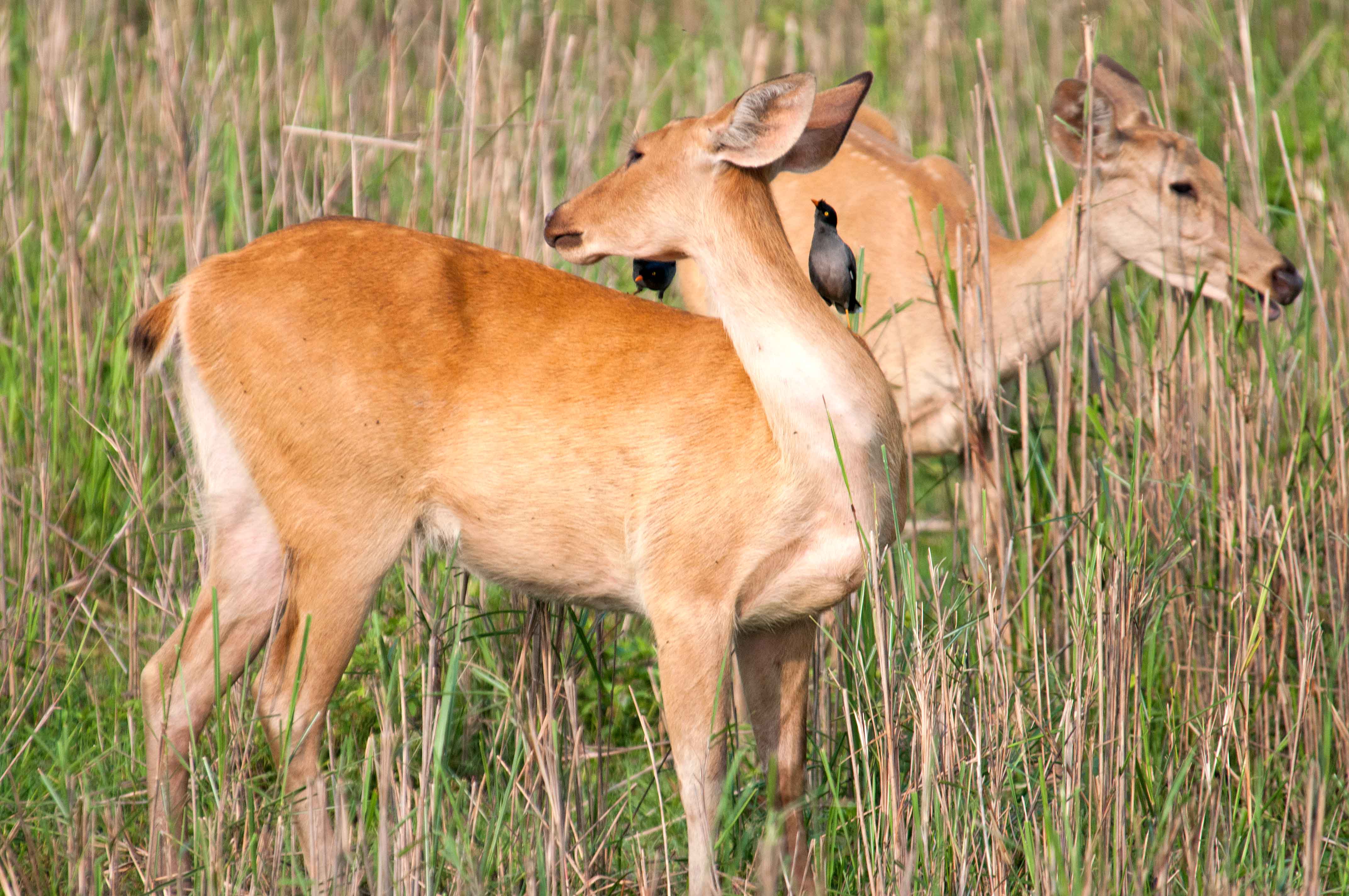
The jungle mynas also provide a tick-pecking service to the deer as well as the buffaloes!
Barasingha or Swamp deer female with Jungle mynas
The deer are keeping a sharp lookout in the following photo and there is a very good reason for them to be wary and alert!
Eastern swamp deer
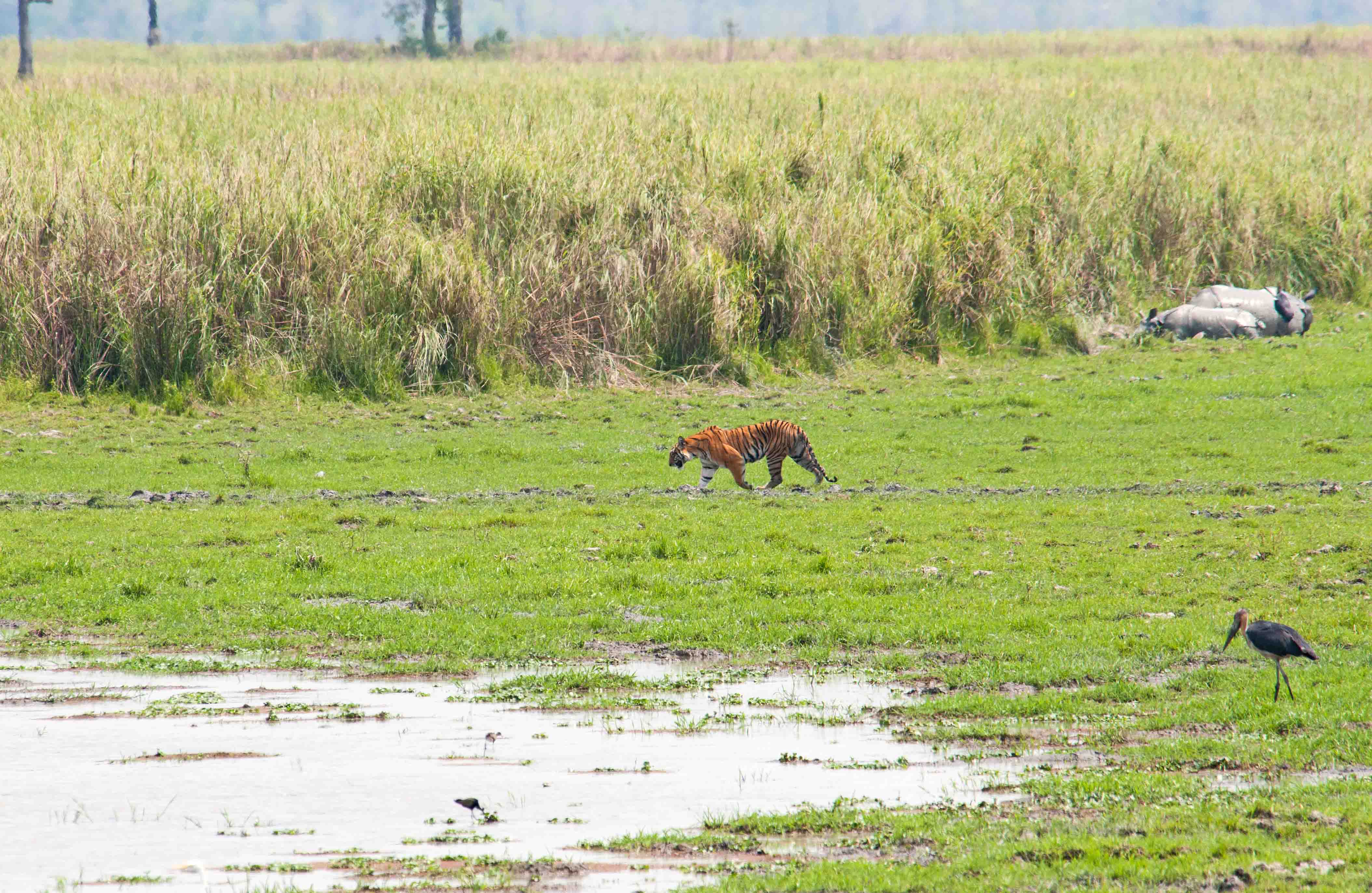
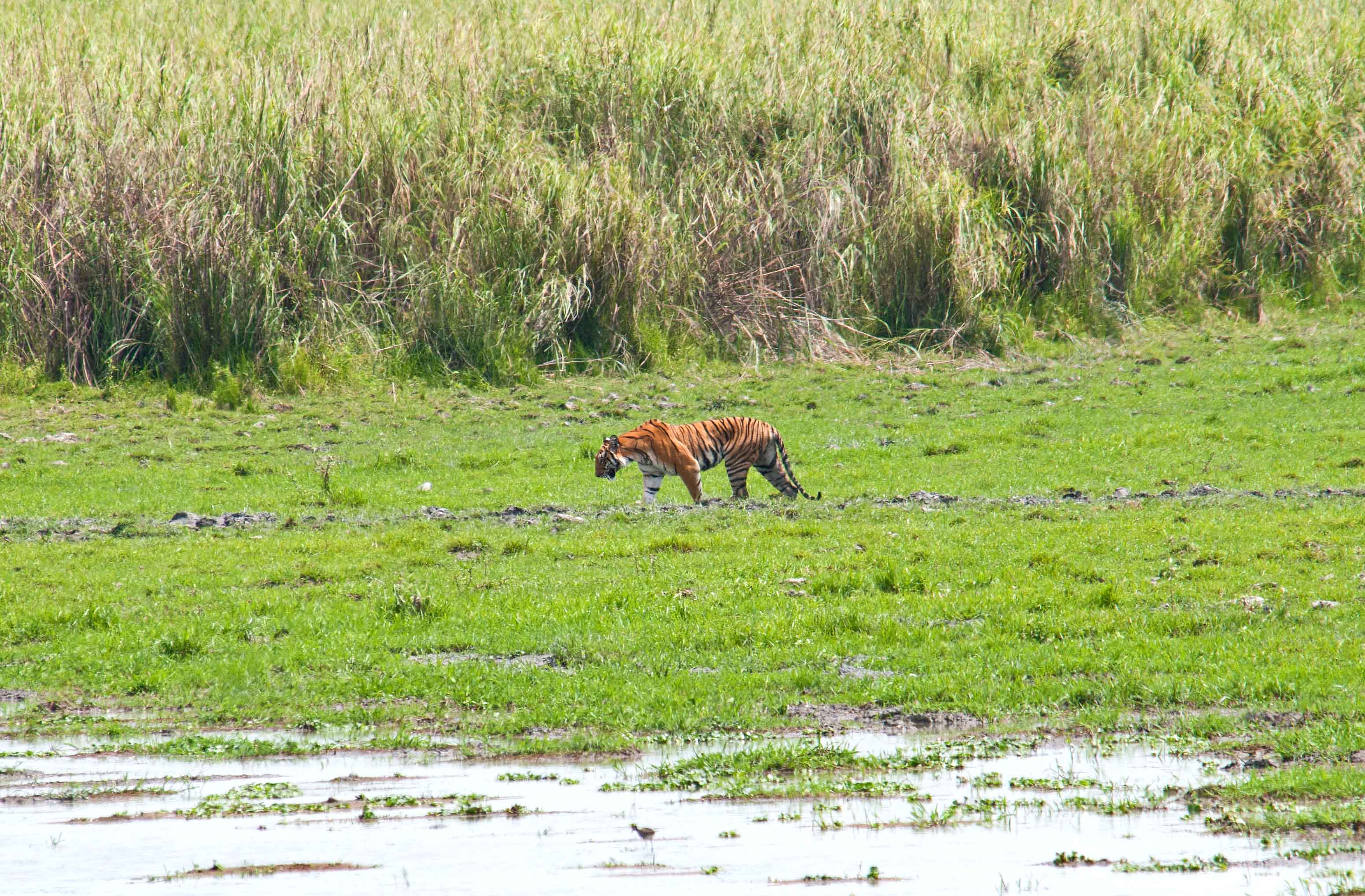
The reason is of course is the Royal Bengal tiger (Panthera tigris tigris)! Tiger numbers have been increasing in the park which now boasts one of the highest densities of tiger in India. There are believed to be more than 125 in Kaziranga NP, out of a total of 167 tigers counted in Assam (ref 6).
Tiger and rhinos, Kaziranga NP, Assam
In the short time I spent there, I saw tigers on two separate days. We were said to be very lucky and indeed it was a huge privilege to see these animals in a such a magnificent setting.
Tiger crossing
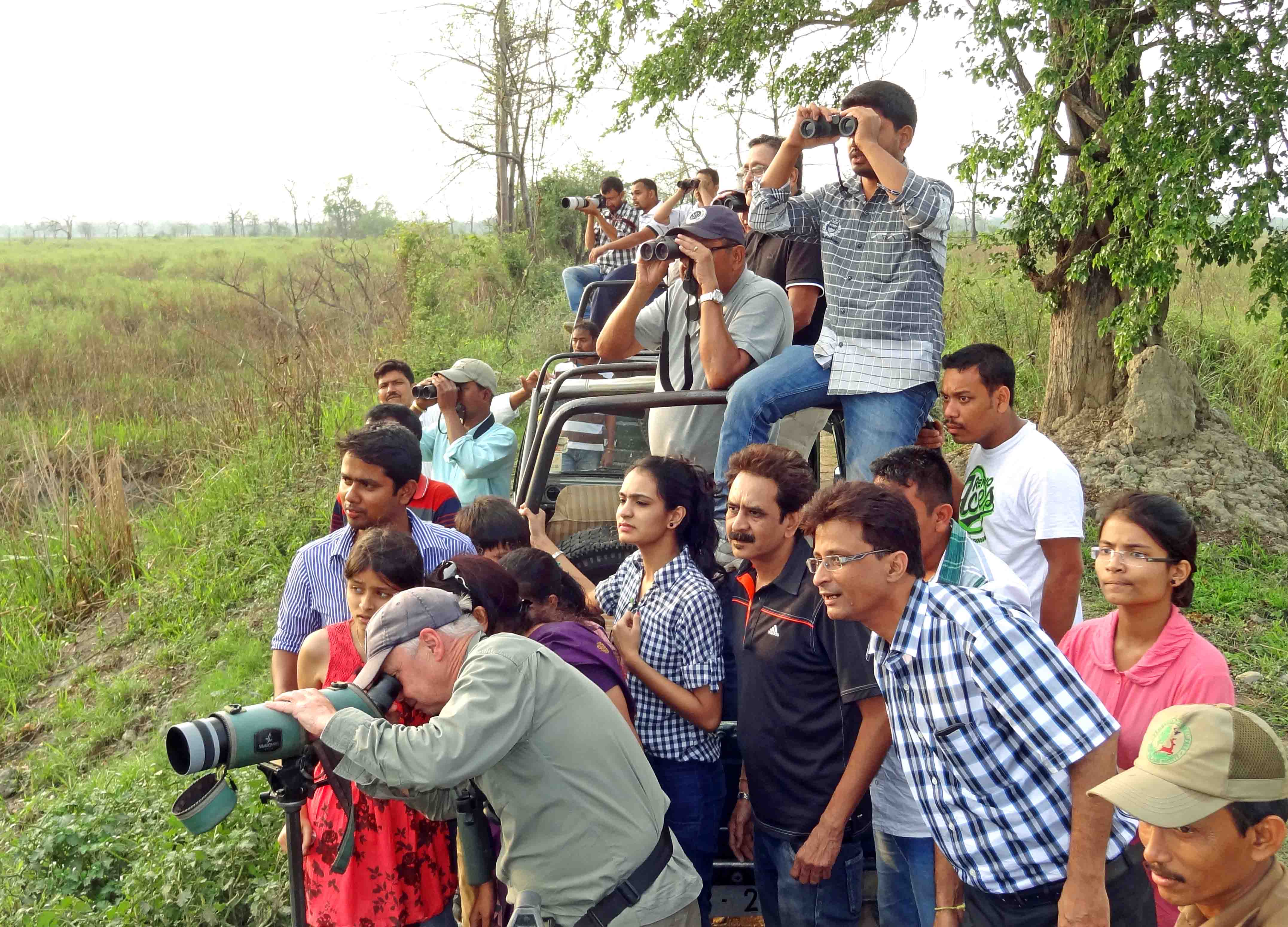
It was amazing to see how exited people were – me included! – to see a tiger for the first time, which gives me a little hope for their long term future.
Watching the tiger
It is said that the reason that the tigers are doing so well here is the relative freedom from poaching in Kaziranga NP as well as the abundance of game for them to hunt. In a world full of so many horror stories involving wildlife destruction, it is a pleasure to be able to finish this travelogue on a positive note.
The park was officially declared UNESCO World Heritage Site in 1985, and it certainly lives up to this recommendation.
If you find yourself passing through La Coruña airport in northern Spain any-time, make sure you have a look at the frogs. This small airport is located in the suburbs of La Coruña – also called A Coruña in Spaanish – and is one of a number of gateways into the province of Galicia. A far cry from the hustle and bustle of Heathrow airport – where flights on the airline Vueling depart from – it is relaxed and uncrowded, with a great restaurant. They even serve you a delicious soup from a steaming hot cauldron at your table. Imagine that at Heathrow!
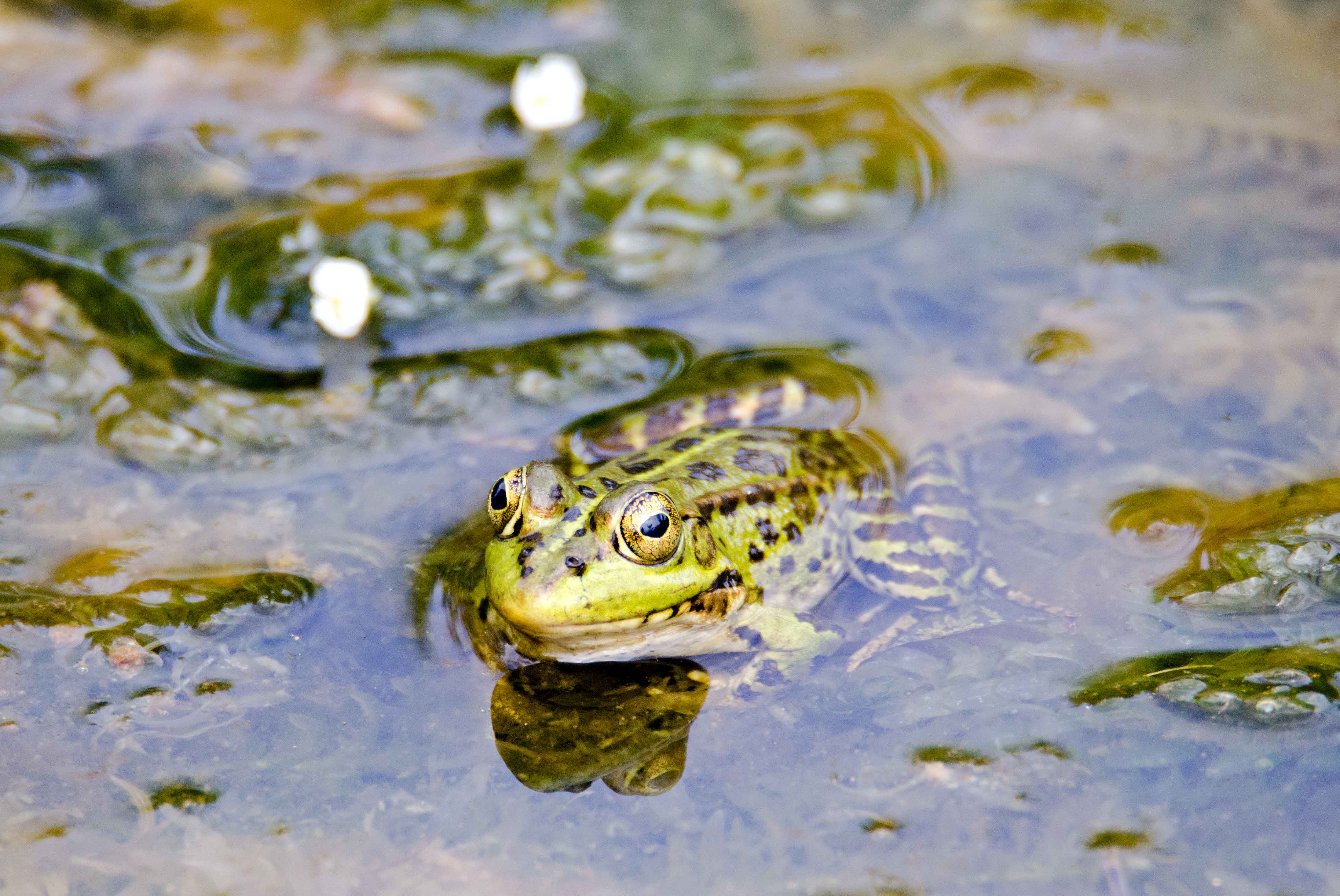
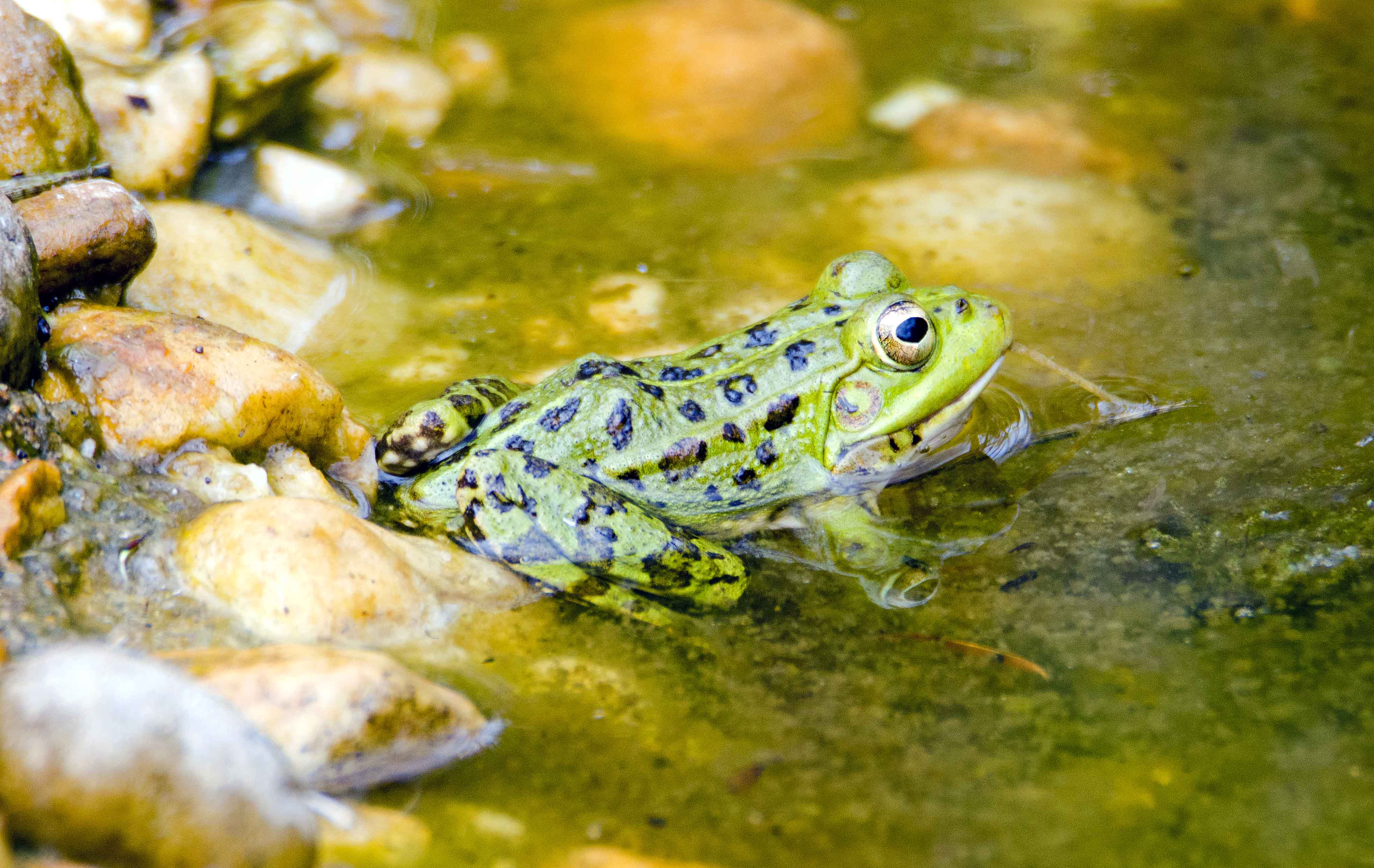
Perez’s frog (Pelophylax perezi)
It’s always fun landing at this airport, which is located on a hill about 7 km from the city centre. But what I have come to appreciate as I have passed through this little airport over the years, is that it is a really good place to see Perez’s frog (Pelophylax perezi), also known as Iberian water frog, Iberian green frog, or Coruna frog. I’m not joking! There is a series of ponds at the at the northern end of the airport, just by the road leading out of the airport, and close to the car park. It is easy to find it as there is an example of the traditional Galician stone gain store (or horreo) besides the ponds.
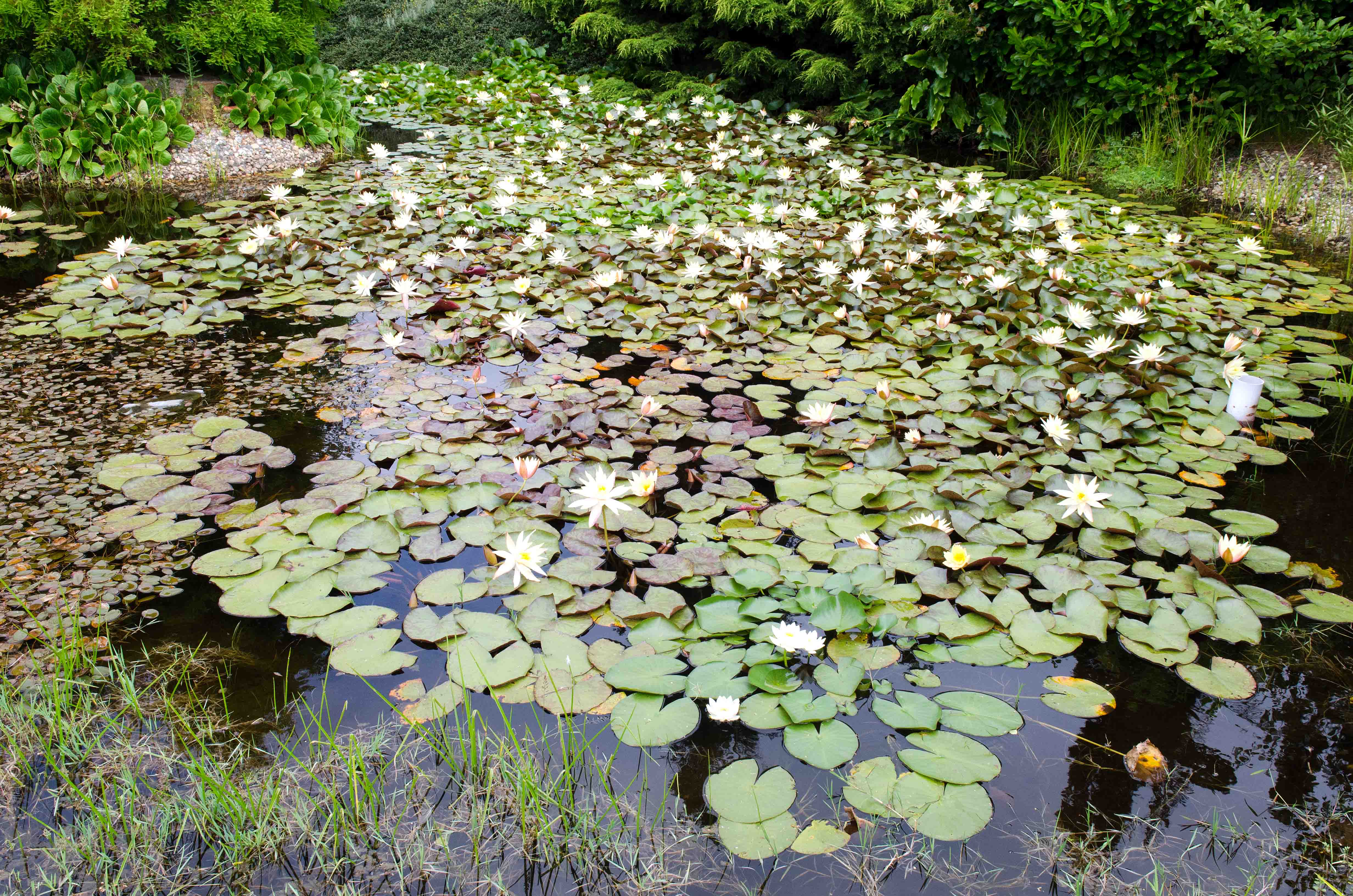
Frog pool or lily pond at La Coruna airport
The ponds themselves are covered in water lilies on which the frogs can be seen resting, if you approach carefully. More likely you will hear plop, plop, plop as all the frogs hear your footsteps and jump into the safety of the water!
Perez’s frog (Pelophylax perezi) La Coruna airport
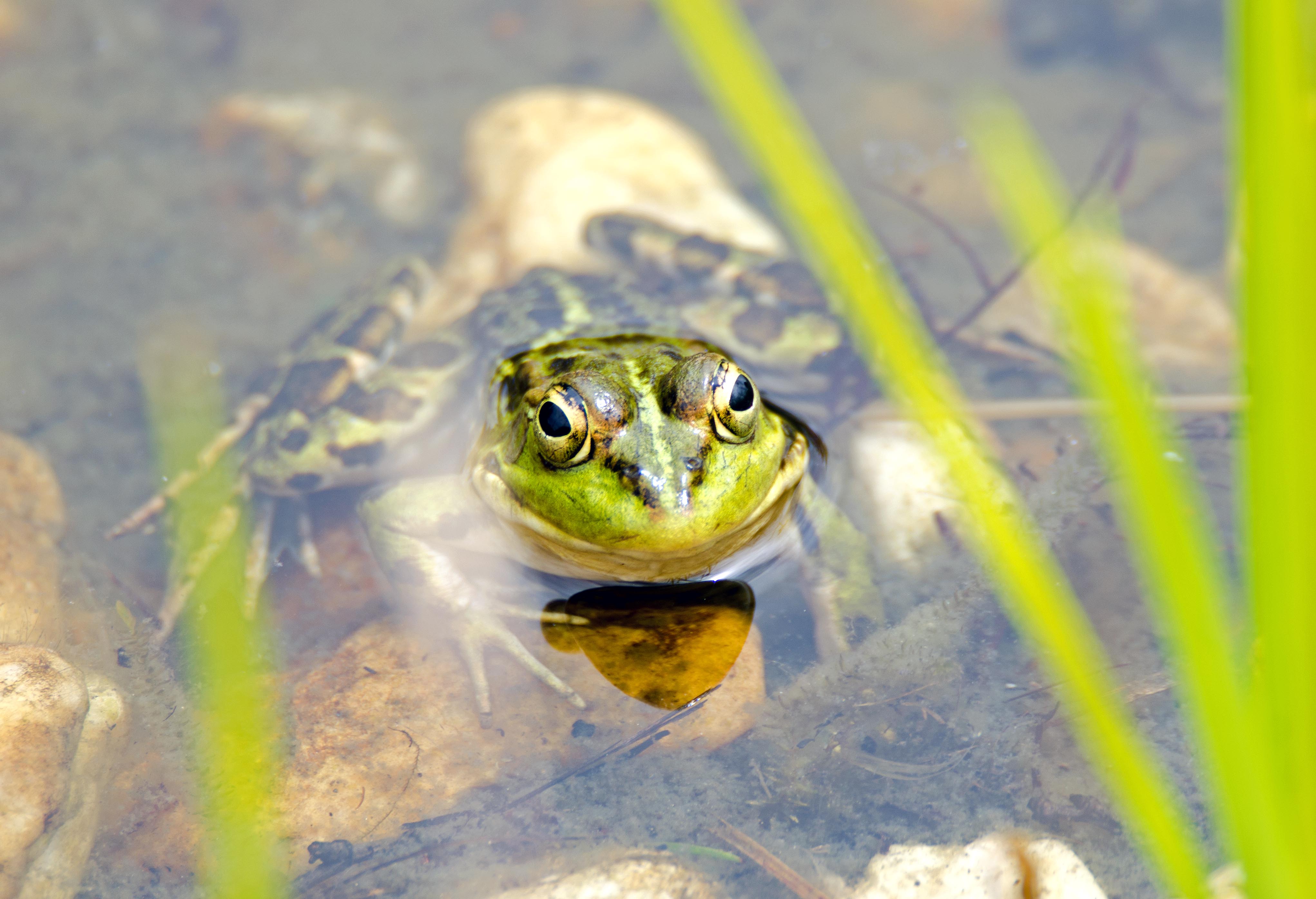
This frog species is not endangered (although amphibians are vulnerable everywhere), as is widely distributed and common across the whole of the Iberian Peninsula and is found in southern France, and elsewhere where it has been introduced, like Madeira, the Balearic and Canary Islands.
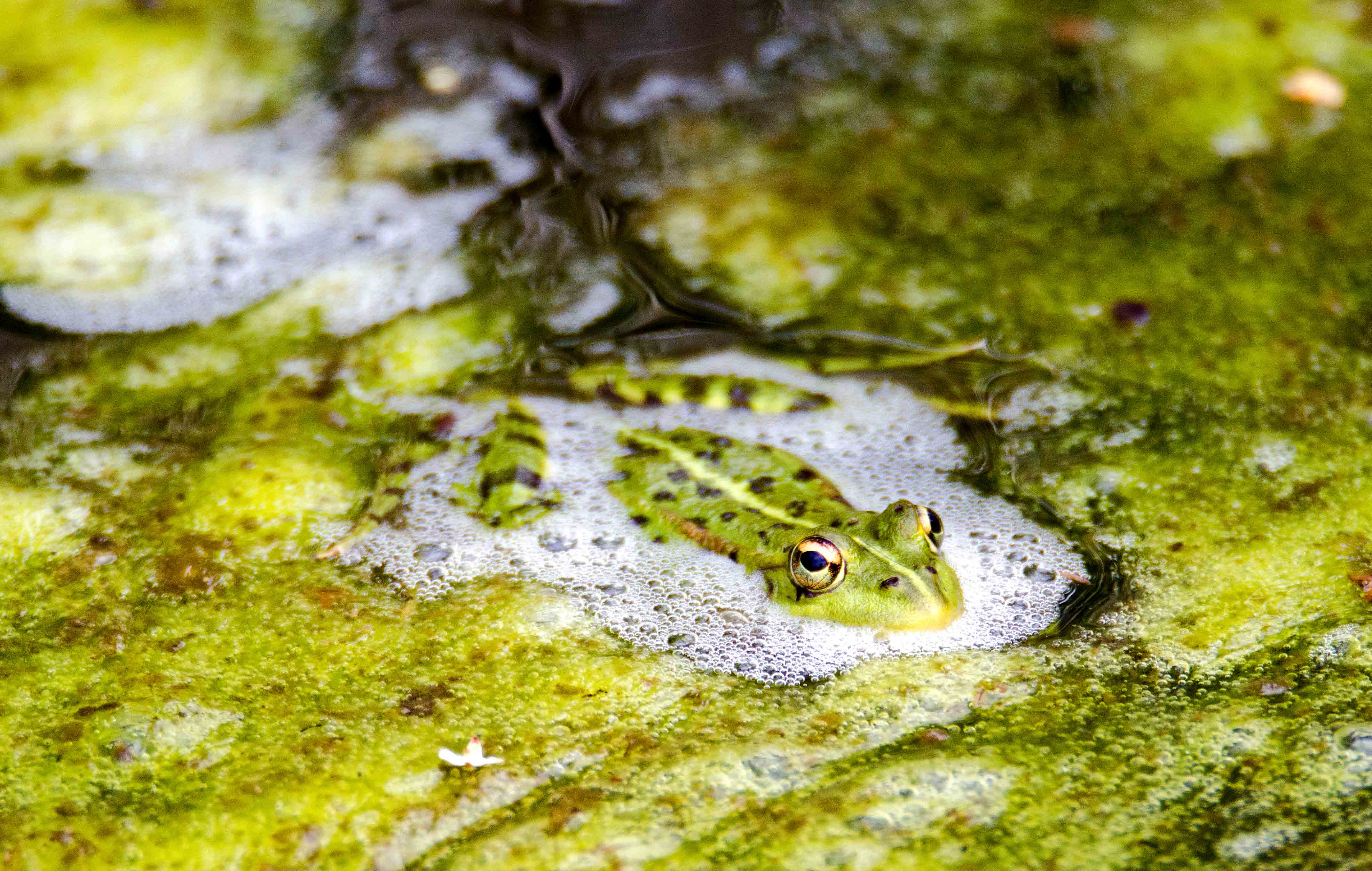
Perez’s frog (Pelophylax perezi) with bubbles
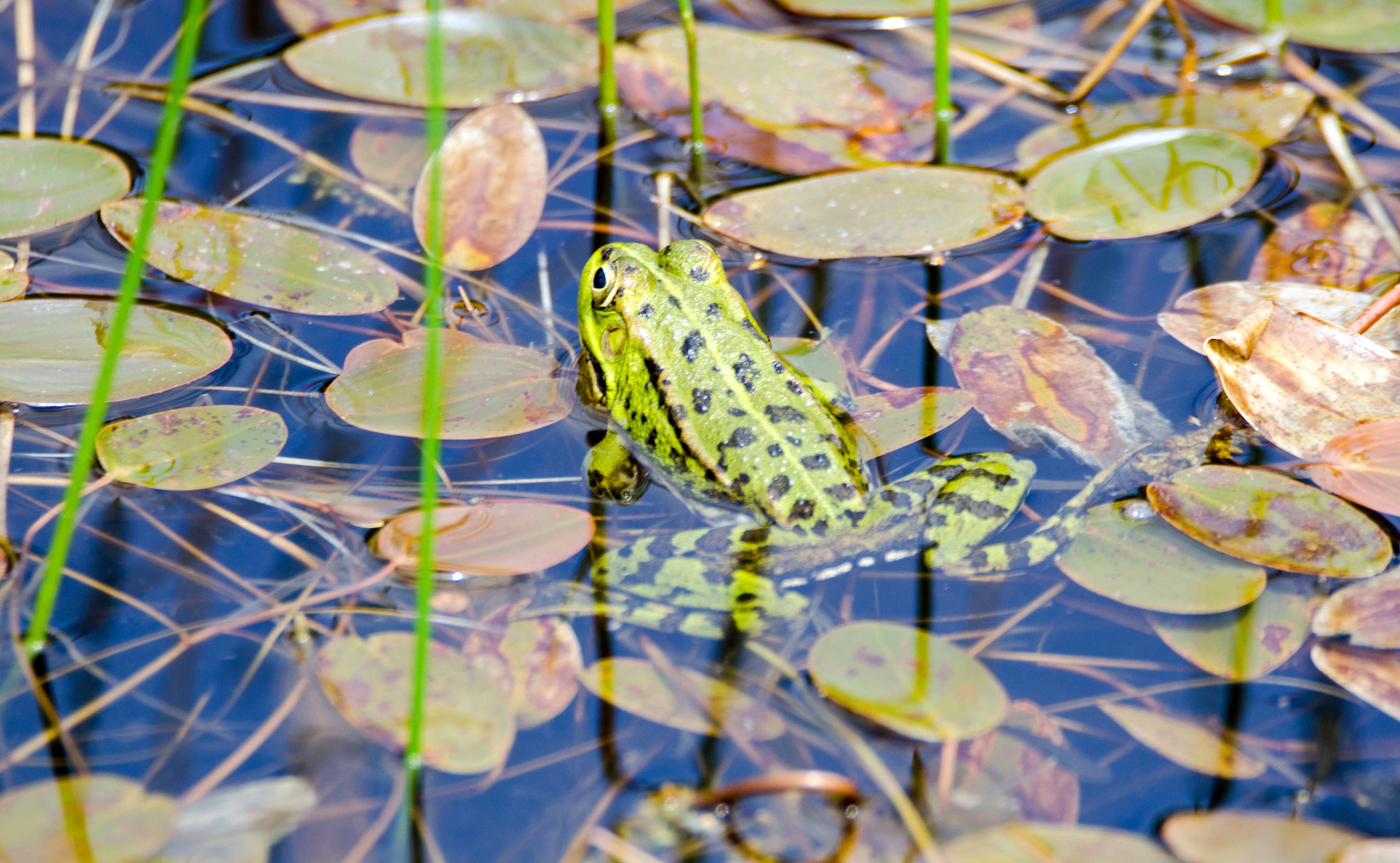
They are highly variable in colour and patterning, and look a lot like the Marsh frog (Pelophylax ridibunda) which is what I thought they were when I first came across them (1). Confusingly, they also hybridise with each other to form a type of hybrid frog!
Perez’s frog (Pelophylax perezi)
So whilst not being unusual, you might not come across a better place to see them whist visiting Spain or Portugal, and it is a good way of whiling away some time waiting for a flight. They are particularly vocal and lively, jumping around and inflating their vocal sacs, during the breeding season (Spring) (1).
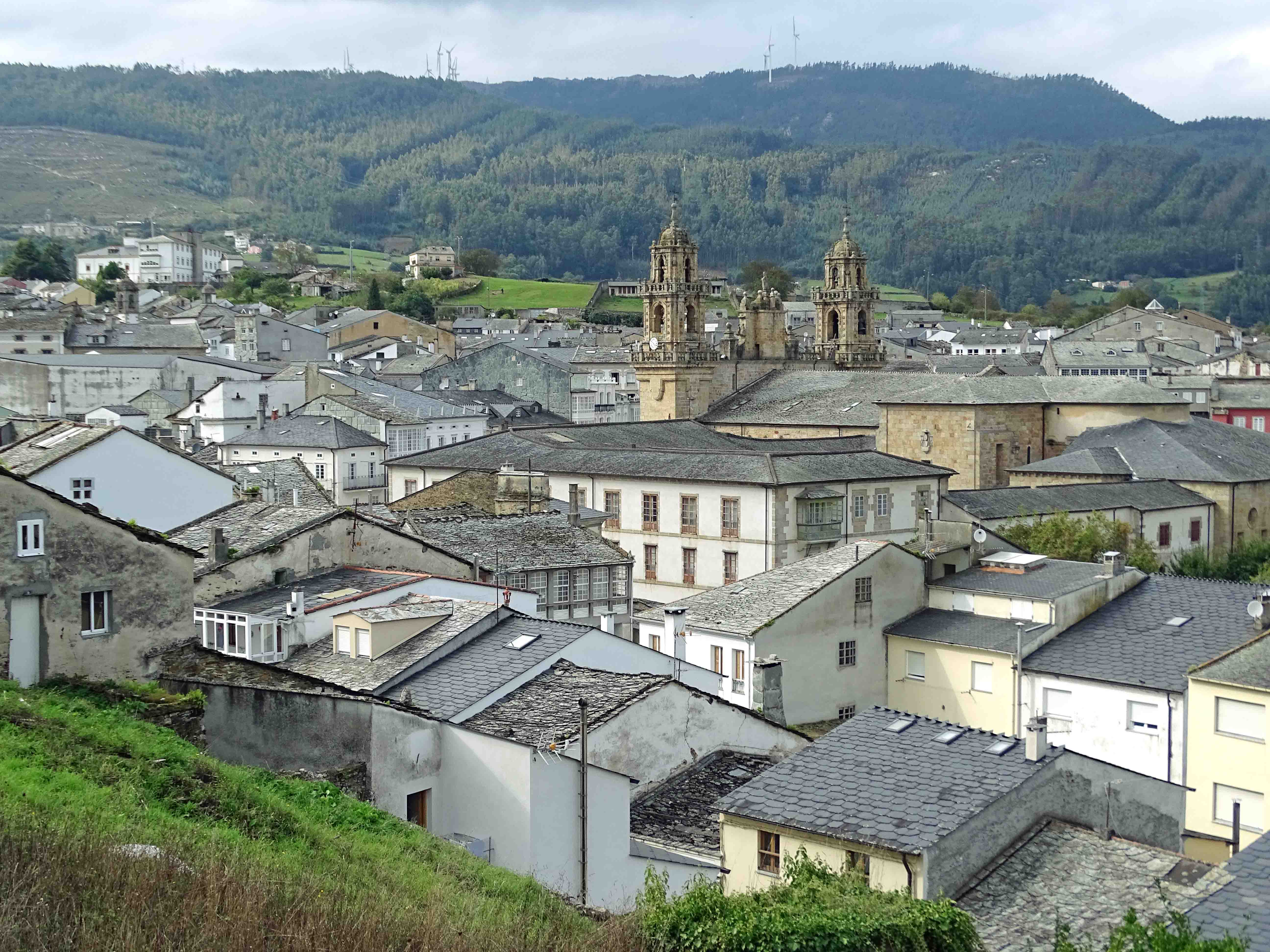
The small city of Mondoñedo is located in the province of Galicia in northwest Spain. It lies along the so-called Northern Pilgrim Way, of the Camino de Santiago (the Way of St. James) (1). Although, it is now a relatively small town of about 4,000 people – the population has been declining since the nineteenth century – it was once a mediaeval city of great historical importance.
Mondoñedo, with the cathedral church rising above the town in the centre
The central square is dominated by a large Cathedral Church which dates from the early thirteenth century. Construction of the church began in 1219 under the first Bishop, San Martín. It is worth remembering that this was at the time of the crusades, just 15 years after the sack of Constantinople during the Fourth Crusade, and at the time of the Fifth Crusade which failed to recapture Jerusalem. It was also at the time of the so-called Reconquest of Spain, when large areas of southern Spain were being recaptured from the Moors by Christian states. Indeed, by the time of the church was consecrated in 1248, most of Iberian Peninsula – apart from a small territory of Granada in the south – was under Christian control.
14th Century mural depicting the Slaughter of the Innocents (detail)
So against this background, it is interesting to look at the 14th century murals or frescos, in the Central nave of the Cathedral, which were only found when the choir was removed from the central nave. They are said to reflect some aspects of St Peter’s life and the Slaughter of the Innocents and the Flight from Egypt.
14th Century mural depicting the Slaughter of the Innocents
Another interesting feature of Mondoñedo cathedral is a statue called the English Madonna – Nuestra Señora la Inglesa – which is located in the sanctuary of the Blessed Sacrament. The Madonna was rescued from St Paul’s Cathedral by an Englishman nobleman called John Dutton during during the Dissolution of the Monasteries (1536 to 1541). John Dutton settled in the town of Viveiro, Galicia and brought many wooden images from English (catholic) churches to Spain. Between 1533 and 1675, thousands of Catholics fled England and moved to Spain, mainly in the north(2). One wonders how easily these exiles settled into Spainish society at the time, and what influence they had.
The English MadonaEnter a caption
The Cathedral boasts an attractive stained glass rose window, dating from the 16th Century.
16th Century stained glass rose window
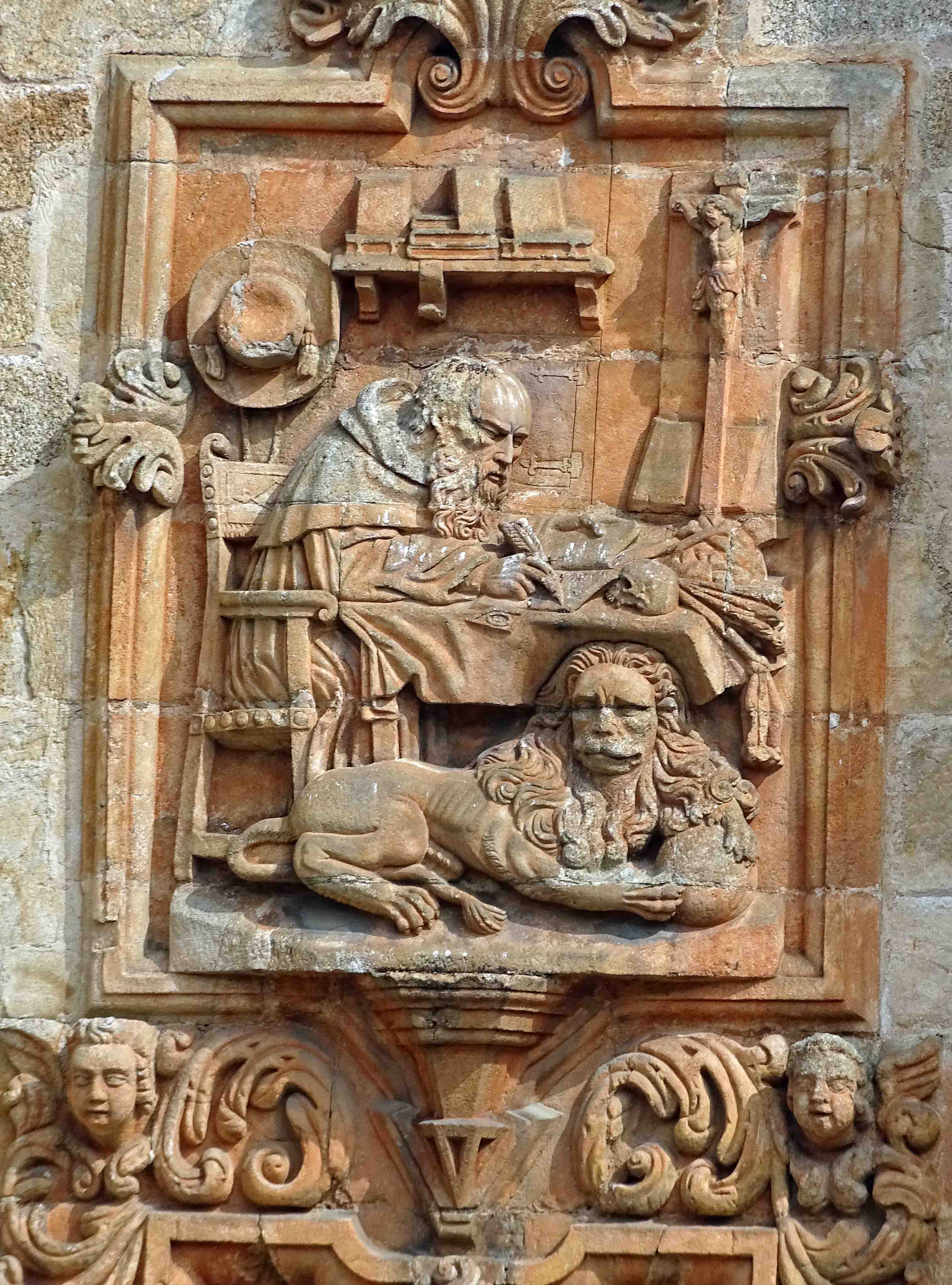
There are some striking reliefs on the outside of the cathedral. I am not sure who is depicted in this work (below), perhaps one of the founding bishops?
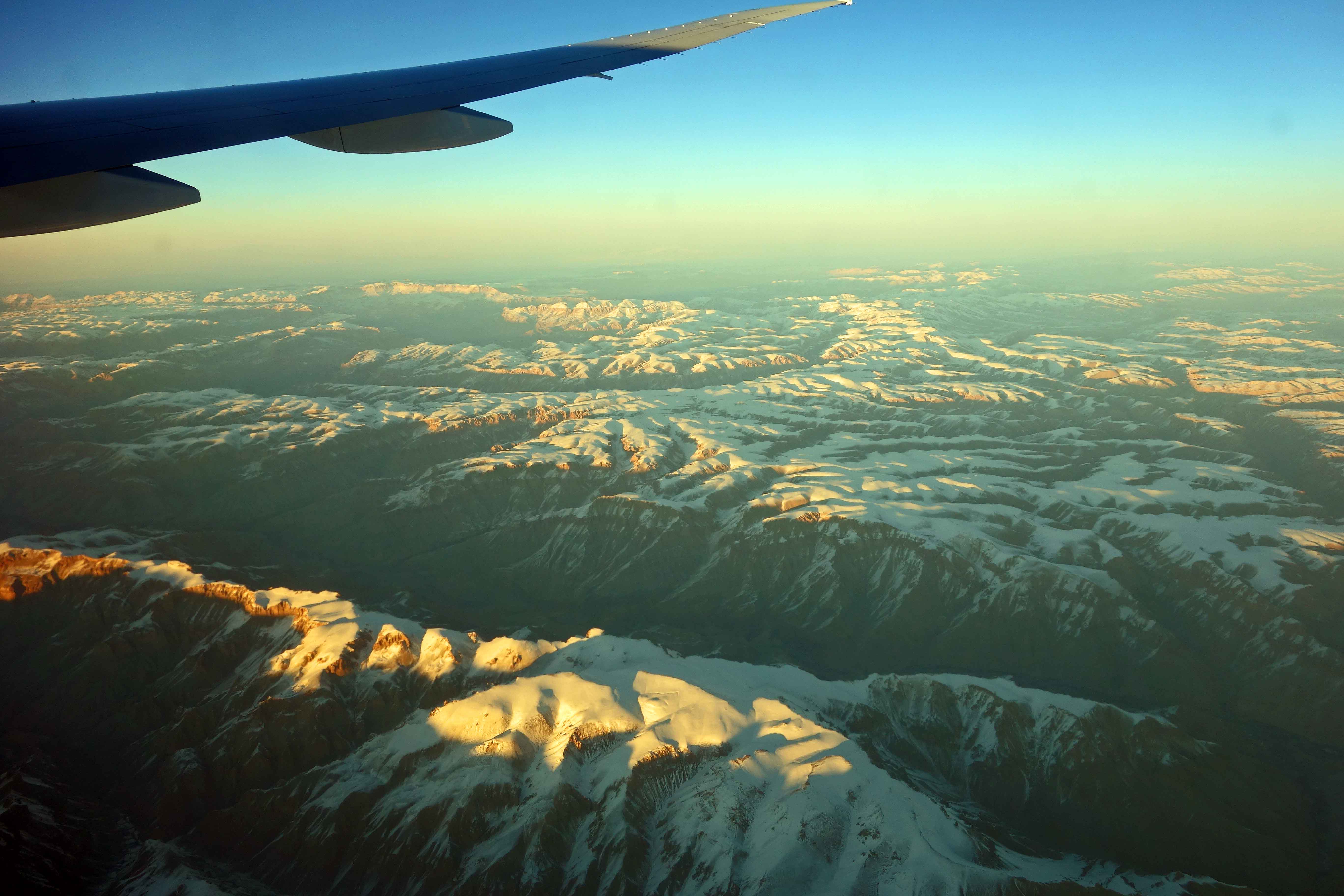
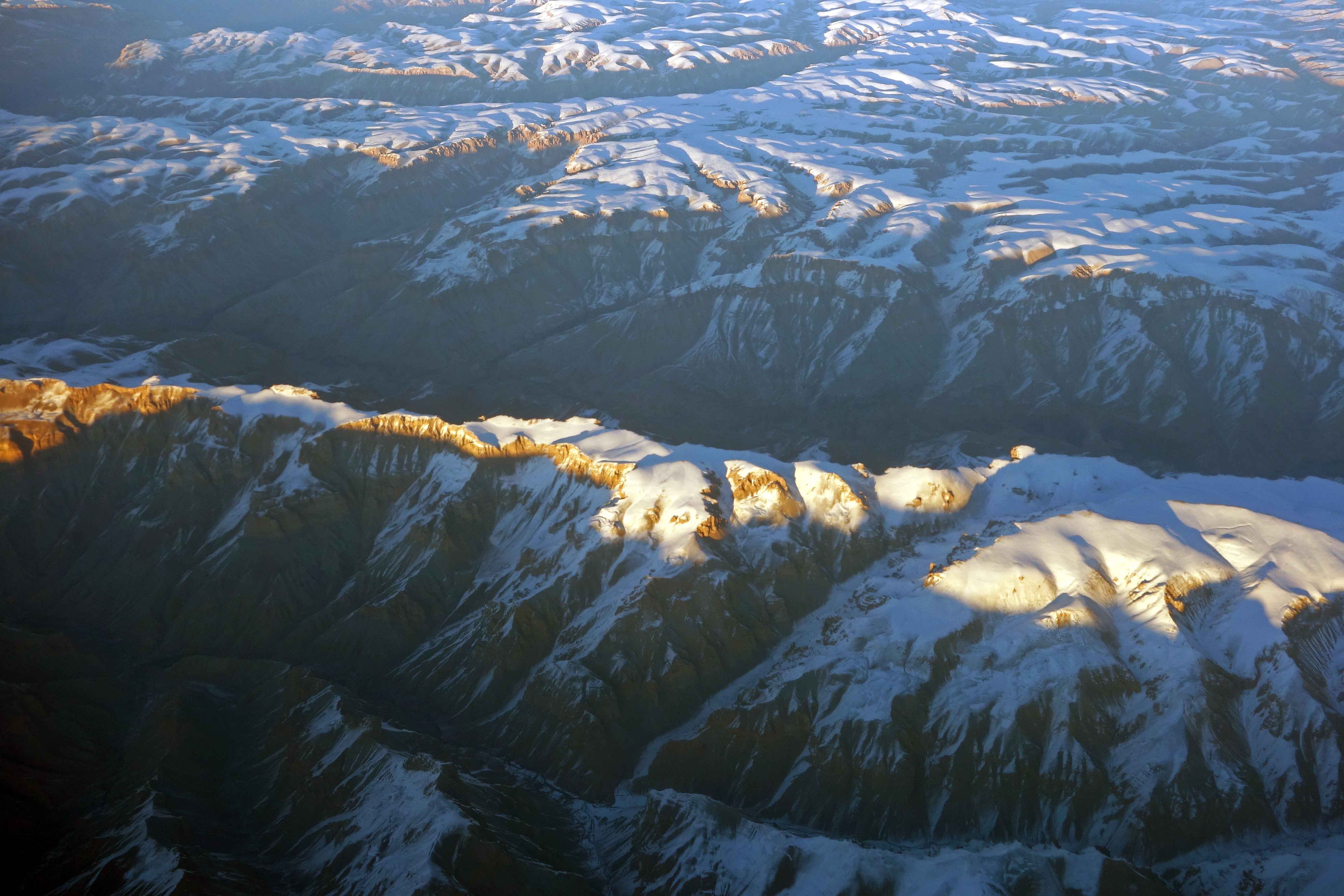
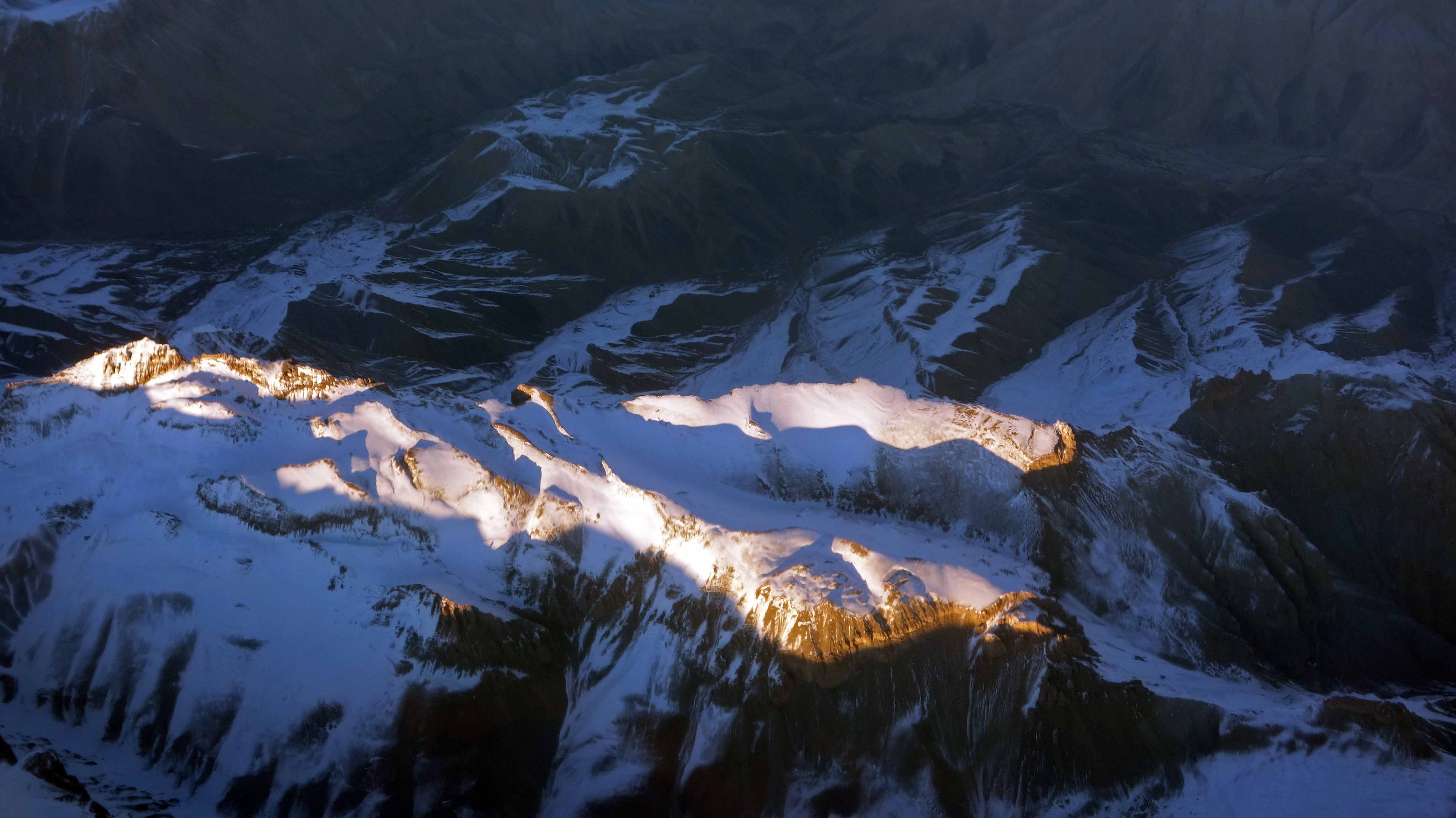
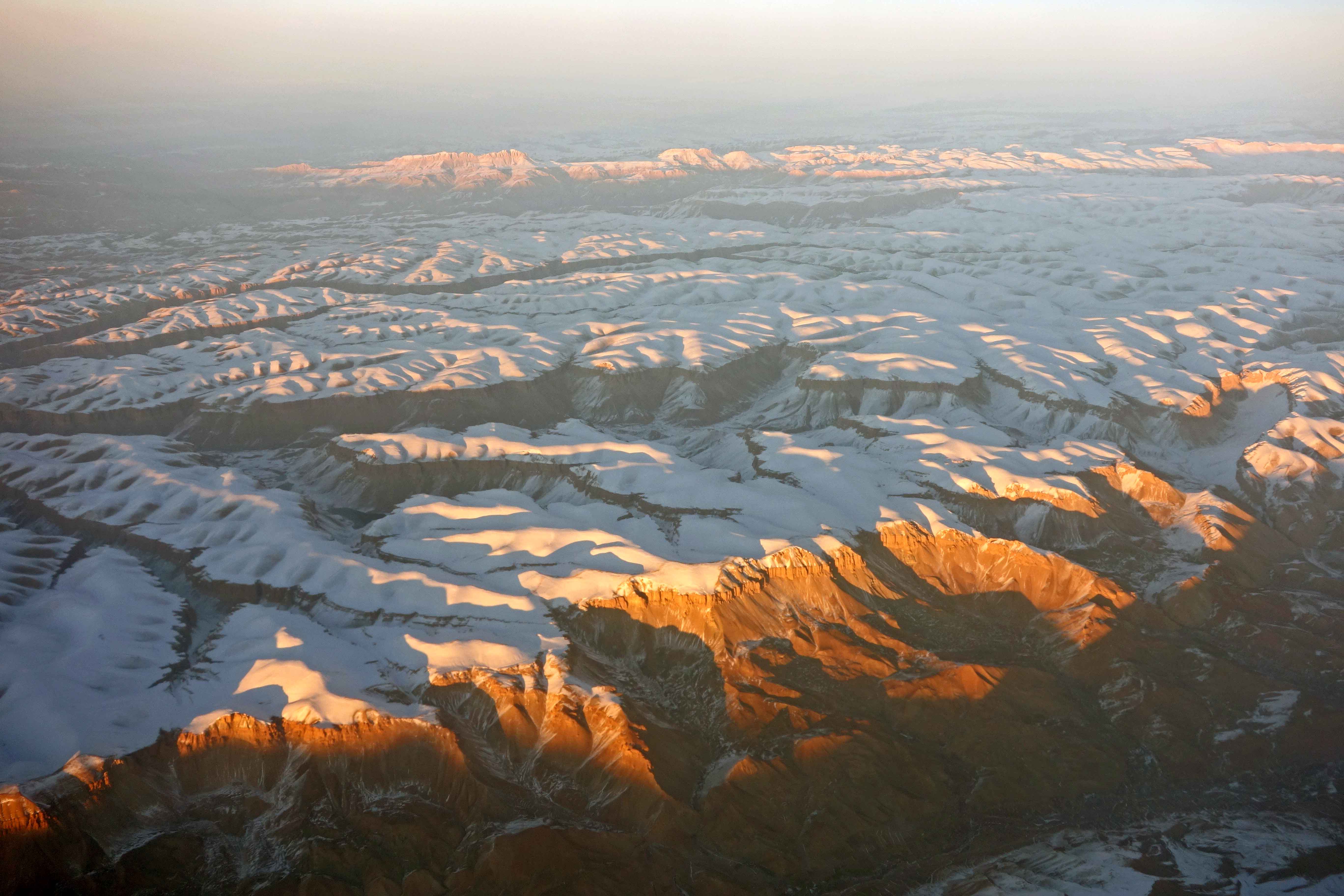
I have never been to Afghanistan, but from 36,000 feet or thereabouts, it certainly has a rugged beauty. Towering, snow-clad mountains are interspersed with deep, dark valleys where the sun sets early in the afternoon.
Unfortunately – for those of us who like to gaze out of the window on the dramatic landscapes passing below – on daytime flights, the cabin crew often ask passengers to pull down the window shades, so some people can sleep if they want to. This annoys me, because I like to look out, so I surreptitiously pull up the blinds to get a peep at the land beneath, every now and again. It is probably annoying for those trying to sleep to have a bright shaft of light shinning in their face just as they are dozing off, but I can’t resist it!
What amazes me is that people are not more curious about the world slipping by underneath. Airline travel allows a unique glimpse of the planet, which our ancestors would have marvelled at. Yet many people take it for granted. Perhaps they are just tired!
These images were taken somewhere to the west of Kabul according to the in-flight map on the screen. Presumably, there are villages down in the valleys. Has anyone climbed any of these peaks? It is such a huge area, yet the impression created by these images could not be further from that conjured up by all the terrible news reports of killings and massacres. Somehow the two must coexist in a strange sort of reality.
I have to confess at the outset that, unlike Alfred Russel Wallace, I did not manage to reach the top of this imposing mountain! Although the upper section of the mountain was closed and off-limits in August 2015 – something to do with a national holiday – I could have got higher if my knees had not given out! OK, Wallace was still only 38 years old, when he and his companions (two local hunters and two ‘coolies’ to carry his baggage!) successfully scaled both the twin volcanoes of Mount Gede (2,958 m) and Pangrango (3,019 m) in 1861 (1). My excuse was that I was considerably older and already worn out from two days of walking in the extensive botanical gardens (2). Next time I will make sure that I am fresh, as I definitely want to go back and get to the top.
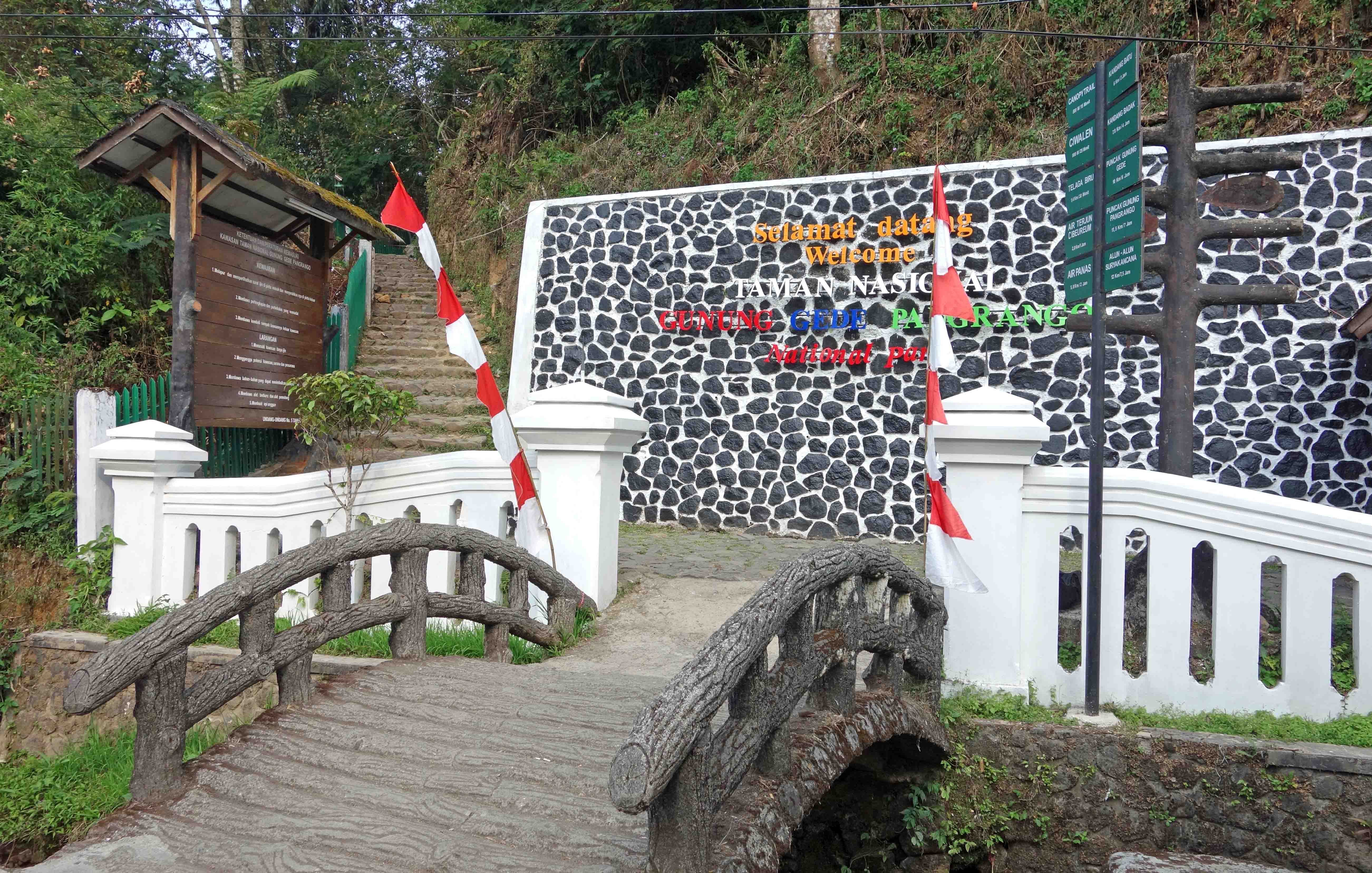
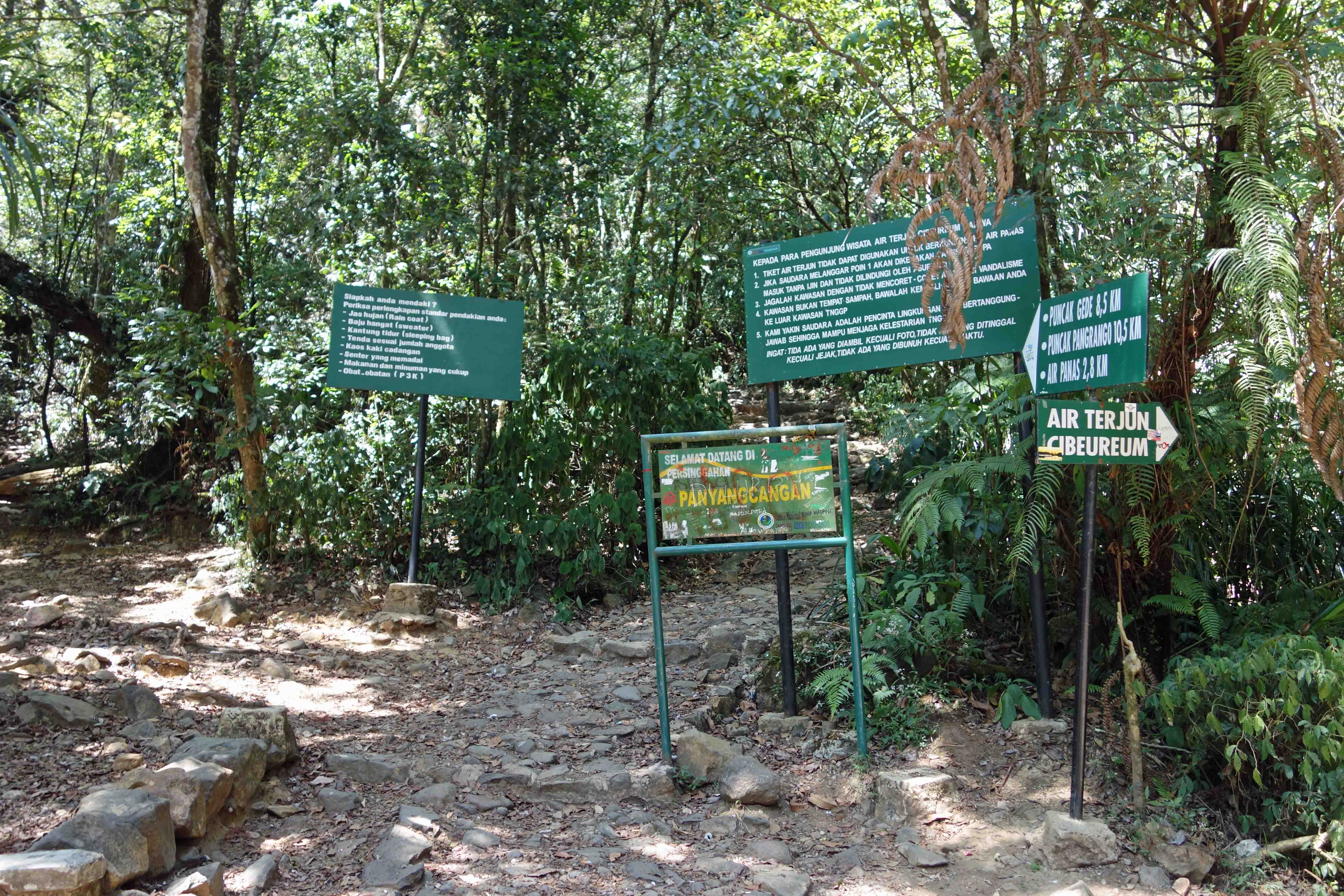
Entrance to Mount Gede Pangrango National Park, Java
Nevertheless, I did manage to get a fair way up the mountain, so can a least make a partial claim to have followed Wallace, and it gave me further confirmation of the vigour and curiosity of this remarkable Victorian naturalist.
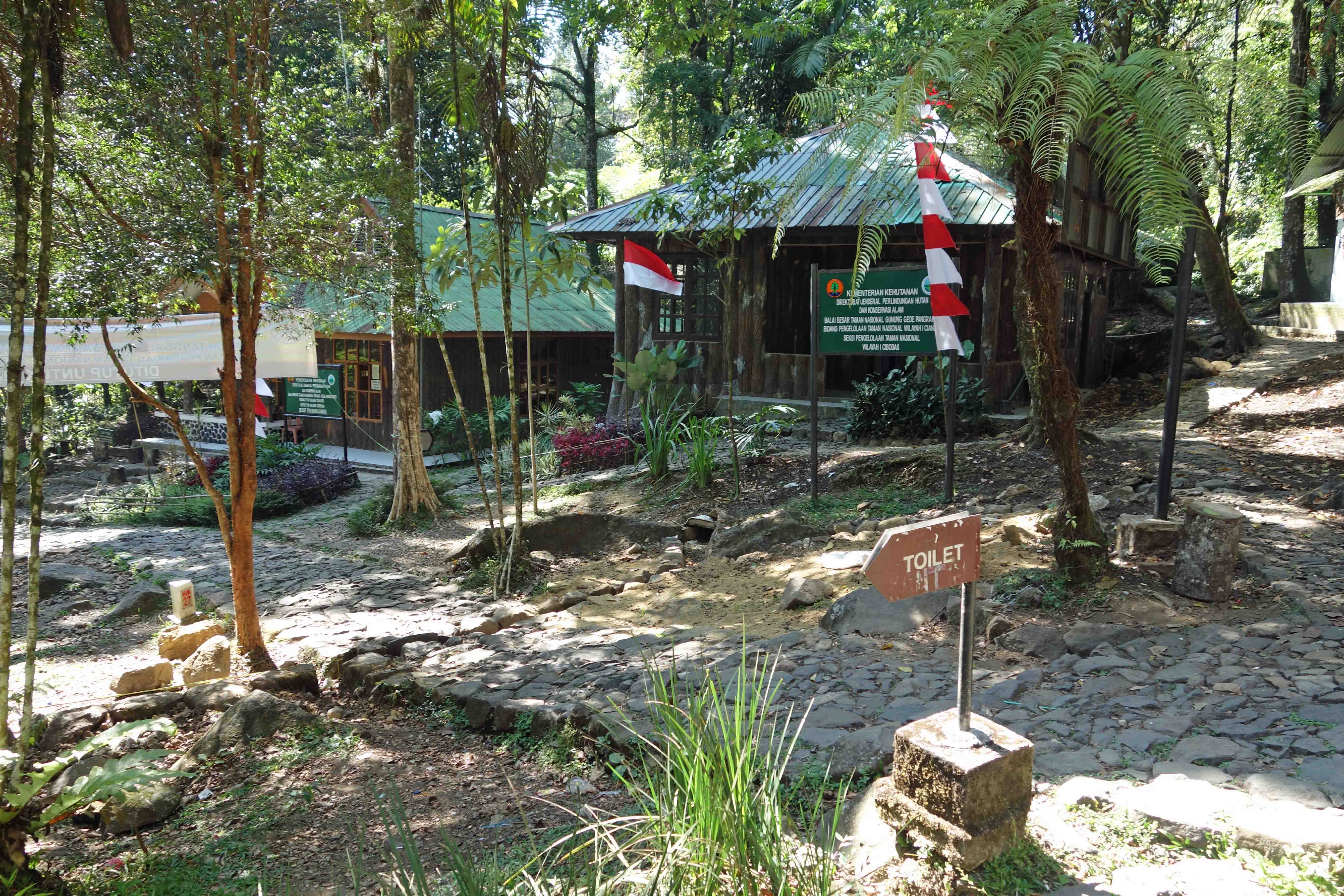
Mount Gede Pangrango National Park office
After paying the relatively steep entrance fee for foreigners (it’s a lot cheaper for Indonesians), I had a delicious cup of sugary white tea (tea tarik) to fortify me for the climb.
Start of the trail to Gunung Gede
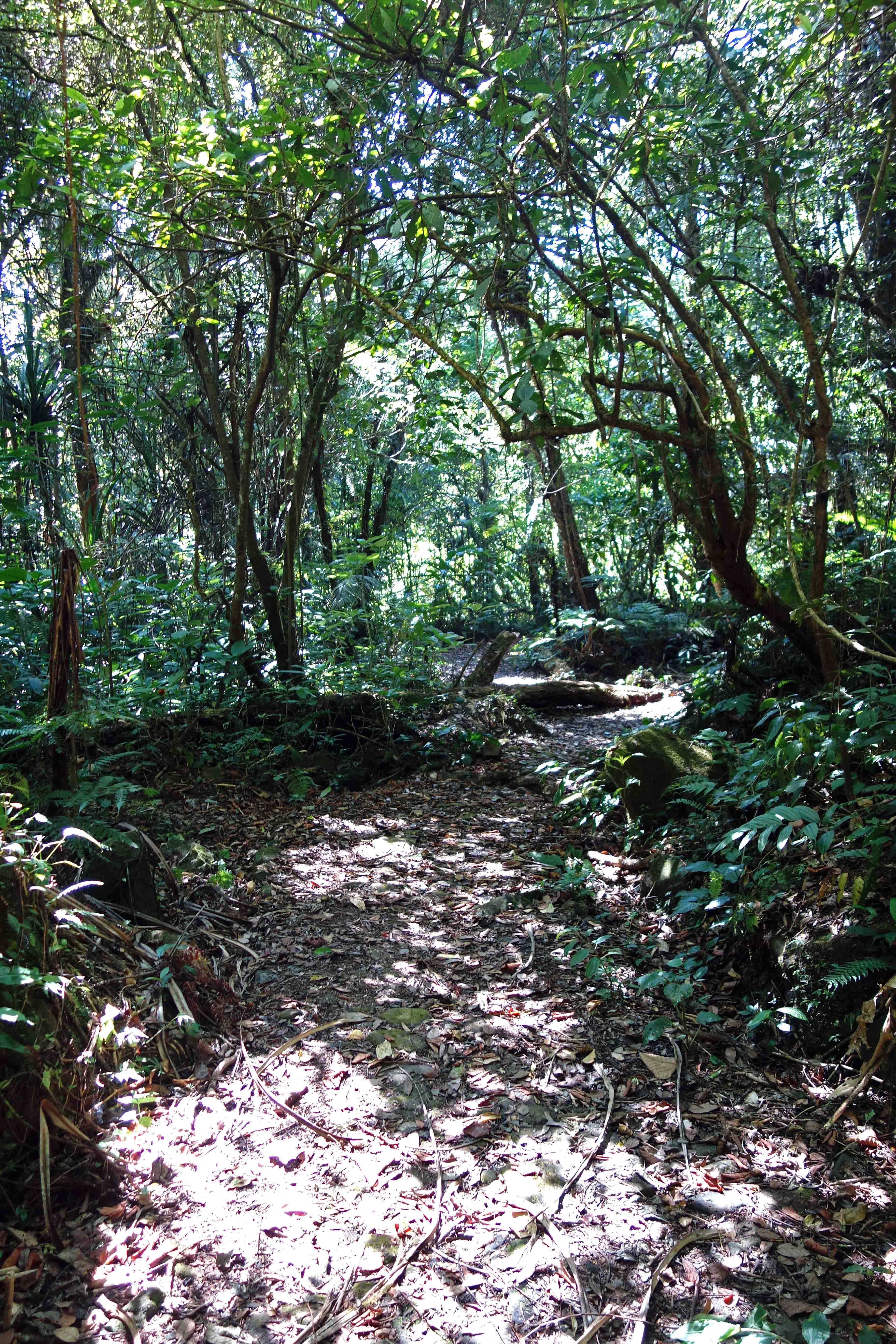
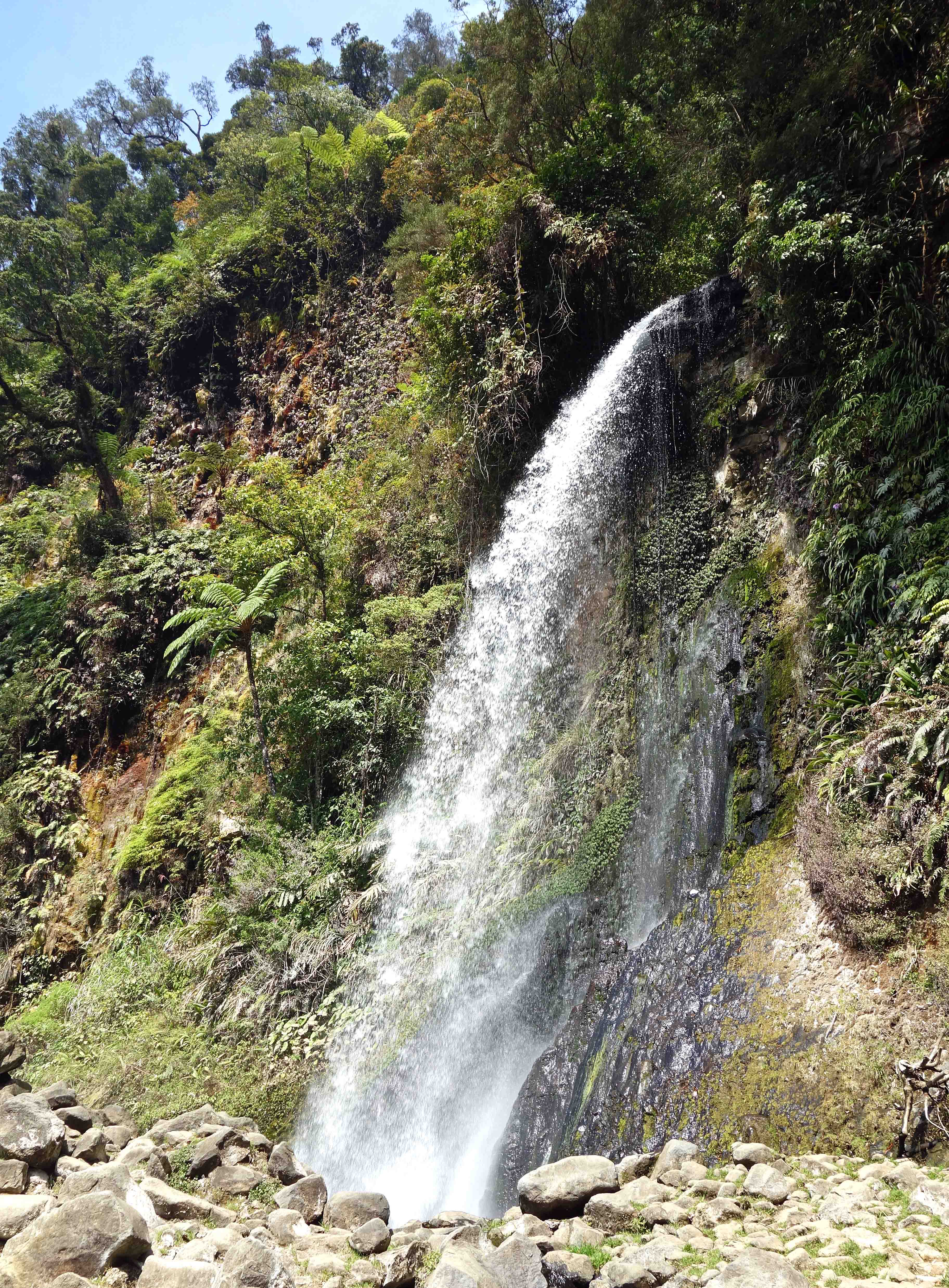
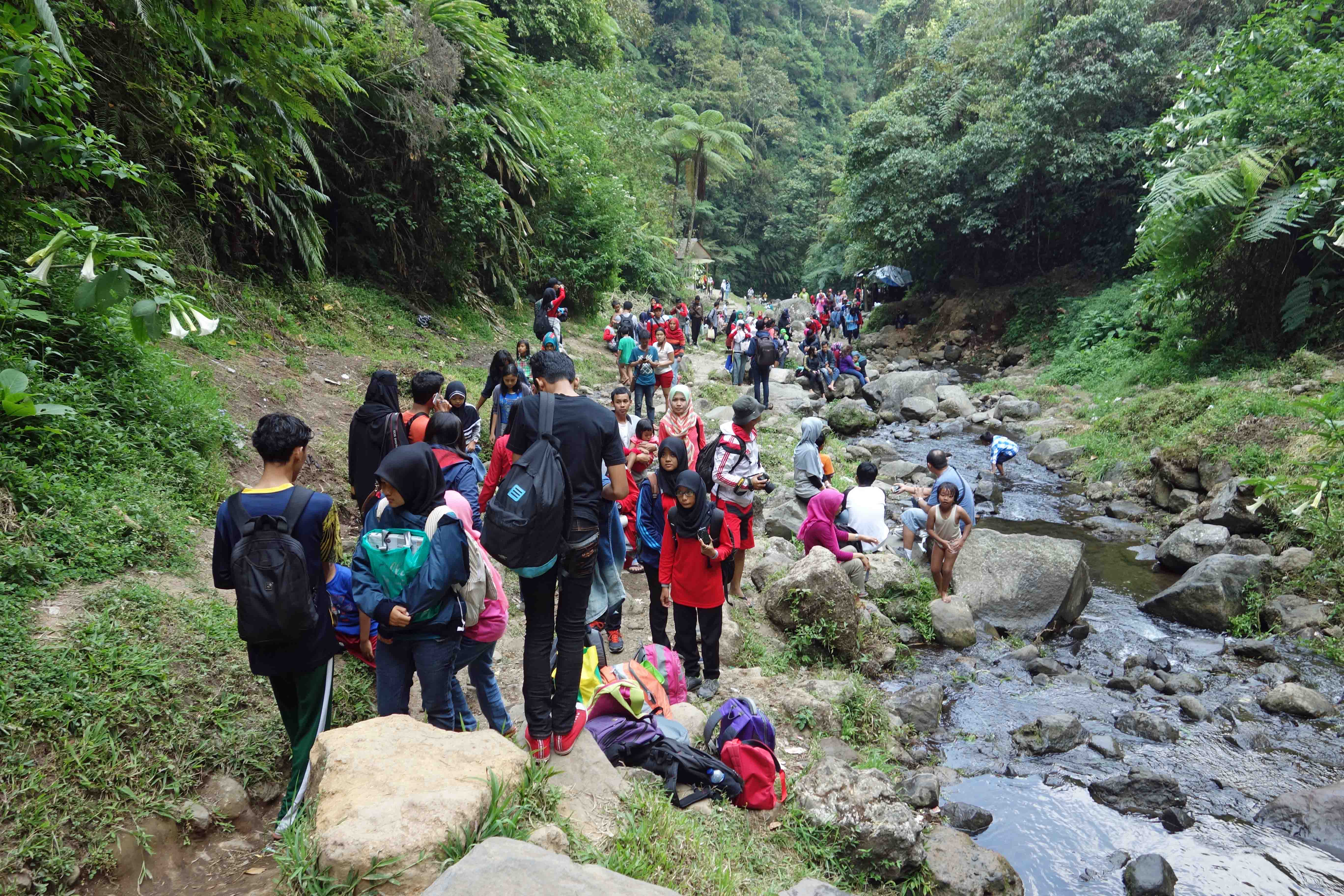
The first part of the trail is, as Wallace describes it in The Malay Archipelago, ‘a tolerably steep ascent through a grand virgin forest’. Whether or not it is still virgin forest today is hard to say, but the birding is good and the forest appears to be very healthy despite the large numbers of people who troop up the trail, particularly the first section which leads to the Cibeureum Waterfalls (at about 1,625 m). Most of the 15,000 hectares of the park are probably inaccessible.
Trail to Cibeureum Waterfall, Gunung Gede Pangrangro National Park, Java.
Wallace was struck by the ‘immense number of ferns’ on the route and recounts ‘continually stopping to admire some new and interesting forms’. His ability to notice (and collect) plants, birds and insects is impressive, but he was a highly experienced tropical naturalist, having spent about four years in the Amazon before his extensive travels in what is now Indonesia.
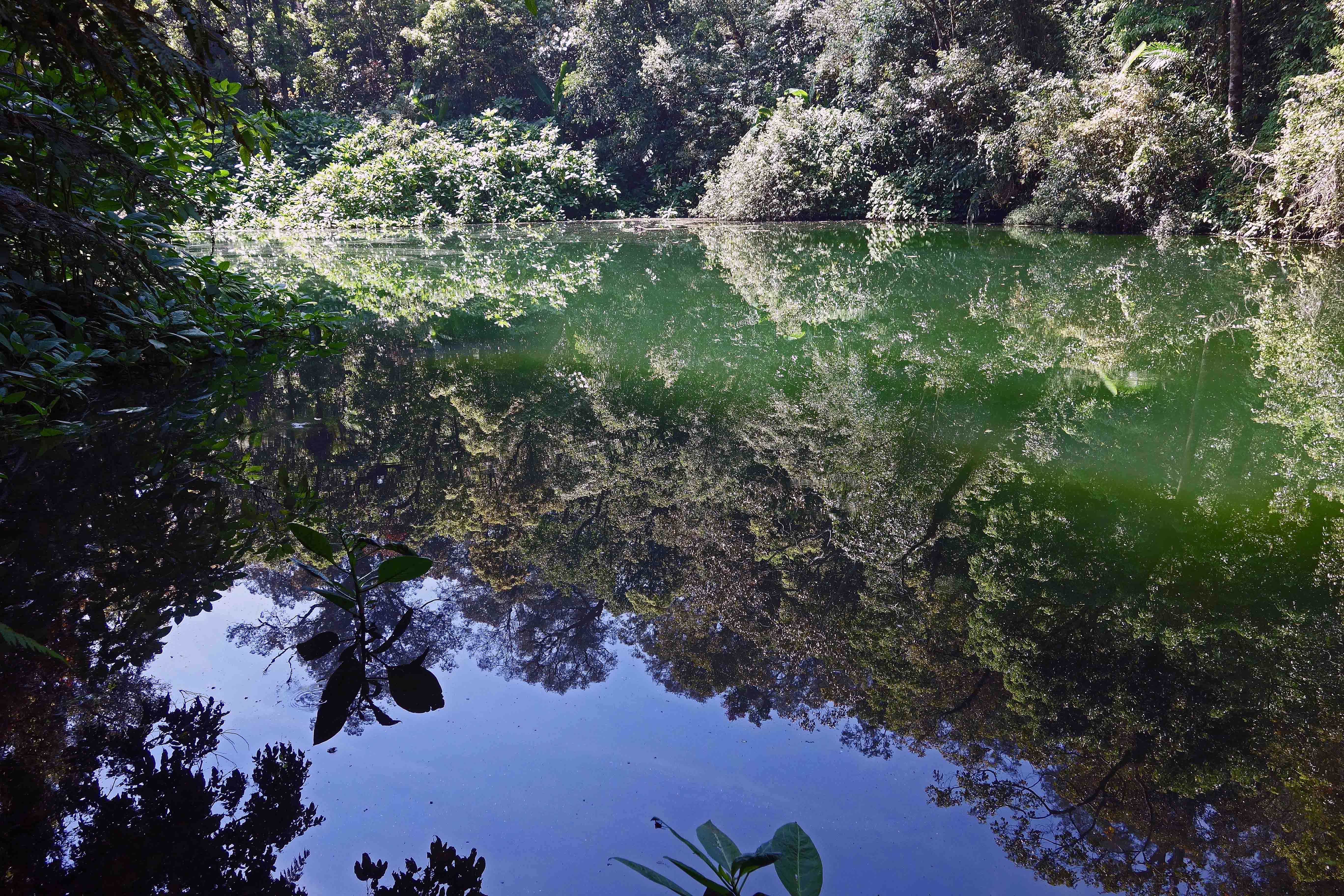
The Blue Lake, Telaga Biru (1,575 m), Mount Gede Pangrango National Park
I almost missed The Blue Lake, but I was very pleased when I stopped to admire it, as a large flock of Sunda minivets (Pericrocotus miniatus) arrived in a nearby tree. These are endemic to Indonesia, Sumatra and Java, and Wallace had already obtained a specimen of this bird on his way to the mountain (1).
Flock of Sunda minivets (Pericrocotus miniatus) near the Blue Lake
Most people on the trail seemed to have target of reaching the Cibeureum Waterfall, which is not too taxing a climb. As well as the waterfall, there are a number of fine tree ferns on the slopes (below).
Cibeureum Waterfall, Gunung Gede Pangrangro National Park, Java
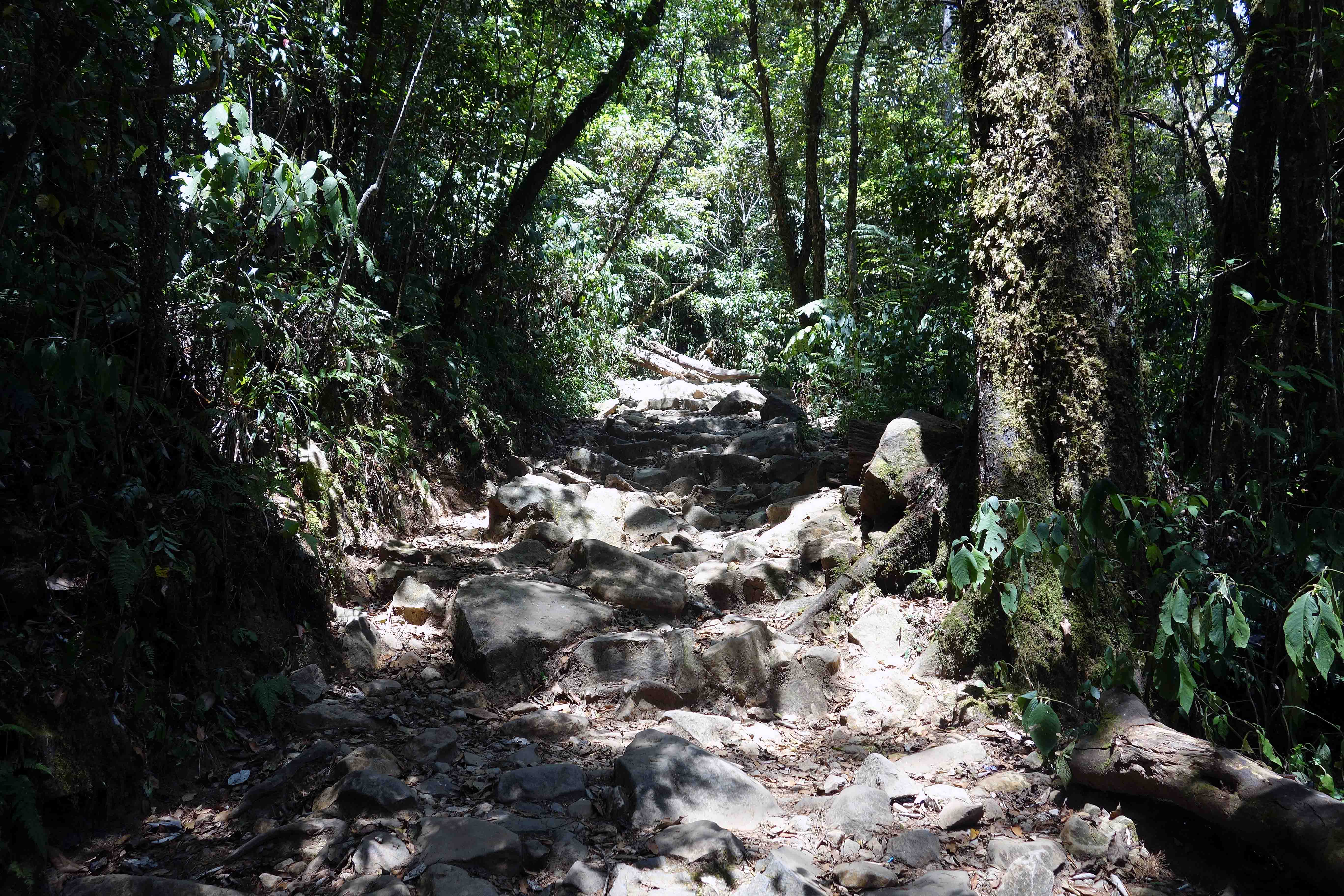
After the turn-off to the waterfall, the trails becomes ‘narrow, rugged and steep’ as Wallace described it (1). The path is very rocky and someone must have laboured long and hard to construct this access way to the peak.
Steep, rocky trail which begins after the waterfall turning
Nevertheless, there is much to look at during rest breaks (!) on the trail, such as the gorgeous Blue nuthatch (Sitta azurea). It appears that Wallace did collect this species from West Java – which was only first described some 30 years before in 1830 (3) – since there is a hand-written letter from A R Wallace in the Natural History Museum concerning this species (using a former name) where he refers to ‘a bird of mine’. Presumably one he collected and donated to the museum?
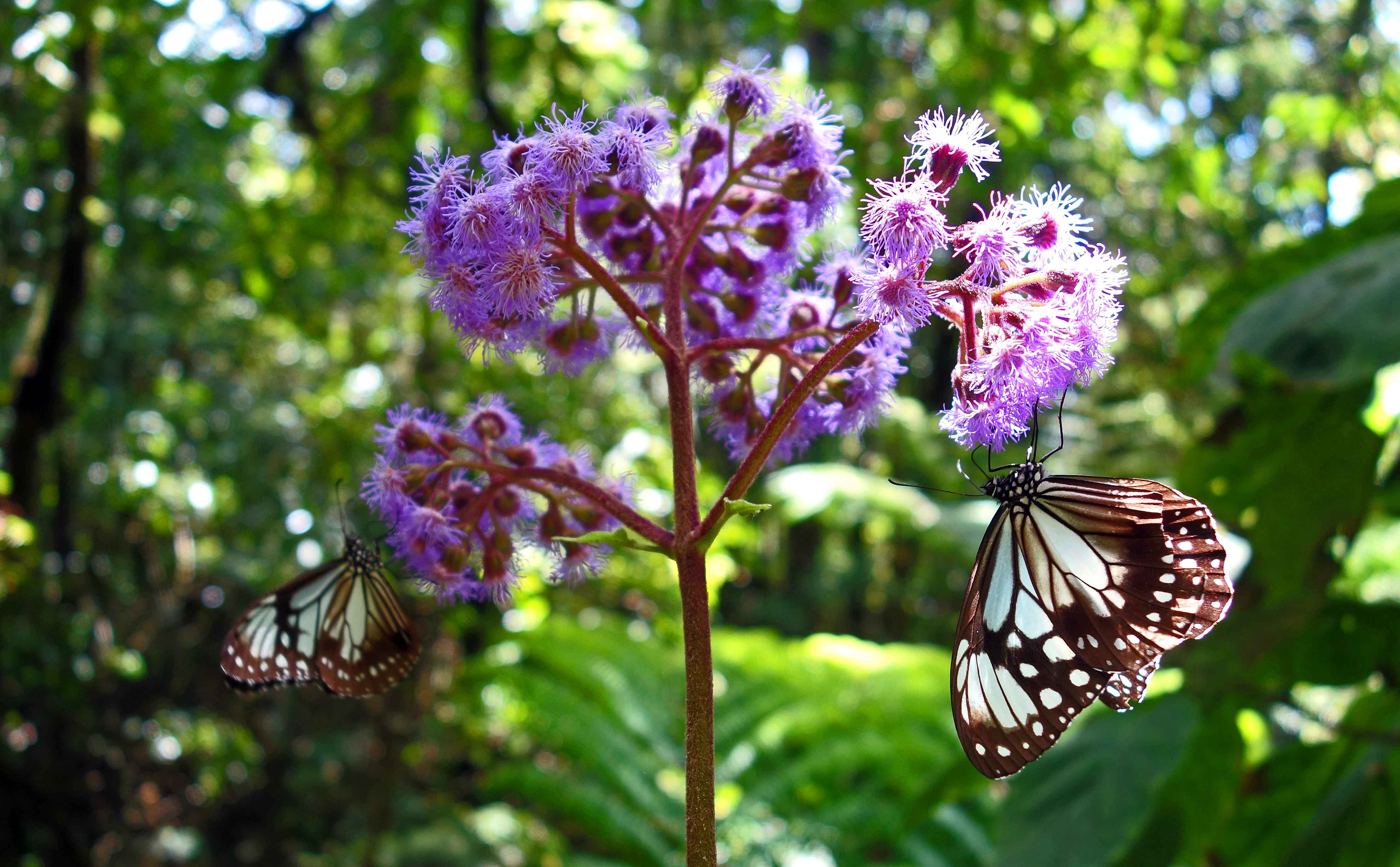
As well as many birds, I was fortunate enough to come across some beautiful tiger butterflies (Zinken’s tiger, Parantica albata) – also called danaids – which are endemic to Java (below).
Zinken’s tiger (Parantica albata) Java
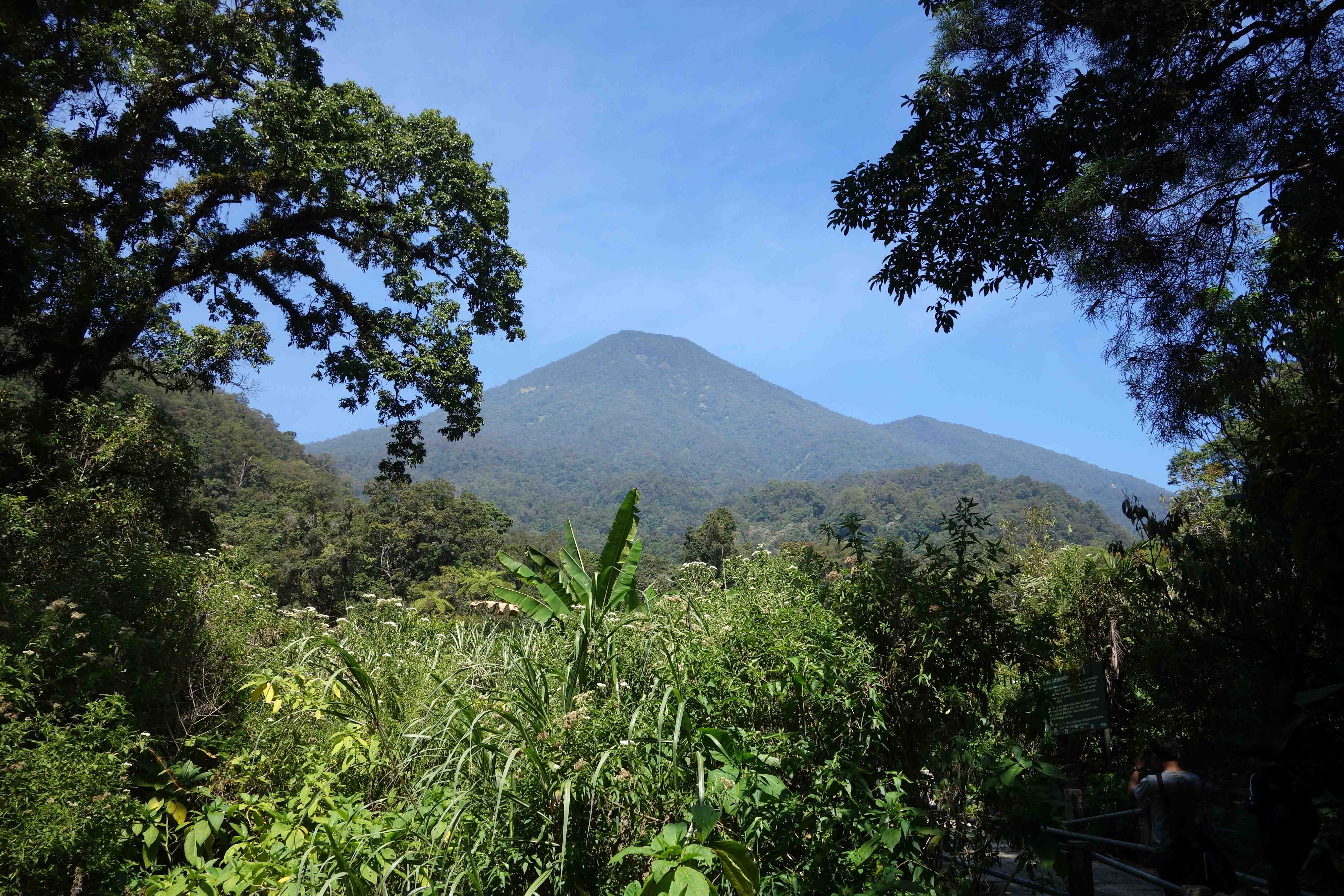
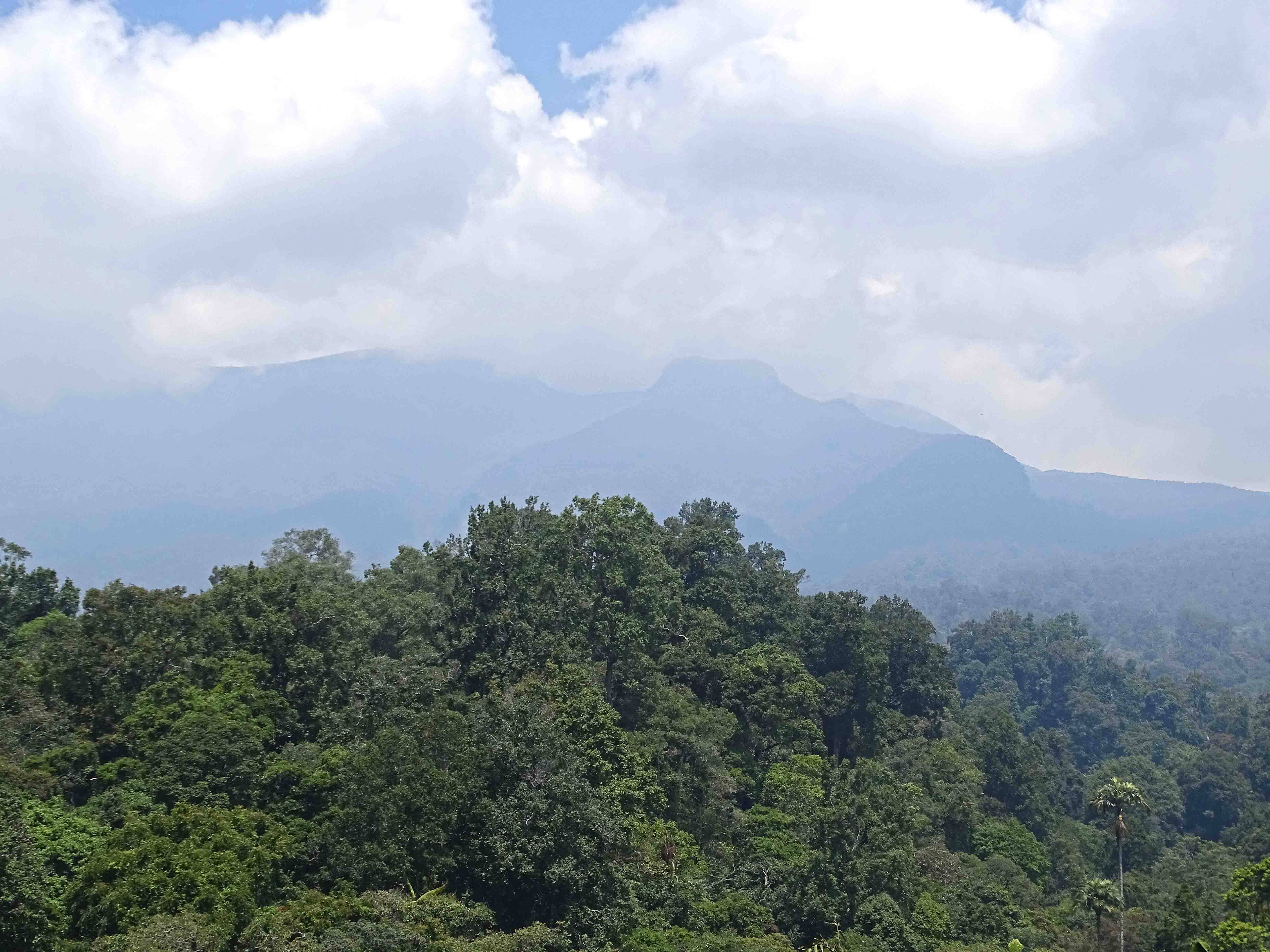
Alas, I never made it to the Hot Springs/Air Panas (2,150 m) and turned around at about 2,000m, to save my knees. There is much to see beyond this point, and Wallace describes in detail the flora on the higher slopes of the volcano, much of which was of a temperate kind, familiar to him from his botanising in England. So I would like to go back, not only to see the impressive volcano itself, but the birds, insects and plants to be found on the top of these mountains. Like many climbers today, Wallace camped near the top and took time to explore both peaks. I had to be content with a view of Mount Pangrango from the trail on the way down (below).
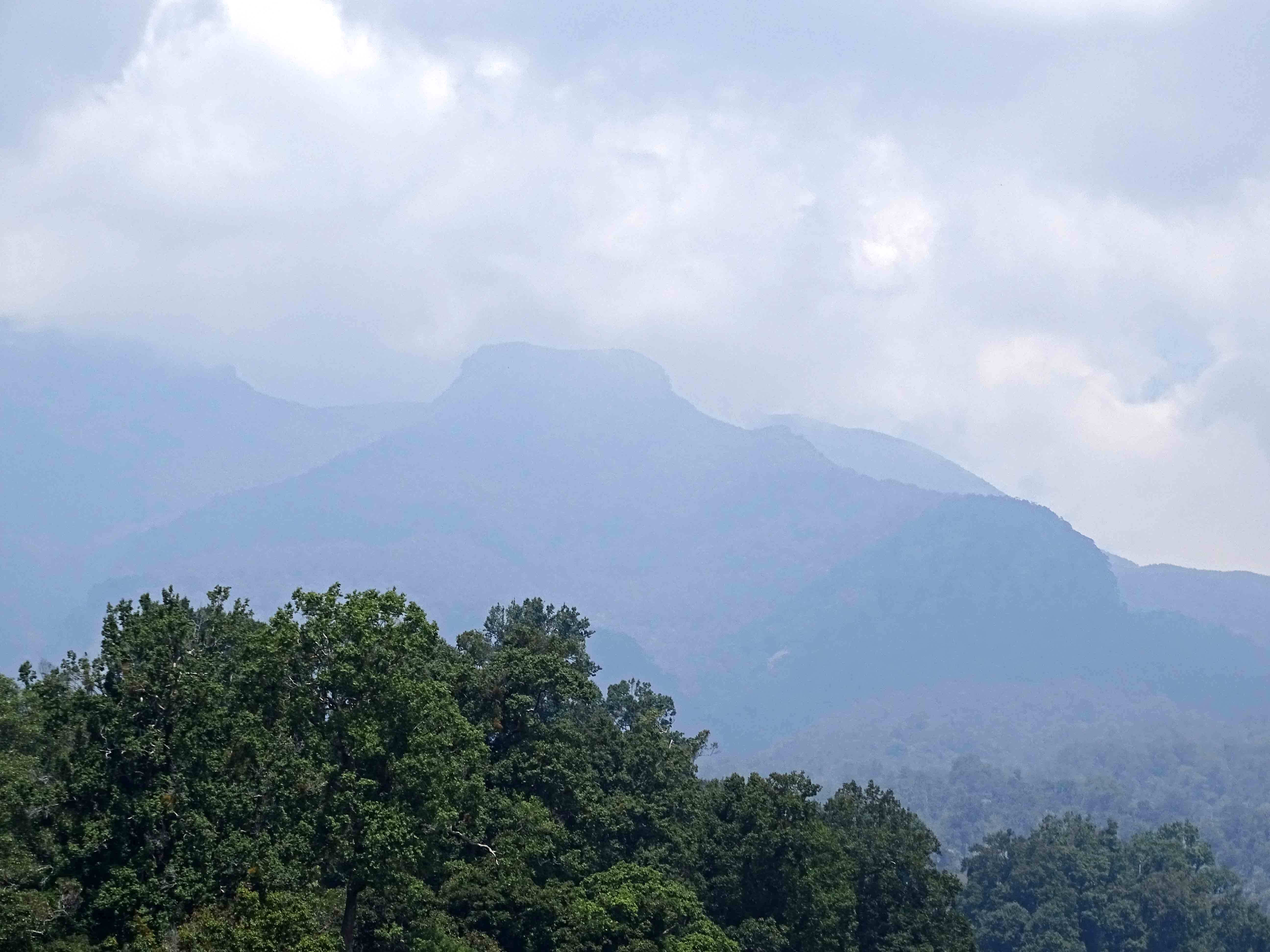
Mount Pangrango (3,019m)
Wallace, Alfred Russel. The Malay Archipelago: the land of the orang-utan and the bird of paradise; a narrative of travel, with studies of man and nature. Courier Corporation, 1869.
Alfred Russel Wallace – the great Victorian naturalist and co-discoverer of evolution by natural selection – described his journeys in West Java in 1861 in his book The Malay Archipelago (1). He travelled from the capital Jakarta, down to the town of Bogor, where he stopped off to look at the Botanical Gardens planted by the Dutch (2). Travelling south from Bogor, by horse and on foot, he headed towards the area around the volcano Mount Gede Pangrango, which is now a National Park. He described capturing a number of birds (which ‘hunters obtained for me’) on the way – a total of 40 species ‘peculiar to the Javanese fauna’.
Cibodas Botanical Gardens trees
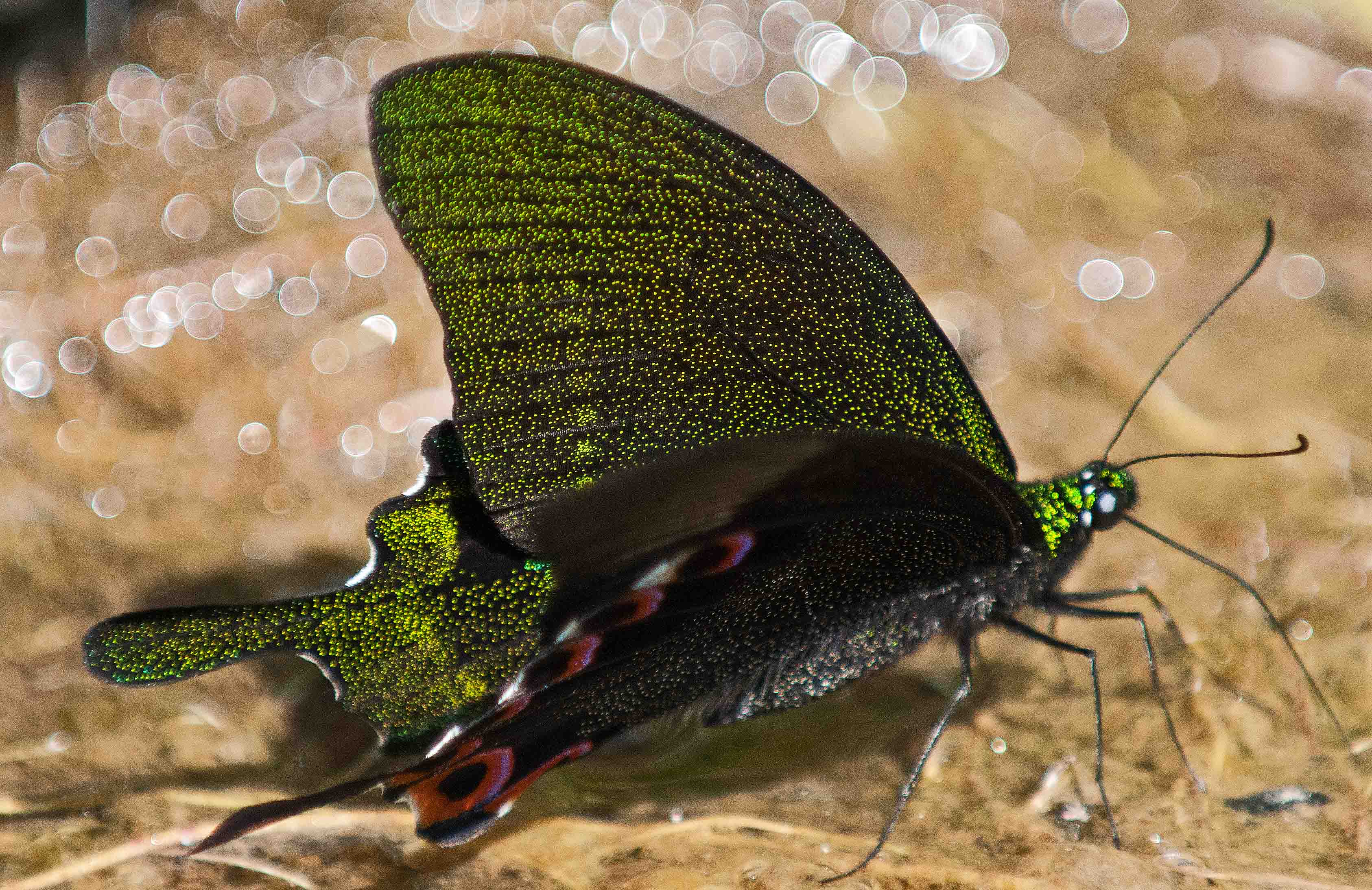
He also collected a number of ‘large and handsome butterflies’, including the ‘superb Papilio arjuna’ now known as the Paris Peacock (Papilio paris). Wallace vividly described the wings of this species as seemingly ‘powdered with grains of golden green, condensed into bands and moon-shaped spots’.
Paris Peacock (Papilio paris), collected by A R Wallace in 1861
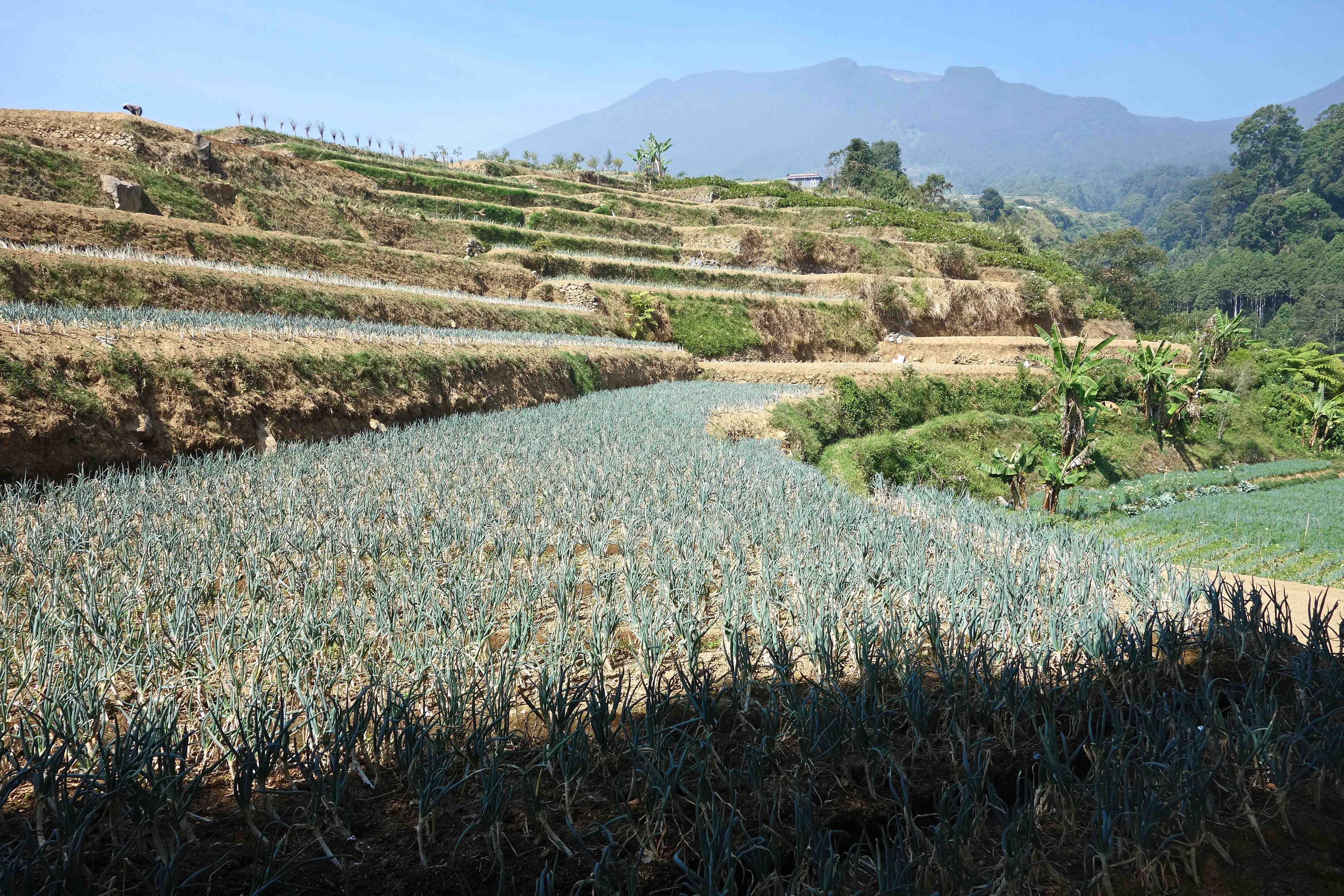
On his journey, Wallace remarked on the ‘system of terrace cultivation’, which is still very much in evidence in this part of Java, Indonesia. I was also struck by how well-tended these terraces were (below).
Terraces planted with onions below Gunung Gede
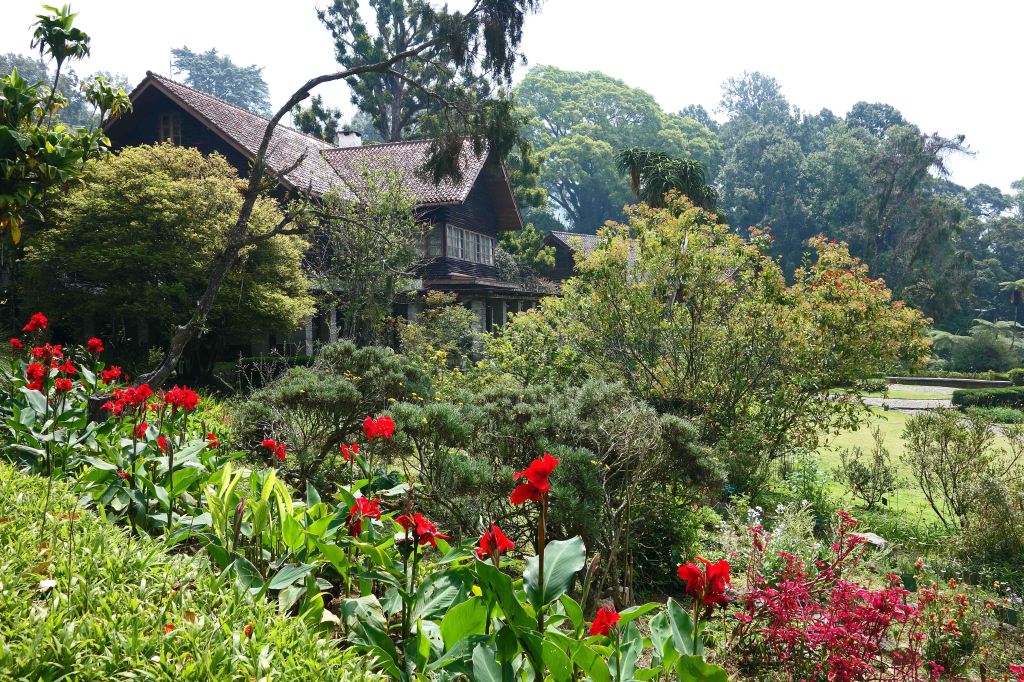
Before embarking on his climb to the summit of Pangarango and Gede mountains, Wallace stopped off at the village of Tchipanas (now Cipanas) near the ‘foot of the mountain’ as he described it. Nearby, are the Cibodas Botanical Gardens, where Wallace stayed a night with the keeper. These large (85 hectares or 210 acres) gardens were founded by the Dutch botanist Johannes Teijsmannas in 1852, as an extension of the Bogor Botanical Gardens (2). They are a magnificent collection of trees and shrubs on the lower slopes (1300-1425 m) of Gunung Gede.
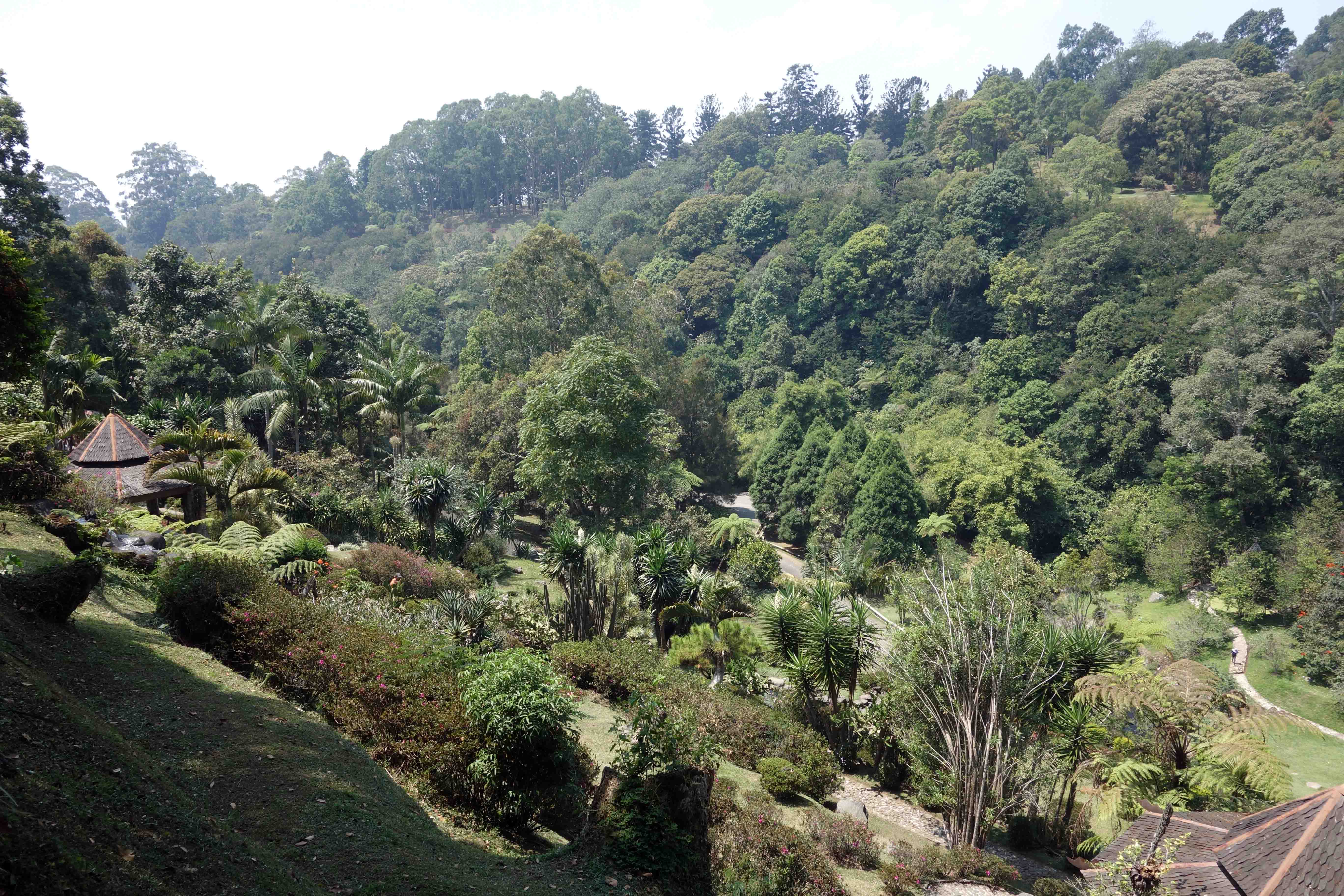
Cibodas Botanical Garden
The Cibodas Botanical Gardens (called Kebun Raya Cibodas or KRC in Indonesian) were therefore, only about a decade old when Wallace visited in 1861. He descibed there being ‘many beautiful trees and shrubs’ as well as an abundance of European vegetables ‘grown for the Governor-General’s table’!
Guest house in Cibodas Botanical Gardens, Java, Indonesia.
The gardens were reportedly the first place in Indonesia where cinchona trees were grown, as a source of quinine. The climate is mild, typical of tropical lower mountain ecosystems with an annual rainfall between 3,000-4,200 mm, and average temperatures of 10-18 °C. It was however, warmer than this when I was there in August 2015. The gardens are popular with both people escaping Jakarta for the weekend, as well as tourists from further afield, such as visitors from Saudi Arabia, who come to admire the waterfalls and picnic in the gardens, at a time of year when temperatures are very high in the Arabian peninsula.
Pathway from Ciismun waterfall, Cibodas Botanical Gardens, Java
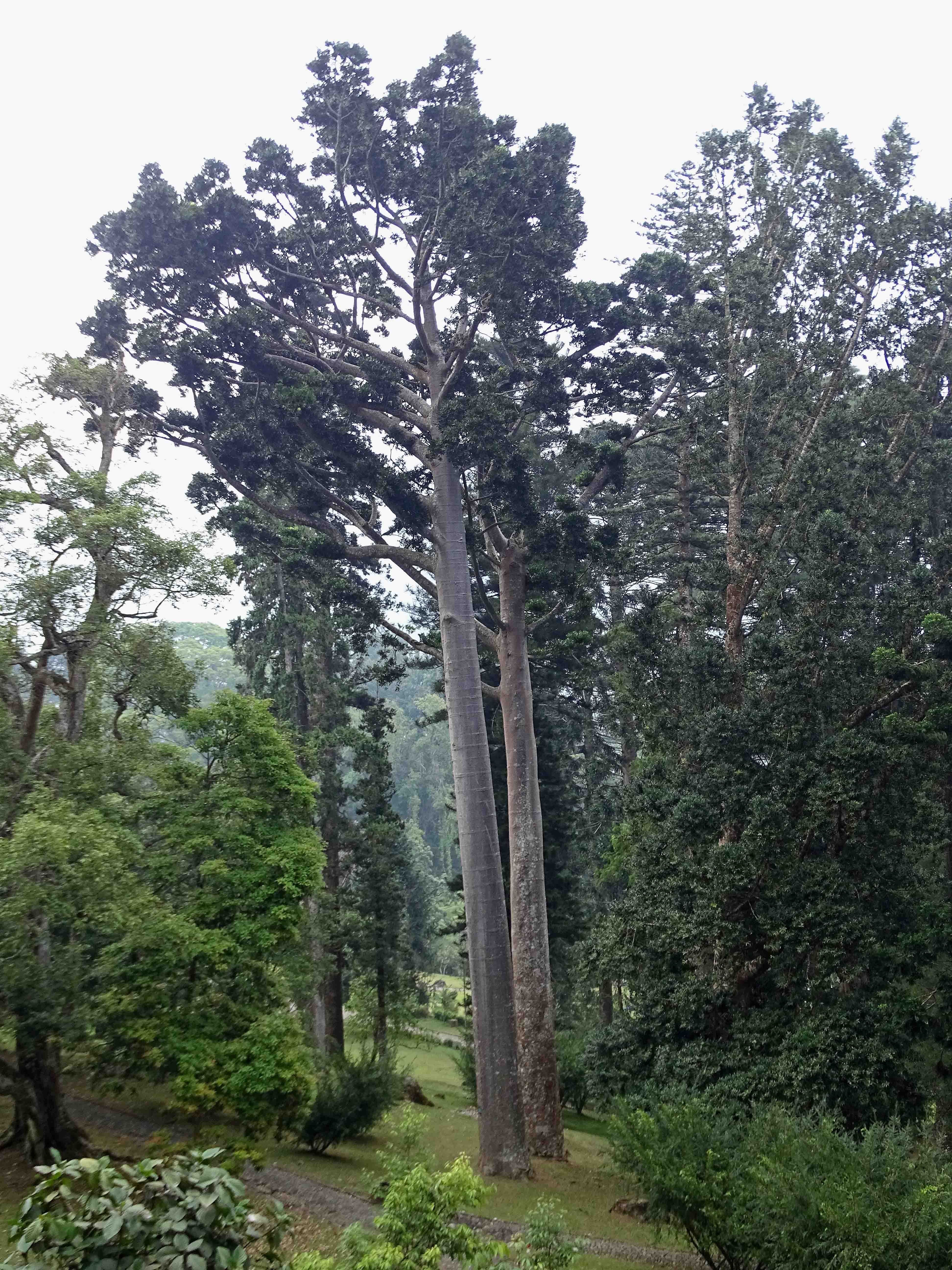
It would be interesting to know what Wallace would have thought of the gardens today. He would probably have been impressed by the size of many of the trees now, some 154 years later (in 2015). For example, he might have marvelled at the Bornean kauri trees (Agathis borneensis), which are very large, evergreen trees that can grow to 60 metres (nearly 200 feet) tall. They have a straight trunk, which goes up very high without branching. Not surprisingly, A. borneensis is valued and sought after for its timber – as well as for its resin (3). I don’t know how old these trees are, but since they are slow-growing, I expect they were here when Wallace visited in 1861.
Huge Borneo kauri trees (Agathis borneensis ) Cibodas Botanical Garden
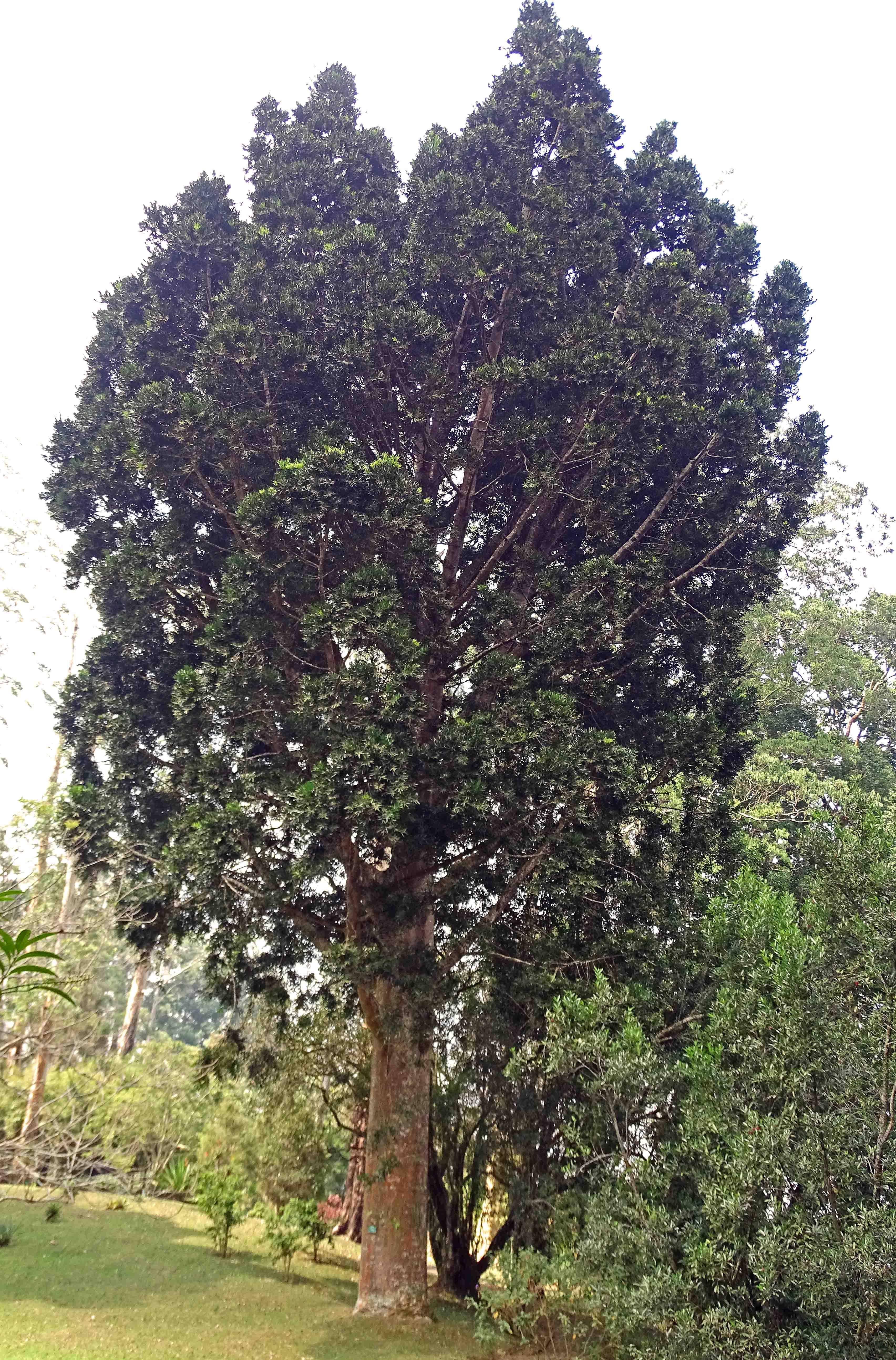
Another similar tree, is the Kauri tree (Agathis australis) from New Zealand, which can live for at least 600 years, probably longer. So the one shown gere (below), which might have been a relatively young sapling when Wallace visited in 1861, will – it is hoped – continue to grown for another 500 years or so, by which time it might equal some of its venerable ancestors in New Zealand.
Kauri tree (Agathis australis), Cibodas Botanical Gardens
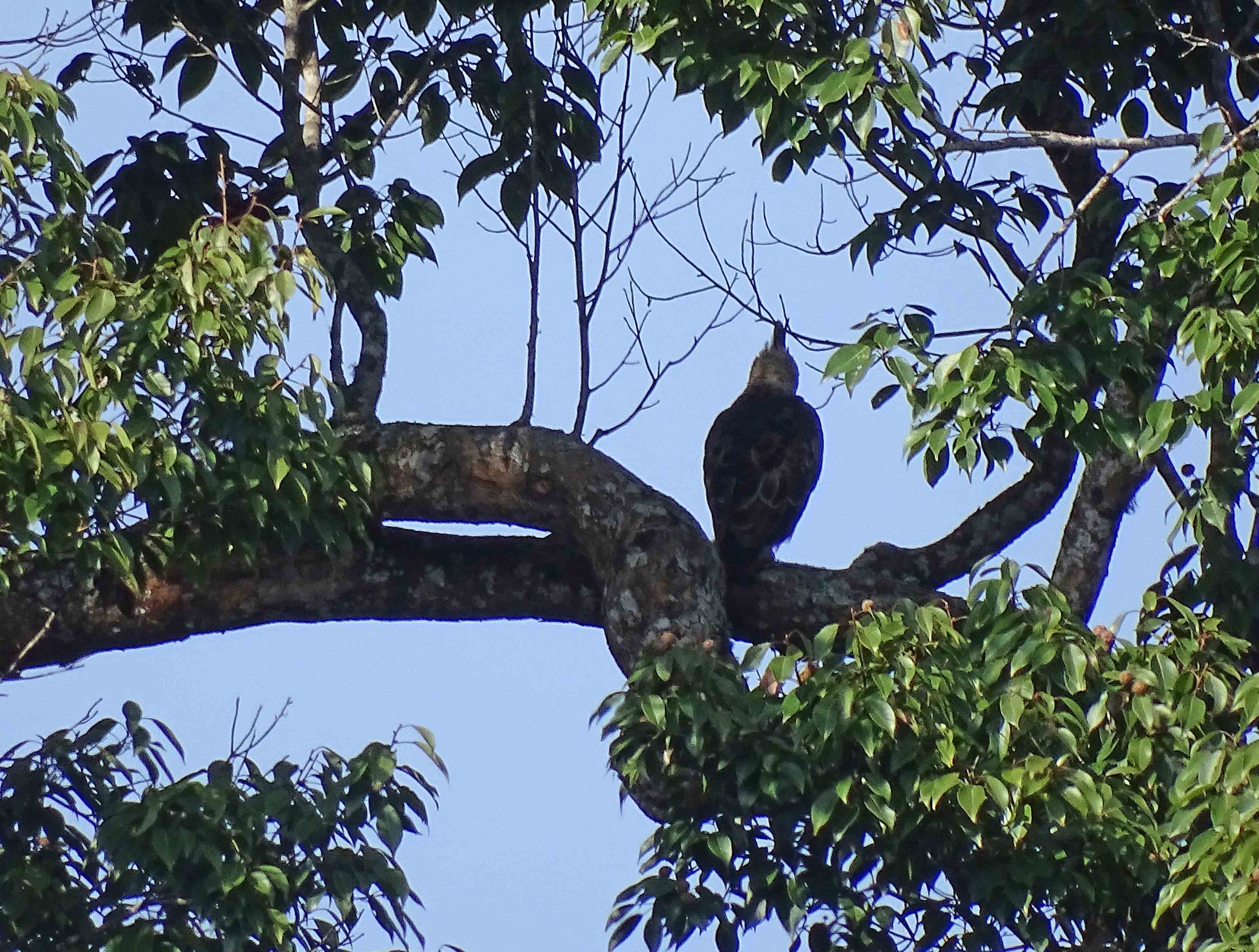
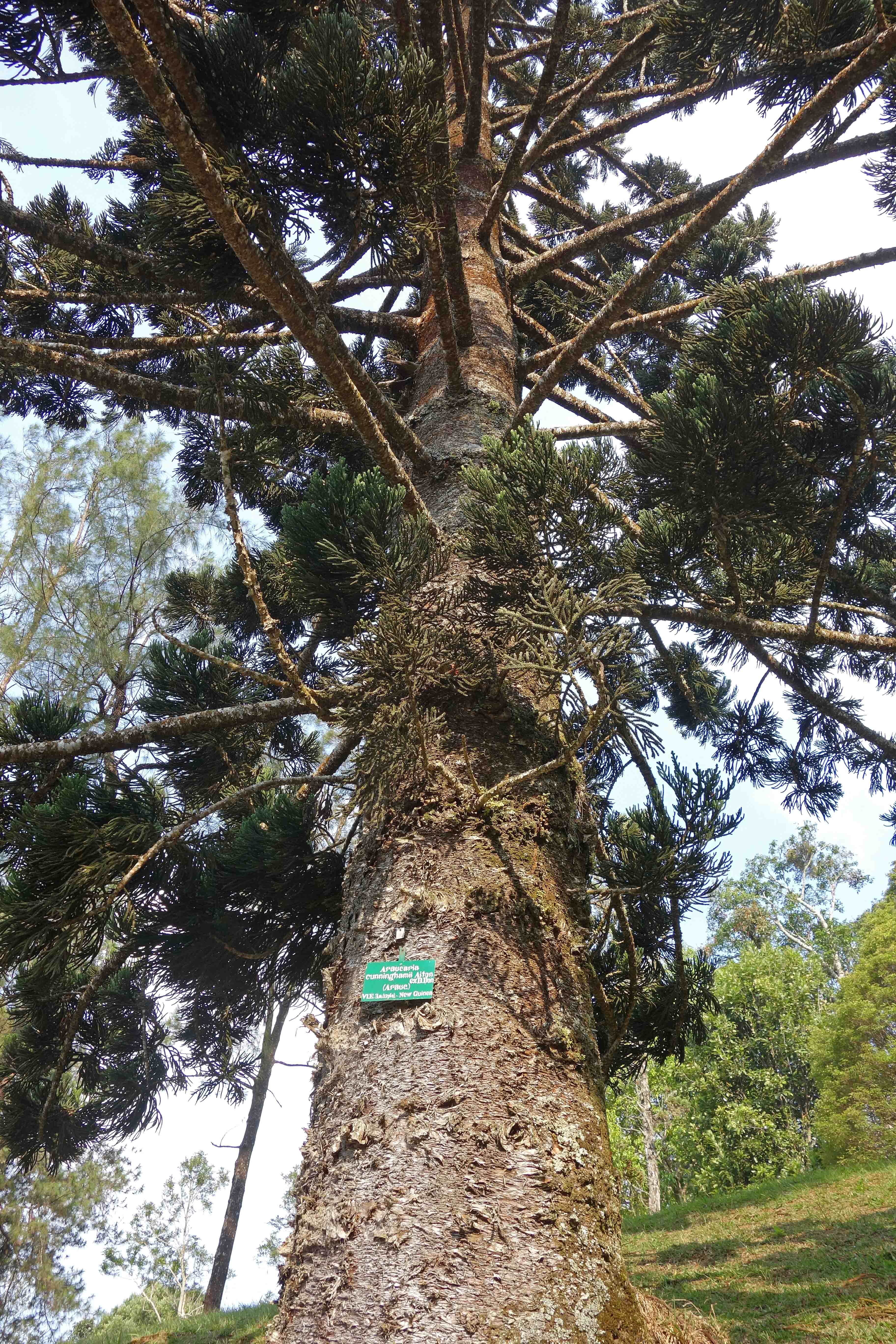
There is a splendid row of large Arucaria trees. Some of these are not native, but originate from New Guinea, e.g. Araucaria cunninghamii var. papuana. The densely branching Arucaria trees are used as roosting sites by endemic Javan hawk-eagles (Nisaetus bartelsi). One morning in the gardens I heard a strange, high-pitched, cat-like calls (4) coming from high up in the Arucaria tree above me. It took me a while to realise what this was, and before I could locate it directly above me, the bird suddenly fly off to another tree further away (below) and proceeded to look out over the forest for a while.
Javan hawk-eagle (Nisaetus bartelsi) high in a tree
The densely packed branches of the Arucaria trees presumably provide protection as well as perches for roosting hawk-eagles.
Araucaria cunninghamii var. papuana
There are said to be more that 1,200 species of plants and trees in the park and many of these are exotic to Java. For example, there is an extensive collection of Eucalyptus trees (63 species) from Australia (4). The Gardens are also a popular location for birders, who come to look for species such as Java munia, Yellow-throated hanging parrot, Java fulvetta and the iconic pygmy tit, which only occurs on Java.
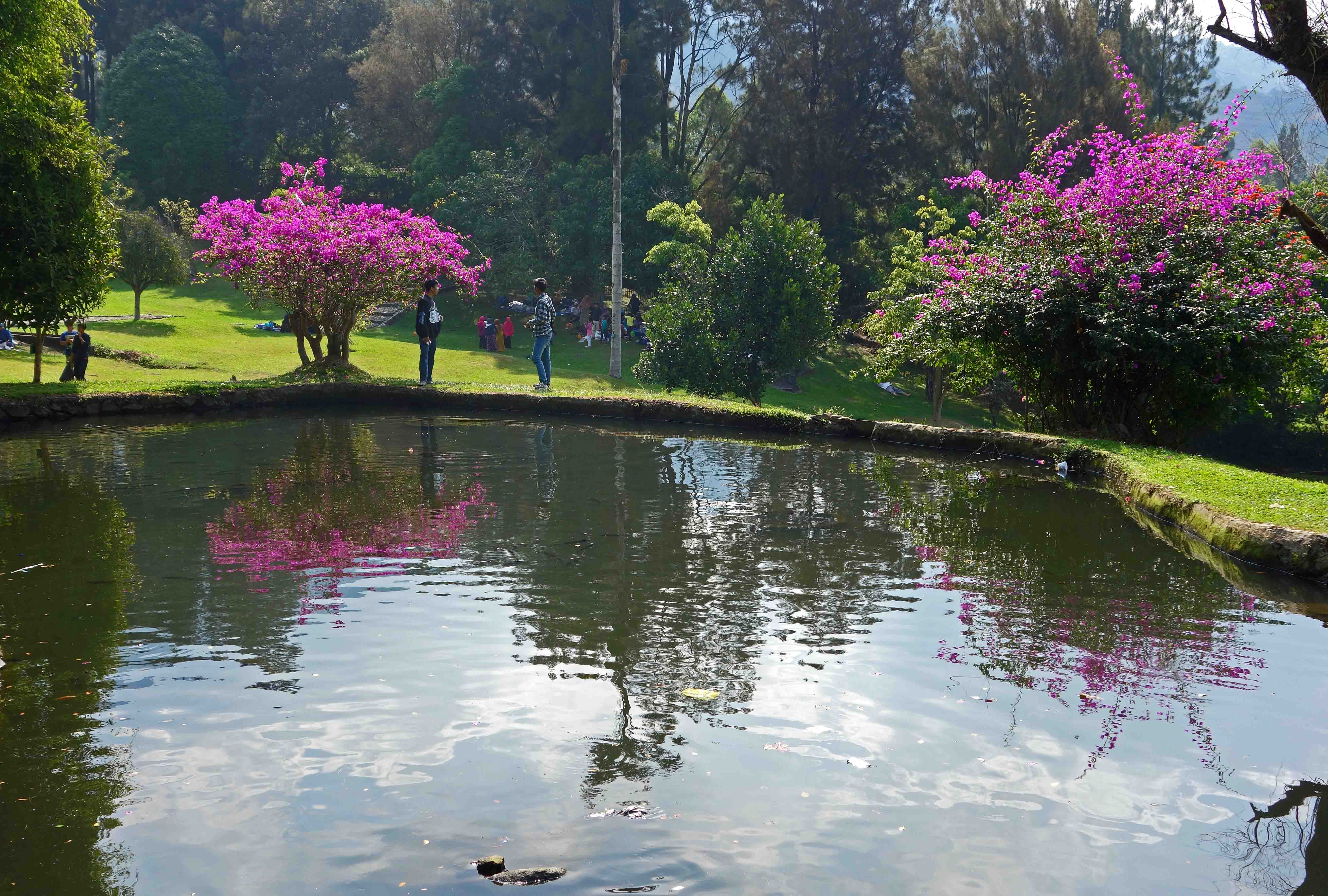
Lake in Cibodas Botanical Gardens, Java
The gardens are a nice place to wander amongst the trees, looking for birds, or admiring the flora. Wallace did not however, linger long at the gardens, after one night he headed off up the mountain (Pangrango and Gede). So it seems that Wallace did not do much collecting here, although I expect that he would have seen insects and butterflies, such as the attractive red dragonfly (Orthetrum chrysis) and the striking Himalayan jester (Symbrenthia hypselis).
Red dragonfly (Orthetrum chrysis)
Himalayan jester (Symbrenthia hypselis)
Cibodas Botanical gardens are popular at the weekend, but the large area soaks up the crowds and they are very pleasant to walk around, with plenty of kiosks and restaurants offering refreshment. There are also number of pleasant places to stay – at very reasonable costs – both inside and outside the gardens. I walked everywhere, but there were occasions when I wished I had a car. Or like Wallace, a horse!
Cibodas Botanical Gardens
Wallace, Alfred Russel. The Malay Archipelago: the land of the orang-utan and the bird of paradise; a narrative of travel, with studies of man and nature. Courier Corporation, 1869.